
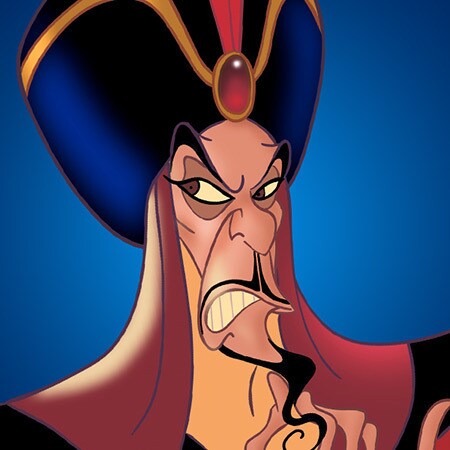
CHARACTER PROFILE · JAFAR · EVERY PROMOTION CREATED ANOTHER CEILING
Jafar Character Profile: Agrabah’s Vizier, the Cobra Staff, Three Wishes, Iago, Jasmine, and the Prison Inside Absolute Power
He understands the palace better than the ruler does and understands people so poorly that every person he reduces to a tool becomes part of his defeat.
The quick file
Jafar is the royal vizier of Agrabah and principal villain of Disney’s 1992 Aladdin. He serves close enough to the Sultan to control information, uses hypnosis to manufacture consent, and seeks the lamp because ordinary political access no longer satisfies him. His wishes reveal that the throne is a stage on the way toward a fantasy of being impossible to challenge.
Jonathan Freeman voices Jafar in the animated feature and reprises the character in major later appearances, including The Return of Jafar. Marwan Kenzari plays the separate 2019 live-action version. Across branches, Jafar combines institutional knowledge, magical ambition, theatrical control, and the conviction that competence entitles him to other people’s obedience.
Name, office, and public role
Jafar’s title is royal vizier, placing him inside Agrabah’s governing structure rather than outside as an invading sorcerer. The office gives proximity to the Sultan, access to state information, influence over guards, and a respectable reason to occupy every room where decisions happen. His villainy grows through an institution already prepared to trust him.
The public court sees an adviser. Private scenes reveal forbidden machinery, magical research, Iago, and contempt for the ruler he serves. Jafar does not need to overthrow the state before using it. He bends the Sultan, weaponizes guards, arranges Aladdin’s confinement, and makes abuse look like procedure. Open takeover comes after quiet capture has already worked.
The cobra staff and manufactured consent
Jafar’s cobra-headed staff hypnotizes the Sultan and turns suggestion into apparent agreement. The magic makes a political truth visible: authority can be manipulated while preserving the performance of lawful choice. The Sultan speaks the result, and Jafar receives cover from the ruler’s own mouth.
Hypnosis is his preferred early weapon because it prevents resistance from appearing. Jafar wants the decision and the image of consent. When magic and wishes later make secrecy unnecessary, he abandons the mask. The progression from adviser to tyrant shows how control behaves when reputational cost disappears.
Relationship with the Sultan
Jafar despises the Sultan’s softness, distraction, and trust while depending on all three. He sees governance as wasted on a man who plays with mechanical toys and treats tradition as a substitute for scrutiny. Some diagnosis is accurate. The conclusion that Jafar should own the kingdom is not.
Their designs oppose one another. The Sultan is round, pale, and associated with soft blue and gold. Jafar is tall, narrow, pointed, and wrapped in red, black, and controlled vertical lines. When Jafar takes the throne, the palace palette changes because institutional space has always reflected the ruler’s body and imagination.
Relationship with Iago
Iago is accomplice, servant, sounding board, and target. Jafar relies on his observations and uses him in disguise while responding to complaint with insults or physical mistreatment. The partnership reproduces the hierarchy Jafar resents above him. He seeks freedom from subordination by making somebody else absorb it.
Iago expresses appetites and grievances Jafar keeps behind court manners. Their contrast creates comedy and operational efficiency. Jafar plans. Iago says the ugly motive aloud. The Return of Jafar becomes dangerous to Jafar because Iago’s betrayal proves fear cannot guarantee permanent loyalty.
Why he needs the diamond in the rough
The Cave of Wonders will admit only a person of particular inner worth, so Jafar needs Aladdin as an extraction worker. He cannot pass the magical test and refuses to treat that failure as judgment. He treats worthiness as a technical gate somebody poorer can open on his behalf.
Disguised as an old prisoner, Jafar offers opportunity while withholding the lethal purpose. The arrangement captures his politics: vulnerable people become useful when their qualities unlock resources he wants. Once Aladdin reaches the exit with the lamp, Jafar attempts to discard the worker rather than honor the rescue.
Jafar and Aladdin as distorted mirrors
Both men perform identities, read rules, use verbal traps, and seek access to a social height currently denied. Aladdin lies because he fears rejection and remains capable of repair. Jafar lies because other people’s informed choice is an obstacle. Their shared cleverness makes the moral divergence sharper.
Aladdin’s final trick works because he understands Jafar’s comparison habit. Jafar cannot enjoy being Sultan while Genie is stronger. He cannot enjoy sorcery while another category remains above it. Aladdin offers a path upward and lets the villain ignore the prison attached.
Relationship with Jasmine
Jafar treats Jasmine as political route, forced bride, captive, and visual proof of rule. Her refusal has no moral status in his system. He first seeks a legal arrangement through manipulation and later uses magical domination when law becomes unnecessary. The methods differ while the ownership belief remains stable.
During the takeover, he changes her clothing, restrains her, diminishes Rajah, humiliates the Sultan, and expects attraction to follow power. Jasmine’s tactical performance exploits that vanity. Jafar mistakes survival strategy for confirmation because domination has trained him to read every response as evidence of his importance.
The three wishes as a psychological ladder
Jafar wishes to become Sultan, then the most powerful sorcerer, then an all-powerful genie. Each wish exposes the previous goal as insufficient. Political title does not create loyalty. Sorcery does not erase comparison. Genie status promises supremacy and delivers binding.
The sequence proves he does not possess a finish line. He seeks freedom from insecurity through rank, but hierarchy recreates insecurity by definition. Somebody can always be imagined above. Becoming a genie is the logical conclusion of an appetite that values power while refusing to examine its conditions.
Sorcerer form and environmental control
As sorcerer, Jafar transforms bodies, architecture, scale, weather-like conditions, and the palace palette. He makes the environment confess that ordinary government was never enough. Power becomes theatrical because he needs victims to see his interpretation of them.
Aladdin becomes small and exposed. Abu becomes a toy. Rajah becomes a cub. The Sultan becomes an object. Jasmine becomes captive ornament. Jafar does not merely defeat opponents. He forces each into a form confirming the place he assigned them. Transformation becomes political caricature.
Cobra form
Jafar’s giant cobra form literalizes the staff used for hypnosis. The symbol of covert control becomes his body during open battle. He no longer needs to hold the instrument because he has fused with the method. The transformation is visually spectacular and psychologically exact.
The cobra also places Aladdin against an opponent whose physical scale cannot be matched through ordinary strength. Survival again depends on observation and language. Jafar’s largest body becomes evidence of how easily he can be redirected by a threat to status.
Genie form and imprisonment
Jafar’s final form grants cosmic power and immediate captivity. Bracelets appear, smoke replaces ordinary legs, and a new lamp pulls him inward. The visual resemblance to Genie reveals the structure Jafar ignored. Granting power is not the same as owning it.
His imprisonment should not be used to justify Genie’s. Jafar knowingly requests the category after Aladdin frames it as superior. Genie’s original history remains unknown. The parallel works as poetic consequence for Jafar and an indictment of the system that can bind any genie to an owner.
The Return of Jafar
The sequel brings Jafar back when Abis Mal finds his lamp. Jafar remains bound to a master while manipulating that master’s greed. The reversal is instructive: the former vizier must work through a foolish owner and experiences dependence from the position he previously imposed on others.
His revenge targets Aladdin, Jasmine, the Sultan, Genie, and especially Iago. Iago’s defection wounds his belief that subordinates remain property after abuse. The sequel’s production is smaller, but the character conflict extends the original logic rather than inventing a completely unrelated resurrection.
Television crossover and continuity
Jafar appears in the Hercules animated-series crossover involving Hades. The episode offers the pleasure of placing two Disney villains in the same scheme. Crossover logic is flexible, so its placement should be labeled rather than forced to control every rule around Jafar’s ending.
Jonathan Freeman’s return preserves vocal identity across the animated branch. Official appearance does not require every crossover joke to rewrite the central films. A careful profile separates released screen material, production context, and the chronology fans infer from it.
The 2019 live-action Jafar
Marwan Kenzari’s Jafar is younger, more physically restrained, and given a background implying an earlier life of theft and social ascent. That detail makes him a more explicit mirror to Aladdin. Both men have crossed class boundaries through adaptability. Jafar concludes that past powerlessness authorizes endless acquisition.
The remake emphasizes his frustration with the Sultan’s foreign policy and passive rule. Political diagnosis gives his ambition a public vocabulary without making the coup legitimate. His quieter performance changes the animated version’s theatrical menace and asks whether control can look modern, disciplined, and almost reasonable until opposition becomes inconvenient.
Voice and performance
Jonathan Freeman gives animated Jafar smooth contempt, precise threat, and controlled amusement. The voice can soothe the Sultan, insult Iago, and expand into fury without losing the sense that language is a weapon he expects the room to obey.
The design and performance reinforce gendered villain coding through elegance, thinness, theatrical gesture, and contrast with Aladdin’s youthful hero body. Recognizing that coding does not erase Freeman’s craft. It reveals the cultural grammar the craft activates for an audience trained to read certain forms of masculine excess as suspicious.
Design and color
Jafar’s tall silhouette, angular face, narrow beard, red and black clothing, and cobra imagery make him readable instantly. He resembles a blade occupying the Sultan’s round environment. The costume gives him visual authority before the throne does.
His transformations escalate the same language. Sorcerer form intensifies color and scale. Cobra form turns symbol into anatomy. Genie form expands power while adding the bracelets and smoke-tail of captivity. Design tells the arc even without dialogue.
Orientalism and villain coding
Jafar occupies a Western fantasy tradition of the dangerous Eastern vizier, sorcerer, sensual despot, and court manipulator. His accent, body, clothing, magic, and appetite operate within Agrabah’s broader cultural mixture. The hero and heroine receive more accessible American vocal coding while the villain carries theatrical foreignness.
The character remains compelling because specificity of performance exceeds the stereotype. Analysis should keep both levels visible. A villain can be brilliantly animated, psychologically coherent, and built from inherited cultural codes that deserve scrutiny. Craft does not dissolve history.
Failures beyond ambition
Jafar cannot imagine loyalty outside fear, advice outside obedience, or love outside possession. His planning is sophisticated and his model of other people is crude. He repeatedly underestimates agency because he sees choice as a technical inconvenience power can remove.
That flaw destroys him more reliably than greed alone. Iago defects. Jasmine deceives him. Aladdin manipulates his comparison instinct. Genie obeys the wording while caring about the victims. Every person he reduces to a function acts from an interior life his system declared irrelevant.
Common fandom misconceptions
Jafar does not become Sultan through legitimate succession. A wish supplies status and force without trust. Becoming a genie does not mean he escapes the lamp system. The captivity is part of the category. His return in the sequel occurs through his lamp and a new master, not because the original defeat had no consequence.
He is not wrong merely because he wants influence beyond an incompetent ruler. His wrongdoing lies in hypnosis, exploitation, attempted murder, coercion, enslavement, forced marriage, and the belief that recognizing institutional weakness grants ownership of everyone affected by it.
Why Jafar lasts
Jafar lasts because he is elegant enough to make domination look organized. He understands the room, diagnoses weakness, and speaks like the person who should obviously be in charge. Then each wish reveals that competence without a limit becomes another appetite.
His defeat is satisfying because the hero does not outmuscle him. Aladdin lets Jafar request the complete version of his own philosophy. Absolute power arrives with absolute service. The villain enters the lamp because he never asked what power costs the person expected to provide it.
Institutional capture before magical capture
Jafar’s most successful work occurs before he touches the lamp. He controls information, places himself near a trusting ruler, uses guards as tools, and makes a vulnerable prisoner disappear. Magic strengthens the operation, but Agrabah’s institutions provide the channels. A kingdom depending on one kind Sultan and one indispensable adviser has already created a succession crisis inside daily governance.
That structure protects Jafar from scrutiny because competence and control can look identical to people who benefit from the result. The Sultan experiences problems as solved. Guards receive orders. Suitors continue arriving. Jasmine is framed as difficult. Jafar turns everyone else’s fragmented view into his private monopoly on the whole picture.
Revenge in The Return of Jafar
After imprisonment, Jafar does not reconsider the ladder that trapped him. He becomes more focused on humiliation and revenge. Aladdin’s cleverness, Iago’s defection, Genie’s role, Jasmine’s resistance, and the Sultan’s survival all become injuries to be answered rather than evidence his model of loyalty failed.
Revenge lets him preserve self-image. If defeat resulted from betrayal and luck, then domination remains correct and only the execution needs improvement. Recognizing that people chose against him would require acknowledging their interior lives. He prefers a story where tools malfunctioned.
Abis Mal and the reversal of mastery
Abis Mal becomes holder of Jafar’s lamp, placing the former master in a service relationship with a foolish, greedy man. Jafar manipulates him through flattery, frustration, and promises, recreating the adviser role under magical constraint. The reversal reveals how much of his power has always depended on steering a weaker authority from beside the throne.
He despises dependence and uses every available ambiguity to regain initiative. The sequel could have treated lamp servitude as automatic moral education. It refuses that easy route. Experiencing constraint does not create empathy when Jafar interprets suffering only as another injustice committed against Jafar.
Jafar and masculinity
Jafar’s villain coding contrasts his tall, thin, robed elegance and theatrical voice with Aladdin’s youthful athletic hero body. Western animation has often used gendered deviation, refinement, age, and expressive excess to mark male villains as untrustworthy. His design participates in that grammar while producing one of Disney’s most effective silhouettes.
The solution is not pretending the coding does not exist or reducing the character to it. Performance, politics, color, magic, and narrative action make Jafar specific. The inherited shorthand helps audiences read danger quickly and carries cultural assumptions about which forms of masculinity appear respectable, desirable, comic, or threatening.
Why the Sultan needs Jafar
The Sultan’s trust is not mere stupidity. Jafar supplies attention and decisiveness the ruler has stopped practicing. An adviser becomes indispensable when the sovereign delegates understanding rather than tasks. The more Jafar solves, the less evidence the Sultan encounters that might expose manipulation.
This dependency makes the ending’s return to benevolent monarchy incomplete. Removing the villain does not repair a court built to let one adviser control information. Jasmine’s future authority becomes important because she must decide whether to inherit the same concentration or build institutions capable of disagreeing before another cobra staff appears.
Jafar and knowledge
Jafar studies magic, machinery, prophecy, and rules with genuine discipline. Knowledge itself is not the villain. His method isolates knowledge from accountability. He discovers who can enter the cave and treats that discovery as a right to exploit the chosen person. He learns what the lamp can grant and never asks what the arrangement costs Genie.
The character warns against expertise that treats everyone outside the expert as material. Jafar is often the most informed human in the room. He is also the least willing to let another person’s experience change his plan. Information becomes domination when curiosity flows only toward control.
The absence of a finish line
Every achieved wish leaves Jafar dissatisfied because he evaluates power relationally. Being Sultan matters only if no subject resists. Being sorcerer matters only if no stronger magical being exists. Genie status looks final because the power appears cosmic. He ignores that status still contains a master above the lamp.
This psychology makes him more than a greedy villain asking for too much. Greed can be satisfied temporarily by possession. Jafar’s comparison system turns another person’s existence into evidence of insufficiency. Peace would require giving up the hierarchy he uses to measure himself.
What a future Jafar adaptation should preserve
A strong adaptation should preserve his institutional intelligence, controlled resentment, theatrical presence, and inability to recognize autonomy. Making him loudly evil from the first scene removes the discomfort of seeing why a court trusted him. Making him only misunderstood removes the people he knowingly exploits.
The most interesting Jafar can diagnose real governmental weakness and choose authoritarian ownership as the answer. Viewers should be able to understand the complaint without confusing it for moral permission. Villain depth comes from the credible road toward harm, not from declaring the harm secretly correct.
What his ending means for Agrabah
Jafar’s defeat removes one operator and exposes vulnerabilities across the palace. The Sultan was hypnotized. Guards enforced covert orders. Jasmine’s legal status created an obvious route to the throne. Aladdin was imprisoned without meaningful review. A functional recovery should address each failure rather than treating the lamp’s disappearance as institutional reform.
The franchise largely returns to adventure, leaving Jasmine’s governing future to carry the question. Jafar’s legacy should be more than a red lamp on a villain shelf. He is evidence that soft authority without scrutiny can be captured long before citizens notice the room changed color.
Profile conclusion
Jafar is vizier, sorcerer, abuser, political operator, and mirror for every insecurity Aladdin could have converted into entitlement. His intelligence makes him dangerous. His refusal to recognize other people as ends makes the intelligence self-defeating.
Return to the Aladdin hub for the full review, wish guide, sequels, television branch, remake, rants, and the complete Agrabah character directory.
The character receipt the franchise has to keep
Jafar needs a receipt, not a résumé. The central argument is institutional access, grievance, and the belief that humiliation authorizes domination. A useful profile follows that argument through choices rather than treating screen time as proof of depth. The character becomes clearest when desire collides with another person’s freedom. That collision reveals who is allowed to refuse, who controls the available information, and whose loss the story expects the audience to forget once the music rises.
The relationship map matters because Jafar does not develop alone. The essential network includes Iago, the Sultan, Jasmine, Aladdin, Genie, and a palace whose weak safeguards let private ambition become public danger. Each bond asks for a different kind of honesty. Loyalty to one person can become harm to another, and love can remain real while conduct remains unacceptable. The profile therefore records who challenges Jafar, who absorbs the consequences, who performs repair, and which relationship changes after the apology instead of snapping back to its earlier setting.
The performance record is equally specific: Jonathan Freeman gives courtesy a blade and lets control crack into appetite, carrying the character from feature animation through sequels and stage performance. Voice cannot be separated from animation here. A pause, swallowed word, burst of speed, or sudden drop in volume changes the moral temperature of a scene. The body supplies a second track through eye line, weight, gesture, costume, or movement. Reading both tracks keeps the profile from reducing performance to a cast list or mistaking loudness for emotional clarity.
The recurring evidence includes the staff, the dungeon, the forced marriage scheme, the genie wish, the lamp imprisonment, and the return that converts revenge into a system of abuse. These moments do not all point toward one flattering conclusion. Some show generosity. Others show fear, coercion, vanity, avoidance, or the habit of letting somebody else pay. Keeping contradictory receipts is the point. Fandom does not require acquittal. The character becomes more interesting when affection survives an honest account of the choices that made the story hurt.
Agrabah also changes how Jafar should be read. The city mixes regions, languages, costumes, architecture, music, and fairy-tale sources into a Western studio fantasy. That mixture can produce memorable design while blurring cultures into atmosphere. A character profile should name the production frame without pretending the fictional city is a reliable map of a real place. Representation, stereotype, beauty, and pleasure can occupy the same image and still require separate judgment.
Later branches cannot be treated as simple upgrades. Sequels, television episodes, stage productions, games, and the 2019 film give Jafar different amounts of authority and different cultural framing. A change is meaningful when it reveals a new pressure or repairs an earlier limitation. More dialogue is not automatically more agency. A larger costume budget is not automatically greater specificity. The profile compares what each version permits the character to choose and what consequences survive the adaptation.
The final test for Jafar is what the story remembers after the climax. Does a boundary remain? Does labor get redistributed? Does the next conversation begin with knowledge earned in the previous one? An ending can be joyful without erasing the damage that made joy necessary. That is the JIN standard here: a person with history, relationships, performance, contradictions, and a future that requires actual change, not a familiar face placed back on the shelf.
The quiet-scene test
Jafar also needs one scene where nobody is asking for a performance, rescue, warning, ride, ruling, joke, or sacrifice. Quiet time reveals whether the relationships described as family can survive without extracting a service. It lets the audience see what comfort looks like, which silences feel safe, and whether the character can receive care without immediately paying it back. That ordinary evidence matters because franchise storytelling often mistakes usefulness for belonging. Jafar should be allowed to exist inside the world before the next plot assigns a function.