
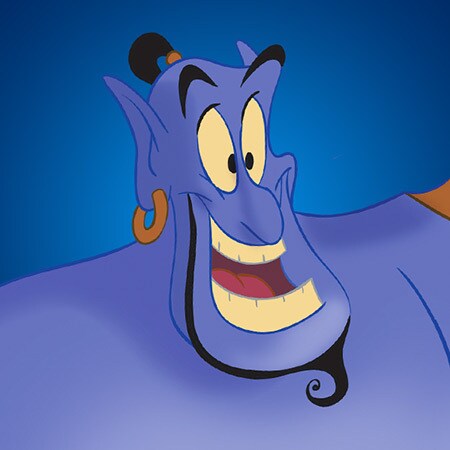
CHARACTER PROFILE · GENIE · COSMIC POWER, TINY LIVING SPACE, NO CONSENT FORM
Genie Character Profile: The Lamp, Three Wishes, Aladdin, Freedom, Voice Actors, and Ten Thousand Years of Compulsory Service
He can grant kingdoms, rewrite bodies, and turn a song into its own animation studio. He cannot choose the next room until Aladdin stops being his master.
The quick file
Genie is the magical being bound to the lamp in Disney’s 1992 Aladdin. He can grant three wishes to a master, subject to stated restrictions, while lacking authority over his own movement. His comic power is enormous. His personal freedom is almost nonexistent. That contradiction makes him the franchise’s largest spectacle and its clearest argument about ownership.
Robin Williams voices Genie in the 1992 film and returns for Aladdin and the King of Thieves. Dan Castellaneta voices him in The Return of Jafar and the animated television series. Will Smith plays the separate live-action version in 2019. Performance changes the rhythm, references, and future imagined for Genie without removing the central question of whether service can ever become friendship while a lamp controls consent.
Name, species, and status
The animated films call him Genie rather than providing a personal birth name. “Genie” describes what he is and the role he has been forced to perform. The absence fits fairy-tale economy and raises an identity problem. A person known entirely through a service category has been denied the ordinary distinction between self and job.
Before the final wish, his legal and magical status is captivity. The lamp’s holder can command wishes. Genie can interpret wording, joke, advise, delay, and sometimes act around the edges, but he cannot simply choose to leave permanently. After Aladdin frees him, later help becomes voluntary. The same magical act carries a different moral meaning once ownership ends.
Ten thousand years inside the lamp
Genie describes a vast period of confinement, usually treated as comic scale rather than a documented calendar. The film does not identify who created the lamp, who first bound him, how many masters came before Aladdin, or whether his memory covers every period clearly. The missing history protects the pace and leaves the system’s original violence faceless.
His personality suggests long experience managing masters. He presents rules like a practiced orientation, anticipates greed, packages power as customer service, and hides disappointment until attachment makes neutrality impossible. The performance is not proof captivity was enjoyable. It is the adaptive expertise of somebody expected to make each new owner feel special.
Powers and stated wish restrictions
Genie can transform himself and others, create objects and spectacle, manipulate environment and scale, transport people, imitate voices and forms, and grant changes with political or material consequence. The precise upper boundary remains flexible because the magic serves fairy-tale character logic rather than a numeric combat system.
He states three central restrictions: no killing, no forcing love, and no resurrection. Those boundaries do not create a complete ethics code. The lamp permits ownership of a sentient being, bodily transformation, political title, imprisonment, and conditions capable of causing harm indirectly. Cosmic rules protect selected outcomes while leaving consent inconsistently defended.
Intent, wording, and the wish counter
Wishes require enough intent for Genie and master to recognize the act, yet the threshold changes with comedy and crisis. Aladdin tricks Genie into escaping the cave without a counted wish by challenging his ability. The episode proves Genie has some discretionary power and that personality can move the edge of the contract.
The drowning rescue is more ethically difficult. Aladdin is unconscious and cannot clearly request help. Genie interprets a movement or creates the permission needed to save him, then counts the rescue. The scene refuses clean contract logic because life matters more than procedural certainty. Genie chooses Aladdin and disguises tenderness as rule enforcement.
Friend Like Me and compulsory enthusiasm
“Friend Like Me” introduces power through a sales presentation delivered by the person being sold. Genie demonstrates limitless service, flatters a master he just met, and turns captivity into entertainment. The joy is genuine because performance belongs to him. The obligation is genuine because the lamp structures the encounter. Both conditions occupy the same song.
Eric Goldberg’s animation lets Genie become line, layout, costume, celebrity impression, object, crowd, and visual transition. Robin Williams supplies velocity and tonal range. The character can appear to control the film while remaining unable to control his destination. Formal dominance hides material captivity until the scene becomes quiet enough for the lamp to look small.
Relationship with Aladdin
Aladdin treats Genie with curiosity, humor, and eventual affection rather than distant command. That difference matters and does not erase the power imbalance. Aladdin controls the wishes and promises freedom, then delays it because Prince Ali feels dependent on continued magical support. Friendship becomes ethically possible only after he stops defending ownership.
The delayed promise wounds Genie because it confirms an old pattern. A master can call him friend while still deciding the master’s insecurity outranks his freedom. Genie withdraws emotionally without becoming indifferent to Aladdin’s safety. His conflict shows how affection can survive exploitation while refusing to make exploitation acceptable.
The final wish changes the structure. Aladdin gives up control, the bracelets fall away, and Genie can choose where to go. Later returns are therefore relational decisions. He can help, complain, travel, celebrate, and leave. Aladdin loses a servant and keeps a friend, which becomes the clearest proof the relationship contained something beyond the lamp.
Relationship with Jasmine
Genie meets Jasmine through the Prince Ali deception and participates in the performance that manipulates her information. He wants Aladdin happy and recognizes the lie is becoming dangerous. After the truth and freedom wish, Jasmine becomes part of the chosen family he visits voluntarily rather than another person attached to a master’s request.
In the 2019 branch, Genie’s relationship with Dalia creates a future not defined by Aladdin’s household. That change gives him romantic and domestic desire separate from service. The animated Genie’s freedom remains more open, while the remake chooses a specific human life. Each version asks what autonomy looks like after the lamp stops setting the schedule.
Jafar as master and mirror
Jafar treats Genie’s power as an extension of possession. He issues escalating wishes and responds to every achieved rank by finding another hierarchy above it. Genie must obey even when the wishes harm people he cares about. The forced service makes the final confrontation a violation of relationship and a demonstration of the lamp’s cruelty.
Aladdin traps Jafar by inviting him to become a genie. Genie grants the wish, and Jafar receives immense power with captivity attached. The outcome mirrors Genie’s condition without making their histories equivalent. Jafar walks into a known ladder of domination. Genie’s original binding remains unexplained and undeserved.
Freedom after the first film
The Return of Jafar brings Genie back from travel. The speed of his return serves franchise production and still carries a moral distinction: he returns because he wants contact. He no longer needs permission to leave again. His magic can be offered, withheld, or used according to judgment rather than a master’s counted entitlement.
The television series often uses Genie as comic support, magical infrastructure, and emergency solution. His ability level bends according to plot. The strongest episodes remember that freedom includes boundaries. The weakest treat voluntary friendship as if it recreates unlimited service without asking whether he wants another assignment.
King of Thieves and chosen family
Robin Williams returns for King of Thieves, and Genie’s comic style again expands into rapid transformation and reference. His role around Aladdin and Jasmine’s wedding resembles family participation rather than contractual service. He helps prepare, celebrates, worries, and confronts disruption because the event belongs to people he chose.
Cassim’s arrival places Genie beside a biological-family crisis he cannot solve with magic. Aladdin wants an answer about his father. A wish could produce appearance or spectacle, but it cannot manufacture the trust Cassim must earn. Genie’s presence emphasizes the franchise’s repeated distinction between capacity and relationship.
Animated and live-action differences
Will Smith’s Genie uses a human star performance, hip-hop and pop-inflected musical presence, physical comedy, digital transformation, and a framing story. The remake does not ask him to reproduce Robin Williams line for line. It gives the character a human future with Dalia and children after freedom.
The animated Genie can become any graphic idea without preserving photographed anatomy. The live-action version must negotiate Will Smith’s recognizable body, digital blue form, costume, simulated light, and physical sets. The media create different kinds of freedom. One can edit the cartoon from inside. The other grounds magic in a performer whose human identity remains visible.
Voice performance history
Robin Williams gives the original performance extraordinary speed, improvisational energy, sadness, and warmth. Eric Goldberg and the animation team translate voice into design rather than merely matching mouth shapes. The marketing relationship between Williams and Disney became contentious, adding production-history complexity to the image of effortless comic abundance.
Dan Castellaneta carries Genie through Return of Jafar and television with a performance shaped for weekly storytelling and a different production context. Robin Williams returns for the animated finale. Will Smith builds the remake version through another cultural and musical vocabulary. Treating one actor as the only legitimate Genie erases how adaptation and serial production work.
Design and the bracelets
Animated Genie is blue, muscular, smoke-tailed, and capable of abandoning stable anatomy. His gold bracelets function as visual signs of bondage even while reading as ornament. The small lamp contrasts with the body’s scale, creating the central joke and tragedy: cosmic capacity lives inside an object somebody else can carry.
When the bracelets fall after freedom, the change is restrained. The film does not need a larger explosion because agency is the effect. Later designs preserve recognizability while giving him legs, travel clothing, or situational costumes. The remake’s human form makes the desired life physically specific.
Labor, performance, and the customer-service mask
Genie anticipates desire, turns requests into experiences, maintains enthusiasm, and manages a master’s feelings. That is emotional labor under magical compulsion. His jokes belong to him and also make the service easier for the owner to consume. A good mood does not prove the labor relationship is voluntary.
The character resonates because many people recognize the demand to make another person comfortable while their own constraint remains invisible. Genie can be the most talented person in the room and still lack the power to leave it. Freedom is not a promotion, better customer, or kinder schedule. It is ending the command structure.
Failures and accountability
Genie participates in the Prince Ali deception, uses cultural and bodily forms as comic material, and sometimes treats boundaries as jokes. His captivity explains constrained choices without making every action neutral. After freedom, greater agency also creates greater responsibility for how he uses power.
The franchise rarely forces him to reckon at length with people created, transformed, or endangered through wish spectacle. Fairy-tale pacing prefers emotional resolution. A deeper continuation could let Genie define an ethics of voluntary magic after millennia in a system that supplied only prohibitions and masters.
Common fandom misconceptions
Genie is not free because Aladdin is friendly. He becomes free after the third wish. The three restrictions are not a complete list of everything magic can never do. His different voice actors do not automatically create separate animated continuities. Jafar becoming a genie does not prove Genie originally deserved imprisonment.
The peddler connection belongs to production history and long-running theory more than a simple fact stated by the released 1992 cut. Labeling the evidence protects the fun. Genie’s impressions also should not be treated as proof every referenced celebrity or modern institution exists literally in Agrabah’s timeline. Comedy can breach the frame without redrawing the map.
Why Genie lasts
Genie lasts because he is unlimited power forced to ask for ordinary autonomy. The visual invention attracts attention, the comedy builds affection, and the small lamp rearranges everything we thought the spectacle meant. He can grant kingdoms and cannot choose a door.
His relationship with Aladdin survives because the final wish removes ownership. The character’s deepest fantasy is not becoming stronger. It is becoming responsible for his own next move. Every sequel and remake succeeds or fails according to whether it remembers that freedom must remain visible after the celebration.
The master history we never receive
Genie’s practiced orientation implies many prior masters, yet the films withhold their names and requests. That absence keeps Aladdin special by making the current bond feel unprecedented. It also means viewers cannot measure whether Genie’s rules, humor, or caution changed after particular abuses. His history appears as fatigue, skill, and the size of the freedom wish rather than a chronology.
A prequel could fill the gap and risks turning suffering into a parade of entertaining bad owners. The valuable question would concern adaptation: which parts of the customer-service persona belong to Genie’s joy, and which parts developed because a master who is laughing may be less dangerous than one who feels challenged?
Comedy as selfhood and armor
Genie’s comedy should not be reduced to a trauma response. He plainly loves invention, timing, music, language, and the pleasure of making another person laugh. Calling every joke armor would deny him artistry. The armor reading becomes relevant when the joke redirects attention from the lamp, disappointment, fear, or a command he cannot refuse.
The performance can be authentic and protective at once. People often develop their strongest creative tools inside restrictive environments without the restriction owning every beautiful thing they make. Freedom does not require Genie to become quieter or more solemn. It lets him decide when the show begins, who receives it, and whether he wants to stop.
Pop-culture impressions and timeline logic
Genie references celebrities, media forms, and styles far outside Agrabah’s apparent historical frame. The jokes establish his mind as temporally and culturally expansive. They do not require every impression to prove a modern television industry exists inside the city. Animation comedy can address the audience through a character without converting the gag into civic infrastructure.
Some references have become less immediate as audiences move farther from 1992. That aging is not simple failure. The performance was designed to feel current and therefore became a time capsule. Genie’s emotional arc outlasts reference recognition because freedom, disappointment, friendship, and compulsory enthusiasm do not depend on knowing every impersonated celebrity.
Genie and Carpet
Carpet offers a crucial contrast: a magical being who helps voluntarily from the first meeting. Carpet invites flight, expresses preference, and forms relationships without a visible master contract. Genie’s enormous abilities can distract from the fact that the quieter magical companion begins with more autonomy.
Their scenes rarely stop to compare conditions, but the franchise gains ethical texture from placing them together. Carpet’s assistance resembles friendship before Aladdin learns how to create that condition with Genie. Both are useful to the human hero. Only one initially has the recognized right to refuse.
What freedom does to responsibility
Before release, command constrains Genie’s choices. After release, power and responsibility move closer together. Voluntary magic can still disrupt economies, transform bodies, or solve one person’s crisis while ignoring another’s. Freedom gives him the right to choose and the burden of considering consequences the lamp’s narrow restrictions never addressed.
The animated series usually prioritizes adventure over a developed post-lamp ethics. A stronger continuation could show Genie deciding which requests resemble the service structure he escaped, how he establishes boundaries with friends, and whether he helps other bound magical beings. Liberation should generate a life, not merely remove bracelets.
Genie and the audience
Genie frequently seems aware of the film as performance. He changes genre, comments through reference, produces visual transitions, and plays to a viewer beyond Aladdin. That meta quality makes him feel less contained than every other character even while the lamp contains him materially.
The audience becomes another customer he can delight without granting a wish. We participate in the contradiction by enjoying labor presented as inexhaustible. The film eventually turns that enjoyment into investment in his freedom. We want the show and are asked to value the performer enough to accept his right to leave it.
The marketing dispute and ownership outside the story
The production and marketing history around Robin Williams adds an uncomfortable echo to Genie’s fictional role. Williams reportedly sought limits on how his performance and character likeness would be used in marketing, and conflict followed over the studio’s promotional choices. The details belong to documented production history rather than rumor shorthand.
The parallel should not be flattened into a perfect one-to-one allegory. An actor under contract is not a magical captive. The resonance still matters because a character about autonomy became the center of a dispute over how a performer’s contribution could be packaged and sold. Authorship, celebrity, studio ownership, and character ownership collided around a film already asking who controls the show.
Common questions about Genie’s limits
The films do not establish a complete maximum range, conservation law, or list of every prohibited wish. Visual feats vary with scene and medium. “Phenomenal cosmic power” describes scale and irony rather than a battle statistic. A claim that Genie can or cannot perform a precise feat needs a screen receipt or should remain a theory.
Freedom also changes the relevance of wish counting. A free Genie can perform magic without a master spending one of three contractual wishes, subject to whatever personal limits and story logic apply. That does not mean every later magical act proves the lamp rules were false. It means the contract was one system governing service, not the definition of his entire being.
Profile conclusion
Genie is performer, magical force, enslaved worker, friend, moral test, and animation experiment in one body that refuses to stay one body. His comedy is inseparable from craft and should never be used to hide the captivity giving his final joy its meaning.
Return to the Aladdin hub for reviews, lamp lore, the watch order, animated and live-action branches, rants, and the complete Agrabah character directory.
The character receipt the franchise has to keep
Genie needs a receipt, not a résumé. The central argument is compulsory labor hidden inside spectacle and the frightening uncertainty of freedom after service. A useful profile follows that argument through choices rather than treating screen time as proof of depth. The character becomes clearest when desire collides with another person’s freedom. That collision reveals who is allowed to refuse, who controls the available information, and whose loss the story expects the audience to forget once the music rises.
The relationship map matters because Genie does not develop alone. The essential network includes Aladdin, the lamp, Jafar, Jasmine, Dalia, and every master who treats personality as part of the purchased magic. Each bond asks for a different kind of honesty. Loyalty to one person can become harm to another, and love can remain real while conduct remains unacceptable. The profile therefore records who challenges Genie, who absorbs the consequences, who performs repair, and which relationship changes after the apology instead of snapping back to its earlier setting.
The performance record is equally specific: Robin Williams turns speed, impressions, and interruption into a survival strategy, while Will Smith builds the remake around rhythm, narration, and a life imagined after release. Voice cannot be separated from animation here. A pause, swallowed word, burst of speed, or sudden drop in volume changes the moral temperature of a scene. The body supplies a second track through eye line, weight, gesture, costume, or movement. Reading both tracks keeps the profile from reducing performance to a cast list or mistaking loudness for emotional clarity.
The recurring evidence includes the rules of wishing, the Cave escape, Friend Like Me, Jafar’s enslavement, the third wish, and the awkward work of becoming a person with time of his own. These moments do not all point toward one flattering conclusion. Some show generosity. Others show fear, coercion, vanity, avoidance, or the habit of letting somebody else pay. Keeping contradictory receipts is the point. Fandom does not require acquittal. The character becomes more interesting when affection survives an honest account of the choices that made the story hurt.
Agrabah also changes how Genie should be read. The city mixes regions, languages, costumes, architecture, music, and fairy-tale sources into a Western studio fantasy. That mixture can produce memorable design while blurring cultures into atmosphere. A character profile should name the production frame without pretending the fictional city is a reliable map of a real place. Representation, stereotype, beauty, and pleasure can occupy the same image and still require separate judgment.
Later branches cannot be treated as simple upgrades. Sequels, television episodes, stage productions, games, and the 2019 film give Genie different amounts of authority and different cultural framing. A change is meaningful when it reveals a new pressure or repairs an earlier limitation. More dialogue is not automatically more agency. A larger costume budget is not automatically greater specificity. The profile compares what each version permits the character to choose and what consequences survive the adaptation.
The final test for Genie is what the story remembers after the climax. Does a boundary remain? Does labor get redistributed? Does the next conversation begin with knowledge earned in the previous one? An ending can be joyful without erasing the damage that made joy necessary. That is the JIN standard here: a person with history, relationships, performance, contradictions, and a future that requires actual change, not a familiar face placed back on the shelf.
The quiet-scene test
Genie also needs one scene where nobody is asking for a performance, rescue, warning, ride, ruling, joke, or sacrifice. Quiet time reveals whether the relationships described as family can survive without extracting a service. It lets the audience see what comfort looks like, which silences feel safe, and whether the character can receive care without immediately paying it back. That ordinary evidence matters because franchise storytelling often mistakes usefulness for belonging. Genie should be allowed to exist inside the world before the next plot assigns a function.