
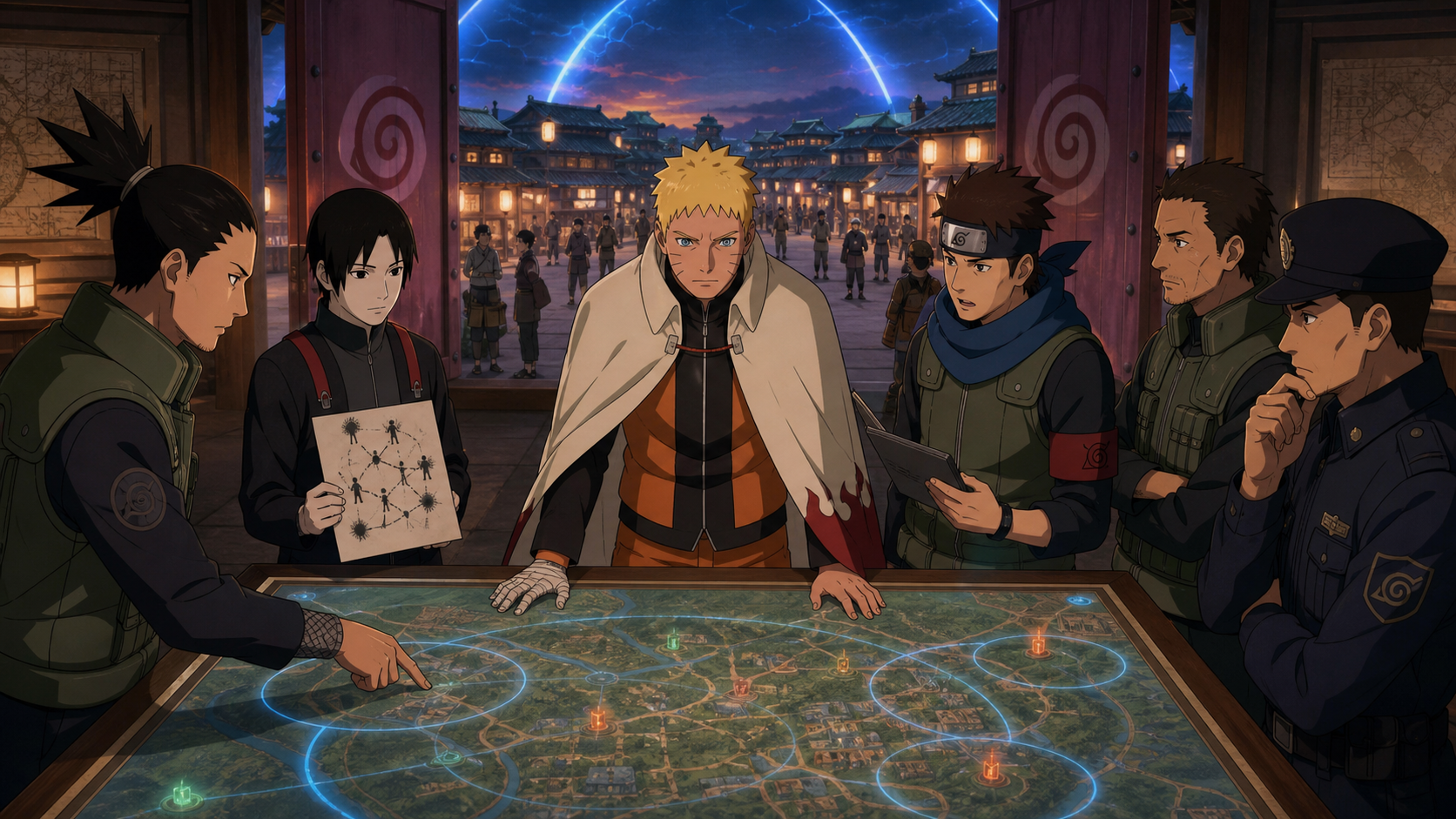
Blockade the A-Un Gate!
Victor proves that danger can arrive with paperwork, reputation, and people already inside the system. Konoha needs better security, but a chakra registry cannot tell the difference between unfamiliarity and guilt.
Series: Boruto: Naruto Next Generations
Episode: 176 · Blockade the A-Un Gate!
Arc: Kara Actuation
Release: 2020-11-29
Previous: Episode 175 · Beyond the Limits!
Directory: All 293 Boruto episodes
Bottom line
Boruto Episode 176 asks the least glamorous question after a major victory: now that Konoha knows Kara exists, how does a village protect people without turning protection into collective punishment? Naruto considers closing the A-Un Gate. Police worry about residents with weak village loyalty. Sai and Konohamaru explain that Kara uses Outers across national borders. Every simple security answer creates another problem.
“Blockade the A-Un Gate!” works because Naruto does not treat fear as policy. Sealing the village might slow an obvious attacker, but Konoha depends on trade, travel, diplomacy, families, missions, and citizens whose chakra already passes through the gate every day. Kara’s strength lies precisely in making insiders, collaborators, companies, and respected officials part of the network.
The episode shifts the Kara Actuation Arc from a fight against Victor and Deepa into an institutional threat assessment. Team 7 won one battle. Orochimaru burned one tree. Konohamaru and Mugino exposed one company. None of those victories answers how many Outers already live behind Konoha’s walls. Naruto has to protect the village without teaching the village to suspect every neighbor.
Victory creates paperwork because survival needs memory
Konohamaru and Mugino return with observations, names, methods, and evidence. A debrief converts their experience into institutional knowledge.
The process may lack a soundtrack, but future missions depend on accuracy. What did Victor’s employees know? Which people called themselves Outers? How did Kara hide laboratories and transport assets?
If the details stay inside two exhausted shinobi, Konoha will repeat the same vulnerability.
Deepa’s defeat does not end Kara
Team 7 broke Deepa’s carbon defense. That result proves training and coordination matter.
Deepa was one operative. Kara supplied assignments, information, and access through a larger system.
Treating his defeat as the end would confuse a battlefield success with dismantling an organization.
Victor’s company proves legitimacy can be camouflage
Victor held status, wealth, laboratories, political access, and public respect. Those advantages protected hidden experiments.
Konoha cannot search only abandoned hideouts and suspicious travelers. Kara can operate through legitimate institutions.
Security planning must follow money, research partnerships, contracts, and influence without criminalizing every company connected to foreign work.
Outers change the threat model
Konohamaru reports that collaborators around Victor called themselves Outers. The term means Kara extends beyond a small circle of visibly powerful Inners.
Outers can gather intelligence, move supplies, maintain cover identities, recruit help, and prepare local access.
An organization becomes harder to detect when most participants look ordinary until one specific request activates their role.
Sai recognizes the pattern from Amegakure
Sai connects the report to earlier investigation with Sasuke. Kara leaves signs across nations while avoiding a single obvious front.
That pattern suggests planning over years rather than one opportunistic company partnership.
Shared intelligence matters because isolated incidents become visible as a network only when records meet.
Classified knowledge leaked beyond the village
Kara knows details about Naruto’s role in defeating Momoshiki. That information should not circulate freely.
The leak may come from surveillance, an infiltrator, a compromised ally, stolen records, or reconstruction from public events.
Naruto cannot assume the source before investigation. Wrong certainty could destroy innocent careers while the real channel remains open.
Closing the A-Un Gate feels decisive
A physical blockade offers visible action. Guards can point to a sealed entrance and say security increased.
The appeal is emotional as much as tactical. After discovering an invisible network, leaders want a boundary they can control.
Visible measures can reassure people even when the threat already crossed the line.
A gate blocks movement, not allegiance
Kara Outers may already live in Konoha, hold valid documents, possess registered chakra, or work through residents who do not know the full organization.
Closing the gate can trap threats inside while disrupting everyone else.
Security architecture fails when officials mistake geography for loyalty.
Konoha is not a sealed military camp
The village contains civilians, children, merchants, immigrants, patients, craftspeople, and visitors alongside ninja.
Daily life depends on movement through the gate. A complete blockade affects medicine, food, income, family contact, and diplomatic trust.
Naruto’s duty includes those consequences, not only the possibility of attack.
The police report a loyalty problem
Konoha Police acknowledge that not every resident feels deep attachment to the village. That fact is normal in any large community.
People arrive for work, marriage, refuge, opportunity, or family. Citizenship does not require emotional worship.
Weak enthusiasm is not evidence of treason. Conflating the two would create the alienation Kara could exploit.
Suspicion can manufacture the threat leaders fear
If security measures target newcomers, critics, or less patriotic residents, innocent people learn that Konoha sees them as conditional members.
Kara recruiters can weaponize that resentment.
Fair treatment is not softness beside security. Fair treatment reduces the pool of people willing to help an organization promising recognition or revenge.
Naruto remembers what exclusion does
Naruto grew up treated as a danger before he committed any wrong. Adults watched, whispered, and denied him belonging because of the Nine-Tails.
That history should make him wary of policies based on identity rather than conduct.
The Hokage can recognize legitimate threat without recreating the social punishment that shaped his childhood.
Protection cannot become collective punishment
Closing travel for everyone because an unknown Outer may exist imposes a cost on people with no connection to Kara.
Temporary emergency restrictions can sometimes be justified, but leaders need evidence, duration, review, and support for affected residents.
Fear does not grant unlimited authority.
Open borders require stronger sensing
Rejecting a permanent blockade does not mean doing nothing. Konoha needs better detection, registration, watch procedures, and rapid response.
The village already maintains a barrier system capable of sensing unfamiliar chakra. The problem is coverage, interpretation, and registered insiders.
Technology must support trained judgment rather than replace human assessment.
Chakra registration creates its own civil questions
Tracking known chakra can distinguish residents from unfamiliar entrants. The system also creates a powerful record of identity and movement.
Who accesses the registry? How are errors corrected? What happens to visitors, children, transformed bodies, or people whose chakra changes?
Security data without governance can become another source of abuse.
Ino’s clan carries a hidden infrastructure burden
The Yamanaka sensing network protects Konoha through constant mental and sensory labor. Residents may never see that work.
Expanding the system means staffing, training, rest, and safeguards for the people monitoring alerts.
An “iron wall” cannot depend on exhausted specialists expected to remain perfect forever.
False positives can harm real people
Unfamiliar chakra does not automatically mean Kara. Travelers, patients, summons, transformed individuals, and foreign allies may trigger concern.
Response teams need escalation steps before force.
A security system earns trust through accurate correction as much as successful detection.
Registered insiders remain the hardest problem
An Outer with legitimate residency or prior access may pass the barrier normally.
Kara could recruit someone already inside rather than smuggling every collaborator through a wall.
Counterintelligence therefore requires behavioral evidence, financial analysis, communications work, and community reporting with protections against harassment.
Sai understands secrecy and its damage
Sai grew up inside Root, an organization that used hidden networks, compartmentalization, and loyalty conditioning in Konoha’s name.
He knows how clandestine structures survive scrutiny and how security rhetoric can justify abuse.
His perspective should push the response toward disciplined intelligence rather than broad fear.
Sasuke’s absence from the room is still felt
Sasuke investigates threats beyond the village and helped identify Kara’s reach. His field knowledge affects the discussion even when he is not physically present.
Konoha needs reporting structures that do not depend on one wandering specialist returning at the perfect moment.
Institutional memory must outlive individual availability.
Konohamaru brings evidence without pretending omniscience
Konohamaru knows what Victor’s employees called themselves and what happened inside the company. He does not know every Outer or Kara route.
That distinction protects the meeting from false certainty.
Good reporting states the boundary around knowledge instead of filling gaps with confidence.
Mugino’s experience should shape the response
Mugino worked inside foreign territory, watched Victor’s corporate cover, and saw how local institutions could be manipulated.
His observations matter beyond combat performance.
Security planners often privilege leaders’ interpretations while overlooking the partner who noticed daily behavior on the ground.
The Five Great Nations need shared intelligence
Outers scattered across borders cannot be addressed by Konoha alone. Each nation holds fragments of the pattern.
Information sharing carries risk because Kara may have infiltrated allied systems too.
The answer is careful verification and compartmented cooperation, not isolation that lets every village rediscover the same threat through casualties.
Smaller nations need a voice in the response
The Land of Valleys suffered Victor’s experiments. A great-nation security conference should not reduce that country to an evidence source.
Local victims, officials, and investigators deserve control over records and decisions affecting their people.
Kara exploited unequal power. The response should not repeat that hierarchy.
Economic disruption is a security issue
Closing the gate may damage merchants and workers, create shortages, and encourage smuggling.
Those effects can generate new criminal routes that Kara might use.
Policy must account for the secondary threat created by the security measure itself.
Naruto chooses responsibility over performance
The easiest political move would be announcing a dramatic blockade and claiming decisive leadership.
Naruto considers the tradeoffs instead. Hesitation based on evidence is not weakness.
The Hokage’s job is protecting people from Kara and from unnecessary harm caused by Konoha’s reaction.
Boruto sees another side of Hokage work
Sarada’s dream and Boruto’s family both connect to the meeting’s burden. Hokage work includes choices where no option feels heroic.
Naruto cannot Rasengan an infiltration network. He must coordinate police, sensing teams, intelligence, diplomacy, and public trust.
The episode quietly shows why the office consumed so much of his time.
Kara benefits when fear becomes visible
A sudden blockade tells Kara that Konoha detected part of the network. Outers can go dormant, destroy evidence, or feed false leads.
Public measures communicate as well as restrict.
Naruto must decide which signals help residents and which signals help the enemy adapt.
Transparency has limits and value
Residents need enough information to understand changes and report suspicious conduct. Full disclosure could expose intelligence methods and targets.
Secrecy should protect operations, not leaders from accountability.
Konoha needs a public explanation proportionate to the restrictions people experience.
Community trust is part of the barrier
Neighbors notice unfamiliar activity, coercive recruitment, sudden resources, and people in distress. They report concerns when they trust authorities to respond fairly.
Mass suspicion destroys that cooperation.
The strongest village wall includes residents who believe security institutions protect them too.
Victor’s failure reaches Kara leadership
Victor must answer for the failed tree, lost assets, exposed company, and attention drawn toward Kara.
The organization’s response reveals internal discipline and distrust. A hidden group cannot tolerate members creating public disasters without consequence.
Konoha’s security problem expands while Kara’s internal problem deepens.
Jigen’s concern suggests an Inner traitor
Kara leadership considers whether betrayal exists among the Inners. Suspicion now moves inside the enemy organization too.
That fracture may create intelligence opportunities, but Konoha does not yet know enough to exploit the split safely.
An enemy divided can become more unpredictable before becoming weaker.
A temporary blockade still needs an exit rule
Emergency measures become permanent when leaders define the threat broadly and never define the condition for reopening. Kara could remain active for years. Konoha cannot suspend ordinary movement until every Outer has been identified because no institution can prove that negative.
If Naruto authorizes a closure, the order needs a written duration, a review date, evidence thresholds, exceptions for medical and family emergencies, and support for people whose income disappears. The village also needs a public explanation of who can challenge a denial and which office records the decision.
Those safeguards are not paperwork placed against safety. They prevent fear from becoming an authority that renews itself. A policy without an exit rule teaches officials to treat emergency power as the new normal.
Loyalty tests would reward the best liar
The police concern about residents with weak village attachment creates a tempting shortcut: ask people to prove devotion. Kara's trained collaborators would prepare convincing answers. Honest residents with complicated histories might refuse the performance or sound uncertain.
Patriotism cannot function as a reliable security sensor. A merchant angry about taxes may remain completely lawful. A refugee grateful for shelter may still criticize Konoha's foreign policy. A decorated shinobi can hide allegiance behind years of public service.
Investigators need conduct, communications, unexplained resources, coercion reports, and verified links. Emotional enthusiasm tells officials which residents know how to reassure authority, not which residents pose a threat.
Public reporting needs protection from rumor
Community knowledge can reveal suspicious storage, recruitment, or financial behavior. The same reporting channel can become a weapon against neighbors when prejudice, business rivalry, family conflict, or political resentment supplies the accusation.
Konoha should separate tips from proof. Trained staff can document a report, protect the reporter from retaliation, check independent evidence, and close false claims without leaving a permanent stain on the accused person's record. Repeat malicious reporting also requires consequences.
Naruto knows how a rumor can define a child before adults ask for facts. A community barrier becomes stronger only when residents trust that speaking up will trigger investigation rather than a mob.
Kara can exploit the blockade as propaganda
A closed gate gives Kara a story to sell: Konoha claims peace while treating movement as a privilege that disappears whenever leaders feel afraid. Outers can repeat that message among workers, immigrants, smaller nations, and people already harmed by great-village decisions.
The propaganda does not need to be fair to become effective. Victor built influence by mixing legitimate business with hidden abuse. Kara understands how one real grievance can carry several lies.
Konoha therefore has to explain restrictions honestly and correct harm quickly. Pretending every inconvenience is necessary invites Kara to become the only voice acknowledging what residents lost.
Security workers need limits too
The meeting focuses on systems, but every system becomes a person staring at alerts, checking documents, questioning travelers, and deciding whether uncertainty justifies escalation. Fear can exhaust judgment long before technology fails.
Gate guards and sensors need rotations, written procedures, supervision, and a way to report pressure from powerful officials. A tired worker facing constant warnings will either treat everyone as dangerous or stop believing the alarms. Both outcomes create openings.
Konoha also needs support after mistakes. Punishing one operator while preserving an impossible workload teaches the next worker to hide errors. Accountability should identify the decision and the conditions that made the decision likely.
The Land of Valleys deserves more than a warning label
Konoha learned about Outers because people in the Land of Valleys suffered experimentation, corporate deception, and violence. Their losses should produce more than a paragraph inside a classified threat file.
Victims need medical assistance, environmental repair, compensation, access to evidence, and a role in deciding how Victor's company records are used. Researchers whose work was stolen or coerced need protection from being treated as collaborators without investigation.
If the Five Great Nations use the disaster to strengthen their own borders while leaving the damaged country behind, Kara's hierarchy survives inside the response. Security cooperation has to repair the place that paid for the lesson.
Naruto's childhood gives him insight, not automatic immunity from error
Naruto remembers exclusion, but personal suffering does not guarantee every policy he chooses will protect marginalized residents. Hokage authority creates distance. Advisers summarize consequences, police bring institutional habits, and urgent intelligence makes restriction sound practical.
The safeguard cannot be Naruto's good heart alone. Konoha needs review from civilians, legal standards, records of enforcement, and leaders willing to tell the Hokage when a measure recreates the harm he hates.
Naruto's best quality in the meeting is not perfect instinct. He listens long enough for the easy answer to become complicated. A leader who experienced prejudice still needs structures that keep empathy active when pressure narrows attention.
Open movement is one of peace's actual benefits
The previous generation fought for a world where children could travel, villages could trade, and former enemies could share knowledge without every border crossing becoming a military confrontation. Closing the gate risks treating those gains as decorative extras beside security.
Peace is not only the absence of an attack. Peace is the ordinary freedom to visit family, seek treatment, study, sell goods, and meet people whose chakra signature began somewhere else. Protecting those routines belongs inside the security mission.
Kara wants hidden control over bodies and movement. Konoha should not answer by making visible control the defining experience of village life. The difficult task is preserving ordinary freedom while improving the intelligence needed to confront specific harm.
The meeting needs people who live with the consequences
Police, shinobi, and intelligence officers bring necessary expertise, but the people affected by a blockade understand costs that security professionals may not see. Merchants know which deliveries spoil. Patients know which treatment cannot wait. Mixed-nationality families know which relatives will be stranded outside.
Naruto's administration should hear those voices before a temporary restriction becomes a complete policy. Consultation does not require publishing operational secrets. Leaders can explain the proposed limit, ask what essential movement must continue, and build exceptions before harm becomes the evidence they should have gathered earlier.
Including civilians also improves compliance. People follow difficult rules more reliably when officials acknowledge the cost, explain the purpose, and create a fair route for urgent needs. Authority can force a gate closed. Trust keeps residents from building dangerous routes around the closure.
The arc ends by widening the danger
Victor’s facility is destroyed and Deepa is defeated, yet Episode 176 makes Kara feel larger.
Outers may exist across nations. Classified information has leaked. Legitimate residents may carry hidden loyalties. The gate cannot solve any of those facts alone.
The Kara Actuation Arc therefore ends without a neat security victory. Team 7 proved children can grow beyond one defeat. Naruto must prove institutions can grow beyond fear. Closing a door is easy. Building a village secure enough to remain open requires intelligence, fairness, labor, and trust that no single Hokage can manufacture by decree.
Sources and lawful viewing
Official episode reference: Naruto Official episode guide
Licensed episode route: Crunchyroll licensed series page