
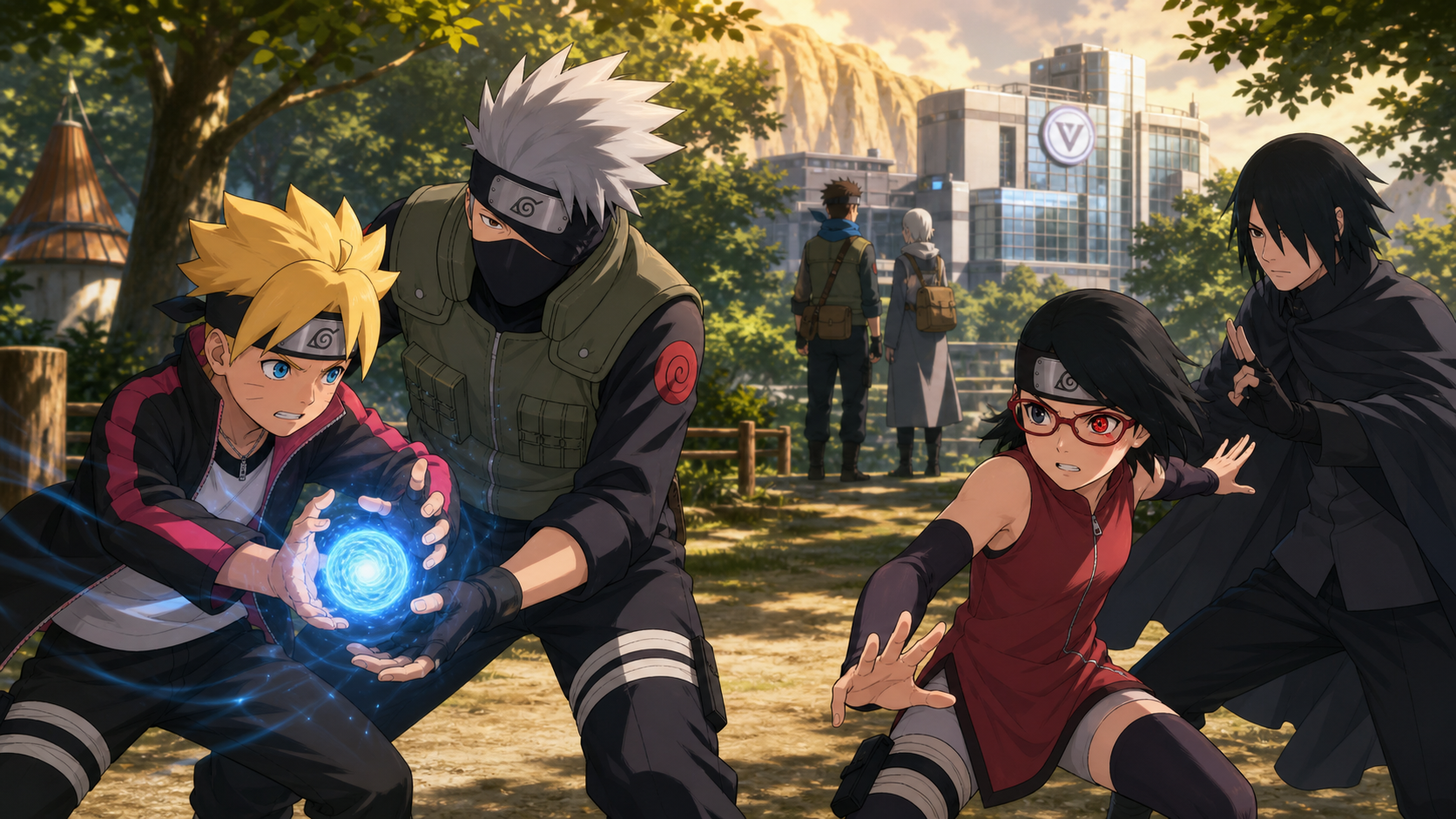
Training Begins!
Deepa exposed every shortcut. Kakashi will not pretend Boruto owns Naruto’s chakra reserves, Sasuke will not hand Sarada Chidori before her eye is ready, and Victor will not put the truth on an approved tour.
Series: Boruto: Naruto Next Generations
Episode: 168 · Training Begins!
Arc: Kara Actuation
Release: 2020-10-04
Previous: Episode 167 · Their Decision
Directory: All 293 Boruto episodes
Bottom line
Boruto Episode 168 gives Team 7 the training chapter they actually earned. Boruto does not receive a bigger Rasengan because the story needs a louder explosion. Sarada does not unlock another Sharingan tomoe because pain owes her a prize. Both children arrive with urgency, famous teachers, and the fresh humiliation of Deepa beating them nearly to death. Kakashi and Sasuke answer with the least glamorous truth in the shinobi world: wanting strength and being ready to build strength are two different things.
“Training Begins!” works because every lesson attacks an assumption. Boruto thinks size equals power, then learns his chakra reserves place a hard limit on the Giant Rasengan fantasy. Sarada wants Chidori, then learns a one-tomoe Sharingan cannot safely support that technique. Konohamaru and Mugino expect Victor to hide something, then receive a polished corporate tour designed to make suspicion look rude. Everybody knows the destination. Nobody gets a clean road.
This is not a perfect episode, and thank goodness. Training should include frustration, bad guesses, sore muscles, parental tension, and the occasional teacher who enjoys letting a gifted child discover that talent has edges. Deepa exposed those edges. Now Boruto and Sarada have to stop admiring their potential and start doing the repetitive work.
Boruto asks for the wrong Rasengan first
Boruto approaches Kakashi wanting the Giant Rasengan. The request makes emotional sense. Deepa’s carbon armor swallowed Boruto’s normal attack, so a larger version feels like the obvious correction. More chakra, more damage, problem solved.
Kakashi immediately punctures the fantasy. Boruto does not possess Naruto’s chakra reserves. Genetics gave him plenty, but inheritance is not photocopying. Naruto’s monstrous stamina came from several sources, including the Nine-Tails, and Boruto cannot build a training plan around resources he does not own.
That answer protects Boruto from becoming a smaller replay of his father. A son can inherit a technique without inheriting the exact way his father expresses power. Boruto needs a Rasengan shaped by his own body, chakra nature, instincts, and limitations.
Kakashi refuses to flatter a prodigy
Kakashi has taught geniuses, disasters, traumatized children, and Naruto. Boruto’s fast learning does not impress him enough to lower the standard. That is precisely why this pairing works.
Boruto often receives praise for accomplishing something unusually quickly. Kakashi looks past speed and asks whether the result can survive a real opponent. Deepa already supplied the answer. A technique that wins academy comparisons may still fail against specialized defense.
Kakashi does not humiliate Boruto. He gives him a useful boundary. Great teachers do not protect talented students from limits. They help students identify which limit can move and which limit requires a different route.
The Rasengan has two jobs
Kakashi breaks the problem into chakra form and chakra nature. Maintaining the sphere requires precise shape transformation. Adding an elemental nature changes what the technique can do.
Boruto already performs the basic Rasengan and accidentally created the Vanishing Rasengan through lightning nature. That history proves he can alter the technique, but accidental success does not equal mastery. A reliable combat answer must be reproducible under pressure.
The lesson also rescues the Rasengan from becoming a family heirloom displayed behind glass. Minato created the technique. Jiraiya carried the knowledge. Naruto expanded the form. Konohamaru learned his own version. Boruto belongs in that lineage only when he contributes something honest rather than copying the largest example.
Wind nature gives Boruto a route that belongs to him
Kakashi identifies wind as the practical direction for Boruto’s stronger Rasengan. The choice echoes Naruto without erasing Boruto’s difference. Naruto turned wind transformation into the Rasenshuriken through absurd chakra, shadow clones, and dangerous persistence. Boruto must find another expression.
Wind offers cutting and penetration, qualities that answer Deepa’s defense better than merely making the sphere wider. Boruto needs density and control, not a chakra balloon.
The episode does not hand him the final solution. He starts learning how difficult purposeful nature transformation feels when an accident no longer counts. That difficulty is the point. Boruto’s next Rasengan must come from deliberate understanding.
Boruto envies the wrong part of Kakashi
Boruto looks at Kakashi’s history and sees a genius with several chakra natures, legendary techniques, and the experience of a Hokage. Envy edits out the cost.
Kakashi’s ability did not protect him from loss, exhaustion, bad leadership systems, or years spent carrying dead friends inside every decision. The Sharingan he once used so brilliantly also drained him because the eye was not naturally his. Talent never made his life easy.
Boruto’s envy feels believable because teenagers see outcomes before they see labor. Kakashi does not need a tragedy lecture. The training itself will teach Boruto that mastery consists of thousands of uncelebrated corrections.
Sarada asks Sasuke for Chidori
Sarada approaches Sasuke with a direct goal. She wants Chidori. Deepa’s armor defeated her current offense, and Sasuke’s signature thrust promises the piercing force she lacked.
Unlike Boruto’s Giant Rasengan request, Sarada’s choice aligns with her chakra nature and Uchiha inheritance. The problem is not desire or compatibility. The problem is readiness.
Chidori produces speed so extreme that the user risks tunnel vision and counterattack. The Sharingan compensates by reading movement. Sarada’s one-tomoe eye cannot yet supply enough perception for safe use. Sasuke refuses to teach a prestigious technique when the required foundation is missing.
A famous surname does not skip prerequisites
Sarada is Sasuke Uchiha’s daughter. That fact does not magically place three tomoe in her eye. The episode resists bloodline entitlement by making her start with visual training.
Sasuke’s own Sharingan developed through trauma, combat, rivalry, and emotional rupture. Sarada has already endured terrifying experiences, including Deepa’s attack, yet the eye follows no clean reward schedule. Pain is not a vending machine where enough suffering releases the next power.
That uncertainty frustrates Sarada because hard work usually offers measurable progress. The Sharingan carries emotional conditions no training chart can completely control. She still chooses the work available now.
Sasuke trains perception before power
Sasuke launches projectiles from a scroll and forces Sarada to track, dodge, and respond. The exercise looks less spectacular than Chidori, but every safe future use depends on this foundation.
Sarada must read trajectories without freezing, maintain awareness under pressure, and make her body answer what her eye sees. Perception alone cannot save her. Episode 166 already proved that. The eye and body need to become one decision.
Sasuke’s method also reveals his version of care. He does not soften the drill because Sarada recently left the hospital. He calibrates the challenge to the skill she needs. Strictness becomes love only when the teacher remains attentive to safety and purpose. Here, Sasuke does.
Sakura sees the danger that Sasuke normalizes
Sakura understands both combat training and Sasuke’s tendency to treat extreme effort as ordinary. Her concern matters. Sarada is ambitious, angry about defeat, and eager to push beyond healthy limits.
Parents do not become obstacles merely because a shonen story wants an exciting montage. Sakura has medical knowledge and personal knowledge of her family. She recognizes when determination can slide toward self-punishment.
The Uchiha household needs both perspectives. Sasuke can teach Sarada what the Sharingan demands. Sakura can remind both of them that a damaged body does not become stronger through denial.
Training from guilt can turn poisonous
Boruto and Sarada both feel responsible for Mitsuki’s injury. That guilt gets them out of bed and into training, but motivation this sharp can cut the person holding the blade.
They cannot repay Mitsuki by destroying themselves. Mitsuki chose to save his teammates because their lives mattered. Treating those lives as disposable training material would misunderstand his sacrifice.
Kakashi and Sasuke therefore serve another purpose beyond technique. Both adults know what guilt-driven strength seeking can become. Kakashi spent years obeying ghosts. Sasuke built an identity around vengeance. Their students need the lessons those men learned too late.
Separate teachers reveal separate weaknesses
Team 7 trains apart because their problems are not interchangeable. Boruto needs greater Rasengan effectiveness within his chakra limits. Sarada needs perception and physical response before Chidori becomes possible. Mitsuki needs medical recovery after pushing an engineered body beyond safety.
A generic teamwork exercise would hide those distinctions. Deepa defeated the group, but every member failed at a different boundary.
Their eventual reunion will matter only if each person returns with something the others cannot manufacture for them. Teamwork is not three people doing the same exercise beside each other. Teamwork is distinct strengths joining without pretending distinct weaknesses vanished.
Mitsuki’s absence shapes every repetition
Mitsuki barely appears, yet the training carries his presence. Every Rasengan attempt and every Sharingan drill answers the same memory: Mitsuki had to reveal dangerous power because Boruto and Sarada could not escape.
The episode wisely avoids turning his recovery into sentimental background music. His damaged body represents a real consequence. Team 7’s next fight cannot rely on Mitsuki breaking himself whenever the plan fails.
Boruto and Sarada are not training to become impressive. They are training so rescue does not always demand the same person pay the highest price.
Victor sells legitimacy as camouflage
Konohamaru and Mugino receive access to Victor’s company, and the corporation presents clean laboratories, helpful explanations, and ordinary research. Nothing on the official tour confirms the horror viewers witnessed.
That polished surface is not proof of innocence. Corporations with power know how to stage compliance. Victor does not need every employee involved in Kara. Compartmentalization protects him. Legitimate work can operate beside hidden experiments and give the entire institution cover.
Konohamaru cannot punch a tour guide because the building feels suspicious. He and Mugino must observe what Victor chooses to show while searching for the boundary around what he refuses to show.
Legal access does not equal truthful access
Konoha waited for authorization to enter the independent Land of Valleys. That legal step matters, but permission only opens the front door. Victor controls the route inside.
The episode distinguishes lawful investigation from naive trust. Konohamaru and Mugino respect national sovereignty without accepting corporate theater. Those positions can coexist.
Their job requires patience because a premature accusation could close the investigation and allow Victor to claim harassment by a larger military village. Evidence must survive more than the heroes’ certainty.
Konohamaru and Mugino refuse the staged exit
Victor’s secretary reports that the Leaf shinobi were escorted to the border. In reality, Konohamaru and Mugino remain behind and infiltrate the company.
That move shows their experience. They let Victor’s staff believe the performance succeeded, then use the resulting confidence to reach hidden areas. Surveillance becomes a contest over who thinks the other side has stopped watching.
The choice remains dangerous. Official permission may not protect them once they leave the approved tour. Mugino’s earlier omen hangs over every corridor, and Konohamaru carries responsibility for bringing both men home with evidence.
Victor’s company is another kind of battlefield
Deepa’s battlefield announced danger through violence. Victor’s company hides danger beneath glass, credentials, and professional smiles. Konohamaru and Mugino need different instincts here.
No visible enemy means every locked door matters. No attack means they cannot reveal their mission by responding too early. The corporation weaponizes normality.
This parallel plot belongs beside the training. Boruto and Sarada are learning that raw power needs precision. Konohamaru and Mugino are practicing the same truth through investigation. A loud move at the wrong moment ruins everything.
Kakashi teaching Boruto is more than nostalgia
Kakashi’s return works because his knowledge fits the problem. He understands the Rasengan, wind transformation, gifted students, and the limits of copying another person’s technique.
The episode does not parade him through familiar catchphrases for applause. He diagnoses Boruto, rejects the impossible request, and redirects the boy toward an individual solution.
That is how legacy characters should function in Boruto. History becomes a tool for the next generation rather than a spotlight stolen from them. Kakashi brings decades of context, then makes Boruto do the work.
Sasuke gets to parent through instruction
Sasuke and Sarada still carry years of absence between them. Training cannot erase that history, but shared work gives them a language both understand.
Sarada trusts Sasuke enough to ask for a dangerous technique. Sasuke respects her enough to explain why the answer is not yet. He does not laugh at the ambition or hand over power to purchase affection.
Their bond grows through honest limits. For Sasuke, whose youth was full of adults hiding essential truths, direct explanation is meaningful parenting.
Progress starts when fantasy gets specific
At the beginning, Boruto wants “a stronger Rasengan” and Sarada wants Chidori. Those goals sound clear until teachers expose the missing steps.
Boruto needs purposeful nature transformation and a form suited to his reserves. Sarada needs sharper Sharingan perception, bodily response, and eventually additional tomoe. Specificity turns frustration into a plan.
That shift carries the episode. Deepa felt unbeatable because Team 7 lacked an answer. Kakashi and Sasuke do not promise victory. They identify trainable problems, which is far more useful.
The real opponent is impatience
Deepa remains the obvious target, but impatience threatens Boruto and Sarada first. Both want to erase the feeling of helplessness immediately. Real growth refuses their schedule.
Boruto must repeat chakra control after years of being praised for quick mastery. Sarada must strengthen the eye she has instead of demanding the eye she wants. Konohamaru and Mugino must endure Victor’s tour before searching beyond the approved route.
Every plot says the same thing without shouting: urgency does not excuse sloppy preparation.
Training begins means the answer has not arrived
The title deserves attention. Training begins. The episode does not claim training ends. Boruto has not solved Deepa. Sarada has not earned Chidori. Konohamaru and Mugino have not exposed Victor.
What changes is direction. Episode 167 gave the wounded children an honest decision. Episode 168 tests whether they can live inside that decision after the emotional speech fades.
They can, at least for today. Boruto accepts that Naruto’s path cannot simply become his own. Sarada accepts that Uchiha power still requires prerequisites. The adults enter a corporation built to hide truth. Everybody moves forward without pretending the next step guarantees victory.
That is good training storytelling. No perfection, no miracle upgrade, no lecture about believing harder. Just talented people confronting the exact places where talent stopped carrying them.
Kakashi should establish a medical baseline before compression work
Boruto is about to force more chakra into less space and contain the pressure through his hands. Before repetition begins, medical staff should record grip strength, joint condition, nerve response, and chakra-pathway strain.
The baseline makes later pain measurable. Without that comparison, Boruto can dismiss numbness or weakness as ordinary training because no adult can show what changed.
Kakashi knows determination can hide damage. Building medical checks into the plan does not insult Boruto's toughness. The checks protect the body that must perform the technique outside a controlled field.
Wind nature needs control before penetration
Boruto wants an attack that cuts through Deepa's armor. Wind transformation can produce that quality, but uncontrolled sharpness creates danger for the user and anybody near the sphere.
Training should separate elemental change from maximum compression. Boruto needs to reproduce the wind effect, maintain shape, and release safely before combining every variable into one attack.
Layered practice may feel slower than chasing the finished result. Layered practice also reveals which part failed when the sphere collapses instead of leaving Boruto to guess among several changes at once.
Sarada needs recovery rules beside the projectile drill
Visual training taxes the eye, concentration, neck, balance, and the body forced to answer each trajectory. Sasuke should define session length, rest intervals, a stop signal, and symptoms that require Sakura's evaluation.
Sarada may interpret stopping as proof that she lacks commitment. A written plan removes that moral judgment. Rest becomes the next assigned step rather than a private decision she fears making.
Those rules also teach leadership. Sarada will eventually supervise shinobi who hide pain to remain useful. Learning to respect her own limit prepares her to protect theirs.
Sakura's expertise should shape the program before injury
Sasuke understands the Sharingan and the combat prerequisite for Chidori. Sakura understands Sarada's medical history, physical development, recovery, and the damage produced when chakra control outruns tissue.
The safest plan uses both parents before training begins, not after Sarada collapses. Sakura can help set intensity and monitor strain without taking control of Sasuke's technical instruction.
Co-parenting becomes strongest when expertise travels across the household. Sarada should not have to choose between the parent who believes in the goal and the parent who protects the body carrying the goal.
Konohamaru and Mugino need a proof-preservation plan
Remaining inside Victor's company after the staged escort gives them access and removes official visibility. Any record they find must survive extraction and withstand Victor's claim that Leaf intruders fabricated the evidence.
They need timestamps, images of material in place, copies stored separately, and communication with Land of Valleys authorities before moving sensitive evidence. Test subjects require rescue first, but documentation can prevent Victor from rewriting the room afterward.
Mugino and Konohamaru should also establish an emergency signal. Investigation loses value if both shinobi disappear with every fact still inside the facility.
Training should make the rematch less dependent on rage
Deepa humiliated Team 7 and nearly killed them. Boruto and Sarada can use anger to arrive at practice, but anger cannot control the final technique or decide the mission plan.
Specific drills give emotion a smaller job. Boruto measures compression. Sarada measures perception and response. Each failure points toward a variable instead of reopening the entire wound.
The rematch will still feel personal. Preparation succeeds when personal pain no longer makes every tactical choice for them.
After each session, Kakashi and Sasuke should compare results with Sakura rather than waiting for visible injury. Early medical feedback can change intensity before soreness, visual strain, or chakra damage becomes the next obstacle Team 7 must overcome.
Sources and lawful viewing
Official episode reference: Naruto Official episode guide
Licensed episode route: Crunchyroll licensed series page