
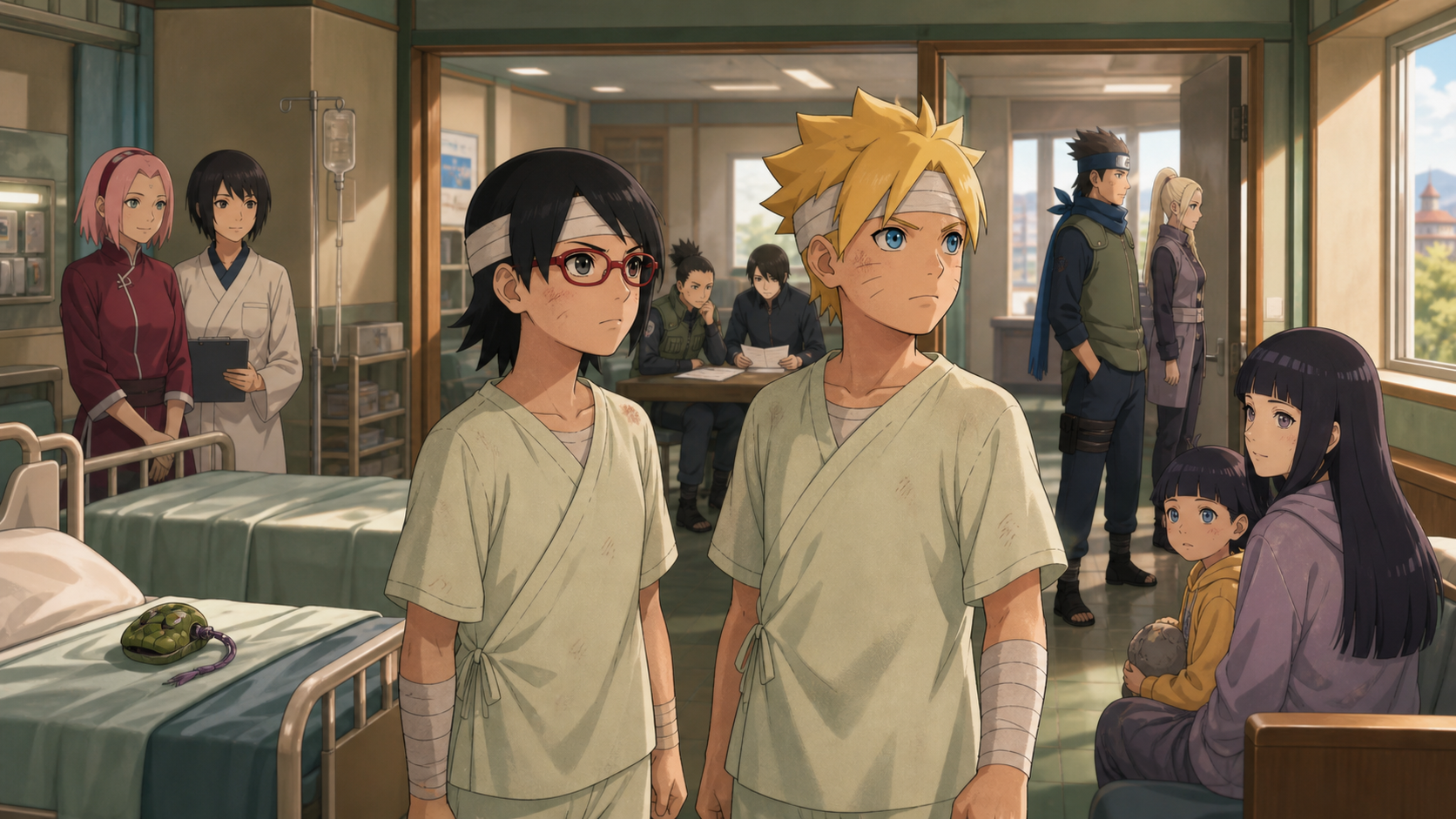
Their Decision
Surviving Deepa was not a victory. Mitsuki paid the escape bill, Sakura and Shizune carry the recovery work, and Boruto and Sarada finally choose training over a reckless revenge trip.
Series: Boruto: Naruto Next Generations
Episode: 167 · Their Decision
Arc: Kara Actuation
Release: 2020-09-27
Previous: Episode 166 · Death Match
Directory: All 293 Boruto episodes
Bottom line
Boruto Episode 167 understands something action anime often rushes past: surviving a fight does not mean the fight is over. Boruto and Sarada wake inside the Leaf hospital with bandages, bruised pride, worried family, and one enormous absence beside them. Mitsuki carried both teammates to safety, pushed his body past the limit, and then disappeared into treatment they cannot even visit. Team 7 escaped Deepa, but nobody gets to call that escape free.
“Their Decision” refuses the cheap version of recovery. Nobody springs from bed after one inspirational speech. Nobody wins a rematch before lunch. Sakura and Shizune do the medical work. Hinata and Himawari sit with the fear Boruto tried to spare them. Orochimaru handles damage ordinary medicine cannot repair. Konohamaru accepts a mission shaped by diplomacy instead of charging across a border. Boruto and Sarada choose training because revenge without growth would only hand Deepa a second victory.
That choice matters. Team 7 lost badly, and the episode lets them feel humiliated without treating humiliation as character failure. Their real test begins after the battlefield: can they admit their current strength was not enough without deciding they are worthless? For once, Boruto gives that question room to hurt.
Recovery is not filler between fights
Anime loves a hospital bed when a hero needs three minutes of reflection and a clean bandage. This episode makes the hospital the whole emotional battlefield. Boruto and Sarada cannot punch their way through pain, uncertainty, or Mitsuki’s absence. Their bodies force them to stop while their minds keep replaying every second against Deepa.
That pause carries weight because Episode 166 did not end with a noble near-win. Deepa dismantled them. Boruto’s Rasengan failed. Sarada’s Sharingan could not create an opening large enough to matter. Mitsuki sacrificed his own safety simply to remove them from the kill zone. “Their Decision” does not soften those facts so the children can feel heroic again.
The episode instead asks what shinobi do after competence collapses in public. Boruto and Sarada have lived on talent, strong teachers, famous parents, and the confidence that Team 7 can improvise a path forward. Deepa exposed every weak seam. Recovery begins when they stop pretending the seams were not there.
Mitsuki pays the bill for Team 7’s survival
Mitsuki carried Boruto and Sarada to Yubina after unleashing power his body was never supposed to reveal casually. Then he collapsed. That sequence changes the meaning of Team 7’s escape. Boruto and Sarada did not retreat through clever tactics. Mitsuki spent himself to buy two lives.
His empty place in the hospital room speaks louder than another dramatic flashback. Boruto and Sarada have medical care close to home. Mitsuki needs Orochimaru because his body is not ordinary and his injuries cannot become public knowledge. The teammate who saved everyone receives the loneliest recovery.
Boruto’s guilt could easily turn self-centered here, but the episode keeps the focus on consequence. Mitsuki made his choice. Boruto still has to live with what that choice cost. Friendship does not erase the debt. Friendship makes the debt personal.
Sakura and Shizune do the work victory stories ignore
Sakura and Shizune stabilize Boruto and Sarada, and that labor should never be treated like background furniture. The children return from a disastrous mission because skilled medical professionals keep them alive, assess damage, manage recovery, and stop impatience from becoming another injury.
Naruto stories have spent years showing how much a village depends on medical ninja while still giving the loudest glory to whoever throws the largest technique. This episode quietly corrects the imbalance. Deepa’s strength created the crisis. Sakura and Shizune’s expertise creates the possibility of a next chapter.
Sarada also wakes under her mother’s care, which adds a family layer no clinical chart can capture. Sakura understands battle damage, dangerous ambition, and the Uchiha habit of pushing past common sense. Her presence means Sarada cannot hide behind shinobi language. Mom knows exactly what defeat looks like.
Hinata and Himawari are allowed to be scared
Hinata and Himawari arrive with the fear Boruto tried to keep away from home. Their concern is not an obstacle to his ninja career. Their concern is the human cost of that career. Boruto can call a mission routine before leaving, but a hospital bed tells the truth when he returns.
Himawari’s presence lands especially hard because she sees her brother as both irritating sibling and dependable protector. Bandages disrupt that image. Hinata understands the profession better than almost anyone, yet knowledge does not make a wounded child easier to see.
The scene also pushes against Boruto’s habit of deciding what his family can handle. Protecting them through silence sounds noble until they receive the emergency after the fact. Love does not become less real because Boruto wants independence.
Cheerfulness is not the same as healing
Boruto and Sarada try to act normal when friends visit. Team 5 brings noise and encouragement. Team 15 brings care. Everybody wants the familiar versions of Boruto and Sarada back because familiar feels safe.
Their friends can still see the strain. Forced smiles do not hide a shattered sense of ability from people who train beside you. That recognition makes the visits useful. Nobody needs a perfect speech. Showing up, noticing, and refusing to reduce the wounded pair to cheerful mascots already does plenty.
Fandom sometimes treats visible sadness as a character becoming weak or annoying. No. Boruto and Sarada were almost murdered. Their teammate nearly destroyed himself saving them. A few quiet scenes do not signal softness. Those scenes prove the story remembers they are children carrying professional violence.
Sarada cannot Sharingan her way around doubt
Sarada’s frustration cuts deeper than a failed technique. She wants to become Hokage, a goal built on the belief that discipline and clear judgment can keep closing every gap. Deepa showed her a gap so wide that sharper perception alone could not cross.
The Sharingan let Sarada understand danger in real time. Understanding did not equal stopping. That distinction matters for a future leader. Seeing the correct problem means very little when your body lacks the speed, stamina, or force needed to answer.
Sarada does not abandon her ambition. She lets the defeat revise her training. That response separates commitment from fantasy. Hokage is not a prize for wanting leadership hardest. The job requires surviving facts that refuse to flatter you.
Boruto’s Rasengan failed and the world kept moving
Boruto built enormous confidence around the Rasengan because the technique carries family history and repeatedly delivered results. Deepa treated the attack like an inconvenience. A signature move met a body designed to neutralize the impact, and Boruto had no second answer.
That failure bruises more than his arm. Boruto is accustomed to fast learning. He improves quickly, surprises adults, and finds an angle when rules seem fixed. Deepa gave him no clever shortcut. The Rasengan was too weak. Full stop.
I appreciate the episode for refusing to reveal that Boruto secretly succeeded after all. No hidden crack rescues his ego. If a technique cannot protect friends against the threat ahead, attachment to the technique’s reputation means nothing.
Konohamaru accepts responsibility without making himself the center
Konohamaru carries guilt because Team 7 suffered under his command. A lesser episode would let him turn that guilt into a reckless solo charge, making the children’s injuries fuel for his own heroic moment. Instead, he reports, waits, and accepts a constrained reconnaissance assignment.
Leadership after failure demands more than anger. Konohamaru has to separate what he wishes he had prevented from what he can responsibly do next. Boruto and Sarada do not need their teacher to collapse beside them. They need him to gather facts, follow the legal boundary, and return alive.
His decision to leave without recruiting the wounded children also respects their condition. Team 7 cannot prove courage by reopening injuries for him.
Mugino’s fortune is not a cute little joke
Mugino’s stop at the pet shop carries an ugly shadow. The fortune reads like a warning, and the episode knows viewers have started measuring danger around every Kara-related mission. His relaxed response does not erase the omen.
That beat should not be flattened into quirky comic relief. Mugino has lived long enough to understand risk, and he still walks forward. The calm feels heavier because the mission sounds administrative: observe Victor’s company, collect information, avoid unnecessary confrontation. Kara has already shown how quickly “observe” can become “survive.”
Boruto’s world keeps teaching children that adults will handle the next dangerous step. Mugino’s scene reminds us those adults are not invulnerable shields.
The Land of Valleys is not Konoha’s property
Victor operates in an independent nation. Naruto cannot simply send Leaf ninja across the border to seize records because viewers know Victor is guilty. Shikamaru needs time to secure permission and contact the proper authorities.
That restriction matters. Great villages possess military power, and power can easily disguise intrusion as protection. The Land of Valleys has sovereignty even when a powerful corporation inside its borders deserves investigation. Konoha’s certainty does not erase another country’s right to govern itself.
Three days feels unbearable while Victor and Deepa remain active, but impatience cannot become policy. Naruto’s title carries an obligation to protect the Leaf without treating smaller nations as hallways Konoha may cross whenever convenient.
Shikamaru chooses patience because shortcuts have victims
Shikamaru understands urgency. He also understands that an unauthorized operation could create a political crisis, warn Victor, or endanger residents who never agreed to become collateral damage. His request for time is not bureaucratic laziness.
Naruto-era villains repeatedly exploited smaller countries because major powers treated those places as disposable terrain. This sequel cannot condemn that history while letting Konoha repeat the behavior whenever the hero has good intentions.
Permission turns Konohamaru and Mugino’s trip into a legitimate observation mission. That legitimacy will not guarantee safety, but the distinction still matters. Rules mean most when breaking them would feel emotionally satisfying.
Victor and Deepa make evil look embarrassingly ordinary
Victor and Deepa argue after obtaining the Hashirama cell, and their irritation strips away any grand mythology. These men helped destroy lives, manipulated a desperate nation, and left bodies across a mountain. Their conversation sounds like coworkers blaming each other after a failed project.
That banality makes Kara more disturbing. Cruelty does not always arrive with a throne speech. Sometimes cruelty arrives as logistics, damaged inventory, and a complaint about who mishandled the sample.
Victor carefully protects the cell because human sacrifice only matters to him as a step toward personal gain. The Haze brothers died for their nation. Victor reduces their entire tragedy to possession of material.
Deepa has already moved on from Team 7
Boruto and Sarada replay Deepa because he shattered their confidence. Deepa does not grant them the same importance. He has another assignment and another item to collect.
That imbalance hurts. Heroes often imagine a rivalry after one devastating encounter, but the stronger enemy may barely remember the fight. Boruto cannot train for Deepa’s recognition. He must train because his friends deserve a teammate capable of helping when recognition never comes.
Deepa’s indifference also blocks the easy revenge fantasy. Beating him later cannot restore the Haze brothers or undo Mitsuki’s damage. Growth must mean more than earning a villain’s attention.
Orochimaru calls Mitsuki a sample because care scares him
Orochimaru frames concern through the language of ownership and experimentation. Mitsuki is valuable data. Mitsuki is a rare body. Mitsuki must be repaired because the sample matters. Log hears the lie hiding inside the explanation.
Orochimaru cares, and caring does not suddenly make Orochimaru safe, warm, or absolved. That tension works. Affection from a person with a monstrous history cannot be graded on a generous curve. Still, the concern exists, awkward and disguised behind laboratory language.
Mitsuki has spent his life asking whether his choices belong to him. Saving Boruto and Sarada was his decision. Orochimaru now has to confront the frightening fact that a “creation” can make a choice worth mourning.
Log notices what Orochimaru refuses to say
Log functions as the witness Orochimaru cannot fool. He recognizes that the medical urgency exceeds scientific curiosity. That recognition keeps the scene from asking viewers to accept Orochimaru’s self-description at face value.
The exchange is small, but RaeRae sees you, episode. Families often hide concern behind chores, sarcasm, or practical instructions because naming fear would make fear too real. Orochimaru uses colder vocabulary than most parents, yet the defense mechanism feels familiar.
Mitsuki deserves care without having to earn personhood through sacrifice. The episode comes close to that truth even while Orochimaru remains emotionally allergic to saying the words.
Revenge would be the easiest wrong decision
Boruto and Sarada leave the hospital, and their friends assume they plan to chase Konohamaru and Mugino. After all, shonen logic usually treats a rematch as proof of courage. The children reject that script.
They tell Konohamaru they will not join the mission. They know their current bodies and techniques cannot help. Following him would turn his reconnaissance work into another rescue operation.
That refusal shows more maturity than any dramatic vow to crush Deepa. Revenge asks, “How do I erase this humiliation?” Training asks, “What weakness placed everyone in danger?” One question protects pride. The other might protect people.
Sarada goes to Sasuke because she knows what she needs
Sarada asks Sasuke to train her. Their relationship has been marked by distance, longing, and the pressure of inherited reputation, so the request carries more than a technical purpose.
She does not ask him to tell her she did enough. She wants the skill to do more next time. Sasuke understands that hunger and also understands where obsession can lead. Their training must sharpen Sarada without teaching her that pain automatically makes every sacrifice wise.
Most importantly, Sarada chooses a path grounded in her own goal. She is not copying Boruto’s response or chasing Deepa blindly. She identifies a weakness and seeks a teacher suited to that weakness.
Boruto does not demand Naruto’s time
Boruto considers asking Naruto for help, then sees his father buried in Kara intelligence and village responsibility. The old version of their conflict would frame the moment as fresh proof that Naruto always chooses work. This episode lets Boruto read the room.
That does not mean the family problem magically vanished. Naruto’s role still consumes time his children deserve. Boruto simply understands that Kara now threatens far more than his bruised confidence. He chooses not to make his father’s emergency revolve around him.
Growth does not require Boruto to stop needing Naruto. Growth means need can coexist with awareness of other people’s burdens.
Sasuke points Boruto toward Kakashi
Sasuke gives Boruto a practical answer: Kakashi also knows the Rasengan. The suggestion opens a smart training relationship because Kakashi understands technique analysis, elemental nature, improvisation, and the stubborn habits of talented boys carrying famous names.
Kakashi can also challenge Boruto without the emotional static surrounding Naruto. Advice from a father may sound like judgment. The same truth from a retired Hokage with no need to prove anything can land differently.
The choice respects the series’ history without using nostalgia as decoration. Kakashi is not appearing for applause. His specific experience answers Boruto’s specific problem.
Their decision is a team decision even while they train apart
Sarada goes to Sasuke. Boruto heads toward Kakashi. Mitsuki recovers under Orochimaru’s care. Team 7 separates physically, but every path begins with the same conclusion: returning unchanged would insult the price already paid.
Separate training also prevents a shallow group montage from pretending all three need identical growth. Sarada’s weakness, Boruto’s weakness, and Mitsuki’s physical limits demand different answers.
The team will only become stronger if each member returns with honesty. Power alone did not fail them. Incomplete preparation, overconfidence, and a threat beyond their experience all collided. Their next formation must carry that knowledge.
Defeat becomes useful only after honesty
Fans love saying defeat makes characters stronger, but defeat does not automatically teach anything. Pain can create denial, reckless revenge, shame, or paralysis. Boruto and Sarada make defeat useful by naming the gap between who they believed they were and what Deepa proved.
That honesty is why “Their Decision” works as a recovery episode. The plot does not race forward, yet every major character changes position. Boruto stops leaning on the Rasengan’s reputation. Sarada stops assuming perception will cover insufficient power. Konohamaru stops guilt from dictating mission composition. Naruto and Shikamaru respect a border while preparing against Kara.
Nobody is healed. Everybody has chosen the next honest step.
The episode earns its quiet
After the brutality of “Death Match,” a quieter chapter could feel like stalling. This one earns the slowdown by following consequences through homes, hospitals, offices, laboratories, and friendships. The battlefield expands instead of disappearing.
The best choice belongs to Boruto and Sarada: they refuse to confuse immediate retaliation with bravery. Mitsuki already paid enough for their survival. Charging after Konohamaru would ask someone else to pay again.
Episode 167 leaves Team 7 incomplete, Kara active, Victor protected by distance and politics, and Mugino walking beneath an omen. No tidy victory waits at the end. What remains is better: wounded children choosing disciplined growth over a performance of toughness. That is not perfection. That is maturity beginning under bandages.
Recovery needs a plan before training starts
Boruto and Sarada leave the hospital with direction, but discharge does not mean every injury has finished healing. Kakashi and Sasuke should receive the medical restrictions, expected recovery timeline, and symptoms that require an immediate stop.
Training can then begin below the threshold that caused further damage. Boruto needs protection for the body holding a new Rasengan. Sarada needs visual and physical limits after Deepa's attack. Neither child should decide alone whether pain counts as acceptable effort.
Mitsuki's condition makes that boundary impossible to ignore. Team 7 learned what happens when determination becomes the only safety system. Their decision becomes truly mature when discipline includes recovery, not merely harder work.
Konohamaru should schedule contact before crossing the border
Once permission arrives, Konohamaru and Mugino need a check-in schedule, an emergency signal, and a clear point when silence triggers extraction support. Victor's company controls local access and has already shown willingness to hide bodies.
The adults cannot promise the children they will return, but they can reduce avoidable uncertainty. A reconnaissance mission should not depend on somebody noticing too late that reports stopped.
Planning for contact also respects Mugino as more than the expendable partner beneath a death flag. Konoha owes both shinobi the same effort to bring them home that Team 7 received after Deepa.
Sources and lawful viewing
Official episode reference: Naruto Official episode guide
Licensed episode route: Crunchyroll licensed series page