
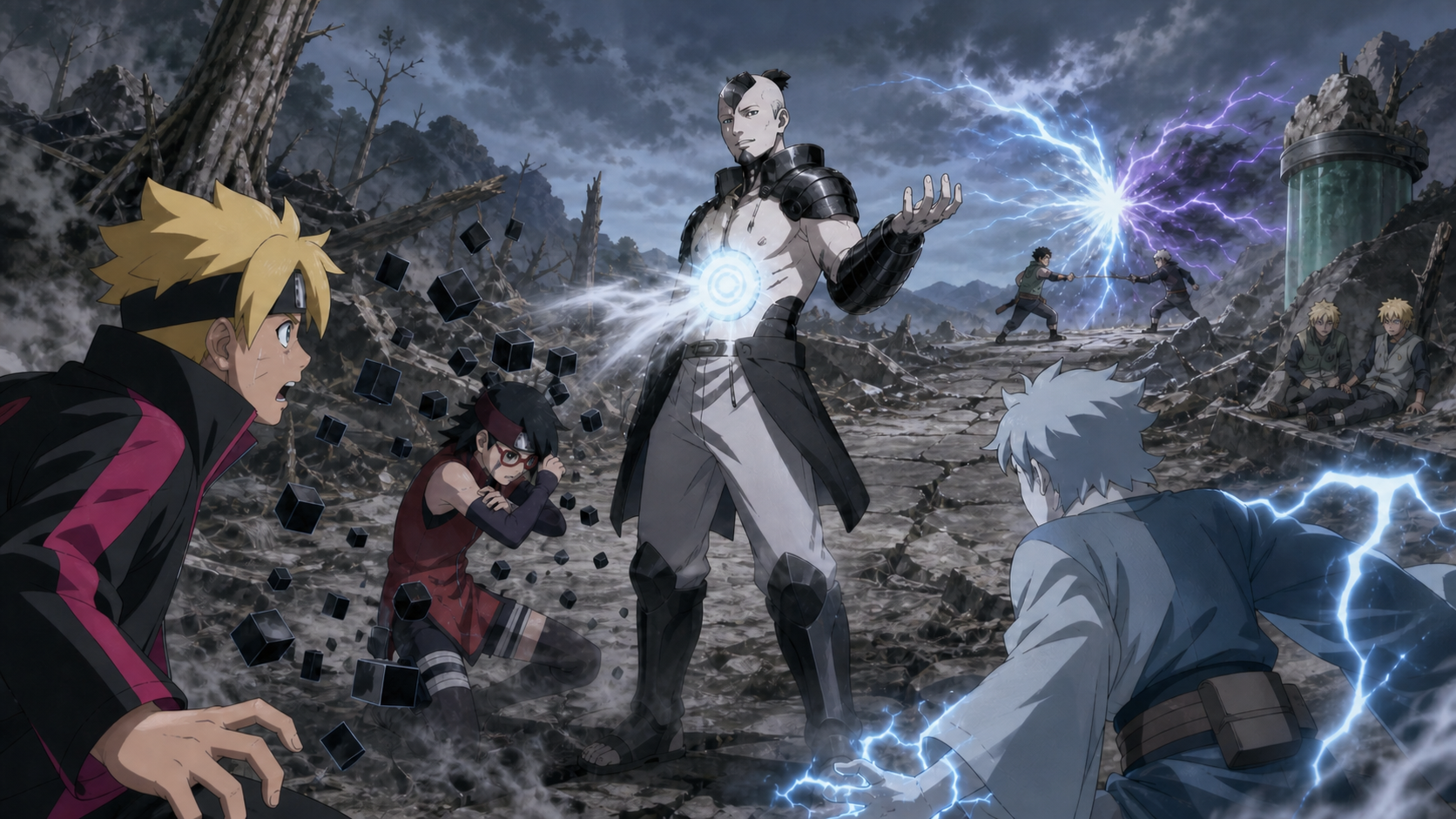
Death Match
Team 7 makes the morally right choice and Deepa beats them anyway. Good intent is not armor, a Rasengan does not obligate victory, and the Haze brothers pay every human cost before Kara collects the prize.
Series: Boruto: Naruto Next Generations
Episode: 166 · Death Match
Arc: Kara Actuation
Release: 2020-09-20
Previous: Episode 165 · The Quadruplets’ Duty
Directory: All 293 Boruto episodes
Bottom line
Boruto Episode 166, “Death Match,” lets Team 7 lose. Not stumble, not retreat from a misunderstood opponent, not win because Boruto discovers one more reserve of determination. Deepa dismantles them. Boruto’s Rasengan does nothing. Sarada’s Sharingan helps her survive a storm of carbon cubes without creating a path to victory. Mitsuki’s lightning does nothing. The same young team that has survived impossible enemies reaches a man who treats their strongest answers like background noise.
The episode earns that defeat by making Team 7 choose the fight for the right reason. They place themselves between Deepa and two Haze brothers who stole the Hashirama cell, framed them for murder, and already sacrificed half their family. Protecting Hiruga and Asaka does not erase those crimes. Deepa represents a worse certainty. Team 7 understands that nobody should be handed to Kara simply because the intended victim also made terrible choices.
Asaka attacks the brother he thinks is already dead
Hiruga catches Asaka, but the reunion begins with an attack. Asaka felt the forbidden jutsu and believed Hiruga had died. A living Hiruga therefore looks like an enemy using transformation.
That suspicion is brutal and logical. The quadruplets have spent the mission watching brothers deliberately die. Their own sacrifice plan has made survival suspicious.
Boruto intervenes long enough for Hiruga to prove his identity. The brothers regain one another for a few minutes, and even that reunion arrives through violence.
The temporary truce has clear limits
Hiruga does not become Konoha’s friend. He agrees to cooperate until the third party threatening Asaka has been stopped.
That boundary makes sense. Team 7 still intends to recover the cell. The Haze brothers still intend to cross the border. Neither side has surrendered the original mission.
Cooperation does not require pretending conflict disappeared. The groups identify one immediate threat whose victory would make every other argument irrelevant.
Deepa announces himself by hurting the brothers first
Deepa attacks Hiruga and Asaka before anybody can stabilize the situation. He does not negotiate for the cell or explain Kara’s interest.
Violence is his introduction because violence is how he establishes hierarchy. Everybody on the road learns that their plans matter only until Deepa decides to interrupt.
Hiruga gave up a fatal jutsu to save Asaka. Deepa arrives ready to make that choice meaningless.
A kunai cannot scratch carbon armor
Boruto’s kunai leaves no mark. Deepa explains that he manipulates carbon and hardens his body until ordinary attacks become useless.
That power is frightening because carbon is not exotic. Carbon exists in living bodies, stone, fuel, and countless materials around them. Deepa turns an ordinary element into nearly absolute defense and weaponized cubes.
The technique also fits his personality. He makes himself hard and treats every other body as breakable.
Konohamaru’s fire changes nothing
Konohamaru tests Deepa with Fire Release. The attack fails to produce meaningful damage.
An adult jōnin technique failing matters. Team 7 cannot comfort themselves with the idea that their youth is the only problem. Deepa’s defense is strong enough to dismiss attacks from their teacher too.
The episode establishes the power gap before separating the adults from the genin. Nobody can claim Konohamaru would have solved Deepa in one move if Victor had not appeared.
Team 7 chooses to shield the Haze brothers
Boruto, Sarada, and Mitsuki put their bodies between Deepa and the men carrying stolen tissue.
That choice is the clearest proof that the last episode changed something. Boruto argued that Hiruga’s life mattered. Now he acts as though the claim remains true when protection becomes dangerous.
Human worth cannot depend on whether the person has earned a clean fandom label.
The protection also completes Boruto’s argument from the sinking mire. He told Hiruga that a life should not be discarded for a mission. Standing aside while Deepa kills the brothers would prove those words ended where inconvenience began. Boruto accepts danger because his principle has to survive contact with people who remain guilty.
Deepa refuses to explain because domination does not owe answers
The Haze brothers ask why he wants the cell. Deepa says an explanation would take too long.
That dismissal reveals Kara’s relationship to everybody outside the organization. Smaller nations, allied squads, criminal markets, and grieving families do not qualify as participants in the decision. They are obstacles or sources.
Deepa does not need their understanding. He expects their removal.
Victor arrives and immediately talks down to Deepa
Victor enters as an ally who still treats Deepa like an unruly subordinate. Their relationship contains cooperation without respect.
Victor wants the Hashirama cell returned because the tissue belongs inside his larger project. Deepa wants the cell too, but his appetite for combat keeps disrupting efficient recovery.
Kara members do not resemble a healthy team. They resemble powerful people temporarily facing the same direction.
The twister divides adults from children
Victor creates a violent wind that separates Konohamaru and Mugino from Team 7. The battlefield becomes two unequal matches: injured adults against Victor and three genin against Deepa.
That division is tactical, but the emotional effect is cruel. Konohamaru can see his students facing a man his own fire failed to damage while another Kara operative blocks the route back.
Mentorship cannot protect children from every consequence once the enemy controls the terrain.
Mugino fights while injured because no healthy option remains
Mugino’s previous injuries limit him, so Konohamaru asks him to support rather than lead the exchange with Victor.
Mugino still helps restrain Victor long enough for Konohamaru to attack from above. He adapts his role without pretending his body has no limit.
That honesty contrasts with the Haze brothers, whose mission treats physical limits as reasons to die faster.
Victor has extra hands for extra control
Victor manifests additional arms to form hand seals and calls down lightning. His body functions like a laboratory that keeps adding features whenever ordinary human anatomy becomes inconvenient.
The extra arms make his medical background feel sinister. Victor does not study bodies to respect their boundaries. He studies bodies to remove boundaries that frustrate him.
Kara’s body modification is not progress by default. Capability without consent can become another form of consumption.
Sarada can see the cubes and still cannot create safety
Deepa fills the battlefield with small carbon cubes. Sarada’s Sharingan helps track the projectiles, but perception does not guarantee a route through saturation.
This distinction matters. A powerful eye can read speed and trajectory while the body still lacks enough space, strength, or time to answer.
Sarada is not weak because seeing fails to solve everything. The attack is designed to overwhelm correct perception.
Boruto lands a Rasengan and receives no reward
Boruto reaches Deepa from above and connects with a Rasengan. The scene follows the visual grammar of a turning point.
Deepa remains standing.
That refusal is exactly what Boruto needs. Effort, courage, and correct execution do not obligate the world to produce victory. A technique that defeated earlier enemies can meet a defense built to neutralize the same kind of force.
Mitsuki’s lightning confirms the problem
Mitsuki lands a surprise Lightning Release. Deepa’s carbon defense withstands that attack too.
The team is testing different natures and angles, not mindlessly repeating one move. Deepa still controls the exchange.
Failure after adaptation feels worse than failure from a careless opening. Team 7 is thinking, and the available answers remain insufficient.
Deepa treats pain like entertainment
Deepa implies that he will eat the genin and enjoys their panic. His threats are not battlefield necessity. He takes pleasure in reducing young opponents to frightened bodies.
That appetite separates him from the Haze brothers. Hiruga and Asaka commit violence for a national mission. Deepa makes violence personal recreation.
Understanding desperation can complicate judgment. Enjoying cruelty deserves no such rescue.
Hiruga dies after choosing to live
Hiruga released his fatal mire because Boruto and Omoi convinced him that Asaka needed protection from Deepa. He reaches his brother, forms a truce, and still dies in the confrontation.
That outcome hurts because survival was finally a deliberate choice. Hiruga did not die according to the original sacrifice plan, yet Deepa’s violence collects him anyway.
Choosing life cannot guarantee life. The choice still matters because Hiruga stopped consenting to his own disposal.
Asaka turns the cell into bait
Asaka draws Deepa’s attention with the Hashirama cell and activates his own forbidden technique. The explosion is an attempt to protect the genin and punish the man who killed Hiruga.
Another brother converts his life into a weapon. The difference is that Asaka acts in immediate grief rather than following the original sequence of assigned sacrifice.
The family pattern survives even after the mission plan breaks. Death remains the only tool the brothers trust completely.
Deepa retrieves the prize from the wreckage
Asaka’s attack does not stop Deepa. Victor later finds him with the Hashirama cell recovered.
Four brothers crossed borders, penetrated Fushū Castle, endured pursuit, and spent every life. Kara receives the cargo.
That is the ugliest possible result. The Land of Haze pays the full human cost while a larger clandestine organization takes the benefit.
Team 7’s unbeaten story ends here
Boruto has carried pride in Team 7’s mission record. Deepa destroys that confidence without granting the dignity of a close contest.
The loss matters because the team cannot blame a technicality. Their formation, signature techniques, and refusal to abandon people were not enough.
Growth after this episode must begin with admitting the distance between surviving past danger and being ready for Kara.
That admission should sting. Team 7 has reason to feel capable, and adults have repeatedly trusted them with serious work. Deepa does not erase those accomplishments. He reveals a new scale. Confidence becomes useful only if the team can separate “we have won before” from “we understand this opponent.”
Mitsuki chooses forbidden power to save his friends
Mitsuki uses Sage Transformation to remove Boruto and Sarada from Deepa’s reach. The choice risks revealing a power he has been warned to conceal and places severe strain on his body.
He does not use that power to win. He uses the power to extract two friends from a battle already lost.
That distinction protects the moment from becoming a secret-form victory button. Mitsuki spends his hidden strength on survival.
Retreat is not cowardice when the alternative is a corpse
Team 7 leaves without the cell, without Hiruga or Asaka, and without defeating Deepa. The mission has failed.
Mitsuki’s retreat preserves the people who can learn from failure. Staying for one more Rasengan would satisfy pride and give Deepa another body.
Mugino’s lesson from the previous barrier returns at a larger scale: refusing the enemy’s chosen finish can be the only responsible move left.
The retreat also preserves testimony. Someone must tell Konoha that Victor and Deepa are connected, that carbon armor neutralized their attacks, that Victor can modify his body, and that Kara recovered the cell. Dead witnesses cannot turn defeat into intelligence.
RaeRae’s verdict
Episode 166 is the beating Team 7 needed and did not deserve. Those statements can coexist. Boruto, Sarada, and Mitsuki make the morally correct choice by shielding Hiruga and Asaka. Deepa punishes them anyway. Stories become childish when good intent functions like armor. This episode lets good intent remain good without pretending that goodness stops carbon cubes.
Deepa is terrifying because Team 7 tries real answers. Sarada reads the attack. Mitsuki changes elements and finds a surprise angle. Boruto lands the Rasengan. Nothing works. Victor keeps the adults occupied while the children discover how far Kara sits above their current level.
The Haze brothers receive the cruelest ending. They believed four orphan lives could buy security for their homeland. Kara takes the Hashirama cell after all four are gone. The nation loses its sons, the family loses every brother, and the powerful organization waiting behind the market collects the asset. That is not noble sacrifice. That is extraction wearing duty’s face.
Konohamaru needs to call the retreat before Mitsuki pays alone
The twister separates Konohamaru from his students, but command responsibility does not disappear with distance. Once Victor blocks the adults and Deepa neutralizes every attack, the mission objective has changed from recovery to survival.
Konohamaru needs a signal Team 7 can recognize without direct contact. A flare, summon, or coded chakra burst could tell the children that protecting the cell no longer outweighs extraction. Without that signal, Mitsuki has to make the decision while his friends remain focused on the fight.
Mitsuki chooses correctly. The team should not depend on one child spending forbidden power whenever command communication fails.
Sarada's perception produces intelligence even when defense fails
Sarada cannot dodge every cube, yet the Sharingan may still capture timing, formation changes, armor response, and the moment Deepa shifts carbon between offense and defense. That information has value after retreat.
Konoha should interview her before memory blurs under medication and shock. The goal is not forcing a wounded child to relive every impact. The goal is preserving what she noticed with consent, breaks, and medical support.
Her failure to create safety does not mean the eye contributed nothing. Perception becomes useful when the village turns observation into a plan instead of grading the child only by victory.
Boruto needs to separate a failed technique from a failed identity
The Rasengan connects and produces no result. Boruto can easily hear that moment as proof that he is weak, fraudulent, or unworthy of Team 7. The actual conclusion is narrower: the current Rasengan cannot penetrate Deepa's carbon defense.
Narrow conclusions create trainable problems. Boruto can study penetration, compression, elemental nature, delivery timing, and coordinated openings. A global judgment about personal worth offers only shame.
Kakashi and Konohamaru should protect that distinction during debrief. Deepa defeated the available technique. He did not define Boruto's future capacity.
Mitsuki's body requires emergency treatment, not congratulations
Sage Transformation saves Boruto and Sarada, but the extraction tears through a body already engineered around dangerous limits. Reaching safety is the beginning of the medical response.
Team 7 needs immediate stabilization, disclosure of which organs or pathways are at risk, and transport to someone capable of treating Mitsuki's unique physiology. Orochimaru may be the only available specialist, which creates another uncomfortable dependency.
Friends can thank Mitsuki later. The first obligation is making sure gratitude does not become a funeral speech after adults celebrate the rescue instead of treating the damage.
The Haze brothers were failed before Deepa arrived
Four young men accepted a plan where each death moved the surviving brother closer to national security. That belief did not appear on the road. Leaders, conditions, and desperation taught them that their bodies were the most available resource their homeland possessed.
Deepa kills the final hope, but the mission structure had already removed every safe future. The brothers lacked extraction support, diplomatic leverage, medical care, and a plan that valued survival after success.
Holding them accountable for murder and theft remains necessary. Accountability should include the authorities who made self-erasure sound like duty.
Victor and Deepa reveal two kinds of Kara control
Victor controls information, bodies, research, and the larger objective. Deepa controls the immediate battlefield through force and appetite. Their contempt for each other does not weaken the operation enough to save Team 7.
Kara can tolerate internal hostility because members remain aligned around access to resources and Jigen's structure. Healthy trust is unnecessary when fear, modification, and personal ambition keep everybody moving.
Konoha should not assume conflict between Victor and Deepa will automatically fracture the group. Division becomes exploitable only after intelligence identifies which need each member refuses to surrender.
The recovered cell turns defeat into a regional emergency
Kara now possesses Hashirama tissue taken through a black-market route that crossed several nations. The danger includes experimentation, body modification, artificial growth, and whatever Victor intends to combine with existing research.
Konoha needs to warn the Land of Fire, Land of Haze, Land of Valleys, and allied villages without exposing vulnerable sources. Medical and scientific specialists should assess likely uses while field teams trace transport and funding.
The response cannot remain Team 7's private revenge mission. A child squad discovered evidence of a network problem. Adults must finally build a network response.
The debrief should name what Team 7 did right
The children protected Hiruga and Asaka, adapted attacks, observed unfamiliar abilities, and retreated with information when victory became impossible. Those choices matter beside every failed objective.
A debrief focused only on losing the cell would teach them that morality and survival count less than cargo. A debrief focused only on bravery would hide the tactical gaps Deepa exposed.
Honest review can hold both. Team 7 made principled choices and remained unprepared for Kara's power. The next training plan should preserve the principle while addressing the preparation.
Hiruga and Asaka deserve identification beyond the mission label
Their bodies, belongings, and final actions should be documented and returned to the Land of Haze through a process that tells families what happened without praising the suicide strategy. The brothers were perpetrators, victims, citizens, and siblings at once.
Konoha should preserve testimony about Hiruga releasing the mire, Asaka confronting Deepa, and the cell changing hands. Those facts matter for accountability and for a homeland that may otherwise receive only a failed-operation notice.
Naming the brothers does not erase the people they killed at Fushū Castle. A complete record keeps victims and perpetrators visible instead of reducing every death to cargo movement.
Boruto and Sarada need trauma care before the rematch plan
Both children watched Hiruga die, saw Asaka choose another fatal technique, believed Mitsuki might die saving them, and experienced an opponent treating their fear as entertainment. Training alone cannot process that experience.
They need sleep, medical stabilization, private conversation, and adults who can hear rage or shame without turning every feeling into tactical advice. Trauma can narrow attention and make revenge feel like the only route back to safety.
The rematch becomes more responsible when Boruto and Sarada can remember Deepa without reliving the entire helplessness of the road. Emotional recovery belongs inside mission readiness, not outside shinobi professionalism.
Sources and lawful viewing
Official episode reference: Naruto Official episode guide
Licensed episode route: Crunchyroll licensed series page