
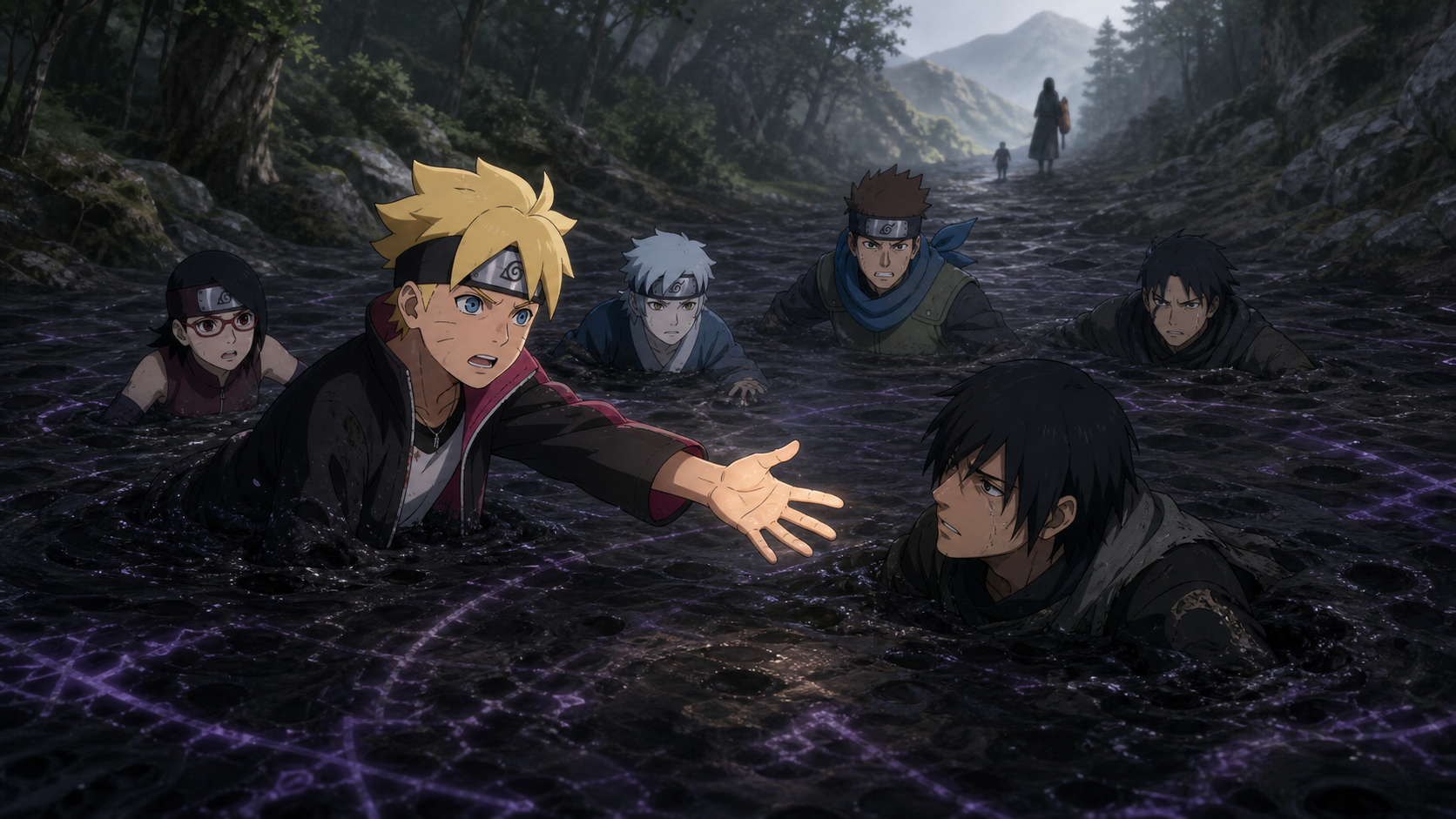
The Quadruplets’ Duty
Hiruga thinks the Land of Haze saved four starving orphans, so four lives belong to the mission. Boruto cannot lecture that history away. He can refuse to treat another brother’s death as settled policy.
Series: Boruto: Naruto Next Generations
Episode: 165 · The Quadruplets’ Duty
Arc: Kara Actuation
Release: 2020-09-13
Previous: Episode 164 · The Forbidden Jutsu of Death
Directory: All 293 Boruto episodes
Bottom line
Boruto Episode 165, “The Quadruplets’ Duty,” puts Boruto inside a sinking trap and forces him to hear the class difference behind the Haze brothers’ loyalty. Hiruga uses a forbidden technique that turns the ground into a black mire, locks Team 7’s movement, blocks hand seals, and drags every trapped body downward. Hiruga sinks fastest because the jutsu plans to kill its caster along with the targets. He calls that sacrifice reasonable. Asaka only needs enough time to cross the border with the Hashirama cell.
Boruto cannot understand why another brother would die on command. Hiruga cannot tolerate a rich great-village kid questioning choices made by orphans who remember starvation. Both boys make assumptions. The episode becomes stronger when Omoi arrives with news that Deepa murdered Kakui and Marui, because Boruto finally has a fact capable of changing Hiruga’s decision. Hiruga does not release the jutsu because Boruto wins a moral debate. He releases the jutsu because his living brother is about to meet a threat their sacrifice plan never accounted for.
Asaka and Hiruga were hungry before they were shinobi
The brothers remember life as orphans before the Land of Haze took them in. Hunger is not an inspirational backstory decoration. Hunger changes what loyalty means.
When a state feeds children nobody else protected, the children can experience service as debt repayment rather than employment. “Our homeland saved us” becomes difficult to separate from “our homeland may spend us.”
Hiruga is not defending an abstract flag. He believes the country gave four abandoned boys a reason and right to live.
Gratitude has been converted into permanent debt
Receiving food, shelter, training, and belonging should not create an unlimited claim over a child’s future body.
The Land of Haze appears to have taught the brothers that rescue must be repaid with absolute obedience. That is not gratitude. That is a debt arrangement with no possible final payment short of death.
Good care helps a child become free. Exploitative care keeps an invoice.
Boruto comes from safety Hiruga never had
Hiruga is right that Boruto grew up inside a powerful village with food, family, education, medical care, and a Hokage father. Boruto knows loneliness and parental frustration, but he does not know childhood starvation.
That distinction matters. Boruto cannot tell Hiruga that sacrifice is foolish without acknowledging the security that lets him imagine other choices.
Privilege does not make Boruto wrong. Privilege means he needs to listen before turning his own available options into a universal standard.
Boruto also inherits a village built partly from the labor and losses of smaller nations. He did not personally design that hierarchy, but innocence does not cancel benefit. A future leader has to recognize when another person’s desperation sits beneath his normal. Sarada’s Hokage ambition applies here too. Great-village children cannot promise a better shinobi world while treating border-country suffering as exotic character development.
The clone ambush makes Team 7 fight the wrong target first
The Konoha group attacks what appears to be the brothers and hits clones. Their destruction obscures the road, and explosive-tagged kunai force the team onto prepared ground.
That sequence proves Hiruga did not simply stop and improvise. He and Asaka designed a delay that controls sight, foot placement, and the team’s response.
By the time the black mire activates, Team 7 has already chosen the trap for him.
The sludge takes away hands before taking lives
The tar-like ground restricts movement and prevents hand seals. Shinobi who rely on techniques suddenly lose the physical language required to perform them.
The jutsu is cruel because the sinking remains slow enough for everybody to understand the approach of death. Team 7 cannot simply jump away or answer with their strongest ninjutsu.
Hiruga turns the ground itself into custody.
Sarada reads the sinking pattern
Sarada notices that bodies closer to Hiruga descend faster. That observation identifies the caster as the center of the technique.
Her Sharingan and analytical habits matter more here than raw strength. The trap presents a pattern, and Sarada names the pattern before panic can consume the group.
Information creates options even when nobody can move.
Mitsuki recognizes that Hiruga will die too
Mitsuki calculates the full cost. Hiruga is not standing safely outside the attack. He is sinking faster than everyone else.
That fact changes the encounter from attempted execution into mutual destruction. Hiruga has built a technique where his death serves as the final lock.
The brothers’ jutsu treat self-preservation as a weakness the mission has already removed.
Mugino finds the lethal solution immediately
Mugino concludes that Hiruga’s death will end the technique. From a mission perspective, killing the fastest-sinking caster may save the trapped squad before Asaka crosses the border.
The logic is brutal and probably correct. Mugino does not enjoy the answer. He refuses to pretend the answer does not exist.
Adult responsibility sometimes means naming the option everybody else hopes to avoid.
Boruto reaches for Hiruga instead
Boruto tries to save the man actively dragging him into the earth. That choice looks naive if measured only against mission speed.
Boruto sees another brother preparing to disappear and refuses to accept that death as the natural end of duty. His instinct does not solve the trap, but the instinct preserves a possibility Mugino’s arithmetic would close.
Mercy creates risk. Killing Hiruga would also create a permanent answer before the team understood his reasons or Asaka’s danger.
Hiruga and Boruto accuse each other of ignorance
Boruto assumes the brothers have been manipulated into meaningless sacrifice. Hiruga assumes Boruto’s protected life makes him incapable of understanding duty.
Both claims contain truth and arrogance. The brothers have been taught to erase themselves. Boruto has never faced their material desperation.
The conversation works because neither boy gets to occupy the clean moral high ground.
“I am saving one life” reveals the brothers’ arithmetic
Hiruga does not think he is throwing life away. He believes his death saves Asaka and preserves the mission meant to help their homeland.
One brother dies so one brother continues. The cell reaches the border. A nation may gain power.
The equation excludes the possibility that the mission itself is killing the people the nation needs most.
Yoruga and Yuuga have already become precedent
Hiruga remembers the brothers who died at Fushū Castle and inside the previous barrier. Their sacrifices do not warn him away. Their deaths become examples he believes he must honor.
Organizations often use previous loss to demand future loss. Stopping would supposedly make the earlier deaths meaningless.
That logic can consume an entire family because every death raises the emotional price of turning back.
Asaka carries more than the Hashirama cell
Asaka leaves with the sample while his brother sinks. He carries the national objective, the hopes of the Land of Haze, and the deaths of Yoruga and Yuuga.
Each sacrifice narrows his freedom. Returning without the cell would feel like betraying three brothers, even if continuing guarantees more harm.
Duty becomes a corridor built from graves.
Boruto cannot talk Hiruga out of his history
Boruto argues that the brothers should value their lives. That appeal cannot erase starvation, rescue, training, national inequality, and years of shared doctrine.
Fandom likes calling any successful conversation “Talk no Jutsu,” but words are not magic mind control. Persuasion works when new information changes the decision facing a person.
Boruto needs more than moral confidence. He needs a fact Hiruga cannot fit inside the old mission plan.
Omoi arrives carrying the missing fact
Omoi reaches the group after Deepa defeats him and kills Kakui and Marui. His warning changes everything: Deepa is moving toward Asaka.
Hiruga’s sacrifice was designed to protect his brother from Team 7. The plan does not protect Asaka from a Kara operative capable of slaughtering trained Cloud shinobi.
The same loyalty that kept Hiruga inside the mire now requires him to leave.
Kakui and Marui should not become nameless proof of Deepa’s strength
Deepa kills Omoi’s teammates, and their deaths function as a warning about his power. That narrative job cannot be the only thing fandom remembers.
Kakui and Marui joined a mission to retrieve dangerous stolen tissue, listened when evidence cleared Team 7, and held Deepa so the pursuit could continue. Their decision gave Konoha time.
Naming them is the minimum respect a recap can offer.
Omoi surviving does not make their stand successful in the way stories usually measure success. Deepa continues toward the cell. Their contribution survives through the warning Omoi carries and the minutes they purchased. That kind of outcome deserves more than “Deepa beat some Cloud ninja.” Kakui and Marui entered the road as professionals, made a judgment based on evidence, and paid for the cooperation Team 7 now depends on.
Hiruga releases the jutsu for Asaka, not for Konoha
Hiruga does not suddenly adopt Boruto’s worldview. He ends the technique because Asaka needs him.
That motivation keeps the turn credible. Hiruga’s core value remains loyalty to his brother. Boruto succeeds by connecting that value to a different action.
Persuasion becomes stronger when the listener can change course without surrendering every belief at once.
Omoi stays behind because grief has weight
Omoi warns Konohamaru and Mugino about Deepa, then remains behind. He is injured, exhausted, and carrying the deaths of two teammates.
The story gives the younger characters forward motion while Omoi absorbs the cost of the alliance. That contrast matters. Team 7 gets another chance to reach Asaka because Kakui and Marui do not.
Progress in this arc keeps arriving through somebody else’s loss.
The episode refuses a simple great-village lecture
Boruto’s belief that lives matter is correct. Hiruga’s accusation about great-nation comfort is also correct.
The great villages possess resources, medical systems, recognized borders, and political leverage that smaller lands lack. Telling weaker nations to make better choices without addressing that imbalance becomes another form of arrogance.
The Land of Haze still chose murder and disposable children. Structural injustice explains the desperation without cleansing the method.
Duty should preserve a community, not consume one
The quadruplets believe duty means completing the mission regardless of how many brothers survive. That definition protects the objective while destroying the family.
A homeland is more than territory and leadership. A homeland is people. Saving a country by teaching its abandoned children to die on schedule has confused the symbol with the population.
Hiruga’s release of the jutsu is the first decision in this mission that preserves a brother instead of memorializing one.
The change arrives late, but late is not the same as worthless. Hiruga cannot recover Yoruga or Yuuga. He can refuse to make Asaka the next memorial. Breaking a destructive family pattern rarely repairs every earlier loss. The first interruption still matters because somebody alive gets a different ending.
RaeRae’s verdict
Episode 165 earns its conversation because Boruto does not simply shame Hiruga into becoming good. Hiruga exposes Boruto’s protected upbringing, and Boruto keeps reaching anyway. Neither can resolve the argument while the original facts remain unchanged.
Omoi changes the facts. Deepa killed Kakui and Marui and is heading for Asaka. Hiruga must choose between dying according to the mission plan and living long enough to protect the brother the plan has left exposed. He releases the technique because love finally demands survival instead of sacrifice.
That is the episode’s real victory. The Hashirama cell remains stolen. Deepa remains ahead. Two Haze brothers and two Cloud shinobi are dead. Nothing is tidy. One man stops sinking because Boruto refuses to treat a disposable life as settled policy, and because evidence gives Hiruga a reason to imagine duty with his body still included.
The Land of Haze owes the brothers more than a mission title
Four orphaned children received food, training, and belonging, then entered a plan where each death moved the cargo forward. The homeland cannot call that arrangement voluntary without examining who controlled every alternative.
Did the brothers receive wages, family support, medical care, or permission to refuse? Did anyone offer another team, diplomatic help, or an extraction route? Gratitude becomes coercion when survival depends on proving loyalty through self-destruction.
The Land of Haze may face real desperation. A desperate government still owes its children futures beyond becoming the cheapest available weapon.
The mire needs a rescue procedure beyond killing the caster
Mugino identifies the lethal shortcut because the team lacks time and movement. Konoha should study the forbidden technique after survival and develop a response that does not require immediate execution.
Possible countermeasures include breaking the chakra link, reaching the caster without hand seals, distributing weight, using summons, or creating an external anchor before the body sinks below reach. Even an incomplete protocol gives future teams more than panic and one fatal option.
Forbidden techniques remain in circulation because smaller nations and hidden groups preserve them. Great villages should share defensive knowledge instead of waiting for another caster to die in front of trapped children.
Boruto's privilege can become responsibility instead of shame
Hiruga is correct that Boruto grew up with resources the quadruplets never had. Boruto cannot undo that difference by feeling guilty or surrendering every moral claim.
He can use access. Naruto can hear the report. Konoha can contact the Land of Haze, provide evidence about Deepa, offer medical support, and ask why four orphans became the entire mission plan. Boruto's position gives him routes Hiruga never possessed.
Privilege becomes useful when the protected person opens those routes for somebody outside the protection rather than treating awareness as the final good deed.
Omoi needs extraction and grief support
Omoi reaches Team 7 after fighting Deepa and losing Kakui and Marui. Delivering the warning does not make his injuries, exhaustion, or shock disappear.
Konohamaru should send a location report and request medical retrieval before the pursuit continues. Omoi may insist on remaining useful because his teammates died buying the warning, but survivor guilt should not determine whether he receives care.
The Cloud also owes him a debrief that names what the team accomplished and allows grief without forcing immediate tactical usefulness. One surviving shinobi should not carry the whole mission record alone.
Kakui and Marui deserve a complete record
Their final stand needs more than inclusion in a casualty count. Investigators should preserve their communications, actions, injuries, and the information they helped Omoi deliver.
Families deserve confirmed facts rather than rumors shaped around Deepa's spectacle. The Cloud should return belongings, explain what remains unknown, and acknowledge that cooperation with Konoha continued because their team chose evidence over the earlier accusation.
The record must also avoid turning sacrifice into recruitment material. Honoring courage should not teach the next squad that death is the expected proof of duty.
Hiruga's change needs protection from punishment
Releasing the forbidden technique abandons the delay plan and may violate direct orders from the Land of Haze. If Hiruga survives the next encounter, leaders could frame his choice as betrayal rather than adaptation.
Konoha witnesses can document why the original plan failed: Deepa killed Cloud shinobi, threatened Asaka, and pursued the cell with strength the brothers had not been told to expect. Hiruga changed course to preserve the mission's remaining person.
Protecting that testimony matters because organizations often punish the first person who stops repeating a deadly pattern. Survival should not become evidence of insufficient loyalty.
Team 7 needs a countermeasure for hand-seal denial
The mire traps limbs and removes access to ordinary ninjutsu. Team 7 should train responses that rely on prepared tools, voice commands, summons, chakra control through available contact, or teammates outside the affected ground.
The lesson extends beyond Hiruga. Enemies will target the physical steps required for a technique. A squad that depends on every member forming seals freely can lose the whole arsenal through terrain.
Sarada's pattern recognition and Mitsuki's bodily flexibility may create future options, but those options need rehearsal before the next sinking field.
The Hashirama cell has created a chain of exploited countries
Victor's experiment harms the Land of Valleys. The black market draws in the Land of Haze. Fushū Castle becomes a target. Cloud and Leaf teams pursue the theft. Kara waits above every local conflict to claim the material.
The tissue moves through nations with unequal power while the largest organization benefits from secrecy and desperation. No single border response can stop that chain.
The Five Great Nations need to share intelligence with smaller countries as partners, not merely warn them after bodies appear. The market survives wherever people believe dangerous tissue offers the only path to security.
Duty needs an end condition
The quadruplets never define a point where enough loss cancels the mission. Every death increases commitment, and every setback becomes another reason the next brother must continue.
A responsible mission sets withdrawal conditions before grief narrows judgment. Loss of half the team, hostile intervention beyond the threat estimate, compromised cargo, or failed communication should trigger reassessment by someone not trapped inside the same emotional debt.
Duty without an end condition becomes a machine that consumes whoever remains. Hiruga's release is the first emergency stop anybody activates.
Survival should not become propaganda for the same system
If Hiruga and Asaka return, leaders may praise their loyalty while ignoring that three brothers died and the cell still attracted a stronger enemy. A ceremony can turn survival into proof that the mission design worked.
The brothers should control how their story is told. They may feel pride, grief, anger, guilt, or continued loyalty at the same time. None of those feelings authorizes officials to recruit more orphans with a polished version of the road.
An honest public account would name the failures: insufficient threat intelligence, no extraction route, lethal forbidden techniques, and a mission objective that kept outranking every life assigned to carry the objective.
Repair begins when the homeland values the surviving brothers more than the story their suffering can sell to the next frightened child.
Anything less keeps the invoice open.
Sources and lawful viewing
Official episode reference: Naruto Official episode guide
Licensed episode route: Crunchyroll licensed series page