
EPISODE 65 · DISNEY+ SEASON 2, EPISODE 26 · LINK · RAE RAE REACTS
Lilo & Stitch: The Series Episode 65: Link
Lilo and Mertle fight over buried treasure until Experiment 251 physically binds them together. Cooperation gets them through Gantu’s ship, but no amount of alien glue can substitute for consent, boundaries, or actual repair.
The final broadcast episode begins with the rivalry the series never fully solved
Lilo and Mertle meet on a beach and immediately turn a shared treasure map into a fight over ownership, credit, and who deserves to win. Their conflict is familiar enough that nobody pauses to ask why two children who attend the same hula school have been allowed to remain locked in mutual hostility for so long.
The adults around them tend to respond after teasing becomes a fight. A healthier intervention would establish boundaries before the next competition, address Mertle’s repeated bullying, and give Lilo support that does not require her to prove toughness every time she is insulted.
A treasure hunt can be cooperative without forcing friendship
Finding the map gives both girls a reason to explore, observe, and solve problems. They do not have to like each other to divide tasks, agree on safety rules, and share whatever they uncover. Cooperation is a practical skill before it becomes an emotional bond.
Adults should avoid framing the exercise as a magical cure for their relationship. Lilo and Mertle need enough trust to complete the task without harm. Friendship, apology, and forgiveness require separate choices.
The incoming tide activates another pod that should never have remained on a public beach
Mertle’s shovel moves Experiment 251 into the water. The accident exposes the continuing failure to recover dormant experiments from locations where children, swimmers, animals, or weather can activate them. The island has carried this risk through the entire series.
Jumba and the Federation need systematic sweeps, public reporting guidance, and water-resistant containment. Lilo should not be expected to discover the last hazard through chance while playing.
Link targets conflict instead of causing it from nothing
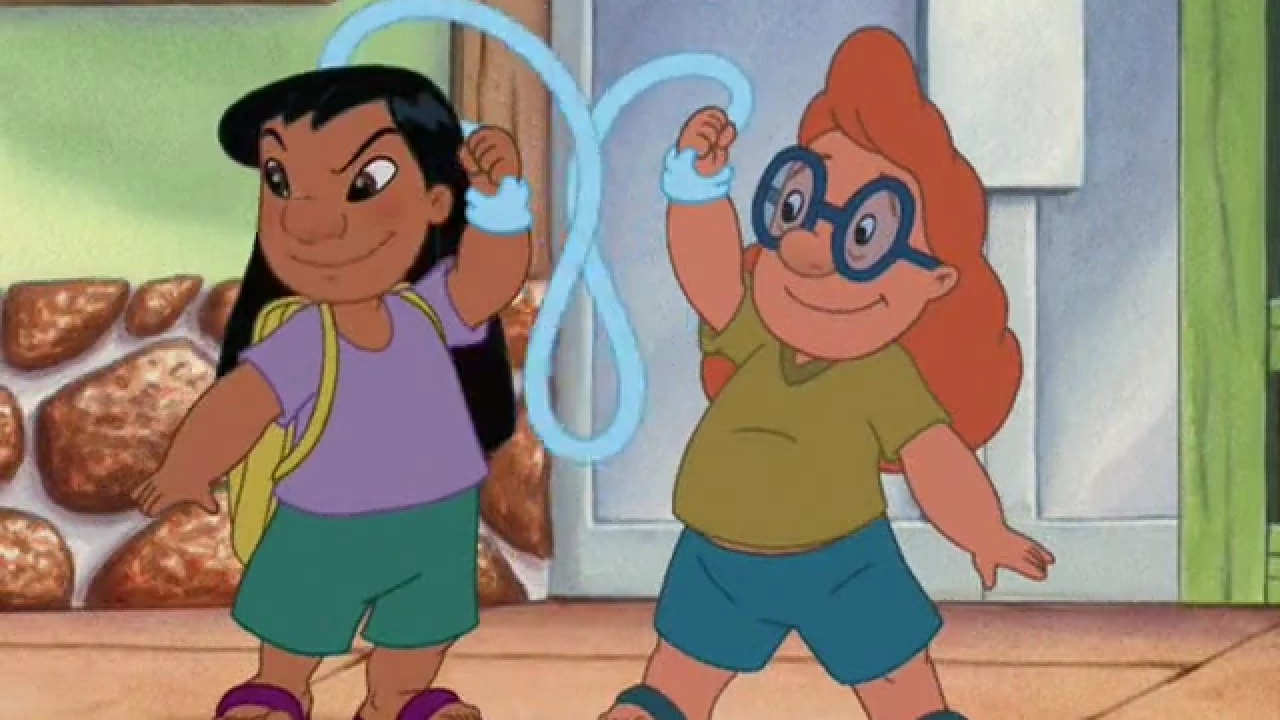
Experiment 251 detects squabbling people and binds them together with elastic adhesive. He does not invent Lilo and Mertle’s hostility. He turns an existing relationship problem into physical confinement, making every refusal to coordinate immediately dangerous.
That difference matters for rehabilitation. Removing Link’s glue cannot repair the reasons people were fighting. His power may reveal a conflict, but counseling, accountability, and changed behavior remain human work.
Binding two people together is coercion even when teamwork follows
Lilo and Mertle learn to coordinate because they have no safe alternative. The result may resemble cooperation, but it is produced through bodily restraint without consent. A lesson learned under coercion should not be celebrated without naming the violation.
Nobody should use Link as a relationship counselor, disciplinary tool, or shortcut for making children reconcile. Forced proximity can increase fear and danger, especially when one person has bullied or abused the other.
Jumba’s “indestructible on fifty planets” claim needs better testing
He explains that the adhesive cannot be broken across fifty worlds, yet mud on Earth dissolves it because Earth was excluded. The gap is funny and demonstrates why universal claims fail when testing ignores the actual deployment environment.
Every experiment profile needs conditions, exceptions, sample size, and emergency countermeasures. Jumba should test locally before announcing that a restraint is permanent. Unknown chemistry and human skin also require medical caution.
Mud becomes an antidote because local knowledge beats laboratory certainty
Stitch frees the bonded pairs using an ordinary Earth material that Jumba’s off-world design did not anticipate. The solution does not require a stronger weapon. It requires noticing the environment and testing a humble substance safely.
The family should package clean mud-based release material for responders, record concentration and contact time, and check for skin irritation. An antidote is useful only when people can access it quickly and know how to apply it.
Nani and Stitch being linked exposes the household’s uneven physical burden
Nani already manages work, caregiving, and alien emergencies. Binding her to Stitch adds his strength and sudden movement to her body without warning. She can be dragged or injured even if Stitch is trying to help.
Stitch needs to slow down, communicate before moving, and let Nani set the pace. The pair’s safety depends on the stronger person adapting to the more vulnerable body rather than treating speed as the solution.
Jumba and Pleakley turn irritation into another test of domestic partnership
Their arguments are often played as comic background, but Link makes every disagreement physically immediate. They have to coordinate balance, direction, and problem solving while still annoyed with each other.
The useful lesson is not that conflict disappears when people are stuck together. It is that people sharing a home need communication habits before emergencies force them to improvise. Pleakley deserves to be heard, and Jumba needs to stop treating technical knowledge as authority over every decision.
Link’s rampage creates public restraint incidents across town
He binds arguing residents who have no information about experiments or the release method. Targets could be driving, cooking, carrying children, using mobility aids, or standing near water. The adhesive can turn a verbal disagreement into serious injury within seconds.
Responders need a perimeter, mud-based release kits, medical assessment, and privacy for those affected. Public warnings should describe behavior without publishing Link’s future home or encouraging residents to capture him themselves.
Lilo and Mertle discover a tool inside the restraint
They use the elastic bond as a lasso to catch Link. The moment works because they stop pulling in opposite directions and coordinate timing. Their intelligence, rather than sudden affection, changes the physical limitation into a controlled action.
The capture still carries risk. Stretching the adhesive could injure shoulders, wrists, or skin, and Link may be hurt when pulled. A planned response should use equipment rather than children’s bodies whenever possible.
Mertle helps because the situation affects her too
Her cooperation does not instantly redeem years of ridicule, exclusion, and cruelty toward Lilo. It does show that she can recognize shared danger and contribute to a solution. Character growth can begin with one practical choice without pretending the past vanished.
Lilo is allowed to appreciate the help without granting friendship or forgiveness. Repair would require Mertle to name specific harm, stop repeating it, and accept that Lilo may remain cautious.
Naming Link does not require Mertle’s enthusiasm
Lilo chooses “Link,” explaining it as short for Linkenstein rather than the obvious function. Mertle is unimpressed. The exchange preserves their distinct personalities after cooperation instead of forcing a sentimental agreement about everything.
Link himself should be included in whether the name fits. Experiments often receive names at the instant of capture, before anyone learns their preferences. A nickname can begin a relationship, but it should remain open to revision.
Gantu demands both the experiment and the treasure map because control expands
His mission concerns experiments, yet he also claims the children’s map. The demand shows how authority used without limits reaches for whatever else is available. An armed adult confronts two children and treats their possessions as part of his operation.
The safest response is escape and adult support, not negotiation in the open. The Federation should already have restricted Gantu’s access to weapons and transport after repeated abductions.
Link attaching the children to Gantu turns restraint back on the captor
The image is comic because the huge armed pursuer now carries the two children he tried to control. It also places Lilo and Mertle close to his head, weapons, and movement. Link’s sabotage does not distinguish between poetic justice and physical risk.
Stitch’s priority should be separating the children rather than exploiting the inconvenience. A villain being embarrassed is secondary to getting minors away from an armed vessel.
The golf-course attack exposes another unsuitable public environment
Link targets arguing golfers, where clubs, carts, water, slopes, and other players can turn sudden binding into injury. His attraction to conflict makes crowded recreational spaces especially unpredictable.
Staff should clear the area and stop play while responders use the known solvent. People do not need to reveal the subject of their argument to receive help. An experiment incident does not cancel privacy.
Gantu’s capture of Link does not make the experiment a lawful prisoner
Blasting Link into a net and transporting him to the ship continues Gantu’s pattern of seizing living experiments for Hämsterviel. Link may be dangerous, but custody without due process, welfare standards, or independent review remains abduction.
The family’s rescue goal should include Link’s safety as well as stopping his adhesive attacks. Dangerous behavior can justify temporary containment without transferring ownership to an abusive captor.
Lilo and Mertle aboard the ship create another child-abduction emergency
They are carried into enemy territory while still physically constrained. The situation demands immediate notification of Nani and the Federation, medical monitoring, and a plan that prioritizes the children over equipment or treasure.
The series often treats Lilo entering Gantu’s ship as an adventure pattern. Repetition should increase adult safeguards, not normalize the danger. Nani deserves to know where her sister is before the rescue is already ending.
Stitch frees Link because rescue extends to the cousin causing the problem
He does not leave Experiment 251 in Gantu’s custody merely because Link restrained the family. That choice reflects the strongest ethic in the series: harmful design and harmful behavior do not erase the possibility of care, accountability, and a different future.
Release should still be paired with a plan. Stitch needs the mud solvent ready, a safe route, and a way to prevent Link from binding the children again during escape.
Link binding Gantu and Reuben creates the exit window
Experiment 251 uses his ability against the captors, giving Lilo, Stitch, and Mertle time to leave. Reuben is caught in the restraint even though Gantu holds more operational power. The adhesive does not distribute consequence according to responsibility.
After the escape, Reuben still deserves safe release. Opposing the captors does not make abandonment in an indestructible bond acceptable. Accountability should target choices without treating collateral harm as deserved.
The cliff-diving attraction repeats the episode’s consent problem
Link’s one true place uses his bonds for couples participating in a cliff-diving attraction. The setting converts elasticity into a safety or thrill mechanism, but the original function specifically targets arguing pairs. Conflict cannot be treated as consent.
Every participant must opt in individually after understanding the adhesive, height, release method, medical risks, and emergency plan. A partner cannot volunteer the other person, and staff cannot use Link to keep a frightened participant from backing out.
A relationship attraction must never market coercion as therapy
Advertising could easily promise that being physically linked will make couples communicate. That claim would be unsafe for people experiencing abuse, control, panic, or unequal power. Forced cooperation can intensify harm rather than create intimacy.
The attraction should be framed as optional recreation for screened participants, not treatment. Couples seeking help need qualified professionals and the freedom to leave separately.
Link needs employment protections and a home away from the attraction
If he works at the cliff site, he needs training, rest, protective equipment, medical care, compensation, an advocate, and the right to refuse. His housing and food cannot disappear during weather closures, low attendance, injury, or retirement.
A backup caregiver and secure residence should be established before opening. One true place is a relationship and community, not a shift schedule attached to a profitable ability.
Lilo and Mertle’s cooperation should lead to boundaries, not a fake friendship
They have evidence that they can solve a crisis together. The next responsible step is a mediated conversation about what helped, what hurt, and what behavior must change at hula school. Mertle’s repeated insults and group exclusion need direct adult attention.
Lilo should not be told that teamwork proves she secretly likes her bully or owes another chance. She can choose limited cooperation, distance, or gradual trust. Mertle can change without controlling how quickly Lilo believes her.
The episode is a broadcast finale but not the cleanest emotional ending
“Link” aired last, while “Snafu” was produced as the stronger culmination and “Leroy & Stitch” closes the Hawaiian television era. That production history explains why the final episode feels like another experiment story rather than a grand farewell.
A directory should preserve both broadcast and story context. Viewers deserve to know that “Link” completes the numbered episode run while the film carries the larger franchise resolution. Neither fact requires pretending one order solves every continuity issue.
The complete series needs a final welfare audit after sixty-five emergencies
Jumba must reconcile every experiment number with activation status, location, caregiver, medical record, abilities, consent, and security needs. Unknown, duplicated, imprisoned, deceased, off-world, or uncertain entries should be marked honestly rather than forced into a tidy list.
Nani needs compensation and support for a home repeatedly used as an unofficial response center. Lilo and Stitch need time without missions. Pleakley needs a defined adult role, and Jumba needs continuing accountability for designs that still place the island at risk.
The Federation should fund local response, legal identity, healthcare, safe housing, and confidential tracking controlled with the experiments. Communities hosting cousins need training without receiving sensitive locations.
A completed hunt is not the same as completed care. The series ends its episode count while the work of sustaining hundreds of lives has barely begun.
What I would keep and what I would repair
I would keep the treasure map, Lilo and Mertle’s refusal to cooperate on command, mud defeating interplanetary glue, the lasso capture, Link attaching the children to Gantu, the ship escape, and the reminder that rivalry does not prevent capable teamwork.
I would repair the lack of adult response, give Mertle’s bullying a real consequence, add medical care for bonded targets, replace the couples attraction with a strictly voluntary safety-reviewed activity, and end with a clearer plan for Link’s housing and the wider experiment community.
RaeRae’s final verdict
“Link” ends the sixty-five-episode run by physically binding together people who would rather win alone. The funniest part is that cooperation works without turning Lilo and Mertle into instant best friends. They coordinate, survive, and return to being complicated children with a history the glue cannot dissolve.
My verdict: keep the mud close, keep Gantu away from children, stop using forced proximity as relationship advice, and let Link have a life beyond sticking arguing couples together for entertainment. Teamwork can get people out of danger. Repair still needs consent, boundaries, and somebody willing to do the slower work after everyone is free.
Where to watch
Watch “Link” through Lilo & Stitch: The Series on Disney+. Disney+ catalogs it as Season 2, Episode 26 and CVM Sekai records it as overall Episode 65. Apple uses a different season order and labels it Season 2, Episode 15. Availability and numbering can change by platform.
Keep exploring
Return to the complete 65-episode directory or return to the Lilo & Stitch hub.