
EPISODE 52 · DISNEY+ SEASON 2, EPISODE 13 · MORPHOLOMEW · RAE RAE REACTS
Lilo & Stitch: The Series Episode 52: Morpholomew
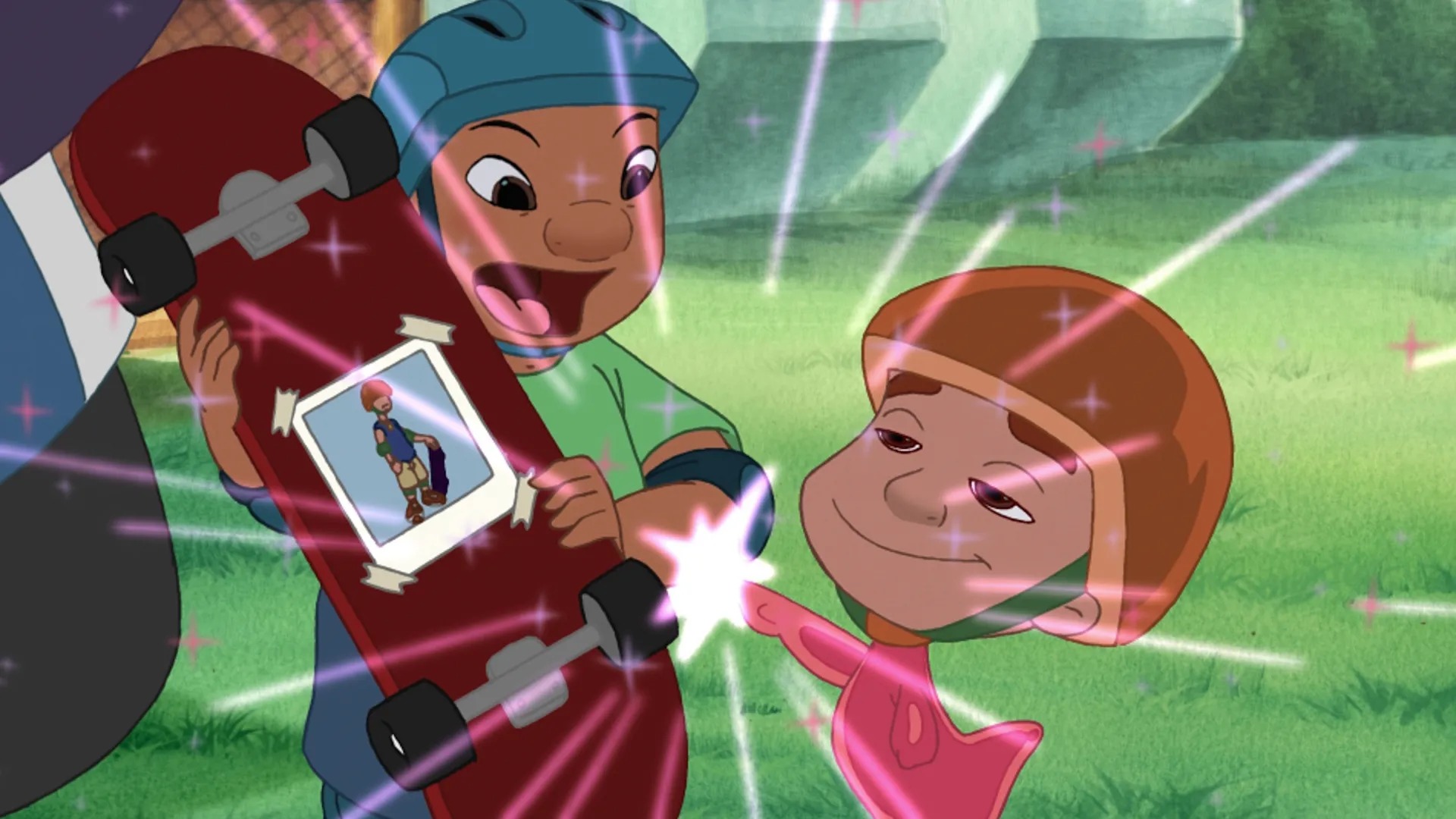
Lilo uses Experiment 316 to enter a skateboard contest and impress Keoni, then copies Jake Long and gets trapped in his body. The crossover turns a crush into a full identity, consent, and magical-alien security crisis.
Lilo enters the contest for Keoni before asking what Keoni wants
Lilo wants to win a skateboard for Keoni while he is away in Australia. The gift sounds generous, but it is also a performance designed to make him see her differently. She builds an entire competition plan around a crush who is not present to request the board, the risk, or the deception.
That does not make Lilo manipulative beyond repair. It makes her a child trying to convert affection into a task with a measurable finish line. Somebody should tell her that being impressive cannot manufacture mutual interest, and a gift obtained through impersonation carries a story Keoni never agreed to inherit.
The age rule is frustrating, but it is still a boundary
Lilo is too young to enter the skateboarding competition. The rule may feel arbitrary when she believes she can compete, yet disguising herself as an eligible person avoids every question about waivers, supervision, injury response, and who is legally responsible if she gets hurt.
A fair alternative would be a youth division, exhibition round, or supervised skills event. The organizers should explain the rule and offer a future path. Lilo still has to accept that exclusion does not authorize identity fraud, especially when the borrowed identity belongs to a real person.
Morpholomew turns insecurity into somebody else’s face
Experiment 316 can transform a target into another person or creature. The power offers Lilo exactly what insecurity promises: skip practice, skip waiting, skip being visibly young, and wear the body that appears qualified. The shortcut changes appearance without transferring skill, experience, judgment, or consent.
The episode understands the joke when Lilo looks right and performs badly. A face can pass an entry check, but it cannot carry another person’s training. Morpholomew exposes how much social authority is granted to appearance while the transformed person remains herself underneath.
Using Keoni’s body without permission crosses a serious line
Keoni is absent, so he cannot agree to Lilo copying his appearance for a public competition. Spectators may believe they saw him skate, fail, sign paperwork, or behave in ways he never chose. The transformation creates reputational consequences for a child who does not know his identity is being used.
The repair must be specific. Lilo should tell organizers the entrant was not Keoni, correct any records or photographs, and keep the failure away from his name. An apology to Keoni matters even if he never learns about the incident from anyone else.
The failed performance proves bodies are not downloadable skill sets
Morpholomew changes visible form, but Lilo does not receive Keoni’s balance, muscle memory, or competition experience. The episode lands an important truth by accident: embodiment is not a costume, and expertise cannot be copied through resemblance.
That point also protects Lilo from the cruel conclusion that her own body is the problem. She needs instruction, time, and an age-appropriate event, not a different face. Practice may be slower than alien transformation, but it produces ability she actually owns.
Jake Long arrives carrying a different kind of double life
Jake is a teenager who moves between an ordinary public identity and the American Dragon. Unlike Lilo’s disguise, his transformation is tied to inherited responsibility and secrecy. The crossover places two forms of identity management beside each other without fully examining how differently power and choice operate.
Jake may understand the exhaustion of hiding, but that does not make his body available for copying. Lilo sees a capable older hero and reaches for another shortcut. The story needed him to explain that looking like the protector is not the same as carrying the duty.
Copying Jake creates risks far beyond the skateboard contest
Jake has friends, enemies, family obligations, and a magical role. Someone wearing his face could issue promises, attract an attack, expose secrets, or be mistaken for the American Dragon by people who understand only part of his life. Identity theft becomes a supernatural security breach.
Trixie, Spud, Fu Dog, and Grandpa deserve immediate notice when the duplication occurs. They cannot protect Jake or Lilo if they do not know which body holds which person. The crossover treats confusion as momentum, but the characters need a verification phrase and regrouping plan.
The transformation should never outlast access to Morpholomew
Lilo becomes stuck in Jake’s form after Gantu captures Experiment 316. That reveals a catastrophic dependency: the transformed person cannot reliably restore herself. If Morpholomew is injured, transported off-world, frightened into silence, or unwilling to cooperate, the change may become indefinite.
Jumba should never permit use before confirming duration, reversal methods, and an independent failsafe. A power that can rewrite a body needs the same caution as surgery. “We can ask the experiment later” is not a recovery protocol.
Gantu mistakes the dragon for the experiment because his intelligence is poor
Jake’s dragon form resembles the kind of impossible creature Gantu expects from Jumba. The mistake is funny, but it shows how little reliable information Gantu receives before conducting armed retrievals. He captures first and identifies later because Hämsterviel rewards delivery, not accuracy.
That system endangers every unusual being on the island. Magical creatures, aliens, costumed humans, and transformed children can all become targets. The family needs a way to document Gantu’s misidentifications instead of treating each one as an isolated chase.
The crossover expands the world without agreeing on its rules
American Dragon brings magic, guardians, dragons, and a hidden supernatural community into a franchise already managing aliens and genetic experiments. The combination is fun because both worlds treat the impossible as an administrative problem, yet the episode avoids deciding how their secrecy systems coexist.
A responsible crossover would establish what Jumba knows about magic, what Grandpa knows about extraterrestrial life, and who handles a crisis involving both. Shared continuity is more than placing recognizable characters in Hawaii. It requires consequences that survive the guest appearance.
Trixie and Spud should not be reduced to Jake’s accessories
Trixie and Spud bring knowledge, loyalty, and experience with Jake’s double life. They can identify behavior that does not match him and help distinguish a transformation from possession or magical disguise. The story gains more when they participate as investigators rather than colorful witnesses.
Their presence also challenges Lilo’s assumption that wearing Jake’s face makes her Jake. Friendship includes patterns, memories, language, and trust that Morpholomew cannot reproduce. People who know someone well are harder to fool than a contest registration table.
Fu Dog and Stitch understand being judged before speaking
Fu Dog and Stitch are visibly nonhuman companions whose intelligence is easy for strangers to underestimate. Both navigate worlds where humans may treat them as pets, threats, or mascots before recognizing them as people. Their meeting could have carried more than crossover banter.
They are positioned to notice Morpholomew as another engineered or magical body being chased for usefulness. A quiet exchange about loyalty, appetite, and difficult humans would have given the episode an emotional bridge between franchises instead of relying only on plot machinery.
The contest organizers need to repair the public record
Once the impersonation is discovered, the result cannot simply disappear with Lilo’s transformation. Registration data, footage, witness accounts, and any score attached to Keoni must be corrected. Other competitors deserve confirmation that the ineligible entrant did not alter placements.
The organizers should also examine how a child passed verification using only appearance. Better safeguarding protects young athletes and the adults whose identities might be copied. Alien technology is unusual, but weak identity checks and pressure to compete are ordinary problems.
Morpholomew needs consent rules before any future transformation
Experiment 316 can alter another person’s body, which means the family needs an explicit yes before every use. Consent must include the intended form, duration, audience, purpose, reversal plan, and permission from the person whose likeness will be copied.
Children require additional protection because a fun disguise can create legal, medical, and social consequences they cannot predict. Emergency use may be justified to prevent immediate harm, but convenience, romance, competition, and entertainment do not override bodily autonomy.
A costume shop is clever only if customers know what is happening
Morpholomew’s one true place at a costume shop matches his ability, but the placement raises questions. Are customers transformed or merely shown possible looks? Are copied faces fictional, licensed, or taken from real people? Can a customer leave before the effect ends?
The shop needs informed consent, age limits, identity restrictions, privacy rules, a reliable reversal station, and a ban on copying real people without permission. Otherwise a cute job becomes an impersonation service with no audit trail.
Belonging cannot depend on making human customers profitable
The series often solves an experiment by matching power to employment. Work can create routine and community, but Morpholomew deserves care even on days when nobody wants a transformation. Housing, food, medical support, companionship, and safety cannot be wages for useful biology.
He may enjoy color, theater, fabric, or helping people imagine themselves differently. The family should discover those preferences instead of assuming a function is a personality. One true place should be a relationship, not a clever business pitch.
Lilo owes herself a better reason to learn skateboarding
After the crisis, the healthiest outcome is not Lilo swearing off skateboarding because Keoni was unimpressed. She can learn if movement feels exciting, if practice helps confidence, or if she likes the community. Her own enjoyment is a complete reason.
A crush can inspire an attempt without becoming the owner of it. Lilo has spent too much of the series negotiating whether other children approve of her. A board under her feet should become one place where progress belongs to her.
Transformation changes how strangers treat Lilo before she says a word
The competition accepts the body it reads as older and eligible. Nobody gains new evidence about Lilo’s judgment, preparation, or safety. The organizers simply see a form that matches their expectation and stop asking questions. Morpholomew therefore exposes how quickly institutions confuse visual familiarity with trustworthy identity.
That matters beyond the contest. Lilo is often dismissed because adults see an odd, young girl before they hear her evidence. When she wears Keoni or Jake, the room grants her a different kind of attention, yet that borrowed attention remains unstable. It can disappear the moment her performance fails to match the face.
The story should let Lilo name that experience. She does not need to conclude that rules are meaningless or that deception is justified. She can recognize that some gatekeepers use appearance as a lazy shortcut, then seek fairer systems that verify age, skill, and consent without rewarding whoever looks most expected.
Morpholomew also needs protection from becoming the family’s answer to discrimination. Changing a person to fit a biased room may offer temporary access while leaving the bias untouched. The experiment should never be pressured to erase age, disability, culture, body shape, or visible difference so other people feel comfortable.
Jake and Lilo both need identities that survive other people’s expectations
Jake is expected to act like an ordinary teenager while carrying magical duties, and Lilo is expected to act ordinary while living with aliens and grief. Both children learn to edit themselves for audiences that may punish the truth. Their common ground could have been the emotional center of the crossover.
Instead of scolding Lilo only for copying him, Jake could explain what it costs when people want the dragon but ignore the boy. Lilo could explain what it costs when people call her weird until an alien crisis proves she was paying attention. Neither lesson excuses impersonation, but it gives the correction compassion.
The strongest ending would leave them with a shared rule: secrecy may protect vulnerable communities, but shame should not decide who they pretend to be. Jake can guard magical knowledge without treating his human life as fake. Lilo can respect age restrictions without treating her actual self as too small to matter.
What I would keep and what I would repair
I would keep the skateboard setup, Jake’s arrival, the mistaken capture, Stitch and Fu Dog sharing the frame, and Morpholomew turning identity into physical chaos. The crossover has enough energy to make two mythologies feel briefly compatible.
I would repair the consent story, give Trixie and Spud real investigative work, make Jumba explain the reversal risk, and require a public correction for Keoni. The costume-shop ending also needs rules before a single customer leaves wearing someone else’s face.
RaeRae’s final verdict
“Morpholomew” gives Lilo a crush, a skateboard contest, somebody else’s body, an American Dragon, and exactly zero minutes to consider how identity fraud works when an alien can change your face. It is a chaotic crossover with a much sharper idea hiding underneath the guest stars.
My verdict: Lilo does not need Keoni’s face, Jake’s body, or a trophy to become interesting. Restore everybody, correct the contest record, ask before copying a person, and let Morpholomew choose a life larger than a costume-shop gimmick. Looking qualified is not being ready, and looking like somebody is never permission to become them.
Where to watch
Watch “Morpholomew” through Lilo & Stitch: The Series on Disney+. Disney+ labels it Season 2, Episode 13. CVM Sekai records it as overall Episode 52. Availability can change by region.
Keep exploring
Return to the episode directory or return to the Lilo & Stitch hub.