
EPISODE 45 · SEASON 2, EPISODE 6 · SKIP · RAE RAE REACTS
Lilo & Stitch: The Series Episode 45: Skip
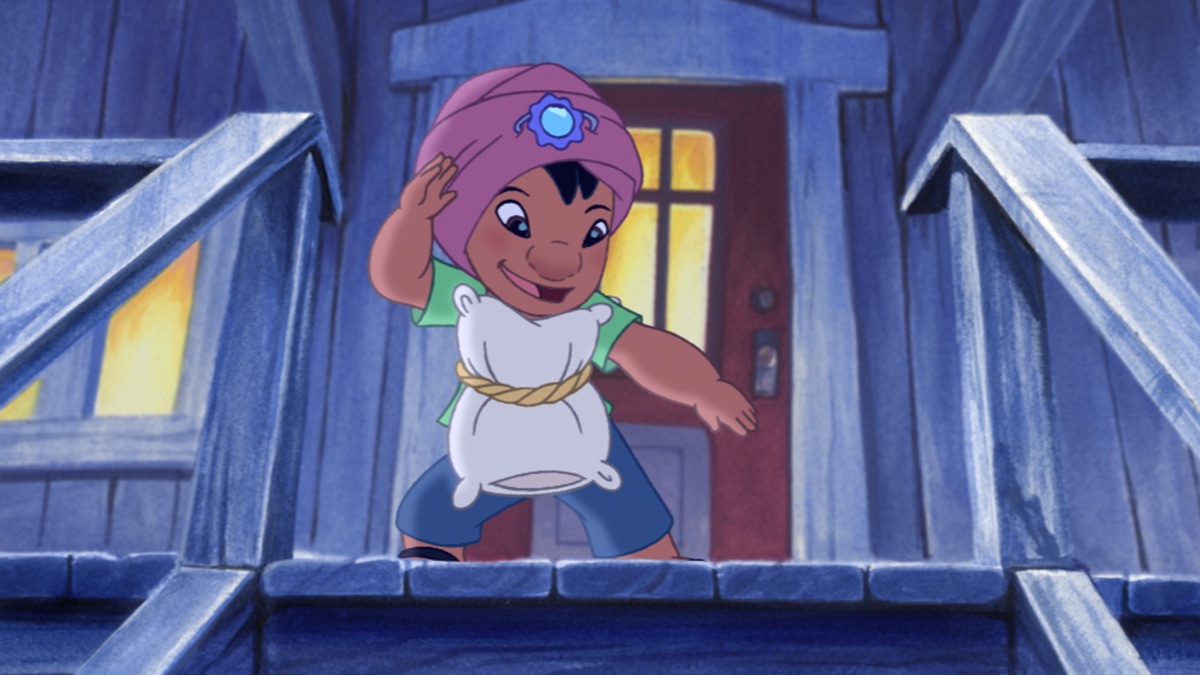
Lilo is tired of childhood rules. Experiment 089 lets her skip ten years at a time, and adulthood arrives with missing memories, unpaid tickets, a repossessed house, and Hämsterviel somehow running the world.
Lilo is tired of being told she is too young
Childhood in the Pelekai house includes rules, school, chores, adult decisions, and the constant experience of knowing more about alien experiments than the adults who still control where Lilo can go. Her frustration is not silly. Children can be capable in one area and still have limited legal power everywhere else.
The problem begins when she treats age as the only barrier between her and freedom. Growing older does not simply remove rules. It adds work, bills, consequences, care obligations, and choices that cannot be returned like a library book. Nobody has explained that without using adulthood as a threat.
Experiment 089 was invented because Jumba could not wait for leftovers
Skip was meant to move time forward briefly so Jumba could avoid waiting for food to heat. The programming error turns minutes into ten years. Jumba created temporal displacement because patience inconvenienced him, then lost the device on an inhabited planet. I need the Federation to put that sentence on every future sentencing document.
The absurd origin does not make the risk small. One press removes people from their communities for a decade, ages their bodies, and allows history to continue without them. A microwave shortcut becomes mass disappearance technology.
The button sits on Skip’s body, so pressing it requires consent
Lilo learns what the button does and uses it because the mechanism appears available. Skip’s body is not public equipment. He should understand the request, choose whether to participate, and have a reliable way to refuse without being grabbed or restrained.
Jumba also needs to know whether activation hurts, exhausts, or disorients him. A sentient experiment cannot be reduced to the function placed on his head. Even when Skip enjoys skipping, consent must cover the people traveling and the person whose body produces the effect.
A child cannot meaningfully consent to losing ten years
Lilo wants relief from current restrictions, but she cannot grasp every consequence of disappearing for a decade. She will lose school years, relationships, developmental experiences, medical care, memories, and the chance to influence what happens while she is gone. Her body may age even though her lived experience does not.
An adult should secure Skip immediately and explain the danger. This is not a decision that becomes safe after one warning. The device needs safeguards that make accidental or impulsive activation impossible.
Stitch goes with her because loyalty can still enable harm
Stitch stays beside Lilo when she presses forward. His presence gives her courage and physical protection, but it also makes the choice feel approved. Loyalty is not always agreement, and protecting a friend sometimes means slowing the plan before both people enter danger.
Stitch needs language for dissent that does not sound like abandonment. He can say he loves Lilo, understands why she wants escape, and will not help her erase ten years. Ohana should survive a boundary.
The first jump creates a teenager without an adolescence
Lilo arrives in a teenage body without the intervening years of learning, friendships, mistakes, schooling, and gradual change. Other people see an older person and expect skills her mind has never practiced. Appearance becomes a false credential.
She deserves support rather than ridicule. Driving, employment, consent, money, and independence require knowledge and context, not a taller body. The jump proves that maturity is not a costume time can drop onto a child.
Borrowing Nani’s dune buggy creates consequences that outlive the moment
Teenage Lilo uses Nani’s vehicle and accumulates parking tickets. The act feels temporary to Lilo because she expects another jump, but the fines remain in the timeline. Nani inherits debt for a decision she did not make and cannot explain.
Using another person’s vehicle requires permission, licensing, insurance, and responsibility for citations. Time travel does not suspend ownership. It makes accountability harder because the person who acted may disappear before anyone can confront the harm.
Lilo skips again because disappointment feels like proof she chose the wrong age
Adolescence does not provide the effortless freedom she imagined, so Lilo moves another ten years forward. She treats time as a menu where the next stage might finally contain a version of life without friction. The pattern resembles any escape mechanism that promises relief while increasing the cost.
A caring adult would help her tolerate disappointment long enough to learn from it. One difficult day at an age does not define that whole period. Growth needs time because adaptation is part of growth.
Adult Lilo has an adult body and a child’s missing history
At twenty-seven, Lilo is read as fully independent. Internally, she has lived only moments since childhood. She lacks the education, records, relationships, and practical knowledge expected from the face everyone sees. That mismatch makes her vulnerable to exploitation and disbelief.
Services would need to recognize temporal displacement as a condition requiring identity restoration, legal help, housing, medical evaluation, and trauma-informed support. Telling her to act her age would punish her for years she never experienced.
Twenty years pass for everyone who did not travel
Lilo experiences seconds while Nani, Jumba, Pleakley, the experiments, and the community live through two decades of absence. They grieve, search, adapt, age, and make decisions without knowing whether she will return. Time travel is not private when people love the traveler.
The episode centers Lilo’s shock, but Nani’s missing years matter too. She loses a child in her care without a body, explanation, or endpoint. That ambiguous loss would shape every day that follows.
The house is repossessed because unpaid debt keeps moving
The parking tickets contribute to the loss of the family home. The detail is comic in delivery and brutal in implication. A childhood escape produces a paper trail that compounds while the responsible person is absent. Nani is left to carry it.
A just system would provide notice, hearings, hardship relief, and investigation into an impossible disappearance before taking a home. Debt collection should not become the quiet mechanism that dismantles an already vulnerable family.
Nani ends up working for Hämsterviel
In the ruined future, Nani labors under the ruler who benefited from Lilo and Stitch’s absence. Her financial vulnerability becomes political vulnerability. She does what she must to survive after losing family, home, and the protection their experiment work once provided.
Lilo cannot reduce this outcome to “I should have stayed a child.” The future shows that individual choices interact with systems ready to exploit absence. Hämsterviel chooses domination; institutions fail to resist; Nani survives inside the result.
Without Lilo and Stitch, the experiment rescue network collapses
The pair disappear for twenty years, and nobody replaces their work catching and rehabilitating the cousins. Gantu captures experiments one by one while the community loses the relationships that turned powers toward care.
That exposes a dangerous dependency. Planetary safety should never rest on one child and one experiment. The Federation needs trained teams, records, equipment, humane placement capacity, and continuity plans for illness, travel, or loss.
Hämsterviel’s rule is a consequence, not destiny
The future is presented as what happens because Lilo leaves, but Hämsterviel still makes choices and others still fail or resist. Blaming Lilo alone would place a dictator’s responsibility on a child who pressed a button. Her absence creates opportunity; it does not morally author his regime.
The family can learn that their work matters without teaching Lilo that the world falls apart whenever she rests. Community resilience should distribute responsibility rather than turning a child into a permanent safeguard against catastrophe.
Stitch and Skip are captured because the future knows their value
Clink captures Stitch and Skip and delivers them to Gantu. Their powers make them strategic assets, and the regime treats personhood as inventory. Skip’s ability could change history, which makes controlling his body a route to controlling everyone else’s time.
Any rescue must prioritize preventing forced activation. Protective headgear, distance controls, and an agreed signal could help. Skip should never be punished for the danger other people create around his power.
Jumba knows there is a reverse function far too late
The discovery that Skip can return travelers to their starting point provides the escape. It also raises the usual Jumba question: why was the emergency control not explained before anyone touched the button? A reversible hazard still causes terror when the reversal is hidden.
Every experiment record needs activation, effects, range, duration, countermeasures, medical risks, and emergency controls. Jumba’s memory is not an acceptable database, especially when his memory tends to arrive after the family has lost two decades.
Returning to the present does not erase what Lilo learned
The ruined future disappears from the current timeline, but Lilo remembers Nani’s hardship, the captured cousins, and the world shaped by absence. Those memories may feel as real as any lived event. Temporal correction does not guarantee emotional correction.
She needs space to tell the story, sleep, check her body, and reconnect with Nani without being told nothing happened. Trauma can come from an event that no longer exists for anyone else.
The body needs a medical check after aging and reversal
Skip ages travelers ten years per jump and later returns them. Jumba should not assume every cell, medication, injury, or developmental process resets perfectly. Lilo’s human body and Stitch’s engineered biology may respond differently.
Medical evaluation should include memory, endocrine function, bone development, neurological status, and any residual effects. Skip needs examination too because he travels every time his power is used.
The timeline needs safeguards against duplicate records
A person who disappears for ten years may be declared missing, lose benefits, accumulate debt, and have property transferred. Returning as an older adult creates identity problems that no birth certificate anticipates. The reverse jump may restore the original timeline, but the family cannot depend on perfect erasure.
The Federation should provide temporal incident documentation and legal specialists. Nobody should lose housing, custody, or identity because an alien device moved them across a decade.
Skip’s one true place is still unresolved
The episode returns him to the present but does not establish a permanent role. A power this serious cannot live casually beside an unlocked button, yet indefinite isolation would punish Skip for Jumba’s design.
A humane placement needs protected controls, companionship, training, enrichment, and carefully supervised voluntary use. Scientific study may be appropriate only with Skip’s consent and independent oversight. He is not a shortcut machine for impatient adults.
The safest use of Skip may be almost no use at all
Some abilities do not need a productive community job. The series often searches for a function that makes each experiment useful, but Skip can belong without regularly moving anybody through time. Safety, relationships, and play are enough reasons for a life.
Emergency use could be considered under strict conditions, though every jump changes lives outside the traveler’s perception. Restraint can be a positive choice when power is enormous.
Lilo’s desire for adulthood deserves a better answer than fear
The episode teaches her to appreciate childhood by showing a nightmare future. Fear works, but it does not answer why she wanted escape. She still needs more voice in family decisions, privacy, meaningful responsibilities, and adults who respect her expertise without making her carry adult burdens.
Childhood can contain limits and dignity together. Nani can explain rules, invite negotiation where possible, and admit when Lilo has earned more trust. The answer to dangerous independence is supported agency, not permanent obedience.
What I would keep from Skip
I would keep the escalating jumps, adult Lilo arriving without the life that should have shaped her, the ruined future, and Jumba finally revealing the reverse control. The episode makes twenty years feel frightening because everybody else had to live them.
I would add Nani’s perspective, a medical recovery scene, and a permanent guard over Skip’s button. I would also make the Federation explain why a time-displacement experiment was ever stored in a pod that could land near a dog shelter.
RaeRae’s final verdict
“Skip” begins with a child tired of rules and ends with a repossessed house, an alien dictatorship, captured cousins, and Nani working off debts created while Lilo was technically twenty years away. Jumba made a time machine because he did not want to wait for leftovers. That man has never met a minor inconvenience he could not convert into planetary risk.
My verdict: Lilo deserves more agency now, not a stolen adulthood. Skip deserves consent, safeguards, and a life beyond his button. The household needs a continuity plan that does not make one seven-year-old responsible for preventing Hämsterviel from conquering Earth. Growing up is not the enemy. Missing the life that teaches you how to grow is.
Where to watch
Watch “Skip” through Lilo & Stitch: The Series on Disney+. Apple labels the story Season 2, Episode 6. CVM Sekai also records it as overall Episode 45 in the complete aired-order directory. Availability can change by region.
Keep exploring
Return to the episode directory or return to the Lilo & Stitch hub.