
EPISODE 38 · SEASON 1 · BAD STITCH · RAE RAE REACTS
Lilo & Stitch: The Series Episode 38: Bad Stitch
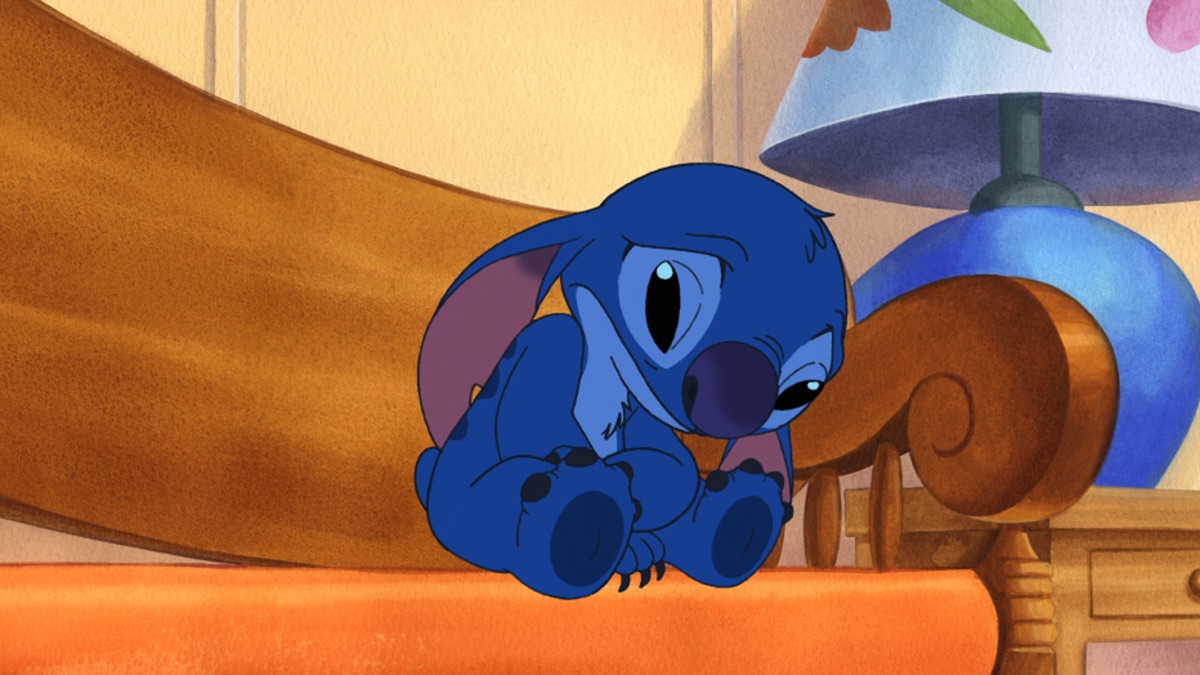
Nani cannot afford another broken thing. Lilo loses hula. Stitch decides his alien body has to earn enough money to keep his place in the family, and Hämsterviel is waiting to buy the guilt.
The bills make destruction visible in Nani’s hands
Stitch’s chaos often ends when the visual gag ends. Nani receives the invoices afterward. Broken property becomes money she does not have, phone calls she has to make, work hours she may lose, and another threat to the stability of the home she built around Lilo.
The episode is strongest when it refuses to treat repair as invisible. Love can absorb a person without absorbing unlimited financial damage.
Lilo loses hula because the household has to choose what gets paid
Nani cancels Lilo’s lessons for the month to cover destruction costs. Hula supports Lilo’s confidence, cultural connection, discipline, and place among other children. Calling it an optional activity misses what the loss means to her.
Lilo is punished by scarcity even though Stitch caused the bills. Nani is not trying to hurt her. She is making a painful choice inside a budget that leaves no gentle option.
The cancellation also threatens a routine that places Lilo with a teacher and peers outside the house. Losing that structure can deepen isolation precisely when the household is tense. Emergency assistance should protect the child’s stabilizing activities before every optional-looking line is cut from today’s budget.
Stitch hears behavior correction as a threat to belonging
Nani warns that continued destruction may mean giving him away. She needs a real boundary because the family cannot survive endless damage. Stitch hears that his home can disappear when he fails, which reaches the deepest fear created by abandonment and prior imprisonment.
A safety plan should separate permanent belonging from specific consequences whenever possible. “You are family, and this behavior must change” gives him a route forward without pretending the harm is small.
The title “Bad Stitch” compresses behavior into identity
Stitch does destructive things. Calling him bad can make every action look like proof of an unchangeable core. That is especially dangerous for a being designed as a weapon and repeatedly told that violence is his natural truth.
Accountability works better when it names the action, victim, cost, and repair. A person can cause serious harm without becoming only the harm.
A dog-training book cannot explain an engineered alien
Lilo tries to civilize Stitch through a training manual written for domestic animals. Routines and reinforcement may help, but the framework treats him as a pet rather than a speaking person with trauma, intelligence, and a combat design.
He needs collaborative goals, accessible rules, sensory supports, safe outlets for strength, and direct participation in the plan. Obedience alone will never equal moral growth.
Training under threat produces performance, not security
If Stitch believes one mistake will remove him from the family, he may comply while panic grows underneath. Fear can create short-term stillness and long-term secrecy. He may hide accidents, avoid asking for help, or choose dangerous shortcuts to prove usefulness.
Nani and Lilo should pair boundaries with predictable repair. Damage leads to stopping, checking for injury, cleaning up, contributing to restitution, and practicing a safer alternative.
Lilo becomes responsible for changing someone she did not create
Nani asks Lilo to train Stitch because their bond is strong. Lilo can help him understand household expectations, but she is still a child and cannot carry the full behavior plan, financial risk, or threat of placement loss.
Jumba created Stitch’s destructive capacities. The Federation placed him on Earth. Adults from both systems owe the Pelekais resources, not another assignment for Lilo.
Stitch’s failed attempts do not mean he refuses to care
The training does not immediately stop the damage. His body, habits, impulses, and environment were built around destruction long before he had a family. Change can be sincere and uneven at the same time.
The household should track triggers and progress instead of counting only failures. A reduced impact, a pause before acting, or asking for help can be meaningful evidence of learning.
Guilt sends Stitch looking for money instead of support
Stitch understands that bills threaten Lilo’s lessons and his place at home. He decides to earn money by revealing himself to a scientist seeking proof of alien life. The plan converts his body into the asset he believes the family needs.
A dependent family member should never feel required to sell access to his body to deserve housing. Financial repair belongs in a supported plan with Nani, not a secret transaction driven by shame.
The advertisement targets desperation
A scientist offering cash for proof of extraterrestrial life appears to solve the exact problem Stitch cannot otherwise fix. The offer rewards disclosure while hiding the risks of examination, captivity, publicity, and loss of control.
Ethical research recruitment must state procedures, risks, privacy, withdrawal rights, and independent contacts. A cash promise aimed at someone under financial pressure creates coercive leverage.
Stitch cannot provide informed consent to a hidden captor
He voluntarily goes to the appointment, but Hämsterviel conceals his identity and purpose. Consent obtained through deception is invalid because Stitch cannot evaluate the person, procedure, or consequences.
The correct response is immediate rescue, evidence preservation, medical evaluation, and trauma support. Nobody should describe the kidnapping as a foolish bargain that Stitch invited.
Hämsterviel weaponizes the identity Jumba installed
The reprogramming attempts to restore Stitch’s original destructive state. Hämsterviel treats violence as factory settings and relationship as a removable defect. The procedure attacks memory, agency, and the self Stitch built with Lilo.
This is neurological assault, not discipline. The fact that destructive programming existed first does not make it more authentic than the values he later chose.
A three-day furlough should not enable an abduction laboratory
Hämsterviel is outside confinement under a temporary release and quickly builds a scheme around Stitch. Any legitimate furlough should include location monitoring, restricted technology access, supervision, and immediate consequences for contacting prior targets.
The Federation’s oversight failure places a child and several protected experiments in danger. Institutional negligence cannot be blamed on Stitch’s decision to answer an advertisement.
Gantu getting fired reveals the employment structure underneath villainy
Hämsterviel dismisses Gantu, who then searches for work. The subplot is funny because an enormous alien hunter tries to translate military capture skills into ordinary employment. It also shows that their partnership is an exploitative job arrangement.
Gantu’s harmful choices remain his responsibility, but unstable employment and dependence on an abusive leader shape his options. A route out requires lawful work, housing, identity documents, and protection from retaliation.
Being useful is not the price of family
Stitch tries to repay damage because he fears being removed. Repair is important, yet belonging cannot depend solely on whether he produces enough money or perfect behavior. Families need boundaries and also room for members who cost more than they can repay.
Nani can require participation in cleanup and safer routines while affirming that placement decisions will involve conversation, support, and a genuine search for alternatives.
Lilo’s reminder reaches the self underneath the programming
When Hämsterviel orders Stitch to kill Lilo, Jumba, and Pleakley, Lilo speaks to the goodness he chose. She does not defeat the machine through technical control. She reminds him of relationship, memory, and the person he practiced becoming.
The moment rejects the idea that an imposed origin owns the future. Recovery still needs medical support because love should not be the only defense against neurological tampering.
Stitch resisting does not prove the procedure caused no harm
He turns against Hämsterviel, but the household cannot assume every altered command disappeared. Triggers, memory gaps, nightmares, aggression, sensory changes, or fear may surface later. Heroic resistance and injury can coexist.
Jumba should perform a consent-based examination while an independent clinician reviews his work. The creator of the original programming cannot be the sole authority on whether restoration is safe.
Nani deserves the truth without another crisis summary
Lilo may want to prove Stitch is good and move past the threat of separation. Nani needs the full sequence: the bills, failed training, secret research offer, kidnapping, reprogramming, and rescue. Partial information prevents her from protecting the household.
Truth should come with a support plan rather than another emergency dropped at her feet. Jumba and the Federation must share responsibility in the room.
The bills belong partly to Jumba and the Federation
Stitch caused damage, but Jumba designed a city-destroying body and the Federation sent the conflict to Earth. Nani should not carry every invoice because she offered sanctuary. External institutions created foreseeable costs.
A compensation fund should cover repairs, insurance increases, missed work, safety modifications, and treatment. It should not require Nani to surrender guardianship or expose Stitch publicly.
Hula lessons should be restored as part of restitution
Because Stitch’s damage displaced Lilo’s lessons, repairing the harm includes restoring that access. He can contribute through safe supervised work later, while the Federation provides immediate payment so Lilo does not wait for an intergalactic claim.
Restitution is most meaningful when it identifies the actual loss. Replacing a broken object while leaving Lilo isolated from hula would miss the consequence that hurt her most.
The household needs safe work options for Stitch
Stitch has strength, speed, mechanical skill, and the ability to perform tasks humans cannot. Employment must be voluntary, age and status appropriate, supervised, and separated from dangerous spectacle. Cash-for-alien-proof is exploitation, not work.
Possible roles could include rescue support, controlled demolition, heavy lifting, or experiment recovery under clear contracts. Pay should belong to him with an agreed contribution toward restitution, not be seized as family debt.
A behavior plan needs environments, not moral lectures
The family can reinforce furniture, lock hazardous equipment, create a safe destruction area, schedule physical activity, use visual reminders, and establish a calm-down route. Prevention respects everybody more than waiting for failure and assigning shame.
The plan should include Nani’s budget limits, Lilo’s need for childhood, and Stitch’s need for choice. Success is a safer home, not a quieter person at any cost.
What made me laugh
Gantu entering the ordinary job market after years of alien abduction has the résumé energy of “excellent at pursuit, less experienced with customer service.” Somewhere a hiring manager is trying to understand why plasma-cannon proficiency appears under soft skills.
Hämsterviel advertising himself as a normal scientist is also absurd because subtlety has never survived five seconds near that voice. Stitch walked into the only laboratory where the red flags had their own laboratory coats.
What made me mad
I get mad that Lilo loses hula because adults and institutions leave Nani alone with the bill. The child with the least power gives up the part of life that supports her confidence while Jumba still lives in the house with a laboratory.
I also get mad when Stitch’s guilt becomes a business opportunity. He is frightened that the family cannot afford him, and a predator offers money for his body. That is exactly when consent needs the strongest protection.
The response plan I wanted
Nani pauses nonessential repairs, contacts a Federation advocate, and restores Lilo’s hula through emergency assistance. Jumba creates a behavior and safety plan with Stitch rather than handing Lilo a pet-training book. The family agrees that no research offer is answered alone.
After abduction, Stitch receives independent medical care and counseling. Hämsterviel’s furlough is investigated, Gantu receives a lawful exit-employment referral, and the Federation pays the household’s documented costs.
The platform-order mismatch needs another receipt
CVM Sekai lists “Bad Stitch” as Episode 38 in original aired order. Apple currently labels the same story Season 1, Episode 35, while DVD listings place it elsewhere. The series continues to carry several incompatible sequences.
The title identifies the story because no new experiment is introduced. This React records Apple’s label while preserving one stable directory order.
The quiet scene I wanted
After the rescue, I wanted Stitch to bring Nani the advertisement and admit that he went because he thought money would make him safe to keep. Nani could apologize for how the warning landed without pretending the damage was sustainable.
Then they could write two promises: Stitch does not sell access to himself in secret, and the family does not discuss placement as punishment during a heated moment. Boundaries would remain, but fear would stop doing all the teaching.
The Episode 38 verdict
“Bad Stitch” understands that behavior problems become family economics. Nani cannot love away repair bills, Lilo loses hula, and Stitch concludes that his body must generate enough money to secure belonging. Hämsterviel exploits that guilt by attacking the identity Stitch chose after creation.
My verdict is pay Nani’s bills, restore Lilo’s lessons, give Stitch a real support plan, and investigate every official who approved Hämsterviel’s furlough. Destructive behavior needs repair. It does not make a person disposable.
Where to watch
Watch “Bad Stitch” through Lilo & Stitch: The Series on Disney+. Apple currently labels the same story Season 1, Episode 35, while CVM Sekai follows the original aired-order directory and uses Episode 38. Availability can change by region.
Keep exploring
Return to the episode directory or return to the Lilo & Stitch hub.