
EPISODE 37 · SEASON 1 · SLUGGER · RAE RAE REACTS
Lilo & Stitch: The Series Episode 37: Slugger
Lilo wagers Elvis, Mertle changes the sport, Gantu joins a children’s team, and Experiment 608 gets treated like a transferable bat before anybody asks whether he wants to play.
A neighborhood game becomes a referendum on humiliation
Lilo’s team loses badly to Mertle and the hula girls, with Pleakley absorbing much of the blame. Losing can be ordinary, but the social history between Lilo and Mertle makes the score feel like evidence about who deserves respect. The rematch becomes emotionally larger than softball.
A child who already expects ridicule may chase a win to repair dignity. That pressure makes reckless wagers and shortcuts feel reasonable even when the game no longer feels fun.
Pleakley is treated like the problem instead of a beginner
Pleakley lacks softball skill, and the team experiences his mistakes as sabotage. Nobody pauses to ask whether he learned the rules, practiced safely, chose the position, or has coordination needs shaped by an alien body. Failure becomes a personality judgment.
A team can want competent play without humiliating a novice. Coaching, adjusted positions, and honest substitution protect both performance and dignity.
Pleakley also deserves to know whether the team wants him there as a friend or merely tolerates him until someone stronger appears. Belonging that disappears after one bad inning was never secure enough.
Lilo wagers the Elvis records because pride wants collateral
Lilo puts her Elvis collection against Mertle’s dolls for the rematch. The records hold personal history, comfort, taste, and connection to the family she misses. They are far more than objects with a resale value.
Children should not be pressured into wagering treasured possessions to prove confidence. The size of the stake does not make the game braver. It makes the emotional consequences less proportionate to a playground score.
Mertle’s dolls are personal too
The episode centers Lilo’s fear of losing Elvis, but Mertle’s collection also carries attachment. Her antagonism does not make her belongings meaningless. A fair analysis refuses to decide that one child’s fandom is profound while another child’s is shallow.
Both collections should stay home. A rematch can have a playful trophy, snacks, or the right to choose the next game without gambling identity objects.
Slugger activates inside sports equipment
Experiment 608’s pod is mixed with softballs and lands in melting ice after a coach throws it aside. Once again, alien containment has entered an ordinary public setting where nobody can identify the hazard. The coach’s reasonable disposal action triggers a living weapon.
The Federation owes parks and leagues scanning equipment, emergency guidance, and a recovery team. Children should not discover Jumba’s project during practice.
His first instinct is deflection because Jumba wrote it into him
Slugger uses a bat-shaped tail to strike incoming objects. He deflects balls, coconuts, and later much larger threats with extraordinary precision. The ability looks perfectly made for softball because both environments reward contact with a projectile.
The resemblance does not mean he was born to entertain a team. Jumba designed battlefield defense. Slugger deserves the choice to play after he understands the game and the risks.
The dog waiting for a ball becomes accidental collateral
Slugger swats away a ball before a dog can retrieve it, showing how automatic deflection interrupts ordinary relationships. He is not attacking the animal. He is responding to motion according to a purpose installed before he had context.
Safe integration requires teaching him which incoming objects belong to play, work, danger, or somebody else. Precision is useful only when judgment has time to join it.
Gantu calls Slugger weak because he measures strength one way
Gantu grabs the small experiment and dismisses him as weak when he struggles. Size and direct grappling power become Gantu’s entire evaluation. Later, Slugger moves a basketball pole and launches Gantu across an enormous distance.
Capability depends on the task. A person can need help escaping a grip and still possess remarkable force, accuracy, flight, or tactical value. Vulnerability and strength can share one body.
Lilo earns trust before she assigns a position
Lilo calms Experiment 608 and promises protection. That moment helps him move from alarm toward relationship. The ethical problem begins when rescue slides immediately into roster planning for a game carrying Lilo’s private wager.
She should separate sanctuary from performance. Slugger needs food, safety, explanation, and time before anyone asks him to solve the team’s losing problem.
A player is not equipment even when his tail resembles a bat
The team sees a perfect hitter and treats his function as the missing sports tool. Slugger is a participant with preferences, fatigue, fear, and the right to stop. He cannot be passed around like a special bat that guarantees runs.
Consent should include rules, practice, protective gear, who may touch him, and what happens if Gantu appears. A grunt or gesture can communicate agreement when teammates take time to learn it.
Mertle changes softball to basketball to remove the advantage
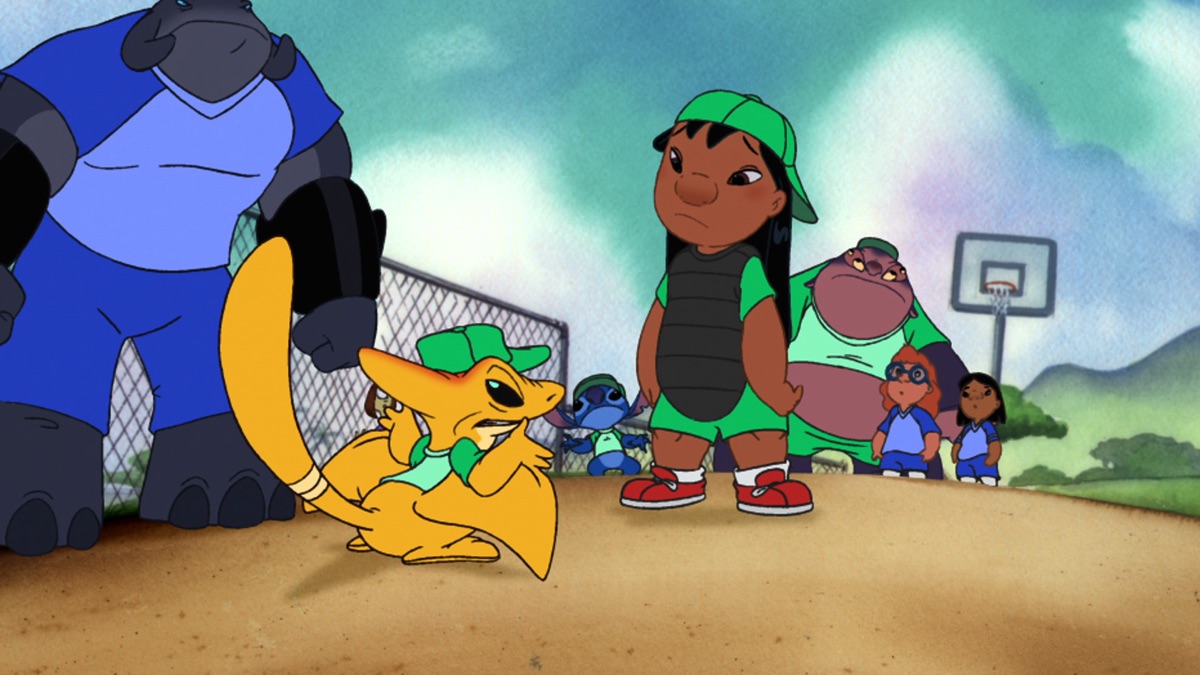
After seeing Slugger’s batting ability, Mertle switches the rematch to basketball and adds Gantu to her team. The change is clever gamesmanship and a breach of the original agreement. It targets a player whose body is specialized for hitting rather than catching, kicking, or throwing.
Rules cannot remain fair if one side rewrites them after scouting the opponent. Any change needs mutual agreement, time to practice, and a chance to revise the wager.
Adding Gantu to a children’s team destroys proportionality
Gantu is an armed adult-sized alien hunter with a history of abducting experiments. Placing him in a children’s basketball game is unsafe regardless of whether he follows the scoring rules. His presence creates intimidation before he touches the ball.
A responsible referee would stop play, remove weapons, verify eligibility, and protect Slugger from capture. Competitive drama cannot replace safeguarding.
Slugger struggling at basketball is not failure
His body is built around deflection. Basketball demands catching, dribbling, passing, controlled possession, and shooting. Difficulty in the new sport reveals a mismatch between task and design rather than a lack of effort or worth.
Good teams adapt roles without pretending every player must perform every skill. Slugger could screen safely, redirect passes under agreed rules, or support from the sideline if he prefers.
Pleakley finally becomes valuable when the task fits him
Pleakley, blamed for the softball loss, proves unexpectedly talented during basketball. The reversal is satisfying because it shows that poor performance in one role cannot define total ability. He did not become worthy between games. The environment finally revealed a strength.
The team owes him an apology that names the earlier ridicule. Winning with his help should not erase how quickly they treated him as dead weight.
Stitch helps win without making Slugger disappear
The basketball victory depends on Stitch and Pleakley while Slugger adapts to a sport that does not favor him. That team outcome is healthier than forcing Experiment 608 to carry every point. It distributes value across different bodies and skills.
Slugger can belong even when he is not the star. Inclusion should survive the moment a specialized advantage stops producing wins.
The wager expands to include Slugger himself
Mertle adds Slugger to the stake, treating a living experiment as transferable property. Lilo’s willingness to continue places his future inside a bet he did not design. No child can wager another person, even when trying to protect that person from Gantu.
The game should end the moment a participant becomes collateral. Slugger chooses where he lives and plays.
Gantu refuses the result because capture was the real objective
After losing, Gantu tries to take Slugger anyway. His behavior proves that the game was never a legitimate route to custody. Competition was camouflage for abduction, and defeat removes the thin layer of sportsmanship.
The children need adult protection and a secure exit. Nobody should negotiate another round with a captor who rejects every condition that limits him.
A basketball pole becomes a weapon because escalation keeps winning
Gantu rips out a goal structure and prepares to retaliate. Stitch responds, then allows Slugger to strike Gantu away with the pole. The scene converts sports equipment into battlefield hardware and places children close to lethal force.
Emergency defense may be necessary, but the field needs evacuation, medical checks, structural inspection, and accountability for whoever allowed an armed hunter into the game.
Slugger’s one true place should be chosen, paid, and supervised
He becomes a coaching assistant for a Little League softball team. The setting fits his joy in hitting and allows his precision to teach rather than defend against attacks. It also creates responsibilities toward children standing near incredibly powerful deflections.
The league needs consent, compensation, rest, insurance, safe cages, distance rules, and a coach trained to communicate with him. Calling the field home cannot turn endless labor into the price of belonging.
Sports access requires communication beyond speech
Slugger communicates through snorts and grunts. Coaches and players need consistent signals for yes, no, stop, pain, tiredness, danger, and preferred drills. A whistle alone may be inaccessible or confused with an incoming-object cue.
Communication support is part of athletic safety. Teammates should learn his language rather than expecting him to imitate theirs.
His projectile reflex needs strong field boundaries
A ball flying toward a spectator, animal, vehicle, or player may trigger automatic contact. Deflection can redirect danger into another direction if the field is not controlled. The later pitching-machine incident proves that perfect contact can still create chaos.
Practice needs netting, marked zones, controlled feeds, spotters, and a stop protocol. Power does not remove the need for environmental design.
The coach who activated him becomes part of the repair
The Little League coach discarded the unfamiliar pod without knowing what it was and later benefits from Slugger’s skills. He is not morally responsible for the alien activation, but he now has a duty to protect the person whose life changed on his field.
That duty includes learning Experiment 608’s needs, refusing exploitative publicity, and keeping the league from treating him as a permanent competitive advantage.
Children deserve sport without social warfare
Lilo and Mertle use teams to continue a personal conflict. Teammates become supporting characters in their rivalry, and the wager turns every error into a threat to somebody’s treasured collection. That atmosphere teaches fear rather than play.
Adults should reset the league around safety, skill growth, mixed practice, and consequences for harassment. Competition can remain intense without making one child’s humiliation the prize.
What made me laugh
Mertle sees a tiny alien with a baseball-bat tail and responds by changing the entire sport. I respect the tactical panic even while rejecting the contract law. She did not come to negotiate with nature.
Pleakley becoming the basketball solution after being blamed for softball also feels correct. He spent one game looking like a liability and the next like he had been waiting his whole intergalactic life for a layup.
What made me mad
I get mad when Slugger becomes part of the wager. Everybody talks about keeping him safe while deciding who gets him based on a children’s score. Protection without his voice becomes another form of possession.
I also get mad at the Elvis-versus-dolls bet. Both girls attach identity to their collections, then make loss the proof of courage. Somebody should have brought orange slices and ended the economic sanctions.
The response plan I wanted
The rematch keeps its original sport and removes personal collections from the wager. Slugger receives an independent explanation and chooses whether to join. A neutral adult confirms roster rules, safety equipment, and a plan for Gantu before play begins.
When Mertle proposes basketball and adds Gantu, the event pauses for a new agreement. Slugger cannot be wagered. If Gantu attempts capture, adults evacuate the children and contact Federation security.
The platform-order mismatch needs another receipt
CVM Sekai lists “Slugger” as Episode 37 in the aired-order directory. Apple currently labels the same story Season 1, Episode 34. DVD and streaming placements differ again because the series has several competing sequences.
The title and Experiment 608 identify the story. This React preserves Apple’s current label while the directory remains stable.
The quiet scene I wanted
After the game, I wanted Pleakley and Slugger alone on the field. Pleakley could admit that being mocked for the wrong sport hurt, then ask Slugger whether he actually enjoyed the day or only liked the moment everybody cheered.
Slugger could choose one simple signal for yes and another for enough. A real team begins when applause is no longer the only language anyone understands.
The Episode 37 verdict
“Slugger” uses sports comedy to show how quickly talent becomes ownership. Experiment 608 is rescued, recruited, wagered, neutralized by a rule change, and nearly abducted before anyone gives his preference enough room. Pleakley’s basketball redemption supplies the episode’s best correction: a bad fit is not a worthless person.
My verdict is return the Elvis records and dolls to their shelves, remove Gantu from youth sports forever, and let Slugger choose a safe coaching role with pay and boundaries. A player belongs to himself before he belongs on any roster.
Where to watch
Watch “Slugger” through Lilo & Stitch: The Series on Disney+. Apple currently labels the same story Season 1, Episode 34, while CVM Sekai follows the aired-order directory and uses Episode 37. Availability can change by region.
Keep exploring
Return to the episode directory or return to the Lilo & Stitch hub.