
EPISODE 4 · SEASON 1 · MR. STENCHY · RAE RAE REACTS
Lilo & Stitch: The Series Episode 4: Mr. Stenchy
Everybody loves the cute cousin until his body becomes inconvenient, and Stitch nearly trades family for reassurance.
The episode starts with weaponized cuteness
Mr. Stenchy is designed to be irresistibly adorable for a limited period before releasing an unbearable odor. Jumba created a social trap. People lower defenses, form attachment, bring the experiment into protected spaces, and then the body turns proximity into punishment. Cuteness is not personality here. Cuteness is part of the mechanism.
That design makes the episode funnier and meaner than a basic stink bomb story. Everybody believes affection arose naturally. Jumba knows the attraction has been engineered. The countdown turns love into a test: who stays when the trait that opened every door becomes the reason everybody wants the cousin gone?
Lilo sees a cousin before the smell arrives
Lilo responds to the small creature with immediate care. Her attachment fits the rescue mission and her habit of recognizing family where others see a specimen. She names Experiment 254 Mr. Stenchy before the name becomes accurate, accepting Jumba’s warning while still enjoying the sweet phase.
The name is affectionate and predictive at once. Lilo does not pretend the body will remain convenient. That knowledge should help her plan accommodation. Instead, the episode lets urgency arrive with the odor because foreknowledge rarely produces an actual household protocol.
Everybody wants access to the cute body
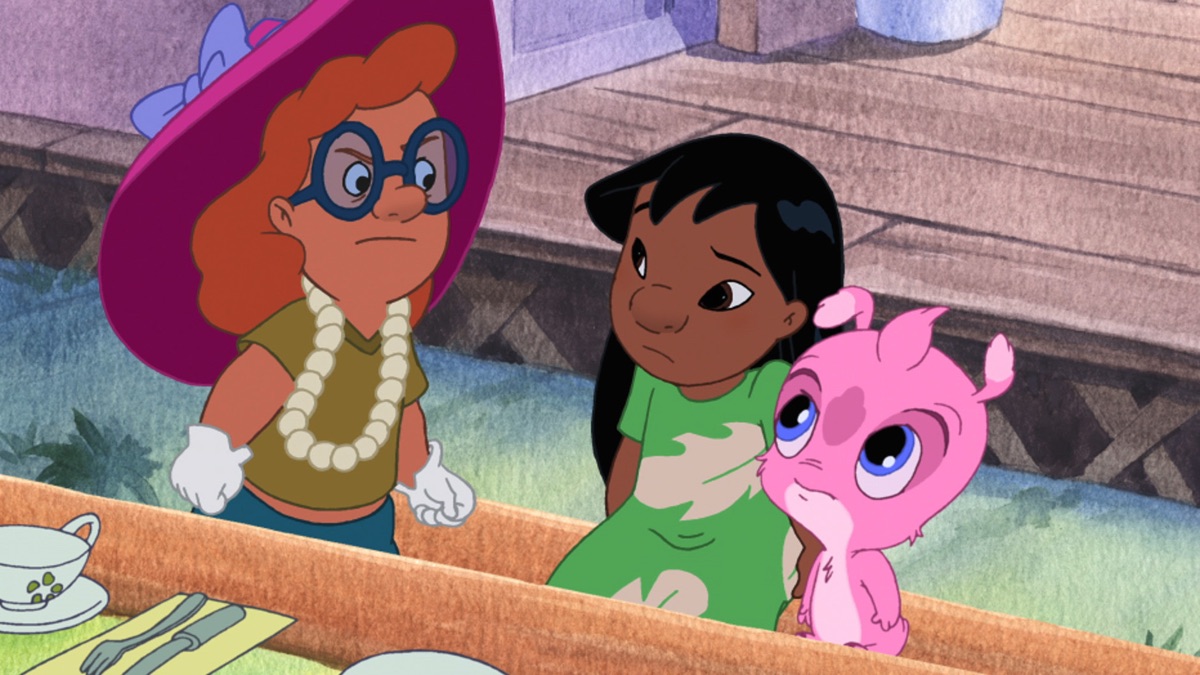
Mertle and the hula girls suddenly include Lilo because they want proximity to Mr. Stenchy. Their affection creates a social invitation Lilo has repeatedly been denied. The cousin becomes a ticket into the group, which means Lilo’s belonging depends on bringing something desirable.
That arrangement is painfully familiar. A lonely child may accept conditional inclusion because temporary warmth feels better than open rejection. The episode lets Lilo enjoy the invitation without fully confronting what the girls are purchasing from her. They are not repairing their relationship with Lilo. They are renting access to cuteness.
The tea party is social currency with tiny sandwiches
The Future Hawaiian Girls of Hawaii tea party represents the polished world Mertle controls. Manners, appearance, invitations, and group approval decide who belongs. Mr. Stenchy enters as the perfect accessory because everybody can perform tenderness around him while reinforcing the hierarchy that excluded Lilo.
Lilo’s presence could have disrupted the room in a good way. Instead, the invitation remains tied to the creature she brings. Hospitality looks generous while the terms stay narrow. One bad smell can reveal whether the welcome ever reached her.
Stitch is jealous because replacement is his oldest fear
Stitch watches attention move toward a newer, smaller, more immediately lovable experiment. His jealousy can look selfish, especially when Mr. Stenchy has done nothing to harm him. The reaction comes from a creature whose earliest relationships involved capture, rejection, and conditional survival. Being chosen still feels fragile.
Lilo’s family promise changed his life, but one promise does not erase attachment fear. He needs reassurance that family expands without replacing him. He also needs responsibility for what jealousy makes him do. Trauma explains the alarm. Trauma does not excuse handing a vulnerable cousin to Gantu.
Letting Gantu capture Mr. Stenchy is a betrayal
Stitch allows the capture because removing the rival appears to restore his place. The choice transforms jealousy into action against somebody dependent on the family’s protection. Mr. Stenchy becomes collateral in an attachment crisis he did not create.
This moment matters for Stitch’s development. He has learned that nobody gets left behind, then decides one cousin can be left behind when belonging feels scarce. The episode tests whether ʻohana survives competition for affection. Stitch fails first and has to choose differently afterward.
Lilo’s attention is not a finite resource
Children and adults can feel love as though every new relationship reduces an existing share. Stitch reads visible attention as measurement. Mr. Stenchy receives cuddles, praise, and fascination, so Stitch assumes his own value has dropped. The household needs language for additive attachment before a crisis teaches the lesson through danger.
Lilo can love a new cousin and maintain her bond with Stitch. She also has limits, time, and needs. Reassurance should not require her to perform endless proof whenever he feels threatened. Family security grows through repeated reliability from everyone, not one child managing every alien’s attachment system.
Gantu’s tenderness is the surprise with receipts
Gantu captures experiments as assets for Hämsterviel. Mr. Stenchy’s cuteness breaks through the professional shell and produces genuine affection. The reaction is funny because his size, armor, voice, and usual aggression contrast with softness. The reaction also proves cruelty never consumed every capacity for care.
One tender response does not erase abduction. The scene opens a character door instead. Gantu can recognize vulnerability when emotional defenses collapse. Later stories can ask why he extends that recognition selectively and why obedience keeps overpowering the better instinct.
Engineered affection is ethically creepy
If Mr. Stenchy’s design compels people to adore him, how much of their response counts as free choice? The experiment may experience genuine connection built on an effect nobody can resist. When the effect fades or the odor overwhelms attraction, the social world changes without him choosing the transition.
A created person should not have to wonder whether every cuddle belongs to the relationship or the program. The franchise could have explored that loneliness deeply. The comedy carries the outline: instant popularity can be another form of isolation when nobody sees beyond the trait causing attention.
The smell is a body change, not a moral failure
Jumba warns that the odor will emerge on schedule. Mr. Stenchy does not choose poor hygiene, malicious behavior, or a disgusting personality. The body changes because the body was designed to change. Rejection therefore targets a condition rather than conduct.
That distinction matters. People can need distance, ventilation, masks, or other safety measures without treating the person as shameful. Accommodation protects community and dignity together. Throwing the cousin away because proximity becomes difficult repeats the exact abandonment story ʻohana claims to reject.
Cuteness was never proof of goodness
The hula girls adore Mr. Stenchy before learning anything about his choices. Visual appeal becomes a shortcut to innocence. Stitch, who arrived destructive and visibly strange, had to fight for every piece of trust. The contrast exposes how appearance shapes who receives patience.
Mr. Stenchy deserves care, but care should not depend on being cute. Richter deserved care while splitting ground. Phantasmo deserved care while possessing objects. Clip deserved care while eating hair. Personhood cannot wait for a face the group wants to photograph.
Disgust is powerful and not morally neutral
Odor triggers physical reaction before careful thought. People may gag, retreat, or become overwhelmed. Those responses can be involuntary. What happens after the reaction becomes a social choice. Mockery, isolation, and abandonment add judgment to sensory discomfort.
The episode uses disgust for broad comedy because visual recoil and panic land quickly. A deeper reading asks whether anybody helps Mr. Stenchy understand what happened. Imagine waking as the center of affection and then watching every face turn away on the same day.
The household needs an accommodation plan
Jumba knows the timeline and should prepare ventilation, safe outdoor space, washable materials, protective equipment, and a way to communicate with Mr. Stenchy before the change. Nani should receive warning before another experiment affects the home. Lilo and Stitch should know how to help without exposing others.
Preparation would not remove the story. Gantu can still capture him. Stitch can still feel jealous. The tea party can still collapse. Planning would shift the crisis from ignorance to relationship, which gives the characters more interesting choices than running from the smell.
The one true place risks becoming exile
A placement built around the odor can be clever if Mr. Stenchy chooses a role where the trait helps repel threats, protect crops, manage pests, or support another safe function. The same placement becomes exile when the community sends him far away so nobody has to accommodate his body.
Distance can be chosen comfort. Isolation can be imposed rejection. A montage may look identical from far away. The ethical difference lives in consent, companionship, access to family, and the right to return when circumstances change.
Stitch has to repair more than the capture
Rescuing Mr. Stenchy addresses immediate danger. Stitch also owes an apology for allowing capture and treating the cousin as competition. The apology should name jealousy without making Mr. Stenchy responsible for reassuring him. Repair belongs to the person who acted.
Lilo can support the conversation while refusing to become mediator for every alien conflict. Jumba should help create attachment support because his experiments arrive with needs shaped by design and abandonment. Family cannot keep outsourcing emotional infrastructure to one child.
Mertle’s invitation reveals the social rule
Mertle welcomes Lilo when Lilo possesses something the group wants. Once Mr. Stenchy becomes inconvenient, the welcome can disappear. That pattern tells Lilo exactly how conditional the group remains. Access is not acceptance.
The episode could have let Lilo name the difference clearly. She does not need Mertle’s tea party to prove worth. She does need peer relationships that do not require entertainment, novelty, or self-erasure. Mr. Stenchy accidentally exposes a contract nobody admitted existed.
What made me laugh
Gantu melting over a tiny creature is excellent because tenderness lands harder when the character spends every other scene performing authority. Stitch sulking while everybody coos around the newcomer also produces recognizable sibling comedy. The looming odor gives every affectionate moment a countdown the audience can enjoy before the room catches up.
The joke works because the episode understands contrast. Huge characters become soft. A sweet creature becomes unbearable. A formal tea party becomes sensory chaos. Jumba, the one person with advance knowledge, remains emotionally underprepared.
What made me mad
Stitch lets Gantu take a cousin because jealousy convinces him that love can be restored through removal. The act hurts because he knows capture fear personally. Trauma can make people repeat the harm they survived when safety feels scarce. That truth is understandable and still infuriating.
The adults also fail the body-change test. Jumba warns without building support. The social group loves presentation instead of personhood. Everybody reacts to odor as though Mr. Stenchy chose betrayal. RaeRae would like one family meeting before the next genetic countdown.
The episode accidentally talks about conditional love
Mr. Stenchy receives affection while meeting everyone’s preferred sensory and visual conditions. When the conditions change, family and friendship have to become intentional. Conditional love says “stay lovable in the way I recognize.” Durable care says “your needs changed, so the relationship has to learn.”
Stitch faces the same lesson from the opposite side. Lilo’s new affection does not cancel him. Mr. Stenchy’s difficult body does not cancel belonging. Both characters need proof that family can survive comparison and inconvenience.
The Episode 4 verdict
“Mr. Stenchy” uses a giant smell joke to expose how quickly people confuse cuteness with goodness and convenience with worth. Stitch’s jealousy gives the episode emotional bite. Gantu’s tenderness gives the villain dimension. The tea party makes Mertle’s conditional inclusion visible.
My verdict is affectionate and suspicious. Protect the tiny cousin. Reassure Stitch without excusing betrayal. Ventilate the entire island. Send Jumba the cleaning invoice. Most importantly, do not call a remote placement “perfect” until Mr. Stenchy gets a vote and regular transportation back to the family.
The quiet aftermath I wanted
Mr. Stenchy should receive one scene where somebody stays nearby with proper protection and explains that the odor changed access, not love. Stitch should apologize without expecting immediate forgiveness. Gantu should sit with the uncomfortable fact that he cared about a prisoner.
Then Lilo should decline any future invitation based on bringing a cute accessory. Tea tastes better when nobody has to rent a family member for admission.
Sensory limits do not make somebody cruel
Some family members may genuinely be unable to remain close during the odor phase. Sensory overload, nausea, breathing problems, work duties, and shared housing create real limits. Respecting Mr. Stenchy does not require everybody to ignore physical needs or pretend accommodation has no cost.
Care becomes creative when limits receive honest language. People can visit outdoors, use protective equipment, improve ventilation, rotate support, and maintain contact from a workable distance. Shame says the body makes him unwanted. Accommodation says the relationship is important enough to redesign.
Popularity is a terrible intake assessment
The hula girls decide Mr. Stenchy belongs because they enjoy him immediately. Gantu softens because attraction bypasses his defenses. Neither reaction tells us whether the environment is safe, whether the cousin understands the attention, or whether affection will survive change. Popularity measures other people’s pleasure, not wellbeing.
Lilo’s rescue system should strongly resist that shortcut. A less cute cousin deserves the same patient intake. A popular cousin still needs privacy, consent, and protection from becoming a communal accessory. The family standard has to begin where the applause ends. Cuteness cannot become a temporary visa for belonging.
Where to watch
Watch “Mr. Stenchy” through Lilo & Stitch: The Series on Disney+. Availability can change by region.
Keep exploring
Return to the episode directory or return to the Lilo & Stitch hub.