
EPISODE 1 · SEASON 1 · RICHTER · RAE RAE REACTS
Lilo & Stitch: The Series Episode 1: Richter
The ground is splitting, the child has no field team, and Pleakley brought an earthquake-safety presentation to a galactic negligence problem.
The series opens by making the island crack
“Richter” does not ease us into the television formula with a harmless cousin and a tidy lesson. The ground moves. Homes, roads, caves, and everybody standing on them become vulnerable before Lilo and Stitch understand the cause. That choice announces the scale problem immediately. Jumba did not misplace quirky pets. He stored hundreds of designed disasters in objects that activate around water on a tropical island.
I laughed at the absurdity and then my brain got stuck on the liability. Nobody built an activation map. Nobody warned residents. Nobody prepared shelters for experiment-specific threats. Pleakley produces earthquake education because the household keeps solving galactic negligence with crafts, panic, and whatever supplies happen to be nearby. The comedy works because the safety plan is offensively late.
Welcome to the unpaid rescue department
Lilo and Stitch enter the series with a mission nobody properly staffs. The Federation has ships, weapons, scientists, records, and jurisdiction. Lilo has a child’s bicycle, local knowledge, stubbornness, and the emotional burden of believing every experiment can become family. Guess who performs field operations.
The pilot movie creates the problem. “Richter” normalizes the workload. One activated cousin can split the planet, Gantu wants the same target, and the adults still allow the child to descend underground. RaeRae is already looking around the room for one qualified risk assessor who did not arrive in a wig.
Pleakley’s safety lesson is funny until the danger becomes real
Pleakley approaches earthquake preparation with the confidence of somebody who researched Earth from a desk and now needs every resident to admire the binder. His information has practical value. The performance also reveals how institutions love education when education lets them avoid fixing the source of danger. Residents learn to brace while Jumba’s creation continues producing seismic force beneath them.
Preparedness and prevention should work together. Teaching people what to do during an earthquake does not excuse the person who knows a sentient earthquake generator may be loose. The episode plays that mismatch for speed, but the mismatch becomes the entire series in miniature: local people adapt while galactic adults improvise.
Richter is born into blame
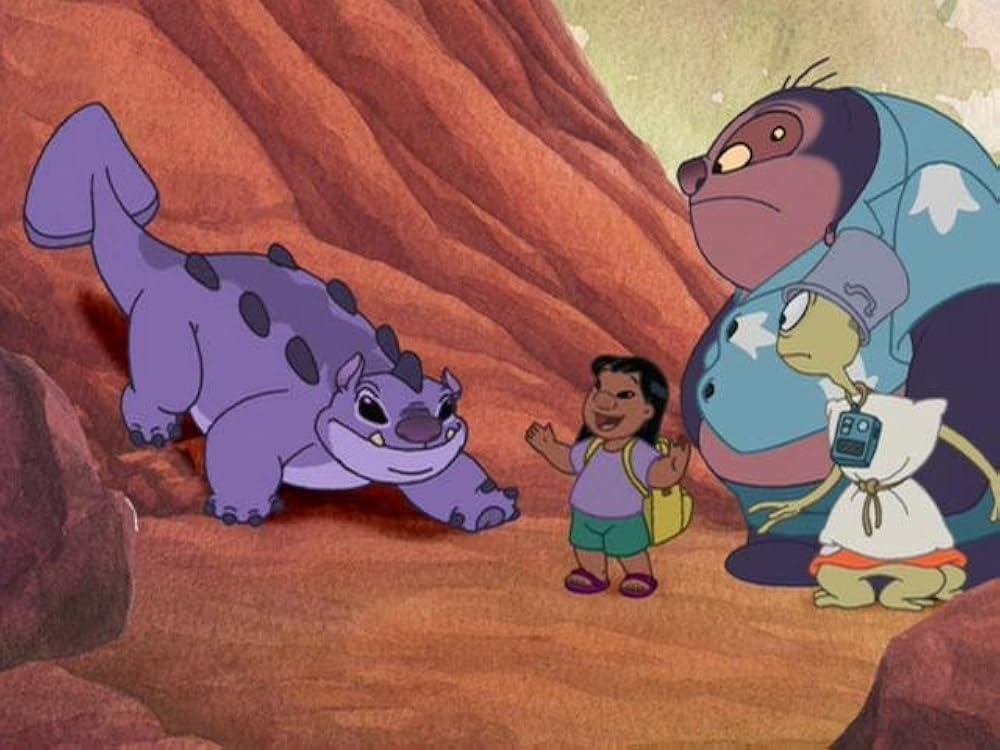
Experiment 513 activates and immediately performs the behavior built into his body. Nobody explains where he is, why he was stored, who Jumba is, or what a community expects. The first relationship he experiences is pursuit. When the ground shakes, the damage is real. The moral picture remains incomplete if we treat design compulsion as a personality verdict.
Richter needs containment because lives are at risk. He also needs orientation, control, and a future not defined by the worst possible use of his claws. Lilo sees that second need faster than the adults. Her gift is refusing the false choice between public safety and personhood.
Stitch has to meet his own origin from the outside
Every cousin forces Stitch to look at another version of engineered destruction. He already knows what humans see when they look at dangerous design because the Galactic Council sentenced him before Lilo offered a home. Now he stands on the rescue side and must decide whether fear makes him repeat the same treatment.
Richter’s power is less socially charming than Stitch’s. Earthquake damage cannot be hidden inside one broken kitchen. That severity tests whether Stitch’s empathy survives when the cousin’s body threatens his new home. The episode becomes stronger when read as recognition rather than monster hunting.
The cave turns power into atmosphere
Moving the pursuit underground gives Richter’s ability weight. Every vibration travels through rock. Escape routes narrow. The ceiling becomes a threat. Stitch cannot solve the crisis through ordinary strength because hitting harder may increase collapse. The environment forces him to protect rather than dominate.
The television animation has limited time, yet the cave does useful thematic work. Richter’s body and the island’s geology meet in one dangerous system. A power never exists in abstraction. Context decides whether a vibration becomes demolition, disaster, communication, or something a community can use safely.
Gantu treats the crisis as inventory recovery
Gantu wants the experiment because Hämsterviel wants assets. Planetary danger does not alter the command structure. Capture remains the metric. His behavior looks ridiculous beside the shaking ground, which is exactly why the villain relationship works. Obedience has narrowed his moral field until completing the assignment matters more than understanding the consequence.
The series will spend time making Gantu funny, frustrated, cruel, lonely, and increasingly trapped. “Richter” starts that journey with a clean contrast. Lilo asks where the cousin can belong. Gantu asks how the cousin can be delivered. One question imagines a person. The other preserves a supply chain.
Reuben watches potential become somebody else’s emergency
Experiment 625 has powers close to Stitch’s and refuses to become the efficient weapon Gantu keeps demanding. His sandwich obsession reads as laziness during the chase. I keep seeing a created being who understands that demonstrating usefulness only invites more commands. The kitchen becomes his tiny zone of control.
Richter has no such buffer. Activation throws him directly into his designed function. Placing 625 beside the crisis quietly shows two responses to instrumentalization: uncontrolled performance and stubborn refusal. Both come from a universe that keeps describing bodies according to what owners can obtain from them.
Lilo believes naming can interrupt destiny
The name Richter turns Experiment 513’s seismic ability into something the family can call. The choice is an earthquake reference, direct and slightly obvious, because Lilo often names from the crisis at hand. The ritual still matters. A number becomes a relationship address.
Naming alone cannot create autonomy. Lilo also has to find a placement and build trust. The series sometimes rushes those steps into one ending. Here the name operates as the first refusal of Jumba’s catalog language. Richter can carry his origin without remaining only an entry in the origin ledger.
The one true place is clever and ethically messy
Richter’s ability can support controlled demolition and construction work when everybody understands the power, creates boundaries, and chooses the task. Redirecting a destructive capacity toward a socially useful role gives the episode its satisfying close. The town gains help. Richter gains a visible place.
The unanswered questions arrive immediately. Did Richter choose the work? Who pays him? Who sets blast limits? What happens when he wants a day off? Does the job include training and protective equipment? “One true place” sounds less romantic when the place resembles permanent hazardous labor assigned on the first day of consciousness.
A job cannot be the entire rehabilitation plan
Work can provide routine, skill, pride, community, and economic independence. Work can also become a condition of acceptance. Richter receives approval because his dangerous body becomes useful. That resolution risks teaching every cousin that family requires converting damage potential into public service.
I want a second scene after the montage. Let Richter eat, play, choose a room, meet neighbors, and discover one interest unrelated to earthquakes. A life needs dimensions that do not benefit an employer. The series has enough heart to imagine those dimensions, even when episode runtime does not show them.
The episode formula arrives fully assembled
Activation, chaos, Jumba’s explanation, Gantu’s pursuit, Lilo’s naming, and a one true place form the machine that will drive most of the series. “Richter” demonstrates the machine cleanly because the ability is easy to understand and the danger escalates visibly. Viewers learn how to watch the show in one episode.
A reliable formula can support strong variation. The risk is moral autopilot. If every power receives the same capture-and-job answer, character difference becomes cosmetic. The best later episodes will complicate who needs rehabilitation, whether the placement works, and what Lilo learns about her own motives.
Lilo is still a grieving child during all of this
The adventure structure can make Lilo look like a fearless case manager. The original film reminds us that she is a child dealing with parental death, social isolation, and the possibility of separation from Nani. Experiment hunting gives her purpose and creates a family mission, but purpose does not erase grief.
A child who has lost family may feel especially compelled to rescue everybody who appears lost. That empathy is beautiful. The compulsion can become exhausting and dangerous. “Richter” celebrates her courage without asking which adult should protect her from carrying every cousin’s future.
Nani is outside the center and still carries the consequences
When experiments damage property, disrupt work, endanger Lilo, or attract authorities, Nani inherits the household cost. The series often needs her away from the central chase so children and aliens can drive the plot. Her relative absence does not remove her responsibility after the credits.
The episode would feel different from her point of view. The island shakes. Her sister disappears into a cave with Stitch. Jumba offers an explanation after danger has already started. Then another alien joins the extended family network. Nani deserves hazard pay from two planets.
The island is home, so disaster cannot become spectacle alone
Earthquakes create exciting animation, but residents live above Richter’s path. Homes, roads, utilities, workplaces, and cultural sites can be damaged. The episode keeps the tone light because the series targets comedy and adventure. A React can hold the fun and restore the stakes the runtime compresses.
Place matters because Richter’s one true place will also operate inside a real community. Rehabilitation cannot mean moving danger from one neighborhood to another. Safety planning should include the people who share the island, not merely the family making the placement.
The title tells us whose story should matter
Calling the premiere “Richter” centers the activated experiment rather than Lilo, Stitch, or the earthquake. That pattern promises a cousin archive. Each episode title can become a name, and each name can become a card, profile, reaction, and place inside the larger family.
The promise raises the standard for coverage. A directory should not show sixty-five generic Stitch pictures. Richter needs his own image, title, summary, watch route, and React. The same featured image should carry from card to hero so readers always know which episode they opened.
What made me laugh
Pleakley trying to impose educational order on a situation created by galactic irresponsibility remains exactly my kind of nonsense. Reuben treating another planetary crisis like sandwich background noise also lands because refusal becomes his entire comic rhythm. Stitch’s physical confidence meeting a problem that strength cannot simply punch gives the action needed friction.
The humor works when character creates the joke. Random reaction faces would not be enough. Pleakley needs to believe the presentation matters. Reuben needs to believe lunch matters more. Lilo needs to believe a rescue remains possible. Their priorities collide while the ground refuses to wait.
What irritated me
Nobody secures the pods before the series begins. Nobody gives Lilo proper equipment, supervision, emergency contacts, or a transportation plan. The Federation allows a child to become the front line between Hämsterviel and hundreds of designed beings. Then the happy ending frames improvisation as proof the system works.
I know the premise needs accidents. My irritation is part of the fun and part of the editorial point. The adults could make better choices without removing adventure. Lilo can remain central because she understands the cousins in a way bureaucracy does not. Understanding should earn her support, not unlimited exposure to danger.
What the episode accidentally says about rehabilitation
“Richter” argues that dangerous capacity does not make somebody irredeemable. Context, relationship, and purpose can redirect a life. That claim is generous. The episode also suggests rehabilitation becomes complete when society finds a profitable or useful function for the same capacity. That claim needs an argument.
The tension will follow the whole series. Lilo sees personhood before usefulness, then the ending often proves personhood through usefulness. RaeRae will keep the receipts. A cousin deserves safety, care, and belonging even when the power cannot be turned into municipal infrastructure.
The Episode 1 verdict
“Richter” is an efficient premiere with real thematic pressure under the simple chase. The earthquake ability establishes stakes, the cave makes Stitch protect rather than overpower, and the placement introduces the moral engine the series will repeat. The episode is fun enough for a first watch and complicated enough to keep bothering me afterward.
My rating lives between affection and side-eye. The family chooses rescue where authority chooses capture. Good. The child performs the rescue without a functioning adult system. Absolutely not. Richter receives a name and community role. Beautiful. The role appears before consent, wages, or a second hobby. RaeRae has opened another tab.
As a premiere, the episode understands the assignment. As a care plan, the episode needs Nani, three engineers, a labor advocate, a geologist, and somebody from the Federation who finally remembers that budgets exist.
Where to watch
Watch “Richter” through Lilo & Stitch: The Series on Disney+. Disney Channel Animation also published the full official Episode 1 on YouTubeDaily+7.4KTotal views18.7M. Availability can change by region.
Keep exploring
Return to the episode directory or return to the Lilo & Stitch hub.