
Harmony in Gold
Tsubaki’s individual numbers are excellent and Team 15 keeps getting worse, because a mission cannot survive when every teammate competes for the same credit.
Series: Boruto: Naruto Next Generations
Episode: 153 · Harmony in Gold
Arc: Team 15
Release: 2020-04-19
Previous: Episode 152 · Developing One’s Medical Ninjutsu
Directory: All 293 Boruto episodes
Bottom line
Boruto Episode 153, “Harmony in Gold,” gives Team 15 a very simple problem: Tsubaki is individually excellent and the team has become worse since she arrived. Her solution is painfully believable. She turns Wasabi and Namida into competitors, chases higher personal scores, and nearly gets a merchant hurt because everybody wants credit for catching bandits more than responsibility for protecting the client.
The fix arrives through a Lightning Burger meal. Fries taste good. A burger tastes good. The drink does its own job. The combination becomes better because no item has to become another item. Team 15 finally works the same way. Wasabi creates the opening, Tsubaki spends her strength on the group that needs breaking, Namida stops the escaping leader, and Wasabi completes the capture. The metaphor is corny. The mission proves the metaphor correct.
Tsubaki can win a fight and lose the mission
Teams 5 and 15 pursue bandits together. The young shinobi disagree about the approach, so Tsubaki acts alone and defeats most of the group. Her speed and sword skill are undeniable. The leader escapes because nobody covered the route beyond her attack.
Team 5 continues the pursuit and receives the visible credit. Tsubaki’s teammates wonder why she held back. The question reveals how they read performance: if the strongest person uses maximum force, success should follow.
The mission exposes the flaw in that equation. Defeating several opponents is not the same as completing the assignment. The target, client, evidence, escape routes, and teammates all remain part of the result. Individual brilliance can create a hole when brilliance pulls attention away from the whole field.
Snowstorm Beheading becomes an excuse
Tsubaki claims her Secret Sword: Snowstorm Beheading has not worked well lately. The explanation protects her pride. A malfunctioning technique sounds better than admitting she misread the mission.
The lie also creates distance from Wasabi and Namida. They cannot adjust around a problem Tsubaki refuses to name. They are left evaluating her power rather than their coordination.
Tsubaki’s samurai discipline makes the avoidance interesting. She values honor and improvement, yet pride still finds formal language when honesty feels too vulnerable. A warrior can train every day and remain bad at saying, “I made the wrong decision.”
Denki brings receipts nobody can argue with
Tension follows when Teams 5 and 15 meet again. Denki tries to calm the argument with compiled mission statistics. Tsubaki’s individual numbers exceed normal genin performance. Team 15’s overall results have fallen since she replaced Sumire.
The numbers do not call Tsubaki weak. The numbers expose the cost of a team reorganizing around one strong member without building new habits. Wasabi and Namida may wait for Tsubaki to act. Tsubaki may see their slower choices as obstacles. The team loses the coordination Sumire once helped provide.
Denki’s analysis is useful because the data compares levels instead of pretending one score explains everything. Tsubaki’s personal score is high. Team 15’s score is low. Both statements are true.
Tsubaki treats a teamwork problem like a motivation problem
Tsubaki decides the team needs competition. Wasabi, Namida, and Tsubaki will race to produce the highest mission performance.
The plan creates energy. Each girl pushes harder. Tsubaki finishes tasks quickly and receives a mountain of fries as a reward. Improvement appears visible because activity increases.
The missing question is whether the activity serves the mission. Internal competition can sharpen effort when roles and shared objectives remain clear. Here, competition makes teammates guard credit instead of covering one another. The scoreboard rewards the person who catches a bandit, not the person who notices the client standing alone.
Hanabi sees the change before they see the danger
Hanabi notices Team 15’s growing competitiveness across several missions. She allows enough room for the girls to test the approach, but she watches the pattern.
Good supervision does not eliminate every mistake before a student can understand the cause. Hanabi also cannot permit competition to endanger civilians. The merchant assignment becomes the line.
Her position differs from the girls’ because she is responsible for the outcome, not the excitement. Wasabi, Namida, and Tsubaki count visible achievements. Hanabi watches coverage, judgment, and client safety.
They catch the bandits and abandon the job
Team 15 guards a merchant targeted by bandits. The girls become so focused on pursuing attackers that they leave the client exposed. Another part of the group approaches from the direction nobody covers, and Hanabi must intervene.
This is the episode’s clearest lesson. The assignment was protection. Capturing bandits supported that goal but never replaced the goal. Team 15 confuses a dramatic action with mission success.
The mistake resembles Boruto’s bank-robber error in Episode 148. Knocking out one criminal looked successful while destroying the route to the larger target. Ninja work requires remembering why an action exists inside the plan.
Losing the next mission is a consequence, not cruelty
Hanabi removes Team 15 from the next joint assignment with Team 5. The girls experience the decision as punishment, and the punishment stings because rivalry made the shared mission important.
Hanabi’s choice is operational. A team that abandoned one client cannot automatically receive another protection assignment before correcting the behavior. Trust belongs to the people placed under shinobi care, not only the shinobi who want experience.
The consequence also interrupts the scoreboard. Team 15 cannot beat Team 5’s numbers from the sidelines. They have to confront why the competition cost them the opportunity to serve.
Tsubaki writes home from inside a culture shift
Tsubaki writes to her mother in the Land of Iron. The letter reminds us that she is not only a talented replacement member. She is a young person learning a different professional culture far from home.
Samurai discipline emphasizes direct martial mastery and a clear relationship to the sword. Konoha teams distribute skills across people with clan techniques, support roles, sensory abilities, tools, and improvised combinations. Tsubaki’s instincts are not stupid. They come from training that rewards a different model.
The exchange program exists because both systems can learn. That learning requires Tsubaki to stop treating Konoha teamwork as a weaker version of individual discipline.
A mountain of fries is not a meal
Tsubaki eats fries at Lightning Burger. Boruto worries that she consumes only one food and explains the meal deal. She tries the other items and notices how each changes the experience of the rest.
The scene is aggressively obvious, and I love that the episode commits. Tsubaki understands systems through concrete experience. A lecture about synergy might bounce off her pride. Salt, richness, sweetness, texture, and contrast make the lesson immediate.
Fries do not fail because a burger exists. The burger does not need to become fries. Harmony comes from difference arranged around one meal.
Boruto helps by being casually observant
Boruto does not know the full Team 15 problem. He sees a person eating a ridiculous quantity of one food and offers an ordinary opinion.
That limited intervention works because Boruto is not presented as the master strategist fixing another team. He supplies a metaphor through daily life. Tsubaki performs the real translation later.
The encounter also shows Boruto functioning outside Team 7’s story. He has relationships across the village and can influence somebody without becoming the center of the mission.
Wasabi and Namida train without waiting for Tsubaki
Tsubaki finds Wasabi and Namida practicing near the forest. They did not respond to the lost mission by sulking or leaving improvement to their strongest teammate.
Their training challenges Tsubaki’s assumption that she carries the team. Wasabi and Namida have been trying to close gaps, even while competition made their effort less coordinated.
Tsubaki also has to approach them. Repair begins when the strongest member returns to the group instead of drafting another plan alone.
The real hunter exposes the replacement
The girls hear groans and find the hunter who was supposed to guide Team 5. He was attacked before reaching Konoha. An impostor has taken his place.
Team 15 informs the police rather than rushing ahead without support. That choice already shows better judgment. They identify the threat, protect the victim, and create an official response.
The impostor is connected to the bandits from the earlier joint mission. A failure left consequences moving beyond the original encounter, just as Shōjōji carried the Hōzuki operation into Tentō’s kidnapping.
Team 15 returns to help instead of steal the score
Team 15 reaches Team 5 and explains that reinforcements are coming. The girls enter because their peers face danger, not because a scoreboard promises credit.
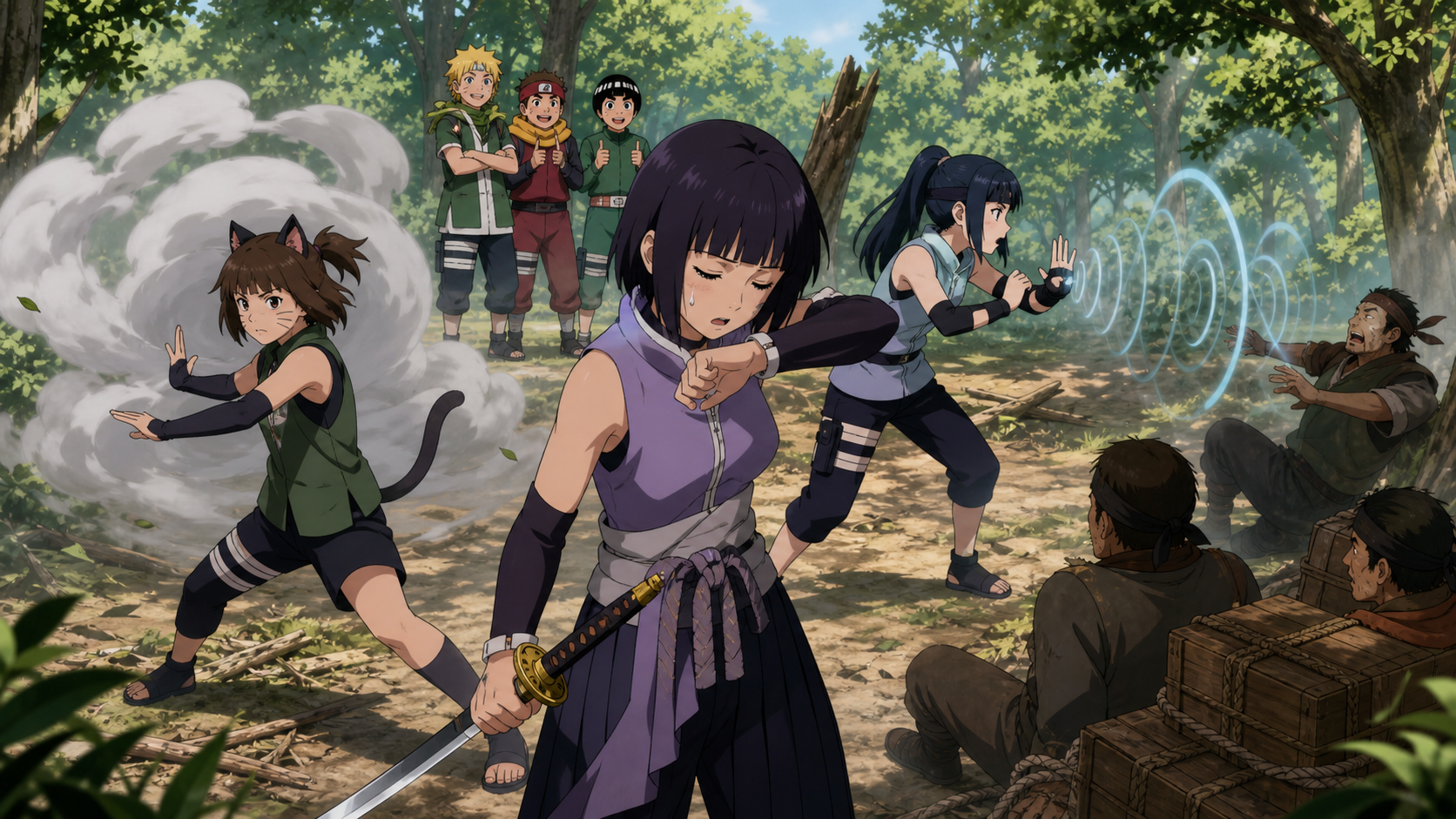
This motive changes the same skills that caused earlier problems. Tsubaki’s speed can now answer a gap. Wasabi’s mobility and smokescreen can reshape the field. Namida’s range can stop a retreating opponent.
Helping Team 5 also softens the rivalry without erasing competitive pride. Rivals become useful when each side pushes the other and still refuses to let the other fall.
Team 5 demonstrates the combination first
During the fight, Tsubaki watches Team 5 cover weak points and amplify strengths. Denki’s analysis, Iwabee’s power, and Metal Lee’s speed do not compete for one identity.
Their coordination resembles the meal combination Boruto described. Each part has a distinct role, and timing turns the parts into a result larger than one person’s score.
Tsubaki finally recognizes that Team 15’s problem is structural. Wasabi and Namida do not need to become miniature samurai. Tsubaki does not need to lower her strength. They need a plan that makes each difference necessary.
Wasabi creates the battlefield Tsubaki needs
When more bandits corner Team 15, Tsubaki asks Wasabi for a smokescreen. The request matters because Tsubaki no longer treats support as something that follows her action.
Wasabi acts first and changes visibility. The smoke lets Tsubaki enter the group on favorable terms. Her sword technique becomes more effective because a teammate designed the opening.
Credit becomes impossible to separate cleanly. Wasabi’s smoke does not defeat the bandits by itself. Tsubaki’s strike cannot reach the same position without the smoke. The result belongs to the combination.
Tsubaki spends her strength and trusts the finish
Tsubaki uses tremendous energy to break the formation. She cannot chase every retreating enemy afterward.
Earlier Tsubaki might have forced another attack to preserve personal control. Now she trusts Namida and Wasabi to complete the job.
Exhaustion becomes evidence of correct role allocation rather than failure. Tsubaki spends her strength where only her sword can create the decisive break. Teammates cover what her body cannot do next.
Namida stops the leader, and Wasabi captures him
Namida uses Calling on Tears to halt the fleeing bandit leader. Wasabi closes the distance and secures him.
The final capture contains all three members. Tsubaki disrupted the group. Namida prevented escape. Wasabi finished the restraint. Removing any one contribution changes the outcome.
The episode does not award one girl the winning point because winning is no longer the question. The client is safe, the bandits are contained, and the teams can return together.
Passing out does not make Tsubaki the whole hero
Tsubaki collapses from chakra exhaustion after the fight. The image could invite a familiar reading: the strongest fighter spent everything and carried everyone.
The episode’s structure rejects that reading. Her maximum technique creates an opening, not a complete victory. Namida and Wasabi remain active because their roles were preserved instead of sacrificed to her spotlight.
Tsubaki’s exhaustion also teaches resource awareness. A technique that empties the user must sit inside a plan with somebody ready to finish and somebody ready to protect the exhausted teammate.
Sumire’s absence changed the team more than a roster line
Team 15’s reduced score after Tsubaki joined does not mean Sumire was stronger. Sumire occupied a coordinating relationship that the new trio had not rebuilt.
Replacing one person changes communication, pace, assumptions, and trust. Teams are not containers where equal statistics produce equal output. History matters.
Tsubaki’s episode becomes more respectful when read this way. She is not a defective replacement. Wasabi and Namida are not weak teammates holding her back. All three need time to create a new identity after Sumire’s transfer.
Denki’s statistics matter because feelings alone were not breaking the pattern
Team 15 experiences the problem as irritation. Tsubaki believes the others lack effort. Wasabi and Namida feel displaced by a teammate whose strength changes every comparison. Nobody has language precise enough to interrupt the cycle.
Denki brings performance records. Numbers do not replace the team’s feelings, but the records expose the difference between activity and outcomes. Tsubaki’s individual success rises while the group’s mission quality falls.
That evidence protects the conversation from becoming a popularity contest. Hanabi does not have to decide which girl sounds more sincere. The work itself shows missed responsibilities, uneven participation, and client harm.
Data can also mislead when leaders count only captures or speed. Denki’s contribution works because the episode connects numbers to the purpose of the mission. A team metric should measure whether people were protected and the assignment was completed, not whether one member looked impressive.
Hanabi’s consequence is leadership, but the team needs a real debrief
Losing the next assignment gives the merchant failure weight. Shinobi work cannot treat abandoned clients as a harmless learning exercise.
Hanabi still owes the girls a specific review. Which checkpoint did they leave? Who had responsibility for the client? When should Tsubaki have requested support? What signals did Wasabi and Namida miss? How could the team preserve pursuit without leaving the protected person exposed?
Without that detail, punishment can produce embarrassment instead of skill. Tsubaki learns the broad lesson because later events create another chance. A professional system should not depend on luck supplying the perfect metaphor.
Hanabi sees the cultural shift early. Her strongest role would be helping the team name the shift before another client pays for the correction.
Wasabi and Namida are teammates, not ingredients waiting for Tsubaki
The meal metaphor risks placing Tsubaki at the center again: she finally learns to appreciate the useful qualities already available around her. Wasabi and Namida have their own work to do.
Wasabi needs to state boundaries instead of allowing resentment to build beneath competition. Namida needs confidence that her specialized technique belongs in planning, not only emergencies. Both girls train independently, which proves they were never simply lazy.
Their final coordination succeeds because they make decisions, not because Tsubaki grants permission for them to matter. Wasabi creates the smoke field. Namida times the stop. Wasabi completes the capture.
Team harmony should redistribute voice as well as combat tasks. Otherwise the strongest member remains the conductor and everybody else receives a better-written supporting part.
Sumire’s departure created grief the episode mostly translates into performance
Team 15 lost a teammate, gained a replacement, and had to rebuild its identity without much space to mourn the old arrangement. Tsubaki did not cause Sumire’s departure, but her arrival makes the change impossible to ignore.
Wasabi and Namida may compare the new structure to a version of the team where roles felt familiar. Tsubaki may sense that she is entering somebody else’s space and overcompensate by proving immediate value. Competition can become a way to avoid admitting that everybody feels uncertain.
The episode gestures toward adjustment without naming grief. A short conversation about Sumire would deepen the conflict and protect Tsubaki from becoming the convenient explanation for every difficulty.
Teams change. Healthy teams acknowledge what ended before demanding instant loyalty to what comes next.
The fries metaphor works because sameness and excess are different problems
Tsubaki orders more of what she already enjoys and discovers that quantity cannot produce balance. The joke is simple, but the lesson avoids claiming that fries are bad or that strength should be reduced.
The team does not need less Tsubaki. The team needs Tsubaki placed beside other skills with equal tactical legitimacy. Wasabi’s speed and transformation, Namida’s range and interruption, and Tsubaki’s sword power solve different parts of the fight.
Harmony is therefore structural. Nobody must become quieter, weaker, or less distinctive. The arrangement changes so that each strength arrives where the mission needs the strength.
That is a better teamwork lesson than asking talented girls to flatten themselves into one agreeable personality.
What Episode 153 gets right
The episode distinguishes individual performance from mission performance with unusual clarity. Denki’s statistics identify the problem, the merchant mission proves the cost, and the final battle demonstrates the repair.
Every Team 15 member contributes to the solution. Tsubaki learns to request support. Wasabi shapes the field and captures the target. Namida prevents escape. Hanabi enforces client-centered standards. Team 5 provides a working example without becoming perfect rivals.
The food metaphor is memorable because the battle matches the metaphor precisely. Different strengths do not need blending into sameness. Arrangement creates harmony.
What could have gone deeper
Namida and Wasabi deserve more interiority before the final fight. We see their training, but the episode spends most of the analysis inside Tsubaki’s realization. The team problem belongs to all three.
Hanabi could also explain the merchant failure in more detail. Naming the exact responsibilities abandoned would turn punishment into a stronger debrief.
The bandit plot functions cleanly but remains generic. A sharper connection between the captured brother, the impersonation plan, and the client stakes would make the mission feel less like equipment for the lesson.
RaeRae’s read
Tsubaki did not make Team 15 worse because strength is bad. She made Team 15 worse because everybody reorganized around strength without deciding how the rest of the team should work.
Competition produced activity, fries, and impressive personal numbers. Coordination protected the client and captured the leader. That difference is the whole episode.
The golden harmony is not three girls becoming equally powerful. The harmony is Wasabi trusting Tsubaki to use the smoke, Tsubaki trusting Namida to stop the retreat, and Namida trusting Wasabi to finish. A meal made entirely of fries can fill the table. A team made entirely around one person can look busy. Neither arrangement gives you what the whole combination was supposed to provide.
Sources and lawful viewing
Official episode reference: Naruto Official episode guide
Licensed episode route: Crunchyroll licensed series page