
Developing One’s Medical Ninjutsu
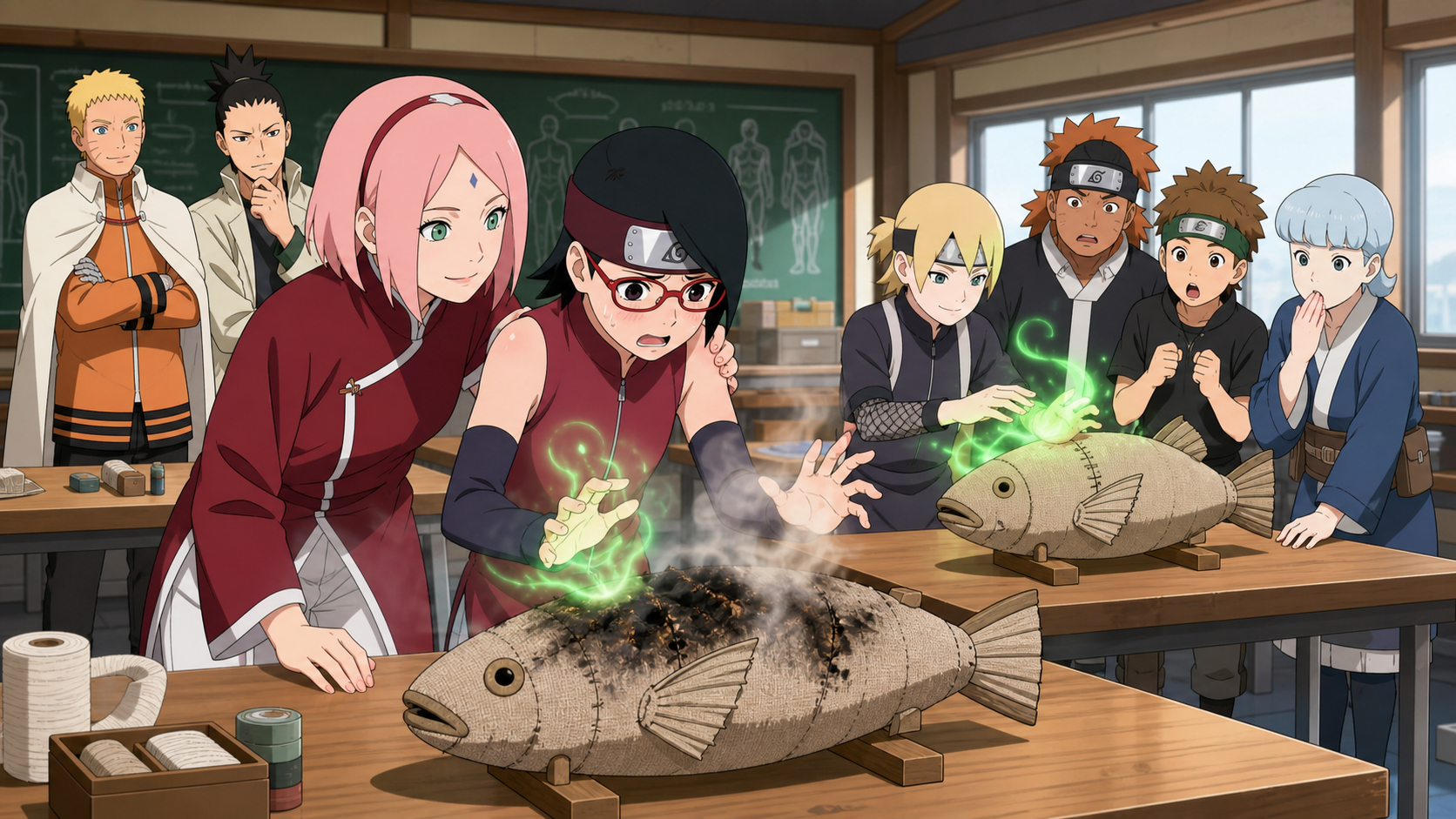
Sarada can study every answer and still burn the practice fish, because Sakura’s daughter is allowed to have weaknesses that training, honesty, and teamwork must address.
Series: Boruto: Naruto Next Generations
Episode: 152 · Developing One’s Medical Ninjutsu
Arc: Sarada Uchiha
Release: 2020-04-12
Previous: Episode 151 · Boruto and Tentō
Directory: All 293 Boruto episodes
Bottom line
Boruto Episode 152, “Developing One’s Medical Ninjutsu,” gives Sarada a failure she cannot punch, study, or inherit her way around. Everybody assumes Sakura’s daughter will dominate a medical ninjutsu course. Sarada knows the truth before class begins: her chakra control in this discipline is unreliable, practical healing makes her anxious, and the pressure to look naturally gifted keeps her from admitting either problem.
The episode becomes stronger because Sarada does not uncover a secret medical genius at the end. She burns the practice fish, confesses that earlier successes were accidents, asks Inojin for help, and learns that Sakura also trained for her expertise. A future Hokage does not need every skill. A future Hokage needs enough honesty to recognize who has the skill, respect the work behind mastery, and stop treating one weakness like proof that the whole dream is fraudulent.
Team 7 volunteers Sarada for the obvious reason
Konoha schedules an advanced medical ninjutsu class and requires each team to send one representative. Boruto and Mitsuki have no interest. Sarada’s mother is teaching, so her teammates nominate her.
Their logic is understandable and lazy. A parent’s profession looks like evidence of a child’s aptitude when nobody asks the child. Boruto assumes proximity to Sakura must have produced medical skill. Mitsuki follows the practical selection. Sarada hesitates because she already knows the family connection raises expectations instead of making the work easier.
She agrees rather than confessing. That decision creates the episode’s real conflict. The class does not trap Sarada. Sarada’s fear of looking inadequate traps her before she enters the room.
Konoha actually needs more medical capability
Naruto, Shikamaru, and Sakura review the class applications and discuss how difficult scheduling has been with the recent incidents. The village wants to identify shinobi with medical aptitude and expand emergency capability across teams.
That purpose matters. Medical ninjutsu is not a decorative elective or a way to make every squad member interchangeable. A teammate who can stabilize an injury changes survival odds when the hospital is far away. The Hōzuki mission, the Mujina fight, and Boruto’s Kāma collapse all demonstrate how quickly a routine assignment can become a medical emergency.
The class also shows what peace should fund. Ikkyū argued for education and social services in Episode 149. Advanced training that keeps shinobi alive sits directly between civilian investment and village defense. Protection is not only a bigger attack. Sometimes protection is one person who can stop bleeding long enough to get everybody home.
Sarada remembers the Academy failure nobody else saw
Sarada struggled with medical ninjutsu at the Academy and never developed confidence afterward. Her classmates do not carry that memory, so they fill the gap with Sakura’s reputation.
The mismatch between public expectation and private evidence produces the anxiety. Sarada is not afraid of learning. She is afraid the class will expose that she failed to inherit the trait everybody already credited to her.
That fear belongs specifically to Sarada. She carries the Uchiha name, Sasuke’s eyes, Sakura’s strength, and a stated ambition to become Hokage. Adults and peers treat those pieces like a complete blueprint. Sarada lives inside the unfinished person who still has to discover what fits.
One overheard conversation makes everything worse
Sarada hears Shikadai and Inojin praising how perfect the Hokage is. They are discussing trading cards, but Sarada assumes they mean Naruto as a leader.
The misunderstanding hits her ambition directly. If Hokage means perfection, every weakness becomes disqualifying. Medical ninjutsu stops being one useful specialty and becomes another test Sarada believes she must pass to deserve the office.
The joke works because the card craze keeps flattening real people. Naruto’s collectible image can look perfect because a card has no missed dinners, paperwork, poor academic scores, or inability to perform medical ninjutsu. Sarada compares her living, anxious self to a polished symbol.
Everybody walks into class expecting Sakura Junior
Hako, Wasabi, Inojin, Dōshu, and Iwabee either assume Sarada will excel or expect her to rescue them if they struggle. None intends cruelty. Their confidence still piles weight onto her shoulders.
Sarada responds by performing certainty. She does not correct them because correction would require admitting the weakness before she can prove the weakness temporary. The silence encourages more expectation, which creates more pressure, which makes practical control worse.
This is how capable children get trapped by praise. People call them naturally good, so ordinary confusion feels like exposure. Asking for help appears more dangerous than failing alone.
Sakura begins with knowledge before chakra
Sakura explains the course and starts with a lecture followed by a written examination. Sarada relaxes because study is familiar territory. She can organize facts, remember principles, and produce the expected answer.
The written success is real. Medical work requires anatomy, diagnosis, dosage, chakra theory, and judgment. Practical weakness does not erase Sarada’s intellectual foundation.
The problem arrives when Sarada treats knowledge as proof that her hands will obey under observation. Understanding a process and performing a process are different skills. The series often celebrates combat intuition, but medicine punishes approximation in ways a sparring match may not.
Medical ninjutsu is hard because precision matters
Healing chakra demands sustained control at a scale most combat techniques do not. Too little energy fails to repair. Too much energy damages what the user intends to save. Emotion, fatigue, and attention change the result.
Sarada’s combat style favors decisive force, quick analysis, and Uchiha visual processing. None of those strengths automatically produces the quiet calibration Sakura spent years mastering. Genetics do not replace hours of repetition.
The episode deserves credit for making a basic class feel consequential. The practice dummy may be harmless, but the technique exists for bodies that cannot absorb mistakes. Sarada’s fear is not completely irrational. A future patient would need competence, not family prestige.
Shizune turns the demonstration into a public test
Shizune arrives for the final assignment with Naruto and Shikamaru as guests. Sarada is encouraged to demonstrate her skill for the Hokage.
Every pressure point converges. Her mother teaches the class. Her peers expect excellence. Naruto embodies the office she wants. Shikamaru represents the institutional judgment around that office. The practical exercise becomes a referendum on Sarada’s identity inside her own head.
Nobody in the room intends to humiliate her. Intent does not lower the stakes she feels. Sarada has built a private audience much harsher than the real one.
The burned fish is funny because the fear is real
Sarada attempts to heal the fish-shaped training dummy and channels too much chakra. Smoke rises. The exercise turns into accidental cooking.
The visual joke lands, but the episode does not reduce Sarada to a punchline. Her panic comes from seeing the hidden weakness become public in front of every person whose opinion matters.
The scorched dummy also gives the mistake a clear physical shape. Sarada cannot argue with a test score or hide behind theory. Her control failed. Admitting that fact becomes the first useful action she takes in the practical lesson.
Sarada finally says the sentence she feared
Sarada confesses that she is bad at medical ninjutsu and does not understand how she passed earlier tasks. The room does not collapse. Sakura does not disown her. Naruto does not revoke her Hokage dream.
The confession removes the fake problem. Sarada no longer needs to protect a reputation that never described her actual skill. Now she can learn from the correct starting point.
Honesty also changes how everybody else can support her. Help offered to “Sakura’s naturally gifted daughter” would miss the need. Help offered to a strong student struggling with practical chakra control can become specific.
Sakura’s daughter is not Sakura’s copy
Sarada explains that Sakura’s reputation created the pressure. The episode names inheritance anxiety instead of leaving the audience to guess.
Children in this franchise constantly carry famous adults on their backs. Boruto is measured against Naruto. Shikadai resembles Shikamaru. Inojin inherits two clan traditions. Metal lives beside Rock Lee’s impossible work ethic. Sarada carries both Sakura and Sasuke, plus the political history of the Uchiha name.
Family can provide teachers, techniques, and examples. Family cannot determine aptitude in every field. Sarada’s identity does not become smaller because one of Sakura’s defining talents does not arrive easily.
Naruto dismantles the perfect Hokage myth
Naruto admits he cannot use medical ninjutsu. Boruto starts listing other things his father does poorly. The interruption is affectionate, embarrassing, and exactly what Sarada needs.
The Hokage is not a complete inventory of every village skill. Naruto leads people whose abilities exceed his own in medicine, intelligence, administration, barrier work, and countless specialties. Leadership requires knowing that fact.
Sarada’s dream becomes more believable once perfection leaves the job description. She does not need to become Naruto, Sakura, Sasuke, Tsunade, and Shikamaru inside one body. She needs judgment, resilience, trust, and the ability to build a team stronger than any individual.
Inojin succeeds and Sarada asks how
Inojin performs the healing exercise successfully. Sarada does not resent him or search for a reason his result should count less. She asks for advice.
That moment is the episode’s most important piece of leadership growth. Sarada identifies competence outside herself and treats the competent person as a resource. Rank, clan, and parental reputation become irrelevant beside the actual result.
Inojin’s success also fits his established skills. Fine control, visual sensitivity, and techniques involving deliberate chakra application give him a plausible route into medical work. The class uncovers aptitude exactly as Naruto, Shikamaru, and Sakura hoped.
Sakura leaves because real patients outrank the lesson
An emergency calls Sakura away from the classroom. Her departure demonstrates the responsibility behind the specialty. Medical ninjutsu is not a family legacy display for Sarada. Real people need Sakura’s expertise on unpredictable schedules.
The interruption also reminds Sarada that mastery creates obligation. Sakura’s skill gives her power, status, and the burden of being summoned when somebody cannot wait.
Sarada may choose to develop medical ninjutsu later, but she should choose with a clear understanding of the work. Copying her mother’s résumé would be a terrible reason to carry lives in her hands.
Shizune tells the story perfection edits out
Shizune explains that Sakura did not master medical ninjutsu instantly. She trained intensely under Tsunade and built the skill through effort.
Public memory compresses experts. People see Sakura’s present control and forget the years of mistakes, study, and correction. Sarada compared her first serious class to her mother’s finished reputation.
Shizune restores the missing timeline. Sakura’s talent was not fake, but talent did not remove labor. Sarada can improve if she wants the discipline enough to accept the same process.
Sakura’s answer protects choice
At home, Sarada asks why Sakura became a medical ninja. Sakura explains that she wanted strength enough to walk beside Naruto and Sasuke. Her medical path came from her own relationships, limits, and ambition.
Sakura does not tell Sarada to repeat the decision. She assures her daughter that training can build the skill. Possibility replaces obligation.
That difference matters. “You can learn” offers agency. “You must inherit” turns love into pressure. Sakura gives Sarada room to decide whether medical ninjutsu belongs in her future rather than demanding proof of family continuity.
The episode quietly repairs how fandom talks about Sakura
Sakura’s medical expertise often gets treated like a convenient support power beside flashier bloodline abilities. Episode 152 emphasizes the knowledge, precision, repetition, and emergency responsibility behind the work.
Sarada cannot copy the technique after one lesson because Sakura’s mastery was never easy. That fact strengthens Sakura rather than diminishing Sarada.
The story also refuses the idea that healing is automatically the girl’s role. Boruto and Mitsuki opt out because of personal interest, not gender. Inojin shows aptitude. Iwabee attends. Medical capability belongs to the shinobi willing and able to develop the control.
A standalone episode can still move a character
Episode 152 follows the Kara reveal with a low-stakes classroom story. The placement may frustrate viewers hungry for the next conspiracy answer. Character development does not become worthless because no organization attacks Konoha this week.
Sarada’s fear of imperfection directly affects her Hokage path. A leader who hides weakness creates danger. A leader who asks the right specialist creates capacity. The medical class gives her a safe place to learn that distinction before a real patient pays for the lesson.
The episode also lets the village breathe after the Mujina arc. Training, education, and awkward family conversations are part of the peace Naruto protects.
Volunteering a teammate without asking is still pressure
Boruto and Mitsuki see Sarada’s intelligence, chakra control, and family connection, then treat participation as obvious. Their confidence sounds supportive because neither intends harm.
Support becomes pressure when the person receiving support loses room to answer. Sarada has already failed privately and knows classmates expect Sakura’s daughter to excel. Being volunteered turns one skill gap into a public test of identity.
Team 7 should learn the difference between encouragement and consent. Ask whether she wants the course. Offer to practice with her. Accept a no without treating the no as cowardice.
Boruto understands unwanted expectations whenever people reduce him to Naruto’s son. That parallel could give him a clean apology and make the friendship lesson reciprocal.
A medical course needs patients, ethics, and limits alongside chakra control
Healing a fish demonstrates precision, but medical ninjutsu begins before chakra touches tissue. A medic must assess the patient, identify the injury, obtain consent when possible, triage urgency, and know when intervention could make harm worse.
The course compresses those responsibilities because one episode needs a visible exercise. Sakura and Shizune could still name the larger discipline. A student who can channel chakra without diagnosing correctly remains dangerous.
Konoha also needs clear scope rules. Genin with introductory training should stabilize, communicate, and transfer care rather than attempt advanced procedures because a teammate is hurt and nobody else is nearby.
Competence includes saying, “This injury exceeds my training.” Sarada’s honesty therefore belongs inside medical ethics, not outside medical ability.
Inojin’s success should open a path instead of becoming a one-day surprise
Inojin arrives without the family expectation attached to Sarada and discovers real aptitude. That moment is funny, generous, and potentially important.
Konoha needs more medical capability. A student who shows unusual precision should receive information about further training, observation shifts, and the real workload before making a choice.
His success also proves that inherited identity does not have to become career assignment. The Yamanaka and Sai legacies give him useful control and perception without dictating one destination.
The episode does not need to declare Inojin a future medic. The institution should notice the possibility and make continued exploration available.
Sakura’s legend has been edited to hide the labor
Classmates expect Sarada to inherit medical skill because public memory compresses Sakura’s years of study into a finished reputation. The village remembers the legendary medic and forgets the student who needed instruction, repetition, failure, and supervision.
That edited story harms both women. Sakura’s achievement looks genetic or effortless. Sarada’s different aptitude looks like personal deficiency.
Shizune repairs the record by restoring process. Sakura became exceptional because she worked under Tsunade, mastered knowledge, refined control, and continued through mistakes. Admiration becomes more useful once effort returns to the story.
Fandom does the same editing whenever Sakura’s later power erases the young girl who had to build every part of that power deliberately.
Hokage leadership depends on building teams around incomplete people
Naruto’s admission matters because the office never required one person to perform every village function. He relies on medics, strategists, intelligence workers, teachers, diplomats, administrators, and shinobi with skills he does not possess.
Sarada’s dream should therefore push her away from perfection. A leader who hides gaps makes the whole system vulnerable. A leader who knows the gaps can recruit expertise and listen before deciding.
Medical failure becomes a small rehearsal for government. Sarada identifies a limit, names the limit, and turns toward people who know more. That behavior protects patients now and could protect a village later.
The Hokage does not have to be the best medic. The Hokage must make sure medics have resources, authority, staffing, and a voice in policy.
What works: Sakura protects possibility without claiming Sarada’s future
Sakura could treat her daughter’s struggle as embarrassment or respond with relentless tutoring until success arrives. She does neither.
Her answer separates love from replication. Sarada can continue learning, stop, return later, or build a completely different specialty. Family knowledge remains available without becoming a debt.
That freedom strengthens inheritance. A technique chosen after honest exploration means more than a technique performed to prove loyalty.
Sakura also refuses false reassurance. Sarada does not secretly possess perfect medical talent. The relationship survives the truth, which teaches Sarada that failure does not threaten belonging.
What Episode 152 gets right
The episode lets Sarada fail without discovering that failure was secretly excellence. Her earlier successes were luck. Her final growth is honesty and willingness to learn.
Naruto’s admission breaks the perfection myth cleanly. Inojin’s success rewards an unexpected aptitude. Shizune restores the labor behind Sakura’s reputation. Sakura gives encouragement without demanding imitation.
The comedy stays connected to character. The burned fish is funny because Sarada’s control problem is specific, the classmates’ assumptions are believable, and the public demonstration magnifies an insecurity already present before class.
What could have gone deeper
Boruto and Mitsuki volunteer Sarada too casually. A brief apology after learning how much pressure she felt would have completed Team 7’s side of the lesson.
The course compresses advanced medical training into a single episode, which can make the discipline feel easier than the story argues. More attention to diagnosis or the consequences of incorrect chakra application would strengthen the educational side.
Sarada’s conversation with Sakura also ends before Sarada says whether she genuinely wants to continue. Keeping the choice open is healthy, but a clearer statement of her current interest would give the ending more definition.
RaeRae’s read
Sarada’s worst mistake was not burning the practice fish. Her worst mistake was believing the Hokage dream required her to hide the weakness until the weakness disappeared.
Naruto became Hokage with enormous gaps in his own skill set. Sakura became a legendary medical ninja through training, not genetic inevitability. Inojin succeeds because aptitude can appear outside the family everybody expects. Those three facts give Sarada a more useful model of leadership than perfection ever could.
The future Hokage in this episode is not the girl pretending to know everything. The future Hokage is the girl who finally says, “I cannot do this yet,” finds the person who can, asks for help, and keeps her dream without stealing somebody else’s path.
Sources and lawful viewing
Official episode reference: Naruto Official episode guide
Licensed episode route: Crunchyroll licensed series page