
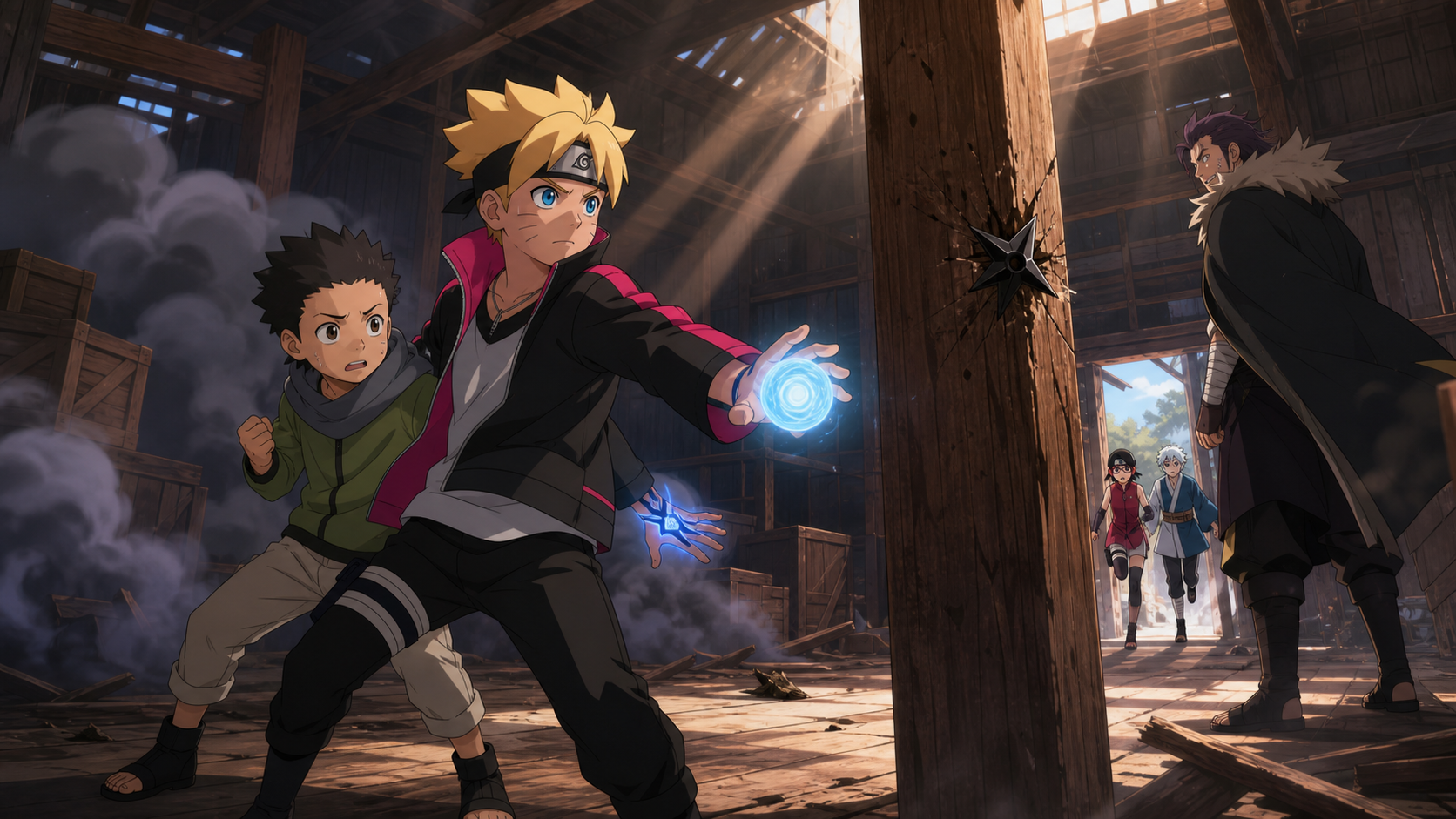
Boruto and Tentō
Tentō’s one earned shuriken creates the opening Boruto needs, but Kāma interrupts their victory and gives Konoha a dangerous new name: Kara.
Series: Boruto: Naruto Next Generations
Episode: 151 · Boruto and Tentō
Arc: Mujina Gang Finale
Release: 2020-04-05
Previous: Episode 150 · The Value of a Hidden Ace
Directory: All 293 Boruto episodes
Bottom line
Boruto Episode 151, “Boruto and Tentō,” pays off the Mujina Gang arc through teamwork rather than a miracle upgrade. Boruto cannot break Shōjōji’s Wind Release defense alone. Tentō uses the shuriken lesson from Episode 149 to create the opening, Boruto lands the Rasengan, and Sarada and Mitsuki arrive because Team 7 never truly abandoned him. The spoiled daimyō’s son becomes part of his own rescue without suddenly turning into a ninja.
Then the Kāma mark activates, paralyzes Boruto, and scares Shōjōji badly enough to give Konoha a new name: Kara. That moment changes the scale of the series. Hōzuki Castle, Kokuri’s murder, Tentō’s kidnapping, and the fight with Shōjōji close one criminal case, but the mark on Boruto’s palm opens a threat that the bandit leader fears more than prison.
Boruto arrives as a friend, not a bodyguard
Shōjōji asks why Boruto returned after the official escort mission ended. Boruto’s answer is simple in every way that matters: Tentō is his friend.
That statement completes the emotional work of Episodes 148 through 150. Ikkyū’s money created the assignment, but payment no longer explains Boruto’s presence. Boruto gave up Team 7’s first B-rank mission and entered a criminal hideout because the relationship outlived the contract.
Shōjōji cannot understand that kind of value. His world contains hostages, ransom, stolen identities, and bodies converted into access. Friendship looks like a weakness until friendship puts Boruto between him and the daimyō’s son.
The Mujina underlings are not the real problem
Shōjōji sends his men forward, and Boruto clears them with shadow clones and speed. The opening exchange establishes that ordinary bandits cannot contain him. Boruto has grown far beyond the genin who once needed a scientific ninja tool to fake competence.
The quick victory also strips away noise. Shōjōji is the real opponent because his ability changes the terms of every attack. Boruto can defeat bodies. He needs a strategy to defeat a defense that turns force back on the attacker.
Tentō stays behind Boruto as instructed. The boy’s restraint matters. Courage does not require charging into a fight he cannot survive. Listening becomes part of the teamwork.
Shōjōji confesses to Hōzuki Castle
Shōjōji reveals that he wore Tsukiyo’s face and later Kokuri’s. Boruto finally learns what happened after Team 7 believed Kokuri escaped.
The confession transforms Episode 147’s uneasy ending into confirmed loss. Kokuri did not simply vanish. Shōjōji consumed him, stole his appearance, took the Mujina notebook, and walked away inside the rescue Team 7 thought they completed.
Boruto’s anger is earned. He risked prison, built trust with Kokuri, fought beneath Hōzuki Castle, and carried the guilt of an operation that felt wrong without knowing why. Shōjōji mocks that effort because cruelty is part of his control. He wants Boruto furious enough to stop thinking.
Anger gives Shōjōji the fight he wants
Boruto attacks with electrified shuriken and the Rasengan. Shōjōji’s Wind Release blocks and reflects the techniques. Every direct assault confirms the same problem: strength aimed straight at the shield becomes wasted strength.
Boruto adds shadow clones and attacks from several directions. The variation improves the pressure, but Shōjōji still controls the exchange. His defense covers space and punishes obvious commitment.
The fight looks good because Boruto’s movement has purpose. He tests angles, disguises the real attack, and nearly slips through. The episode does not portray him as weak. Boruto is capable and facing a technique designed to neutralize his favorite solutions.
Shōjōji knows Boruto’s clone limit
After Boruto uses smoke to create uncertainty, Shōjōji identifies the real body and destroys the clones. He knows Boruto can maintain four shadow clones. Information becomes another shield.
That knowledge should bother everybody. Shōjōji has studied the Hokage’s son, whether through observation, criminal reports, or information gathered during the prison operation. Boruto entered the hideout believing surprise belonged to him, but the bandit leader prepared for his habits.
The scene reinforces the danger of Boruto acting alone. A known technique set becomes predictable without teammates creating new variables. Sarada and Mitsuki are not optional decorations around the protagonist. Team 7 exists because three minds make a harder target to solve.
Sai follows the money
Ikkyū gathers the ransom, and the movement of that much money catches Sai’s attention. The intelligence response begins through financial evidence rather than Boruto’s report.
That detail makes Konoha’s security system feel alive. Criminal operations leave traces. Guards mobilize, money moves, communications narrow, and trained observers notice patterns. Boruto’s secrecy delayed coordination, but the village is not blind.
Sai captures Mujina spies and moves toward the real crisis. Ikkyū’s earlier fear about infiltration was correct. The answer is not permanent isolation. The answer is controlled investigation by people equipped to identify the breach.
Boruto finally asks Tentō to participate
Boruto uses a smoke bomb and forms a plan with Tentō. The choice respects Tentō’s limited skill instead of treating him as luggage.
Boruto does not ask Tentō to defeat Shōjōji. He asks for one interruption at the correct moment. Tentō’s shuriken training provides a narrow capability, and Boruto builds the strategy around that truthful limit.
This is good mentorship. Boruto sees what Tentō can do, names the part that matters, and carries the rest of the risk himself. The plan turns a beginner’s single skill into a tactical asset without pretending practice erased the experience gap.
Tentō’s shuriken becomes the real hidden ace
Shōjōji grabs the real Boruto after clearing the clones. Boruto cannot mold chakra. The fight appears finished until Tentō throws the shuriken.
The throw does not overpower Shōjōji. Surprise breaks his concentration and creates the fraction of a second Boruto needs. Tentō’s contribution works because Shōjōji dismissed him as a helpless child.
The bullseye from Episode 149 was never only a cute training payoff. Repetition gave Tentō the ability to act when money, status, and guards failed. Boruto gave him a tool. Tentō decided when to use the tool.
Their teamwork also reverses the card-shop conflict. Boruto once stood between Tentō and Iwabee because Tentō’s behavior created danger. Now Tentō stands inside Boruto’s plan because the friendship created trust.
The Rasengan lands because somebody else helped
Boruto drives the Rasengan into Shōjōji while the wind defense is down. The attack succeeds through timing, not a larger chakra ball.
That distinction matters for Boruto’s growth. During the Chūnin Exams, he used technology to manufacture results he had not earned. Here, a basic technique lands because he studies the defense, shares a plan, trusts Tentō, and acts on the opening.
The Rasengan remains Naruto’s legacy, but Boruto’s use belongs to Boruto. He combines the inherited technique with his own relationships and judgment. A father can pass down a tool. The child still has to learn when force will work.
Kāma interrupts the victory
Shōjōji decides that Boruto’s body and techniques would make a valuable Corpse Clone. Before he can act, the mark on Boruto’s palm expands and causes intense pain. Boruto loses control of his body.
The mark first appeared as a silent worry in Episode 148. Episode 151 turns the worry into a physical event during combat. Boruto cannot dismiss Momoshiki’s warning as a dream or wait comfortably for Sasuke’s research. Something inside his body responds to danger and chakra without his permission.
The activation also steals Boruto’s clean victory. He and Tentō solved Shōjōji’s defense, yet the mark leaves him vulnerable immediately afterward. Power and danger arrive through the same symbol.
Shōjōji recognizes fear before he recognizes the mark
Shōjōji sees Kāma and briefly believes Boruto may belong to a certain organization. His confidence collapses. The bandit who laughed at Konoha, the daimyō, and Team 7 suddenly measures his words.
That reaction supplies the first external evidence that the mark connects to something organized. Sasuke knew the symbol was unusual. Momoshiki knew the consequence. Shōjōji knows enough to be afraid.
He quickly realizes Boruto does not understand the reference, but the damage is done. The criminal underworld has heard of people associated with similar seals. Boruto’s private mystery now touches a larger network.
Sarada and Mitsuki arrive because trust works both ways
Mitsuki restrains Shōjōji, and Sarada knocks him out. Their arrival saves Boruto after Kāma takes away his ability to protect himself.
Sarada and Mitsuki handled the B-rank situation, followed the evidence around Boruto’s disappearance, and entered at the decisive moment. The episode restores Team 7 without pretending Boruto’s secrecy was ideal.
Sarada notices the mark and asks why Boruto hid the problem. Her frustration is justified. Sasuke told Boruto to keep the mark quiet, but secrecy inside Team 7 has operational consequences. Teammates need to know when one member may collapse during a fight.
Boruto explains Sasuke’s instruction. The answer resolves the immediate accusation, not the larger question. Protecting sensitive intelligence and protecting teammates cannot remain opposing goals forever.
Ikkyū and Tentō finally meet as father and son
Ikkyū arrives and sees Tentō alive. Relief strips away the political distance that defined their earlier scenes.
Tentō no longer needs to perform wealth or ninja ambition to force attention. His father nearly lost him, and the crisis makes the emotional debt impossible to delegate. The episode does not solve their relationship with one embrace, but Ikkyū now knows money cannot replace knowledge of his child.
Tentō also returns changed. He protected Ikkyū’s life, resisted Shōjōji, contributed to the rescue, and learned that Boruto came after him when no contract required the risk. Recognition finally arrives through relationship instead of spectacle.
Konohamaru praises the rescue and names the violation
Konohamaru congratulates Team 7 for defeating Shōjōji, then reminds them that they abandoned an accepted mission. The rescue’s success does not erase procedure.
That response respects both truths. Boruto saved a child from a major criminal and exposed the Mujina Gang’s leader. He also left a B-rank assignment without authorization and withheld critical information.
Consequences are not proof that the moral choice was wrong. Shinobi organizations need reporting and accountability because teammates and civilians absorb the risks created by individual decisions. Boruto should be proud of Tentō’s rescue and still learn a safer way to act next time.
Kokuri’s disappearance becomes official grief
Konohamaru confirms that Kokuri disappeared after leaving Konoha. Boruto now understands the terrible gap between the person Team 7 tried to save and the face that walked away.
The information should remain part of Boruto’s memory. Shōjōji did not merely provide an exciting boss fight. He murdered a frightened witness who trusted Boruto. Capturing him creates the possibility of justice, but justice does not restore Kokuri.
The Hōzuki episodes gain purpose through this confirmation. Team 7’s failure was not pointless filler. Their experience exposed Shōjōji’s method, connected the prison network to the kidnapping, and gave Boruto the emotional reason to refuse the bandit’s definition of shinobi.
Boruto returns the card
At the train station, Boruto gives back the rare card Tentō slipped into his jacket. He wants to pull the card from a pack himself.
That decision protects the friendship from becoming another transaction. Tentō’s gift already completed its purpose by leading Boruto back to the hotel. Keeping the card would not invalidate the relationship, but returning the collectible tells Tentō that no payment was required.
Boruto also reclaims the pleasure of effort and chance. The desired card will mean more when the search belongs to him. That lesson mirrors Tentō’s shuriken training: earned satisfaction cannot be purchased by somebody else on your behalf.
Sasuke gets Shōjōji talking
Sai and Ibiki prepare to interrogate Shōjōji. The bandit demands compensation equal to the value of his information. He tries to turn knowledge into another ransom.
Then Sasuke arrives. Reputation accomplishes what negotiation has not. Shōjōji knows enough about Sasuke to understand that silence may become a very uncomfortable strategy.
The scene gives Sasuke’s position weight without requiring a fight. He has spent years investigating threats outside normal village boundaries. A frightened criminal recognizes him as the person most likely to understand the scale of the secret.
Kara changes the direction of Boruto
Shōjōji cannot explain Kāma fully. He distinguishes the seal from Orochimaru’s cursed seals and names a group interested in marks like Boruto’s: Kara.
One word reorganizes the mystery. Momoshiki’s warning no longer belongs only to Ōtsutsuki aftermath. Human actors may be studying, using, or hunting similar power. The criminal world knows the group by reputation, which means Kara has influence without public visibility.
Boruto began Episode 148 worrying about a mark nobody could explain. He ends Episode 151 with a name and more danger than before. Answers do not always reduce fear. Sometimes an answer proves the problem has infrastructure.
Tentō’s shuriken works because training became relationship
Boruto did not teach a flashy technique that would make Tentō look impressive for five minutes. He taught one basic action, repeated the motion, corrected the grip, and treated effort as worth his time.
That lesson becomes useful because Tentō chooses the right moment. Technique without judgment would send the shuriken wide or expose him too early. Judgment without practice would leave courage with no reliable form.
The throw also repays Boruto’s change as a teacher. He began the assignment resenting a spoiled client and eventually recognized a lonely child who wanted somebody to see him clearly. Tentō responds to that recognition by helping rather than waiting to be carried.
The hidden ace is not secret power. The hidden ace is a small skill another person took seriously.
Konohamaru’s debrief should separate courage from command failure
Boruto was right that Tentō faced immediate danger. He was wrong to conceal the decision, abandon the assigned mission, and enter without coordinating with Team 7.
A good debrief can hold both truths. Praise the rescue goal. Name the intelligence Boruto possessed. Then examine why he withheld the information, which backup routes existed, and how secrecy placed Sarada and Mitsuki in the position of finding him after the operation had already begun.
Punishment alone would teach him to hide better. Celebration alone would teach him that a successful outcome erases process. Leadership needs the uncomfortable middle: brave intent, real success, and unacceptable operational risk.
Sarada and Mitsuki also deserve acknowledgment for refusing to let his unilateral choice become a solo legend.
Kokuri is the cost the arc cannot file under “case closed”
Shōjōji’s confession resolves the mystery of the prison escape, but resolution is not mourning. Kokuri trusted protection, transferred information, and died because the criminal organization reached him inside a supposedly controlled system.
The prison, escort team, intelligence office, and village should review how identity theft passed every safeguard. His surviving records should be preserved, his contacts notified where safe, and his evidence credited rather than absorbed anonymously into the case.
Boruto’s anger during the fight proves Kokuri mattered to him. The aftermath should give that relationship more than a line before Kara takes over the plot.
A franchise obsessed with inherited wills should remember ordinary dead people whose names do not become monuments.
Kāma steals the emotional beat because Kāma is already stealing Boruto’s body
The mark activates at the moment Boruto should feel control. He and Tentō created an opening, the Rasengan lands, and Shōjōji falls. Then Boruto’s hand announces that another power can interrupt his victory without permission.
That timing is frustrating by design. Kāma does not wait for a convenient mythology episode. The mark enters friendship, combat, pain, and identity whenever the mark chooses.
Shōjōji’s fear gives Boruto information but also turns his body into evidence for an organization he barely understands. Kara becomes important because somebody else recognizes what he carries.
The scene would benefit from one breath for Tentō, yet the interruption makes the larger violation personal. Boruto saved a child from being treated as valuable flesh while discovering that powerful strangers may view his own body the same way.
What Episode 151 gets right
The episode pays off almost every object and relationship in the mini-arc. Tentō’s shuriken interrupts Shōjōji. The rare card leads Boruto to the kidnapping and returns without becoming payment. Sarada and Mitsuki prove Team 7’s trust. Shōjōji’s Hōzuki confession closes Kokuri’s ambiguity. Kāma opens Kara.
The fight also understands scale. Boruto is talented but cannot brute-force Wind Release. Tentō is brave but cannot win alone. Sarada and Mitsuki arrive because solo heroics have limits. Sai and Sasuke turn the capture into intelligence because defeating one criminal is not the end of the threat.
Most importantly, Tentō’s growth stays specific. He learns one basic skill, makes one courageous throw, and helps at the correct moment. The story never needs to pretend he became a prodigy.
What still bothers me
Boruto faces too little immediate consequence for entering alone. Konohamaru names the abandoned mission, but the episode moves quickly toward farewell and Kara. A serious debrief about secrecy, the suspected spy, and Team 7’s operational safety would strengthen the growth.
Kokuri’s death also deserves more space. Boruto becomes angry during the fight, yet the aftermath gives the loss little room. Kokuri was a person, not only evidence of Shōjōji’s cruelty.
The Kāma activation arrives at the perfect plot moment but interrupts Boruto’s emotional victory. That frustration is intentional. Still, Boruto and Tentō deserved one breath after defeating Shōjōji before the next mythology swallowed the room.
RaeRae’s read
“Boruto and Tentō” works because the title names a pair, not a hero and a rescue subject. Boruto supplies training, strategy, and force. Tentō supplies persistence, timing, and the opening. Neither contribution works alone.
Shōjōji loses because he misunderstands both boys. He thinks Tentō is a price attached to a body and Boruto is a collection of techniques worth stealing. Friendship creates behavior his calculations cannot predict.
The victory does not give Boruto peace. Kāma turns his own hand into the next threat, and Kara turns one frightened criminal’s reaction into a warning about the world beyond Konoha. The Mujina Gang arc ends with a child saved, a murderer captured, a friendship proven, and the series finally pointing toward the organization hiding behind Boruto’s future.
Sources and lawful viewing
Official episode reference: Naruto Official episode guide
Licensed episode route: Crunchyroll licensed series page