
The Value of a Hidden Ace
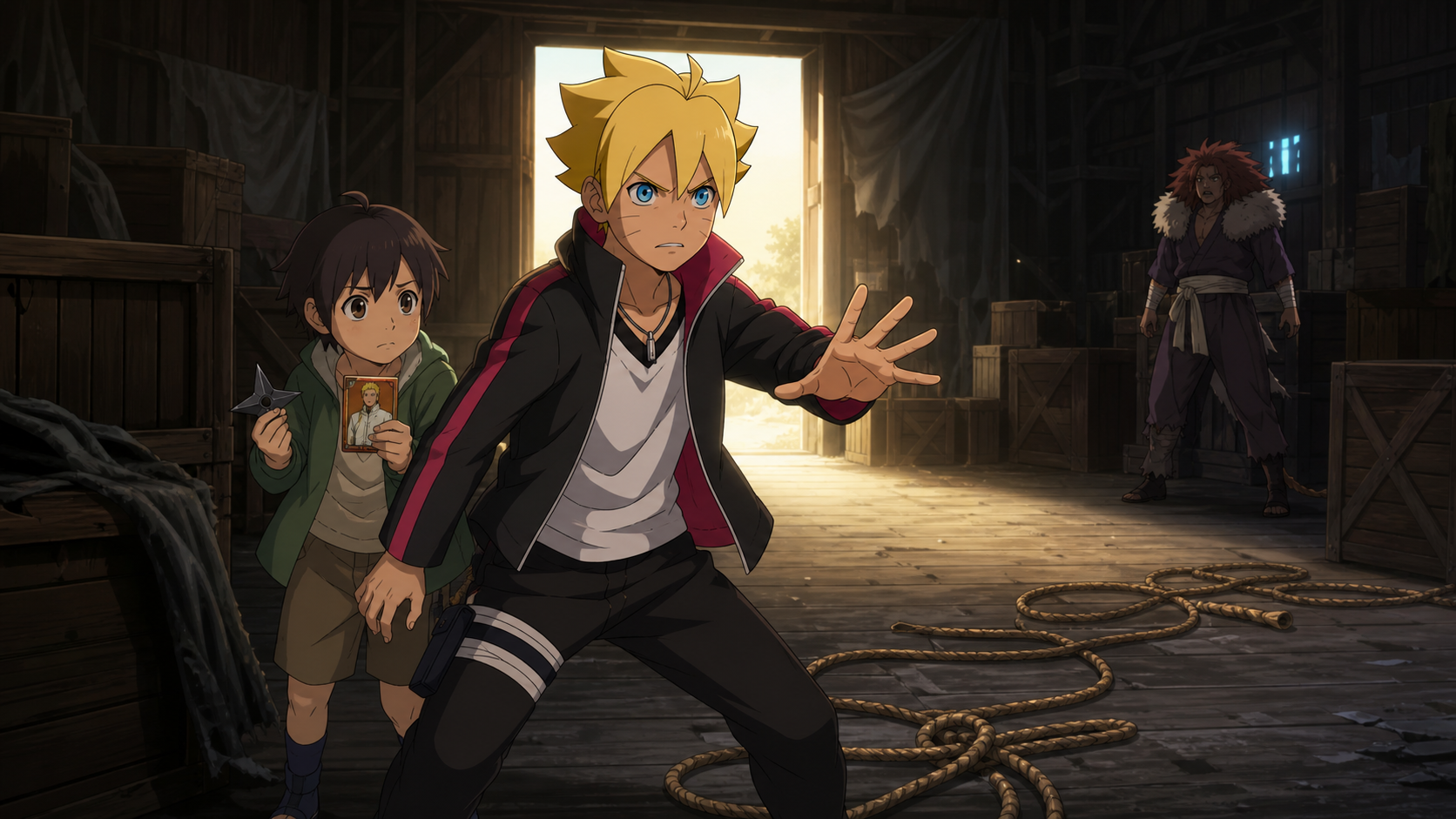
Tentō’s rare card leads Boruto back to a kidnapping, while one earned shuriken gives the daimyō’s son a chance to resist Shōjōji’s stolen face.
Series: Boruto: Naruto Next Generations
Episode: 150 · The Value of a Hidden Ace
Arc: Mujina Gang
Release: 2020-03-29
Previous: Episode 149 · Friends!!
Directory: All 293 Boruto episodes
Bottom line
Boruto Episode 150, “The Value of a Hidden Ace,” asks what people do when the mission they want collides with the person who needs them. Team 7 finally receives a B-rank assignment, the promotion Boruto has been demanding since graduation. Then Boruto finds Tentō’s rare card in his jacket, follows that small act of friendship back to the hotel, and learns the Mujina Gang kidnapped him. Boruto gives up the prestigious mission without waiting for applause because Tentō has stopped being a client and become his friend.
Tentō makes an even harsher choice. After Shōjōji reveals that he ate Yamaoka and plans to wear Tentō’s face, the boy uses his training shuriken to escape his ropes. When escape fails, Tentō turns the blade toward himself so Shōjōji cannot use his body to murder Ikkyū and seize the daimyō’s position. The episode takes the spoiled child from the card shop and proves that courage has nothing to do with how much money sits behind a name.
Tentō practices when nobody is grading him
The episode opens with Tentō throwing shuriken and remembering Boruto’s instruction. Boruto is gone. No reward is waiting at the target. Tentō keeps practicing because the skill now belongs to him.
That choice completes the lesson from Episode 149 better than another bullseye could. Anybody can work while an admired teacher watches. Repetition after the teacher leaves shows that motivation has moved inside. Tentō still wants Ikkyū’s recognition, but Boruto gave him a route that requires effort instead of spending.
The shuriken will matter later, yet the emotional value comes first. Tentō possesses one object that represents what he earned, one skill that cannot be confiscated with his credit card, and one memory of a peer who saw him change.
Shōjōji weaponizes Tentō’s new courage
Wearing Yamaoka’s face, Shōjōji tells Tentō that a suspicious man threatens Ikkyū. Tentō decides to investigate because he wants to protect his father. Two episodes ago, Tentō tried to control people with money. Now he accepts personal risk for somebody else.
Shōjōji twists that growth into bait. The same courage Boruto encouraged pulls Tentō away from security. That manipulation does not make the courage foolish. Children still need adults who understand that bravery and judgment develop at different speeds. Yamaoka’s familiar face supplies the authority that turns a dangerous suggestion into a believable mission.
The scene also proves why Shōjōji’s Corpse Clone Technique is more frightening than a loud attack. The disguise steals trust accumulated by another person. Tentō does not merely see a familiar face. He sees routine, household access, and the adult assigned to protect him.
Team 7 finally earns a B-rank mission
Konohamaru announces Team 7’s first B-rank assignment, and the genin react exactly as expected. Boruto is thrilled. Sarada understands the advancement. Mitsuki shares their readiness without turning the moment into a performance.
Konohamaru warns them that a higher rank brings real danger. The warning lands differently after Hōzuki Castle. Team 7 already faced death, deception, and a mission that ended with Kokuri gone despite their effort. Rank never contained all the risk. Rank controls expectations, authority, and the village’s formal assessment of the work.
Boruto wants the B-rank because the title confirms that adults finally see Team 7 as capable. That desire makes his later refusal costly. He does not abandon a routine chore. He walks away from recognition he has actively wanted.
Ikkyū finally tries to learn his own son
Ikkyū sees the mountain of card purchases and remembers his conversation with Naruto. He decides to speak to Tentō directly. The decision arrives late, but late attention still matters when the alternative is continued avoidance.
The scene avoids turning Ikkyū into a heartless father. He loves Tentō and has been using money as a substitute because money is the tool his position makes easiest. Political leaders become skilled at allocating resources, delegating care, and solving visible problems. A child’s loneliness resists all three habits.
Ikkyū is ready to begin the conversation just as Shōjōji removes the opportunity. That timing gives the kidnapping weight beyond ransom. Father and son are finally moving toward each other, and the Mujina Gang steps into the gap before either knows the other has changed.
The rare card becomes Tentō’s real message
Boruto finds the super-rare card he wanted hidden in his jacket. Tentō could have handed the card over dramatically and demanded gratitude. Instead, he leaves the gift without creating a scene.
That quiet delivery proves Tentō learned the difference between giving and buying. He is not purchasing another lesson or forcing Boruto to call him a friend. Tentō gives something Boruto values because Boruto gave him time, skill, honesty, and the Seventh Hokage card.
Boruto briefly wants to keep the collectible. Of course he does. Then he realizes the gift deserves a response and rushes back to return or confront Tentō. The card becomes the thread that pulls Boruto toward the kidnapping before official intelligence reaches Team 7.
This is what the title means by a hidden ace. The valuable card has almost no value as merchandise once Boruto understands the message. The relationship behind the card becomes the actual advantage.
The empty hotel tells Boruto something is wrong
Boruto reaches the villa and sees guards mobilized everywhere. The atmosphere has changed from private luxury to contained panic. Wealth can rent a hotel, but wealth cannot guarantee control once one trusted person becomes the breach.
Boruto searches for Tentō’s room and overhears the kidnapping discussion. The Mujina Gang demands 500 million ryō and the release of every prisoner at Hōzuki Castle. Those demands tie the new crisis directly to Team 7’s earlier operation.
The ransom is not only money. Releasing the prisoners would restore Mujina manpower and erase the state’s recent gains. Shōjōji uses one child to force both a family and a government into submission.
Ikkyū understands the spy problem immediately
Ikkyū concludes that the kidnappers must have infiltrated either Konoha or his staff. Tentō disappeared without witnesses from an intensely protected environment. An outsider could not create that absence alone.
His reasoning explains why the family does not immediately broadcast the kidnapping. Public escalation could warn the spy, move Tentō, or trigger the threatened killing. Secrecy is not automatically wise, but Ikkyū’s fear follows the available evidence.
Boruto absorbs the same problem. He knows official channels may contain a leak, yet he does not know the leak is literally wearing Yamaoka’s face. Boruto chooses speed and secrecy because every delay feels like time handed to Shōjōji.
Boruto gives up the mission he wanted
Boruto tells Sarada that he cannot join the B-rank assignment. He offers little explanation. Sarada hears his tone and understands that the reason is serious. She does not demand a full confession before agreeing to cover the mission with Mitsuki.
That exchange shows how far Team 7 has come. Sarada could quote procedure, accuse Boruto of impulsiveness, or remind him how long they waited for this rank. Instead, she reads her teammate. Mitsuki accepts the shift because trust does not always arrive with a complete briefing.
Boruto thanks them and leaves. No speech turns the choice into heroism. Friendship simply changes his priorities. The boy who ruined a robber operation because private anxiety overwhelmed the plan now makes a deliberate sacrifice and ensures his teammates can still complete their responsibility.
Boruto’s secrecy is understandable and dangerous
Boruto does not report the kidnapping to Konoha because a spy may exist inside the village or the daimyō’s staff. His logic is not ridiculous. His decision is still risky.
A twelve-year-old genin is about to enter a criminal hideout alone against an enemy whose abilities he does not understand. Boruto has no extraction team, no medical support, and no confirmed map. The urgency is real, but urgency does not transform one person into a complete operation.
The story wants us to admire Boruto’s loyalty while noticing the recklessness. Sarada and Mitsuki would help if they understood the scope. Sai’s intelligence network could investigate quietly. Boruto chooses the narrowest path because he fears every additional person may expose Tentō. That fear mirrors the Kāma anxiety that disrupted Episode 148: invisible threats push him toward solitary action.
Shōjōji reveals what happened to Yamaoka
Shōjōji drops Yamaoka’s appearance and tells Tentō that he devoured the attendant to copy his face. The revelation is grotesque without requiring graphic imagery. A trusted adult did not betray Tentō. A predator removed him and occupied his place.
Tentō’s response includes confusion about Shōjōji’s status. He knows famous shinobi through cards and cannot understand why the bandit leader lacks one while Orochimaru appears in the collectible world. The joke cuts Shōjōji’s ego beautifully. He wants criminal fame and receives a child’s blank stare.
The card system has reduced history to marketable rarity, but Shōjōji desperately wants inclusion. Tentō spent money trying to possess status. Shōjōji commits atrocities trying to manufacture importance. Both seek recognition, but only Tentō has begun learning that a relationship cannot be forced.
Shōjōji’s plan reaches beyond ransom
The ransom demand is only the immediate leverage. Shōjōji plans to consume Tentō, take his appearance, return to Ikkyū, consume the daimyō, and seize political power.
The scheme reveals the terrifying reach of Corpse Clone. Identity theft becomes institutional capture. A face grants access to family, security, documents, and government. Every intimate habit becomes potential evidence, but the first moments of reunion would give Shōjōji enough proximity to strike.
Ikkyū’s concern about infiltration was correct and still too small. The spy is not merely inside the household. The spy intends to become the household.
Tentō uses Boruto’s lesson to free himself
Tentō sees the shuriken and the Seventh Hokage card. The two objects carry the whole relationship: effort and recognition. He uses the blade to cut the ropes.
The escape attempt pays off the training without pretending one afternoon made Tentō a combat ninja. Boruto taught a basic skill. Tentō applies that skill under pressure. The moment works because the capability remains limited and believable.
Tentō does not wait passively for his father’s money or a professional rescue. He acts with the tool he earned. The spoiled boy from Episode 148 has become somebody who can contribute to his own survival.
Tentō’s last choice is brave and horrifying
When escape fails, Tentō tries to turn the shuriken on himself so Shōjōji cannot use his body against Ikkyū. The scene is disturbing because Tentō understands the stakes quickly. He would rather die than become the weapon that destroys his father.
That decision proves love, but nobody should romanticize a child reaching that conclusion. Tentō has no safe adult in the room and believes his death is the only remaining protection he can offer. Courage and desperation collapse into the same action.
Shōjōji stops him because Tentō’s body is valuable. The bandit treats a child as political material, which makes every earlier joke about money uglier. Tentō spent two episodes learning that human value cannot be purchased. Shōjōji measures him entirely by ransom and access.
Boruto arrives because the gift spoke clearly
Boruto interrupts Shōjōji before the Corpse Clone ritual. His entrance lands because the rare card already completed the rescue’s emotional logic. Tentō gave the card freely. Boruto understood the gift as proof of change. That understanding sent him back.
The rescue is not repayment for merchandise. Boruto would not calculate a friend’s life against a collectible. The card functions as evidence that Tentō learned how to reach another person without using power or money.
Boruto also arrives alone, carrying every risk created by his secrecy. The entrance feels triumphant, but the next episode still has to prove that loyalty can survive contact with Shōjōji’s actual abilities.
The rare card becomes communication because Boruto learned to listen
Tentō cannot send a normal warning under Shōjōji’s control. He uses the object carrying the most specific meaning between him and Boruto.
The card works because the friendship changed its meaning. At first, rare cards belonged to a market where Tentō could buy attention and Boruto could measure status. Giving the card away rejects that economy. Leaving the card behind turns rejection into a message.
Boruto reads the absence, the placement, and the history attached to the gift. That interpretation requires emotional intelligence, not a tracking technique.
The episode rewards ordinary attention. Boruto knows Tentō well enough to recognize behavior that does not fit. Friendship becomes an intelligence network built from details Shōjōji considers worthless.
Ikkyū’s sudden attention cannot repair years of distance in one conversation
Ikkyū finally listens and tries to understand what his son values. That movement matters, especially because political work has become his justification for absence.
Tentō still carries the habits created by neglect. He expects gifts to substitute for time, performs obnoxious confidence before admitting loneliness, and assumes important adults will remain unavailable until a crisis makes him useful.
One earnest conversation opens a door. Repair requires repeated presence after the kidnapping: protected family time, truthful discussion of security, therapy or trauma support, and respect for interests that do not serve the daimyo’s public image.
Ikkyū can love his son and have failed him. Naming both truths gives the relationship somewhere honest to go.
Yamaoka’s identity theft creates a security failure larger than one guard
Shōjōji consumes Yamaoka and walks through trusted space wearing his face, voice, and memories. The technique defeats security built around visual recognition and personal familiarity.
The household needs procedures that do not turn every relationship into suspicion. Rotating codes, paired verification, check-in routines, and independent location records can create friction without demanding that Tentō distrust every person who cares for him.
Yamaoka also deserves a complete investigation. His death cannot become a plot explanation filed beneath the kidnapping. The family should recover what remains, notify his relatives, examine where the substitution occurred, and credit him as a victim of the same operation.
Shōjōji weaponizes trust. A responsible response protects trust while admitting that a familiar face is no longer sufficient proof.
Boruto needs a covert alert plan before he needs another lecture about rules
The suspected spy makes a public announcement dangerous. Complete silence makes Boruto the single point of failure.
Team 7 should already possess emergency signals: a coded phrase, a dead drop, a marked card, a clone-delivered message, or a private route to Konohamaru. Sarada and Mitsuki should know what Boruto’s unexplained departure means and when to escalate.
Children assigned covert work need protocols designed before fear narrows their choices. Telling Boruto afterward that he should have reported the danger does not help if every reporting channel might include the spy.
His decision shows excellent priorities and poor operational resilience. The village should protect the first quality by teaching him a safer method for acting on the same loyalty.
Tentō’s attempt to die is not a graduation test
Shōjōji corners a child with the belief that death is the only remaining action capable of protecting other people. That moment is horrifying because Tentō applies Boruto’s lesson about courage inside an impossible situation.
The story must keep the blame where the blame belongs. Tentō does not prove maturity by preparing to kill himself. Shōjōji proves how thoroughly he has removed perceived alternatives.
Boruto’s arrival restores choice. After rescue, Tentō needs adults to say clearly that survival was never selfish and responsibility for the hostage crisis belongs to the kidnappers.
Trauma support matters even if he jokes, trains, or appears relieved. A child who reached that decision should not be expected to process the decision alone once the danger ends.
What works: the episode makes small continuity details carry the climax
The shuriken, card, hotel, mission rank, prison demand, and Yamaoka’s face all return with changed meaning. None appears as a last-minute solution.
That construction gives the episode emotional fairness. Tentō’s bravery grows from practice shown earlier. Boruto’s discovery grows from a gift already exchanged. Shōjōji’s access grows from an identity technique the arc established as terrifying.
The plot also refuses to equate setup with inevitability. Objects matter because characters choose how to use them. Tentō could hide the card differently. Boruto could miss the signal. Sarada could refuse trust. Each payoff remains attached to behavior.
That is why the mini-arc feels larger than the fight. Relationships do the work before the Rasengan arrives.
What Episode 150 gets right
The episode converts earlier details into consequences. Shuriken practice becomes escape. The rare card becomes a warning and a route home. Yamaoka’s familiar face becomes the kidnapping mechanism. Hōzuki Castle becomes part of the ransom. Team 7’s B-rank promotion becomes the opportunity Boruto must sacrifice.
Tentō receives the strongest material. His willingness to work in Episode 149 now supports action under pressure. The story does not make him suddenly powerful. The story lets one small skill matter.
Sarada’s response also deserves credit. She trusts Boruto without making his decision about her feelings. Team 7’s bond shows through professional flexibility rather than another friendship speech.
What still does not sit right
Boruto should have found a safer way to alert somebody. The spy concern justifies discretion, not complete isolation. A coded message to Sarada or Konohamaru could preserve secrecy while preventing one genin from becoming the only rescue plan.
The episode also moves quickly past Yamaoka’s death. Tentō has known him long enough to trust his face without question. Learning that Shōjōji consumed him should carry grief alongside fear. The immediate danger leaves little room, but the loss should not disappear after the fight.
Tentō’s attempt to die is powerful and needs careful framing. The action is not proof that suffering made him mature. The action proves how completely Shōjōji cornered a child. Boruto’s arrival matters because Tentō should never have needed to make that choice.
RaeRae’s read
Episode 150 measures value three ways. The rare card has a market price. Tentō has a ransom price. Friendship has no price, which is why friendship ruins Shōjōji’s calculation.
Shōjōji understands bodies, faces, money, and leverage. He does not understand why Boruto would abandon a B-rank mission for a former client or why Tentō would give away the card he could have used to control Boruto. Their choices make no sense inside a system where every person is an asset.
That is the hidden ace. Tentō’s courage, Sarada’s trust, and Boruto’s loyalty were built in ordinary time before the crisis. Shōjōji planned for guards and ransom negotiations. He did not plan for two children who had stopped treating each other like a transaction.
Sources and lawful viewing
Official episode reference: Naruto Official episode guide
Licensed episode route: Crunchyroll licensed series page