
Friends!!
Tentō cannot buy a bullseye or Boruto’s respect, so he finally works for both while Shōjōji turns a trusted face into the arc’s next trap.
Series: Boruto: Naruto Next Generations
Episode: 149 · Friends!!
Arc: Mujina Gang
Release: 2020-03-22
Previous: Episode 148 · A New Mission!!
Directory: All 293 Boruto episodes
Bottom line
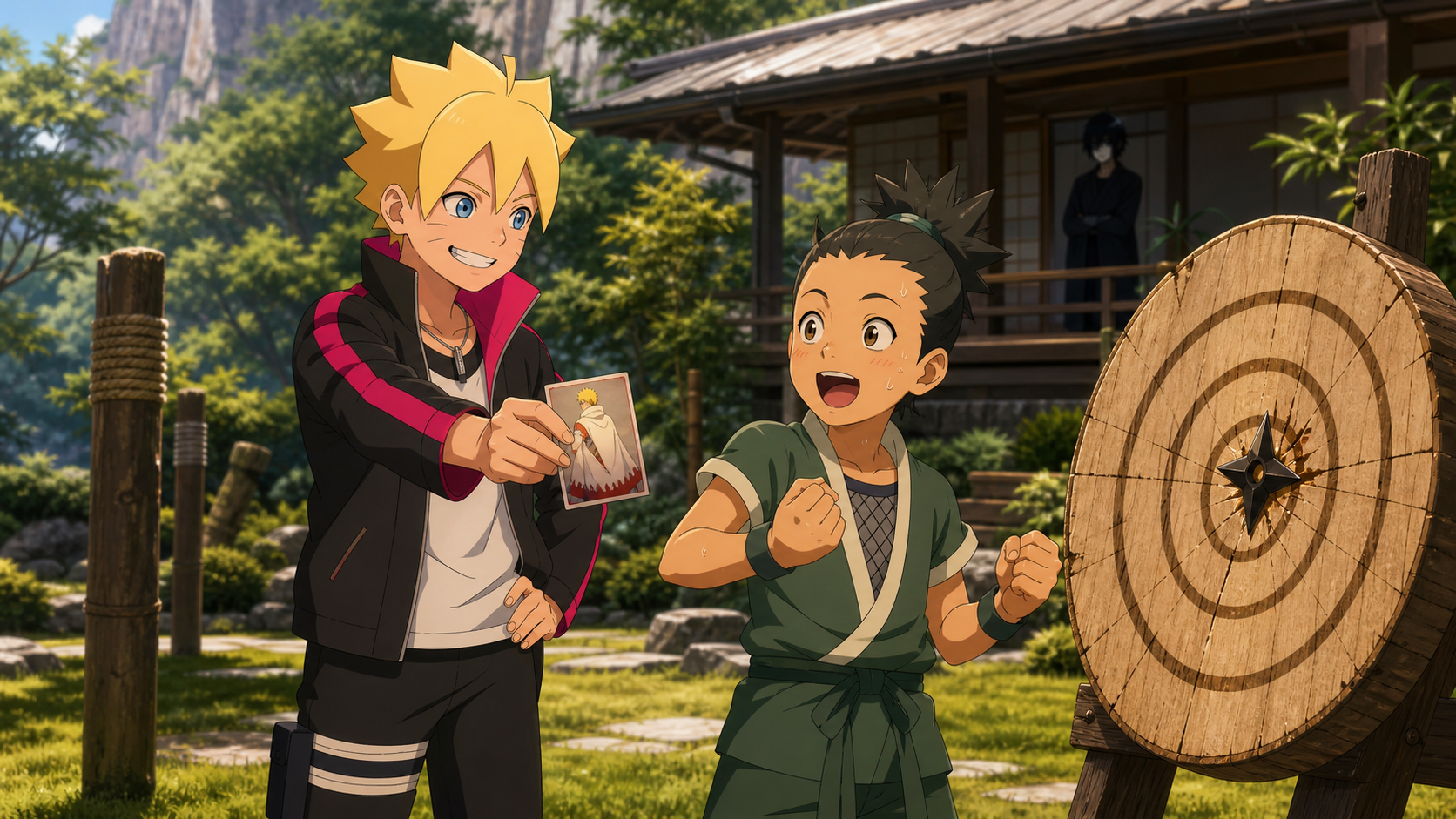
Boruto Episode 149, “Friends!!,” earns the friendship that Episode 148 only promised. Tentō stops buying attention long enough to fail at something honestly, and Boruto stops treating him like a walking credit card long enough to teach him. A shuriken hitting a wooden target should not feel like a major emotional victory in a ninja series. Here, the bullseye matters because Tentō cannot purchase the throw, hire somebody to practice for him, or order Boruto to respect him afterward.
The episode also places that small victory beside a much larger political argument. Ikkyū Madoka wants to cut Konoha’s defense budget and spend more on education and social support during peacetime. Naruto argues that protecting people remains a shinobi responsibility regardless of the budget. Both men have a point, and both are discussing children’s futures while failing to notice what their own sons need from them. Meanwhile, Shōjōji takes Yamaoka’s face and walks straight toward the trust Boruto just helped Tentō build.
The richest child in Konoha rented the whole hotel
Boruto arrives at Konoha Mountain Villa and learns that Ikkyū rented the entire property for the visit. The detail establishes Tentō’s world before the boy opens his mouth. Privacy is purchased. Space is purchased. Staff attention is purchased. Tentō has probably never needed to ask whether a room was available or whether another family wanted the same table.
Boruto reacts with the exact mix of annoyance and fascination the episode needs. He dislikes the excess, but he is still a child walking into another child’s impossible card collection. Wealth looks ridiculous until Tentō opens the cabinet containing the super-rare card Boruto has been chasing.
That card becomes the first real negotiation between them. Tentō offers the collectible in exchange for ninjutsu lessons. Boruto initially refuses because accepting would confirm every ugly thing he said about Tentō. Then Tentō keeps pushing, and Boruto decides harsh training might knock some arrogance out of him. Neither boy enters the arrangement with noble motives. Good. Friendship built from immediate moral perfection would feel cheaper than Tentō’s unlimited credit card.
The Harem Technique fails for the funniest possible reason
Boruto tries to shock Tentō with the Harem Technique. Tentō laughs because beautiful women are apparently a normal feature of the wealthy life surrounding him. The joke lands because Boruto expects his usual disruptive trick to control the room, and Tentō’s class position makes the trick ordinary.
Boruto then accuses Tentō of having no friends. That line is mean. Boruto has correctly identified the wound and uses the wound to win an argument. Tentō’s answer complicates the cruelty: he already considers Boruto a friend because he has always wanted a shinobi friend his own age.
Tentō’s definition of friendship is dangerously thin. Boruto was assigned to guard him. Money and political power created the meeting. Still, Tentō’s desire is genuine. He does not ask for another servant or famous adult. He wants a peer who can say no, laugh at him, and show him something real.
Boruto teaches through irritation before he teaches through care
Boruto agrees to shuriken training because he wants to correct Tentō’s attitude. The first lessons are punishment disguised as instruction. Tentō struggles, Boruto pushes, and the target refuses to flatter anybody.
That wooden target does more parenting than most of the adults in Tentō’s life. The target does not know his surname. The target does not care who pays for the villa. Every miss looks exactly like a miss. Tentō cannot threaten the target, and the target cannot be ordered to move closer.
Boruto understands that kind of honesty. Ninja training has frustrated, embarrassed, and exposed him since childhood. His gifts never eliminated practice. Naruto’s name actually made failure more public because everybody expected the Hokage’s son to be exceptional. Boruto recognizes Tentō’s anger because Boruto has thrown his own version of the same tantrum.
Tentō keeps throwing after the fun disappears
The key character beat is not the bullseye. The key beat arrives when Tentō misses repeatedly and chooses another throw. Boruto offers to stop. Tentō refuses.
For the first time, Tentō wants a result that cannot arrive through purchase. His hands hurt, his pride hurts, and Yamaoka tells him that a daimyō’s son does not need ninja training. Tentō keeps going because the skill connects to something deeper than collecting cards. He wants his father to see him as somebody worth admiring.
That motivation is painful because Ikkyū already loves his son. Love without attention still leaves a child guessing. Ikkyū gave Tentō an unlimited credit card because he did not know what the boy liked. Money became an apology that never required the father to learn the answer.
Yamaoka explains the credit card and exposes the family
Yamaoka tells Boruto that Ikkyū gave Tentō the card because he had no idea what interested his son. Tentō started collecting Extreme: Shinobi Picture Scrolls cards and entering tournaments. The collection is not merely spoiled consumption. The cards are evidence of a hobby Tentō built in the empty space where shared time should have been.
The explanation does not absolve Tentō’s behavior in Episode 148. He still used money to pressure Iwabee and disrupt local shops. Context gives the behavior a cause, not a free pass. RaeRae has no interest in pretending a sad backstory turns bad treatment into good treatment.
What the explanation changes is Boruto’s attention. He stops asking why Tentō is so annoying and starts asking what Tentō is trying to accomplish. That shift is the beginning of care. Boruto does not become softer by abandoning honesty. He becomes more useful because his honesty finally aims at the right problem.
The bullseye belongs to Tentō
Tentō hits the center of the target. The episode lets him celebrate without undercutting the moment. Boruto looks proud because the throw proves Tentō can endure frustration and improve.
The bullseye also prepares a future payoff. Learning one basic shuriken throw will not turn Tentō into a shinobi. The training gives him one action he can take when money, guards, and titles fail. A child who has spent his life protected by other people gains a tiny piece of agency.
Boruto rewards the effort with one of his rare Seventh Hokage cards. The same duplicate he treated as an annoyance becomes meaningful because he chooses to give the card after Tentō earns his respect. This exchange reverses Episode 148. Tentō offered money and could not buy a Naruto card. Now Boruto gives one freely because their relationship changed.
A gift is not the same thing as a purchase
Episode 149 understands that the object is less important than the terms of exchange. Tentō’s money makes every transaction feel compulsory. Boruto’s gift has no price and creates no debt.
The card also carries an uncomfortable family connection. Boruto gives Tentō an image of his own father, while Tentō trains because he wants recognition from his father. Naruto’s face becomes a bridge between two boys who struggle with paternal attention from opposite directions.
Boruto has spent years rejecting the public Hokage image because that image steals Naruto from the family. Tentō admires shinobi because his father admires them, hoping excellence might finally pull Ikkyū’s eyes away from work. Neither boy simply wants fame. Each wants proof that the person behind a powerful title sees him.
Ikkyū’s budget proposal deserves a real conversation
While the boys train, Ikkyū tells Naruto and Shikamaru that he wants to reduce defense spending and direct more money toward education and social services. The Land of Fire is living through peace. Funds once consumed by war could address needs previous generations never had the chance to prioritize.
The proposal is not foolish. Naruto grew up poor, isolated, and failed by village institutions long before any foreign army threatened him. Better schools and stronger social systems are also forms of protection. A village can survive an attack and still destroy children through neglect.
Naruto answers that shinobi must protect people regardless of the budget. He is also right. Peace does not erase organized crime, rogue ninja, Ōtsutsuki threats, or political kidnapping. Shōjōji is planning an operation against the daimyō’s son while the adults debate whether the era is safe enough to spend less on defense.
The scene works because the story does not need one man to be stupid. Public money always reflects competing definitions of safety. Schools protect children. Social support protects families. Intelligence work protects leaders. Trained shinobi protect civilians when those other systems are attacked. The real failure would be treating any single category as the whole answer.
Fathers discuss policy while their sons discuss recognition
Ikkyū admits that his relationship with Tentō is strained. Naruto understands more than he says because his own work has damaged his relationship with Boruto. The symmetry is almost painfully obvious, but the episode earns the comparison through different class realities.
Naruto knows what Boruto likes and still misses moments because the Hokage’s office consumes his time. Ikkyū appears not to know what Tentō likes at all and substitutes unlimited spending power for knowledge. One father is emotionally informed but physically absent. The other provides complete material access while remaining personally unreadable.
Both boys respond by performing. Boruto acts unimpressed by Naruto’s fame while chasing recognition through ninja achievement. Tentō collects shinobi cards and tries to become a ninja because his father admires them. The sons are speaking loudly. The fathers are listening late.
Friendship grows through shared time, not one speech
Boruto and Tentō train and play cards over several days. That quiet passage of time matters. One conversation can reveal a wound, but repetition builds trust. Boruto watches Tentō keep trying. Tentō watches Boruto remain present after the mission stops being entertaining.
The card games allow Tentō to possess real knowledge. Boruto may be the ninja instructor, but Tentō understands his collection and the game. Their relationship becomes reciprocal rather than another rich-client arrangement. Tentō can teach, compete, lose, joke, and improve without asking Yamaoka to purchase the outcome.
The episode title uses “Friends!!” because the friendship becomes a fact through behavior. Boruto gives the Naruto card. Tentō works for the bullseye. They spend ordinary time together. No grand promise is required.
Yamaoka walks away and Shōjōji walks back
Yamaoka leaves to prepare dinner and encounters a figure. By the final scene, Shōjōji has taken Yamaoka’s appearance. The Corpse Clone Technique turns the episode’s warmest development into a security nightmare.
Tentō has just learned to trust somebody without money. Now a criminal wears the face of an adult Tentō already trusts. That contrast is vicious. The danger does not enter by smashing the villa gates. The danger enters through familiarity.
Episode 147 established the technique’s horror with Kokuri. Episode 149 applies the same horror to a child who cannot know the person beside him has been murdered and replaced. Shōjōji exploits relationship infrastructure: attendants, routines, private rooms, and the assumption that a known face belongs inside the perimeter.
Boruto’s guard mission finally becomes a ninja mission
Boruto began the assignment believing Tentō was the hardship. The real hardship is protecting a client whose behavior initially makes empathy difficult. Guard work requires Boruto to see the person before the threat arrives.
Training Tentō looks like a distraction from security, yet the lessons may become the most important protection Boruto provides. A guard cannot control every room forever. Teaching Tentō to observe, endure, and throw one shuriken gives him options after the perimeter fails.
Boruto also repairs the weakness from Episode 148. During the robber mission, private anxiety broke his focus and ruined the larger plan. With Tentō, Boruto learns to look beyond the irritating behavior and identify the deeper need. That same attention will matter when familiar faces stop being reliable.
Tentō’s training works because Boruto stops making talent the standard
Boruto begins impatiently because throwing a shuriken feels basic to him. Tentō’s repeated misses expose how easily natural aptitude can become bad teaching.
A beginner needs the movement broken down, a reachable correction, and enough repetition for the body to remember. Teasing may loosen tension after trust exists. Teasing before trust can confirm a child’s belief that failure makes him ridiculous.
Boruto improves as the lesson continues. He notices effort, treats persistence as meaningful, and lets the bullseye belong to Tentō rather than claiming credit for instruction.
That shift matters beyond one afternoon. A skilled shinobi is not automatically a skilled teacher. Boruto becomes useful when he adjusts to the learner instead of demanding that the learner resemble him.
The hotel proves that unlimited service can produce extreme isolation
Tentō can rent space, order food, summon entertainment, and remove inconvenience. Every purchase creates another layer between him and ordinary contact.
The adults around him anticipate requests because anticipation is employment. Tentō cannot easily tell whether somebody enjoys his company, fears his status, or performs warmth because the contract requires warmth.
That uncertainty helps explain the bragging. Displaying wealth lets him control the relationship before somebody else can reject him. If attention was purchased openly, disappointment can be blamed on price rather than loneliness.
Boruto changes the room by becoming irritated, honest, and eventually invested. Friendship begins when another child reacts in ways the account cannot script.
Ikkyū’s social-spending proposal should not lose because a criminal exists
Education, housing, healthcare, food security, and civilian opportunity are security policy. Stronger public systems reduce the desperation, exclusion, and unattended children that criminal organizations recruit.
Naruto is right that shinobi readiness still matters. Peace does not erase kidnapping, espionage, border conflict, or organized crime. The answer should be a budget built around several forms of protection rather than a contest where one danger cancels every social need.
Naruto’s childhood makes the issue personal. A village full of armed adults failed to feed, supervise, and emotionally protect one orphan carrying a national security secret. More shinobi spending would not automatically repair that failure.
Shōjōji proves the need for capable defense. Tentō’s loneliness proves why defense cannot be the only service a government funds.
Yamaoka deserves a life before his face becomes evidence
Tentō trusts Yamaoka enough to follow his familiar appearance. That trust implies routines, conversations, and years of care the episode barely names.
Shōjōji’s technique is horrifying because murder does not end the violation. He consumes identity and uses the victim’s remembered relationships as access credentials.
The story should preserve details that belong only to Yamaoka: how long he served the family, what he taught Tentō, who depended on him, and when somebody last confirmed his safety. Those facts would help investigators and keep the dead man from becoming a disguise with no history.
Tentō will later have to grieve both the person and the betrayal performed through that person’s face. Adults owe him language separating Yamaoka’s care from Shōjōji’s imitation.
The Naruto card becomes valuable only after market value stops mattering
Boruto once treated the duplicate card as proof that the system mocked him with the father he already struggled to reach. Tentō could offer money, trades, and rarity, but none addressed that emotion.
Giving the card away means Boruto has changed what the object holds. Naruto remains complicated. The duplicate can still become a sincere gift because Tentō sees the Hokage differently and because Boruto chooses the recipient.
Tentō understands the difference immediately. A purchased rare card proves access. Boruto’s duplicate proves attention.
The scene does not resolve Boruto’s relationship with Naruto. Good gifts do not need to solve every wound. The card carries one honest moment between two boys who stopped bargaining long enough to recognize each other.
What works: friendship develops through behavior instead of instant confession
Boruto and Tentō irritate one another, share time, practice, argue, observe, and revise their assumptions. No single speech performs the entire transformation.
Tentō keeps throwing after Boruto could have dismissed him. Boruto keeps teaching after the assignment no longer feels like easy money. Each boy becomes more credible through repetition.
That process makes the kidnapping land. Shōjōji attacks a relationship the audience watched being built in small units. The threat is not merely that an important child has been taken. A child who just learned how genuine attention feels has been approached through the face of somebody he trusted.
The ordinary middle of the episode earns the urgency at the end.
What Episode 149 gets right
The episode gives emotional growth a physical process. Tentō misses, sweats, complains, returns to the line, and eventually hits the target. Boruto does not deliver a perfect friendship lecture. He teases, pushes too hard, notices more, and changes his approach.
The political conversation adds substance without stealing the episode from the boys. Ikkyū’s proposal makes sense, Naruto’s warning makes sense, and Shōjōji’s infiltration proves why the argument cannot be reduced to “peace good, soldiers unnecessary.” The village needs a wider idea of protection, not a slogan.
The Naruto card payoff is especially good. Episode 148 introduced the duplicate as a joke about Boruto’s relationship with his father. Episode 149 transforms the card into recognition. Tentō could buy inventory, but he could not buy that gift.
What could have gone deeper
Ikkyū’s budget discussion deserved another scene. Education and social services are not decorative evidence of peace. Naruto’s childhood alone could support a serious argument for stronger civilian systems. The story uses Shōjōji to validate defense spending quickly, but one criminal plot does not erase the daimyō’s point.
Yamaoka’s death or replacement also happens with very little space for the man himself. The technique is frightening, but the victim risks becoming only a face that Shōjōji needs. A brief detail about Yamaoka’s history with Tentō would have made the violation even sharper.
Tentō’s improvement arrives fast because the arc has limited episodes. The montage helps, though I would have welcomed one more ugly failure after the first burst of motivation. Children rarely abandon entitlement in one afternoon. Tentō does not become perfect, which saves the episode from feeling dishonest.
RaeRae’s read
Episode 149 is about the difference between being serviced and being known. Tentō has spent his life surrounded by people paid to anticipate needs, yet his father does not know his interests. Boruto begins as another assigned service provider. Friendship starts only when Boruto stops performing the contract and responds to the boy.
The shuriken bullseye matters because Tentō owns the effort. The Naruto card matters because Boruto owns the choice to give the gift. Neither moment can be charged to Ikkyū’s account.
That earned relationship makes the ending crueler. Shōjōji steals Yamaoka’s face precisely when Tentō begins learning whom to trust. The next episode will test whether Boruto’s lessons were a pleasant diversion or the first tools Tentō has ever earned for himself.
Sources and lawful viewing
Official episode reference: Naruto Official episode guide
Licensed episode route: Crunchyroll licensed series page