
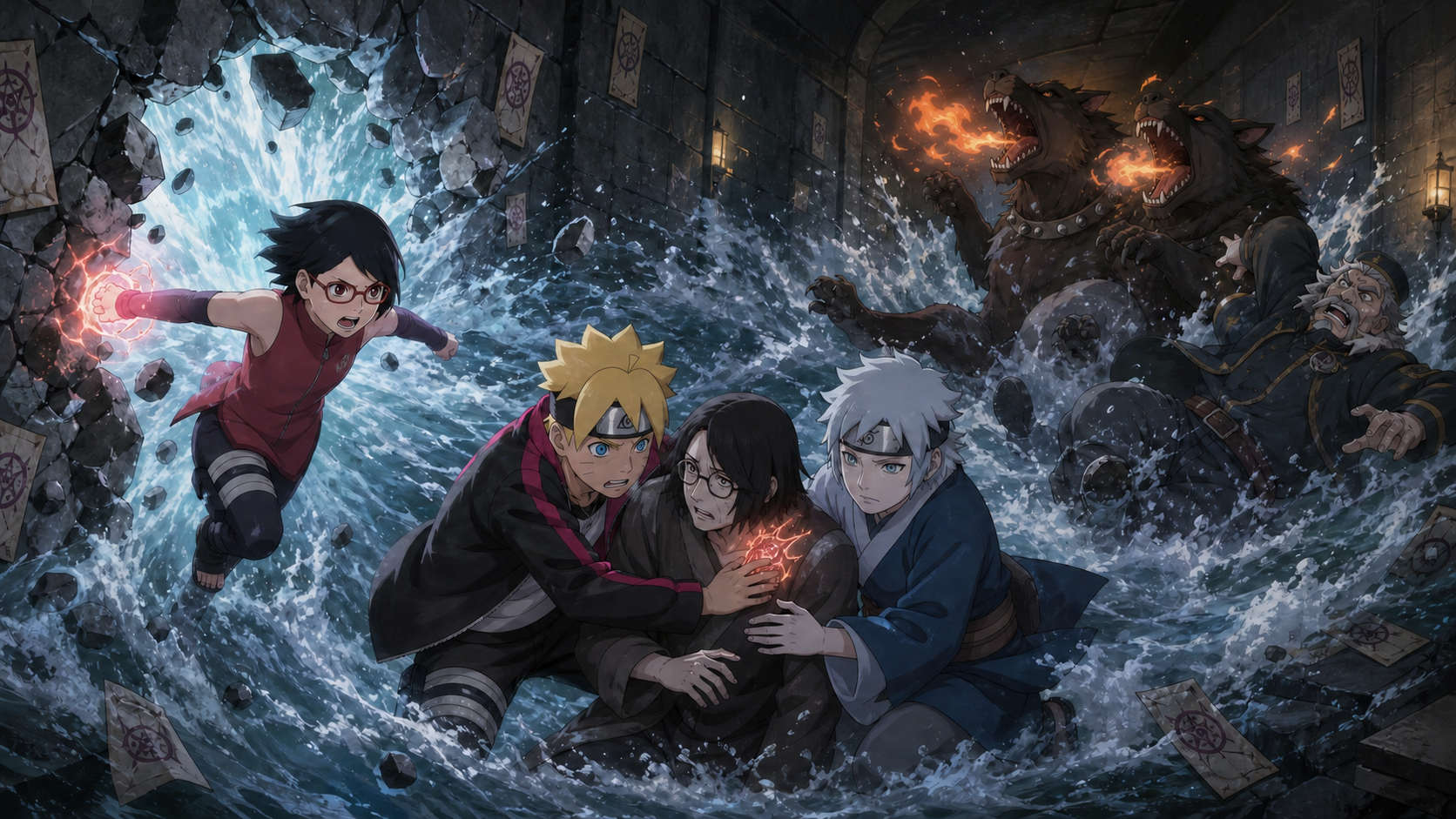
Executing the Prison Break!
Kedama restores Kiku’s forgotten escape route, Sarada releases the spring tide, and Benga destroys every safeguard between himself and Tsukiyo.
Series: Boruto: Naruto Next Generations
Episode: 146 · Executing the Prison Break!
Arc: Hozuki Castle
Release: 2020-03-01
Previous: Episode 145 · Breaking Out of Hozuki Castle
Directory: All 293 Boruto episodes
Bottom line
Boruto Episode 146 pays off the prison-break setup by letting every overlooked person and neglected system matter. Boruto's shadow clone buys time. Mitsuki's snakes track the guards. Kedama refuses Benga's offer, rescues Sarada, and shares the spring-tide route that Kiku once discovered. Sarada turns that forgotten knowledge into the wall of seawater that suppresses Kokuri's Heavenly Prison seal and sweeps Benga out of the escape corridor.
The episode also shows why Benga was doomed long before Tsukiyo killed him. Benga confuses control with loyalty. He withholds reinforcements, lies about catching Kokuri, removes Tsukiyo's seal for a promised reward, and assumes a gang lieutenant will honor a bargain after every useful safeguard is gone. The man who exploits letters, medicine, food, and sentences cannot recognize another predator doing the same thing to him.
My biggest frustration is how much competence disappears whenever the hound needs to look dangerous. Boruto survives direct fire without meaningful injury, Mitsuki's first attacks fail too neatly, and the barrier tags arrive exactly where the escape route needs another delay. The spring-tide rescue still lands because Sarada and Kedama earn that solution through the previous episode's history and infrastructure.
Boruto moves because waiting guarantees failure
Boruto, Mitsuki, and Kokuri leave the cell at night without Sarada's signal. Kokuri worries that the old tank may not contain water, which could make the route fatal once his seal reacts.
Boruto chooses faith in Sarada. The decision is risky, but Benga plans to transfer Kokuri to Hozuki Castle II. Missing the supply window means surrendering him to Mujina members already waiting there.
The team is not choosing between safety and danger. They are choosing between uncertain escape and organized assassination.
Mitsuki turns small creatures into a security network
Mitsuki's snakes monitor corridors and report guard movements. Their size lets the team see around corners without exposing a person.
The tactic fits the mission better than overwhelming force. Fighting every guard would confirm the breakout, endanger ordinary staff, and slow the group before they reach water.
Mitsuki's role remains quiet but essential. He provides the moving map that lets Boruto carry confidence without walking blind.
Kokuri's abandoned shinobi training still matters
Kokuri admits that he once tried to become a ninja before settling into bookkeeping. He feels ashamed because his skills have faded and he depends on teenagers to protect him.
That shame misunderstands his value. Accounting knowledge exposed the Mujina network. His ability to recognize patterns in money may harm the gang more than another combat technique.
The arc keeps asking what counts as useful strength. Kokuri cannot win a shinobi fight, but his records and choices created the entire mission.
Sarada lies unconscious while the plan assumes success
Below the castle, Sarada remains unconscious after the gas-line explosion. Seawater rises around her before she can contact the team.
The crosscutting makes Boruto's confidence uncomfortable. He is correct that Sarada completed the valve work, but he does not know she is trapped in the resulting water.
Trust keeps the plan moving. Trust cannot rescue an injured teammate by itself. Kedama's later intervention becomes the missing contingency Team 7 never planned.
Benga finds the evidence Sarada left behind
Benga searches Sarada's belongings and discovers notes linking her to Boruto, Mitsuki, Kokuri, and the old water tank.
The discovery is a basic operational failure. Sarada needed research materials, but leaving a readable plan in a room Benga could search gives him the route and countermeasure.
The mistake feels believable under time pressure. Team 7 changed from protection to escape within hours, and Sarada had to gather infrastructure details without a secure base.
The shadow clone keeps the cell looking occupied
Benga enters Boruto's cell and destroys the shadow clone with a fire-coated punch. The clone confirms the breakout while proving that Team 7 gained a meaningful head start.
Boruto uses a familiar technique for deception rather than spectacle. The clone does not defeat anyone. The clone makes prison records and guard assumptions remain wrong for a few more minutes.
Benga orders guards to report sightings without engaging. He understands that the fugitives possess abilities ordinary officers cannot safely contain.
The prisoners treat escape as shared possibility
News of the breakout agitates the cell blocks. Prisoners shout, demand release, and celebrate the idea that someone may have beaten the castle.
Their reaction explains why Benga feared Kiku becoming a martyr. One successful escape can change how every prisoner imagines the walls.
The institution depends on inevitability. If Boruto and Kokuri reach the shore, obedience stops looking like the only rational option.
Kedama refuses Benga's second attempt to buy betrayal
Benga praises Kedama for staying behind and offers special treatment in exchange for the fugitives' location. The offer repeats the lie that defined Kedama for years.
Kedama claims to know nothing because he sleeps deeply. The response is funny, but the choice carries weight. He refuses to let Benga turn him into the informant everyone already believes he was.
Silence once protected Benga's lie. This silence protects Kiku's unfinished hope.
Benga drains the old tank
After reading Sarada's notes, Benga reverses the water plan and drains the old tank. Boruto, Mitsuki, and Kokuri arrive as the last water disappears.
The empty chamber changes a carefully researched route into a trap. Kokuri cannot suppress the seal, and the group cannot wait while guards close in.
Benga wins this round because information travels faster than the fugitives. Sarada's notes give him the exact system to sabotage.
The two-headed hound makes the prison hunt personal
Benga summons a massive two-headed hound inherited through generations of wardens. The creature tracks fugitives and breathes fire, turning an institutional pursuit into a physical monster.
The inheritance matters. Hozuki Castle did not create escape violence with Benga. Wardens preserved tools designed to hunt prisoners across administrations.
Benga treats the hound as proof of permanent authority. The animal represents a tradition that assumes every escapee deserves capture before anyone asks whether the sentence remains lawful.
Mitsuki uses the castle against the hound
Mitsuki strikes with Lightning Release and collapses part of the ceiling onto the animal. The attack buys time without requiring a long arena fight inside a narrow corridor.
The hound survives and continues the pursuit, which keeps pressure on the group. The scene also reinforces how difficult the creature is to stop once Benga knows the route.
Mitsuki adapts through terrain, but later exchanges make the hound's evasions feel more convenient than intelligent.
Kedama finds Sarada in the rising water
Sarada wakes underground as seawater climbs around her. Kedama reaches the chamber and saves her before the space floods.
His rescue completes the choice he made with Mitsuki. Keeping the escape secret was passive protection. Entering the dangerous underground route is active commitment.
Kedama receives no promise of release. He risks punishment because Team 7 achieved the escape Kiku never completed.
Kiku's route becomes the new plan
Kedama explains that the chamber belonged to his failed escape plan with Kiku. They discovered how the spring tide moved beneath the prison.
Benga erased Kiku's legacy by calling Kedama a snitch. The prison break restores that legacy through practical knowledge. Kiku's research becomes the route that saves Kokuri.
The episode gives memory a material consequence. Remembering Kiku does not remain sentimental background. His work changes who survives.
Barrier tags turn the corridor into a seal trigger
Boruto, Mitsuki, and Kokuri encounter barrier tags along the route. The tags activate the Heavenly Prison and make forward movement dangerous.
The trap exposes another weakness in the original plan. Team 7 researched the tanks and ship schedule but did not identify every seal boundary.
Kokuri becomes the person most endangered by each surprise. Boruto and Mitsuki can fight. His body carries the punishment for a route he cannot verify.
The hound and Benga close the distance
Benga arrives with the hound and explains the animal's history as a warden's hunting tool. The confrontation gives him the audience he wants.
Mitsuki attempts to restrain the creature, but the hound knocks him down. Boruto protects Kokuri while trying to keep the path open.
The action has urgency, though the choreography sometimes lowers Team 7's ability to extend the threat. A two-headed fire hound can be dangerous without making trained shinobi forget coordinated attacks.
Kokuri's seal ignites at the worst moment
Kokuri attempts to flee and triggers the Heavenly Prison. The mark burns across his body while the water route remains empty.
The scene makes the seal's cruelty visible. Prison control lives inside his skin. Even after officials destroy his parole order, the jutsu still treats movement toward freedom as guilt.
Boruto and Mitsuki cannot simply carry him through the pain because the technique can kill him before they reach the shore.
Sarada releases the spring tide
Sarada reaches the corridor and smashes through the stone, allowing the spring tide to surge into the passage. Water floods over Kokuri and suppresses the seal.
The same force washes Benga and the hound away. His attempt to control the prison's water system fails because Kedama knows a deeper route than the official infrastructure he sabotaged.
Sarada's entrance works because the rescue combines her strength, Kiku's research, Kedama's decision, and the natural tide. No single hero owns the solution.
Kedama confronts Doragu without fear
Kedama meets Doragu and tells him he is free to report the escape. Doragu notices that Kedama's Heavenly Prison mark has been removed.
Kedama has already received the reward Doragu cannot understand. Team 7 completed the escape route he and Kiku once sought, and he stopped living inside Benga's false story.
Doragu asks what benefit could justify the risk. Kedama's answer rejects the prison economy where every choice must purchase comfort or influence.
Benga refuses outside reinforcements
Haie wants to contact Kusagakure because the prisoners are restless and the escape has exposed a security crisis. Benga prevents the call.
Outside help could stabilize the prison and preserve lives. Outside help could also reveal Mujo's condition, the burned parole order, Sarada's disappearance, and Benga's unauthorized decisions.
He chooses control of the story over control of the emergency.
Tsukiyo recognizes Benga's lie immediately
Benga tells Tsukiyo that he handled Kokuri and demands payment. Tsukiyo hears desperation rather than success.
Benga spent the arc reading prisoners' tells, threatening their secrets, and deciding whose need could be exploited. He now performs the same weakness in front of a more experienced criminal.
Tsukiyo promises to handle Kokuri's accomplices if Benga removes his Heavenly Prison seal. Benga accepts because he has run out of institutional options.
Removing Tsukiyo's seal removes Benga's last protection
Benga releases Tsukiyo and expects a reward. Tsukiyo kills him instead.
The outcome is not karma delivered by the universe. The murder follows Benga's own decisions. He blocks reinforcements, frees a gang lieutenant, and abandons the only mechanism limiting that man's chakra.
Corruption teaches Benga that every relationship is a transaction. He never learns that a transaction without enforcement is only a request made to someone stronger.
The escape reaches the shore but not safety
Boruto, Sarada, Mitsuki, and Kokuri reach the shoreline, where the supply route offers a way away from Hozuki Castle.
Tsukiyo appears before they can complete the escape. Benga's final bargain releases the exact threat Team 7 entered the prison to contain.
The team has escaped the institution while carrying the institution's last failure with them.
Sarada’s unsecured notes are an operational failure with a believable cause
She is working inside a hostile institution, balancing disguise, injury, time pressure, and a plan that depends on details nobody else can easily reconstruct. Writing information down reduces cognitive load.
Leaving the notes where Benga can find them gives the warden the route, water dependency, and timing he needs to sabotage the escape. The mistake deserves a direct place in the debrief.
That does not make Sarada foolish. Good operations assume competent people will become tired, injured, or interrupted. Sensitive notes need codes, destruction triggers, divided storage, or a trusted handoff.
The lesson is not “never write anything.” The lesson is that information security belongs inside mission planning before stress makes every improvised hiding place feel temporary.
Kedama restores Kiku’s work by refusing the role Benga assigned him
Benga survives by turning prisoners into extensions of his control. Informants trade other people’s safety for small protection and learn that cooperation with authority is the only available agency.
Kedama breaks that pattern when he rejects another bargain, finds Sarada, and carries forward Kiku’s route. He cannot undo the earlier betrayals or restore Kiku’s life. He can decide that Benga no longer gets to define what he does next.
That choice gives the escape its moral center. Boruto and Mitsuki bring shinobi skill. Sarada brings force and planning. Kedama brings knowledge from inside the population the mission could not have succeeded without.
Repair begins through action, not instant absolution. His decision matters because the decision costs him the last scraps of safety Benga offered.
Benga’s refusal of reinforcements turns corruption into public danger
By this point, the crisis threatens guards, prisoners, infrastructure, and anyone living near the castle. Blocking outside help protects Benga’s secret while increasing danger for everybody he commands.
Haie and the remaining staff need an emergency authority independent of one warden. If a commander can suppress alerts after mass system failure, the institution has built secrecy above safety.
Staff also need protected reporting routes. Watching abuse without acting becomes easier when every complaint travels through the person committing the abuse.
Benga makes the decisions, but governance determines how long one official can make those decisions without interruption. The final inquiry should examine the chain above him as carefully as the crimes attached to his name.
The prison hound should reveal Team 7’s coordination instead of reducing their competence
A two-headed chakra beast inside narrow corridors can create a real tactical problem. Fire, scent, bulk, and familiarity with the grounds all favor the animal.
The fight stretches because the episode needs water and escape routes to converge. At points, trained shinobi absorb attacks or repeat ineffective movement longer than their established skill supports.
A stronger sequence would give the hound an explicit barrier enhancement, regenerative seal, or command pattern that Team 7 must decode. Mitsuki’s use of terrain could then become the culmination of observation rather than the moment the heroes remember they are clever.
Difficulty should come from the opponent’s defined advantage, not temporary reductions in everyone else’s ability.
Kokuri’s seal proves why extraction needed a medical specialist
The punishment seal is a lethal device attached to a protected person. Team 7 knows water may suppress activation, yet the plan depends on prison infrastructure and improvisation.
A medic or sealing specialist could evaluate trigger conditions, monitor Kokuri, and prepare containment before the route collapses. Instead, three genin and a compromised inmate carry the full responsibility while fighting guards and a chakra hound.
The seal also raises accountability questions. Who authorized its use? How many prisoners carry similar marks? What medical records exist? Can a warden activate a lethal punishment without independent review?
Escaping Kokuri is urgent. Documenting the system that placed the seal on his body is part of preventing another prisoner from becoming the next emergency.
Tsukiyo understands Benga because corruption never created loyalty
Benga imagines that withholding information and manipulating seals give him leverage over the Mujina Gang. Tsukiyo reads the lie because their arrangement was transactional from the beginning.
Neither man trusts the other. Each expects betrayal and prepares to benefit first. Removing Tsukiyo’s seal destroys the only restraint Benga controlled while offering no reason for mercy.
His death therefore follows the logic he imposed on everyone else. Benga treated people as tools, information as private currency, and institutional power as personal property. He reaches the shore with no relationship capable of protecting him.
The outcome is satisfying without making prison reform complete. One corrupt official dying does not repair the systems that enabled him.
Haie’s position deserves attention too. A deputy who recognizes escalating danger needs a documented route to override a commander acting against public safety. The prison cannot depend on personal bravery with no procedural backing. Emergency doctrine should define when blocked communications, unexplained seal activation, mass movement, or commander incapacity automatically notify outside authorities. Those triggers protect staff from having to prove corruption while people are drowning. They also create records that later investigators can compare against Benga’s orders. Silence should never remain the default simply because the person causing the emergency holds the highest title inside the walls.
What worked for me
Kedama and Sarada give the climax emotional and mechanical weight. His choice restores Kiku's erased work, and her strength converts that knowledge into the spring-tide rescue.
The episode also completes Benga's collapse through character. Every step follows his need to hide evidence and collect a private reward.
Boruto's shadow clone, Mitsuki's snakes, and the water system keep the escape grounded in preparation even after the chase becomes action-heavy.
What needed more room
Team 7's fight with the hound relies on uneven competence. Boruto absorbs fire too easily, and coordinated shinobi struggle longer than the setup justifies.
Sarada leaving detailed notes unsecured is believable but deserves acknowledgment as a serious operational mistake. Those papers allow Benga to drain the tank and target the exact route.
Haie also needs a stronger response after Benga blocks reinforcements. The prison staff has watched enough abuse to know that silence now endangers everyone.
The verdict
"Executing the Prison Break!" succeeds because escape becomes a collective correction to Benga's control. Kedama rejects the snitch role. Kiku's forgotten route returns. Sarada releases the tide. Boruto and Mitsuki keep Kokuri moving until water can suppress the seal.
Benga loses because he destroys every system that could save him from his own decisions. He hides Mujo's condition, blocks outside help, drains the tank, lies to Tsukiyo, and removes the gang lieutenant's seal.
The walls are behind Team 7, but Tsukiyo is waiting at the shore. Freedom remains one fight away, and Benga has handed the enemy full access to chakra before dying for a reward that never existed.
Sources and lawful viewing
Official episode reference: Naruto Official episode guide
Licensed episode route: Crunchyroll licensed series page