
Breaking Out of Hozuki Castle
Team 7 turns bird droppings, supply schedules, old water tanks, and Kedama’s buried history into a prison-break plan Benga is willing to kill to stop.
Series: Boruto: Naruto Next Generations
Episode: 145 · Breaking Out of Hozuki Castle
Arc: Hozuki Castle
Release: 2020-02-23
Previous: Episode 144 · Kokuri’s Secret
Directory: All 293 Boruto episodes
Bottom line
Boruto Episode 145 builds a prison break out of bird droppings, supply schedules, old plumbing, and one damaged man's decision not to repeat a lie that ruined his life. The escape has to solve three different problems at once. Team 7 needs a route off the island, enough water to suppress Kokuri's Heavenly Prison seal, and a way to coordinate with Sarada while Benga controls the guards.
The episode understands that a real escape plan is mostly logistics. Mitsuki maps hidden routes with snakes. Boruto learns when food ships arrive. Sarada studies the castle's water system. Seagulls create the excuse that lets four people meet without looking like a conspiracy. None of those details feel glamorous, but every detail matters more than a giant jutsu fired at the front gate.
Kedama carries the emotional center. Prisoners call him a snitch because Benga blamed him for Kiku's death. Kedama accepted the hatred because he felt guilty about arriving late to their escape. His silence protected Benga's version of history for years. When he discovers Team 7's plan, he can finally decide whether guilt will keep serving the man who killed his friend.
Bird droppings become operational cover
Mitsuki calls seagulls toward the prison while Boruto scatters bread crumbs. The resulting mess earns Boruto, Mitsuki, and Kokuri a cleaning assignment.
The setup sounds ridiculous, which makes the cover effective. Guards expect prisoners to resent filthy work, not request the chore because bird waste creates access to Sarada. A humiliating punishment becomes the only safe meeting room available.
Team 7 keeps turning prison routines into openings. Mail exposed Benga's bribes. A lighthouse wager bought information. Cleaning duty now creates a planning session. Their advantage comes from seeing function where officials see only discipline.
The escape needs a route, timing, and a seal solution
Mitsuki has used snakes to scout a path through Hozuki Castle. Boruto learned from Doragu when the food-supply ship will arrive. Those two pieces create a possible exit and transportation away from the island.
Kokuri's Heavenly Prison mark remains the harder problem. Crossing the prison boundary or using chakra can trigger fatal burning. Team 7 cannot simply hide him inside a crate and hope the seal ignores geography.
Water suppresses the technique. The plan therefore depends on moving Kokuri through enough water at the right moment, not merely reaching the ship before guards notice.
Sarada studies infrastructure instead of waiting outside
Sarada learns that the main above-ground drinking-water tank is too exposed for Kokuri to approach. Sabotaging that tank will force the prison to draw from a newer underground system that filters seawater.
An older underground tank still exists beside the new equipment. Security around the unused structure should be lighter because officials no longer consider the tank operational.
Sarada plans to adjust the valves so the old chamber fills too. That water can become a hidden corridor where Kokuri's seal remains suppressed long enough for the group to pass.
The plan respects the prison's physical systems
Many escape stories treat walls as the only obstacle. Hozuki Castle adds schedules, seals, tanks, pipes, tides, guards, and transportation.
The water system was designed to sustain the prison, but Team 7 recognizes that maintenance redundancy can create an alternate route. A backup tank exists because infrastructure fails. That same redundancy gives prisoners a space administrators stopped watching closely.
The plan feels earned because Team 7 does not discover a magical tunnel. They research how the castle moves food and water, then redirect those systems.
A signal has to carry more than information
Sarada and the others establish a signal confirming that she has opened the correct valve. Without that signal, Boruto and Mitsuki cannot know whether the old tank contains water or whether Sarada has been caught.
The signal also carries permission to risk Kokuri's life. Moving too early could activate his seal inside an empty chamber. Waiting too long could allow Benga's transfer order to take effect.
Coordination becomes the fragile center of the plan because Team 7 cannot use obvious communication tools inside a monitored prison.
Kedama sees Mitsuki's snake
Kedama notices one of Mitsuki's lookout snakes near the cleaning area. He claims that he only came to deal with the bird mess, but his presence places the entire escape at risk.
Boruto and Mitsuki know his reputation. Prisoners believe he reported a previous escape attempt to the guards. The easiest response would be to treat reputation as proof and remove him before he can speak.
Episode 145 deliberately revisits the lesson from Arai's frame-up. A history told by the prison may be evidence, but a reputation is not the same as verified truth.
Mitsuki restrains Kedama before listening
Mitsuki follows Kedama and binds him with snakes. The display reveals that Mitsuki can use ninjutsu despite wearing the Heavenly Prison mark, which gives Kedama dangerous knowledge about the undercover mission.
The restraint is tactically understandable. Team 7 cannot allow him to reach Benga before they know his intention. The approach still begins with force because the mission has narrowed their options and patience.
Mitsuki then does the more important work. He recognizes that Kedama is hiding pain rather than plotting betrayal and gives him room to explain.
Mitsuki understands the loneliness of infiltration
Mitsuki remembers his own experience entering an enemy group and living beside people who could not know his real purpose. That memory lets him read Kedama as a person carrying divided loyalties rather than a simple informant.
Empathy becomes operational intelligence. Mitsuki asks why Kedama accepted years of hatred instead of focusing only on whether he will report Team 7.
The connection works because Mitsuki does not pretend their situations are identical. He recognizes the emotional shape of secrecy, guilt, and being judged through a role other people assigned.
Kiku's death explains the flowerbed
Kedama reveals that he planned to escape with his friend Kiku. He arrived late, and Benga caught Kiku before the plan could succeed.
Kiku cared for the flowers that Kedama still watches. The ruined flowerbed is therefore not random prison decoration. Kedama keeps returning to the place where his friend's labor remains visible.
The episode gives grief a physical routine. Kedama cannot repair the past, but he can look after the last living evidence that Kiku wanted beauty inside the prison.
Benga manufactured the snitch story
Benga did not want Kiku's death to inspire resistance. A prisoner killed while attempting escape could become a martyr, especially if others viewed his defiance as brave.
He told the inmates that Kedama reported the plan. That lie redirected anger away from the guards and toward a prisoner already weakened by grief.
The strategy is classic institutional self-protection. Benga does not merely punish escape. He controls the story afterward so prisoners police the memory of rebellion for him.
Kedama's guilt kept Benga's lie alive
Kedama never denied the accusation because he blamed himself for arriving late. His silence felt like punishment he deserved.
Guilt and responsibility are not identical. Kedama may regret failing Kiku, but Benga chose to catch, punish, and erase the dead man. Benga also chose to frame the surviving friend.
By accepting the false label, Kedama let Benga's story become prison history. That consequence does not make him responsible for the original lie, but silence allowed the lie to keep harming him and Kiku's memory.
Kedama promises not to expose Team 7
Kedama tells Mitsuki that he will keep the new escape secret. The promise gives him a chance to act differently without pretending the old guilt vanished.
Protecting Team 7 does not bring Kiku back. The decision does refuse Benga another opportunity to turn one prisoner's hope against another.
Kedama's choice carries more weight because nobody offers freedom or payment. He receives trust and a chance to stop serving a lie.
Doragu's information was never neutral
Doragu reports Boruto's questions about supply ships to Benga. The unofficial inmate boss has been part of Benga's information network.
His earlier help was transactional, but Boruto treated the exchange as a closed deal. Prison economies rarely separate favors from surveillance so neatly. A person powerful enough to know schedules is often powerful because authorities tolerate or use him.
Doragu sells access in both directions. Boruto buys the ship schedule while Benga buys knowledge of who requested the schedule.
Sarada's questions also reach Benga
Benga learns that Sarada questioned Tsukiyo about their relationship. Her reporter cover no longer protects the investigation because the people she studies compare notes.
He orders guards to find her. Sarada creates a distraction and reaches the underground valve system before the search closes around her.
Her portion of the mission requires more than research. She has to execute the sabotage alone while knowing any confrontation could expose the entire team.
Benga attacks the person threatening his paper authority
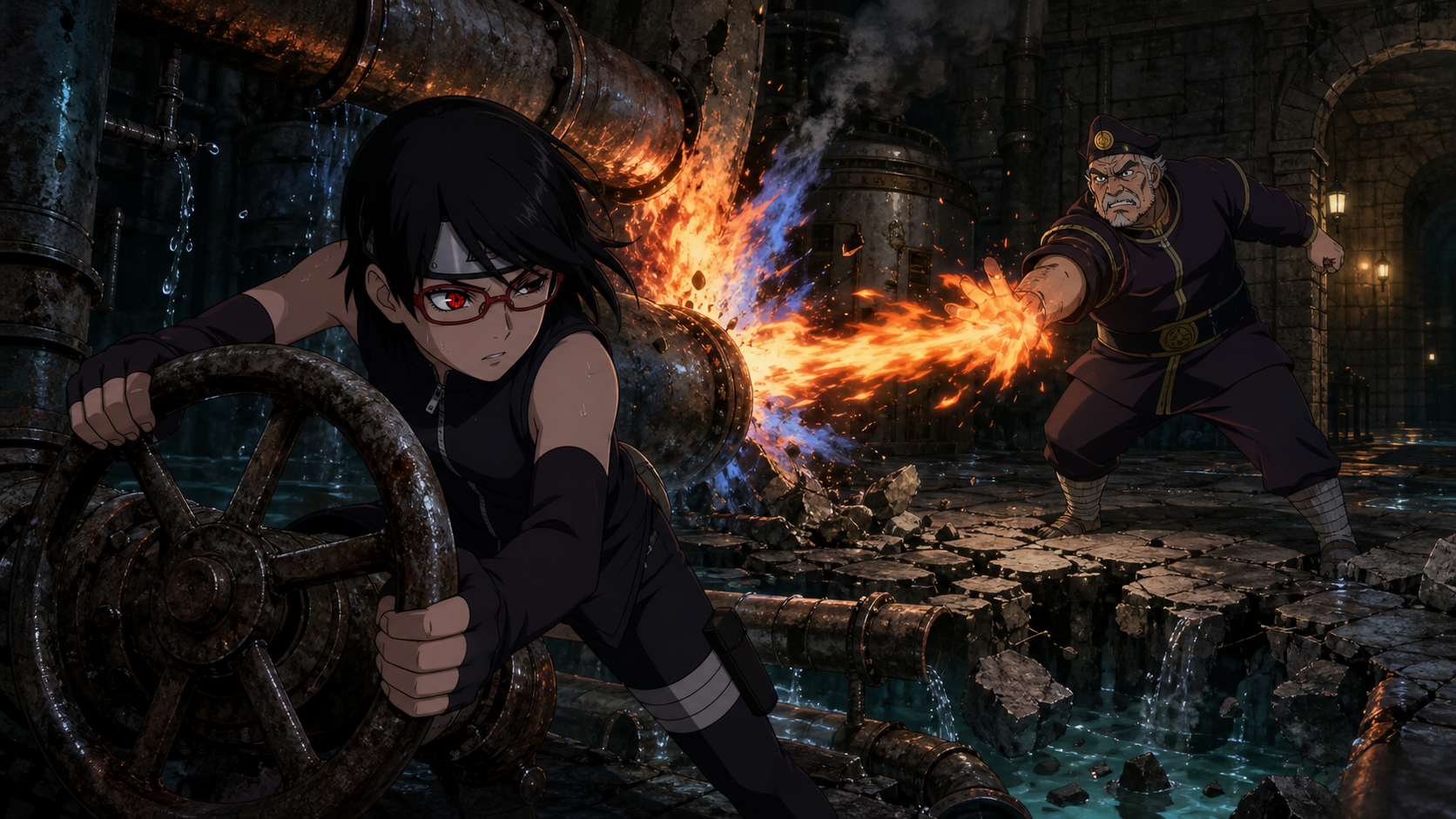
Benga intercepts Sarada underground. She implies that she knows about his abuse of power and tries to make him back away.
He answers with Fire Release. The attack confirms that his authority cannot survive transparent examination. A legitimate chief guard could detain a suspicious visitor and document the reason. Benga needs silence because the prison records would expose him.
His violence also shows that he no longer expects Mujo or outside officials to restrain him. Control of the institution has become permission to remove witnesses.
Fire, gas, and old stone punish Benga's recklessness
Sarada dodges the flames, but Benga's attack strikes a gas line. The explosion tears through the underground chamber and collapses the floor beneath her.
The accident grows directly from his abuse of power. He uses a combat technique inside aging infrastructure without concern for workers, prisoners, or the water system supporting the castle.
Benga wants complete control, yet his need to dominate Sarada creates the uncontrolled disaster that may expose or destroy the prison's foundations.
Kedama hears the cover-up begin
Kedama overhears Benga cancel the search for Sarada and order guards away from the gas leak. Benga does not report that she fell underground or organize a rescue.
Silence becomes another attempted disappearance. If Sarada dies below the prison, Benga can describe her as a missing outsider who entered restricted space.
Kedama now holds information that could protect Team 7, but he does not immediately tell Boruto and Mitsuki. His hesitation shows how years of punishment can survive even after someone chooses a different side.
Boruto moves without Sarada's signal
The agreed signal never arrives. Boruto has to decide whether the absence means failure, capture, injury, or a communication problem.
He chooses to believe Sarada completed her task and keeps the escape on schedule. That confidence can look reckless because Kokuri's life depends on water being present.
The decision also reflects earned teamwork. Boruto knows Sarada would not abandon the mission silently. If she could act, she acted. Waiting for perfect certainty would hand Kokuri to Benga.
Trust does not remove the need for contingency
Boruto's faith in Sarada is emotionally satisfying, but a prison-break plan needs a backup check. Team 7 should have a second signal, a water-level test, or a delay condition.
Trust answers whether Sarada tried. Trust cannot prove whether an explosion interrupted the valve before the old tank filled.
The episode makes the risk clear enough that the missing contingency feels intentional. Team 7 has run out of time, and imperfect action is the only alternative to guaranteed transfer.
The flowerbed is an archive built where Benga expected decoration
Kiku cannot place a formal accusation into a system controlled by the person she needs to accuse. The flowerbed preserves memory through location, labor, and the questions later investigators might ask.
Benga turns her death into a warning and Kedama’s guilt into a wall around the truth. The garden survives that narrative because plants do not repeat his version of events.
Sarada’s infrastructure work and Mitsuki’s conversation with Kedama finally connect the physical clue to the buried history. Evidence was present long before Team 7 arrived. The institution lacked a safe listener.
That distinction matters. Corrupt systems often claim nobody reported abuse while punishing every available method of reporting. Kiku left a record. Benga made recognition dangerous.
Kedama’s silence is survival training that becomes another prison
He has learned that speaking can kill people, trusting can be used against him, and Benga controls which story guards accept. Silence therefore protects him until silence begins protecting Benga too.
Mitsuki does not fix that conditioning with one kind sentence. He offers a specific choice under pressure: protect the escape or return to the role Benga wrote for him.
Kedama’s promise matters because the promise runs against years of learned behavior. His later hesitation also makes sense. A person can decide to change before the body stops expecting punishment.
The episode should give that conflict more time when he overhears Benga’s orders. Courage is not the absence of the old fear. Courage is carrying information while the old fear remains active.
Sarada’s research proves that infrastructure is part of shinobi intelligence
She studies water flow, tanks, valves, cleaning routes, food delivery, guard patterns, and seal behavior. None looks glamorous. Together, they determine whether Kokuri lives.
The work suits her future leadership better than another isolated combat showcase. A commander needs to understand systems, identify dependencies, and recognize which ordinary worker knows more than the official plan.
Her confrontation with Benga also shows the cost of discovery. Once he realizes she can connect the records, he attacks the evidence-holder rather than answer the evidence.
Sarada is not “outside the action.” She is working on the part of the battlefield that decides whether action has somewhere to go.
One missing signal should not collapse the entire extraction plan
The signal carries timing, confirmation, and permission to move. When Sarada cannot send the signal, Boruto must choose between waiting for certainty and watching the transfer become unavoidable.
His decision is understandable. The planning failure happened earlier. Team 7 needs a secondary signal, a deadline rule, and a response for each likely failure: Sarada delayed, route compromised, water unavailable, or Kokuri’s seal activated.
Contingencies do not mean teammates distrust one another. Contingencies acknowledge that competent teammates can be injured, trapped, or cut off.
The episode uses the missing signal to create tension and prove trust. Stronger operational writing could keep both without making the whole plan depend on one communication path.
Doragu sells information because prison authority rewards selective truth
His position lets him translate rumors, prisoner behavior, and guard expectations into value. Information is never neutral when the person collecting the information chooses which details reach Benga.
Boruto treats a useful answer as progress. Doragu treats Boruto’s questions as a product that can be resold. The exchange reveals why undercover work needs source evaluation, corroboration, and clear limits on what one contact can learn.
Benga benefits from a prison culture where informal power reaches every cell. He does not need cameras in every conversation if prisoners and intermediaries know that reporting earns protection.
Doragu is responsible for his choices. The institution makes those choices profitable.
Benga attacks evidence because paper authority cannot survive examination
He has rank, keys, guards, records, and the ability to label a prisoner dangerous. Sarada threatens him by comparing those official surfaces with the physical system underneath.
Fire and gas turn his attempt at control into structural collapse. The prison itself resists the fiction that one officer can destroy evidence without endangering everybody.
Benga’s recklessness is not random villain behavior. Accountability would expose the reward scheme, Kiku’s death, Kedama’s coerced role, Mujo’s condition, and his dealings with the Mujina Gang. Each new secret makes destruction feel cheaper than disclosure.
That calculation explains him and condemns the oversight structure that allowed the calculation to remain rational for so long.
Mujo’s incapacitation should have triggered an automatic external review of every unusual order Benga issued afterward. Temporary command cannot become a blank check. Staffing changes, restricted communications, punishment-seal activity, medical records, and prisoner transfers should leave audit trails that one acting warden cannot erase. Guards need a protected route to attach concerns to those records without asking Benga for permission. Prisoners need access to counsel or independent inspectors who do not depend on good behavior points controlled by the same administration. Oversight is boring until one official decides that every locked door belongs to him. Hōzuki Castle demonstrates the cost of waiting for spectacular proof.
What worked for me
Kedama's history gives the episode depth beyond escape mechanics. Benga controls prisoners by controlling stories, and Kiku's flowerbed preserves the truth that official history tried to bury.
The planning also respects physical reality. Ships, tanks, valves, seals, cleaning assignments, and lookout snakes create a route that requires every member's specialty.
Sarada receives consequential work rather than serving as the outside messenger. Her research identifies the solution, and her confrontation with Benga changes the condition of the entire prison.
What needed more room
Kedama's failure to warn Boruto after hearing Benga's orders needs more interior conflict. His promise to Mitsuki and his old habit of silence collide at the exact moment information matters most.
Doragu's relationship with Benga deserves earlier foreshadowing. His authority always looked suspicious, but the reveal arrives mainly as a plot mechanism to expose Boruto's questions.
Team 7 also needs a stronger backup for the missing signal. Trust is character growth. A second verification method is competent planning.
The verdict
"Breaking Out of Hozuki Castle" earns its title before anyone crosses the wall. The escape begins when Team 7 understands the systems that hold Kokuri: the seal, the water supply, the food ship, the guard network, and the stories prisoners believe about one another.
Kedama's story matters most because Benga imprisoned him without changing his cell. A lie isolated him, turned Kiku's death into shame, and trained him to stay silent. Mitsuki offers a chance to choose differently.
Sarada opens the water route while Benga destroys the floor beneath her. Boruto moves without the signal because time has disappeared. The prison break is no longer only a rescue mission. Team 7 is moving through an institution that will bury evidence, memory, and people to keep one corrupt officer in control.
Sources and lawful viewing
Official episode reference: Naruto Official episode guide
Licensed episode route: Crunchyroll licensed series page