
Kokuri’s Secret
Kokuri’s donated fortune saves Kamata’s sister, but Benga burns an official parole order and turns prison administration into an assassination route.
Series: Boruto: Naruto Next Generations
Episode: 144 · Kokuri’s Secret
Arc: Hozuki Castle
Release: 2020-02-16
Previous: Episode 143 · The Criminal Targeting Kokuri
Directory: All 293 Boruto episodes
Bottom line
Boruto Episode 144 finally answers the money question, then reveals that stolen cash was never the most dangerous thing inside Hozuki Castle. Kokuri did not hide the Mujina Gang's fortune for himself. He donated the money to a medical foundation after discovering that his accounting work had been laundering proceeds from robberies. That donation helped pay for Kamata's sick sister, which gives the episode a human consequence beyond one nervous man's confession.
The real theft happens elsewhere. Benga steals Kokuri's freedom by burning an official parole order, withholding Mujo's medicine, and taking control of the prison long enough to arrange a transfer into Mujina territory. No mask or secret passage is required. Benga uses administrative authority, access to correspondence, and control over medical care. The chief guard becomes more dangerous than Arai because his violence can arrive stamped as procedure.
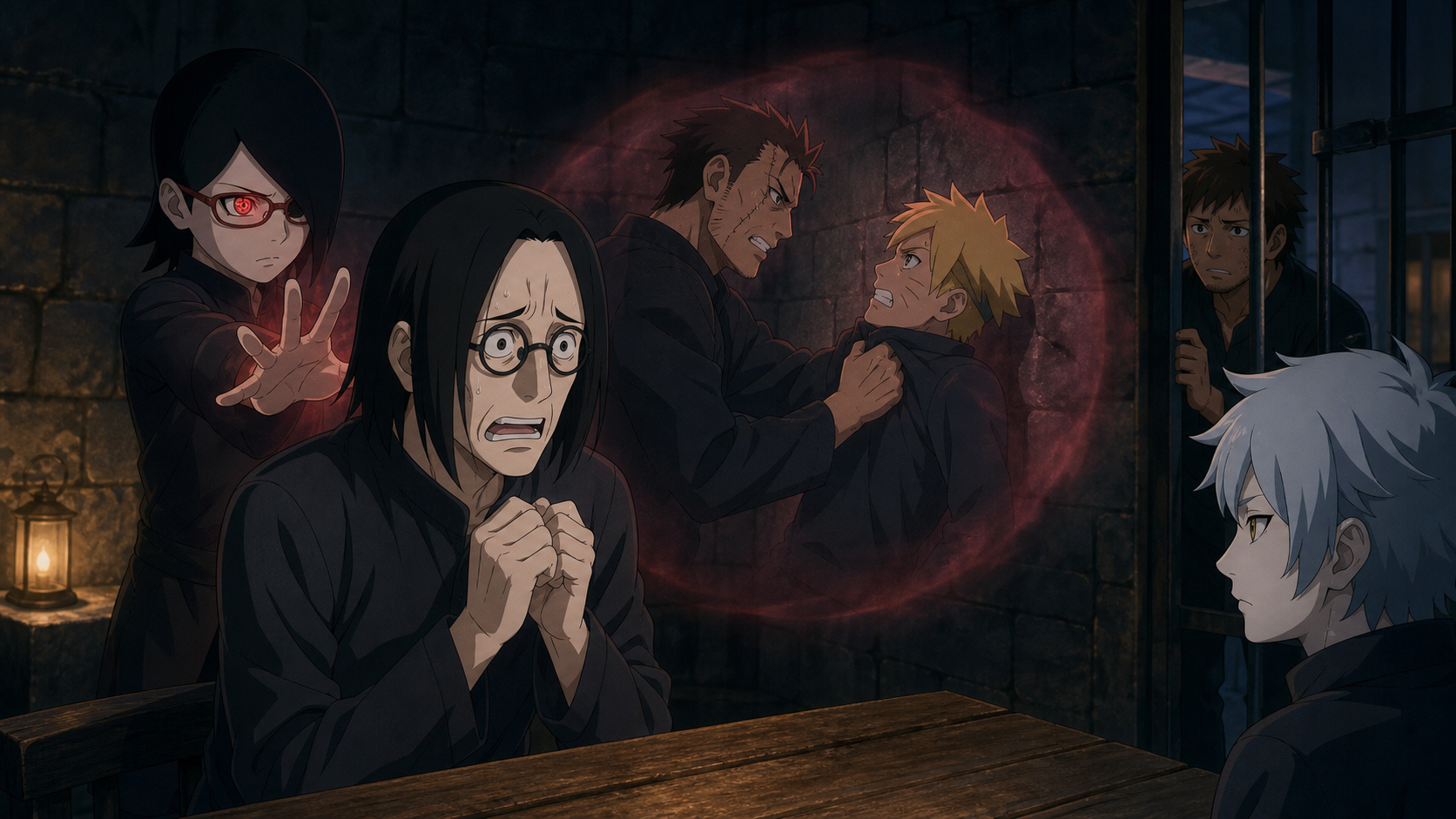
Team 7 also crosses an ethical line. Sarada uses genjutsu to make Kokuri believe Tsukiyo is beating Boruto, forcing him to reveal where the money went. The test proves Kokuri is telling the truth, but truth obtained through manufactured terror is not the same as trust. The episode wants us to celebrate the result. I cannot ignore the method, especially when the entire arc already shows powerful people using confinement and fear to control weaker people.
Kokuri's protection still depends on information
Arai has been removed from the cell, but Boruto and Mitsuki remain uneasy. Kokuri asked Konoha for protection while refusing to explain the fact most likely to determine why the Mujina Gang wants him dead: what happened to the stolen money.
Protection requires more than sympathy. Team 7 needs to know whether Kokuri buried the money, passed the money to another criminal, kept records, or attracted enemies beyond Tsukiyo. Every hidden fact can change the escape route and the number of people waiting outside.
Kokuri's fear makes sense. He spent his life moving money for clients before learning that his employer served a violent gang. Trusting new people after that discovery would be difficult. His silence still transfers risk onto Boruto, Mitsuki, and Sarada.
Kamata sees Kokuri as a possible payday
Kamata tries to become friendly with Kokuri after hearing about the Mujina money. His interest is practical rather than affectionate. Prison has taught him that every relationship may contain a trade, favor, secret, or price.
That behavior makes him easy to judge, but Episode 144 gives his desperation a name. His sister needs surgery. Kamata wants money and freedom because somebody outside the walls is living with consequences he cannot repair from a cell.
The episode does not excuse his crimes. The episode does explain why a rumor about stolen gang money would feel like the first real chance he has seen in years.
Benga weaponizes Kamata's sister
Benga summons Kamata and pressures him for information about Boruto and Kokuri. He mentions the money Kamata won through Doragu, produces hamburgers purchased with Kamata's own earnings, and holds the letter Kamata wrote to his sister.
The meal is not generosity. Benga converts Kamata's money into a prop, then eats or controls the reward while demanding obedience. The letter gives him a sharper weapon. Kamata told his sister a heroic lie about saving a child from a rogue ninja in the Land of Lightning. He wants her to believe he became someone worthy while she waited for surgery.
Benga threatens to expose the truth and offers a future visit after her operation if Kamata spies for him. That is coercion disguised as a bargain. One man controls mail, food, sentence length, and access to family. Kamata does not enter the deal as an equal participant.
Tsukiyo understands which official can be purchased
Tsukiyo asks Benga to transfer Kokuri to Hozuki Castle II, where Mujina members can kill him. The request sounds bureaucratic because murder becomes easier when paperwork moves the target into the correct building.
Benga has already shown that rules matter only when rules support his authority or income. Tsukiyo does not need him to swing a weapon. A transfer order can deliver Kokuri into a prepared execution while allowing every officer involved to claim ordinary procedure.
The arrangement shows why defeating one inmate assassin never solved the mission. The gang can recruit another prisoner, pressure a guard, or redirect the institution around Kokuri.
Sarada's genjutsu creates a believable nightmare
Boruto asks Sarada to place Kokuri under genjutsu. Kokuri sees Tsukiyo overpowering Boruto and demanding the location of the money. Believing Boruto will be hurt or killed, Kokuri admits that he donated everything.
The tactic works because Kokuri already carries fear and guilt. Sarada does not invent a random monster. She recreates the exact criminal who has pursued him and places Boruto, one of his protectors, in immediate danger.
Kokuri chooses disclosure to save Boruto. That choice tells Team 7 something meaningful about his priorities. The illusion also denies him informed consent and uses his trauma as an interrogation tool.
A successful interrogation can still be wrong
The episode treats the genjutsu as clever proof that Kokuri is trustworthy. Fans can appreciate Sarada's precision while still asking whether Team 7 had a less violating option.
Kokuri has already survived an assassination attempt and lives under constant threat. Making him experience another attack, even inside an illusion, risks worsening the fear that caused his secrecy.
Trust does not grow because the stronger party proved that the weaker party could be broken. Team 7 gains accurate information, but Kokuri is never allowed to decide how that information should be shared.
The donation changes Kokuri's moral position
Mitsuki verifies the confession through news coverage of a recent anonymous donation to a medical foundation. Kokuri did not keep the Mujina money, spend the money, or hide the fortune for later leverage.
Donating stolen proceeds does not magically correct every problem. The original victims were robbed, and the medical foundation could not know the source. Kokuri made a desperate restitution decision without a lawful route for returning funds or exposing the gang.
His choice still matters. Once he understood the money's origin, he refused to profit. He tried to convert criminal proceeds into care while escaping people capable of killing him.
Kokuri was an accountant before he became a target
Kokuri explains that he moved money for company clients. Newspaper reports about Mujina robberies eventually revealed a pattern, and he realized the accounts he handled were connected to stolen funds.
That background makes him valuable because an accountant sees networks that street-level members may never understand. Payments reveal associates, schedules, false businesses, and movement between territories. Kokuri may possess enough knowledge to damage the gang even after the cash disappears.
He ran in panic and accidentally carried the latest proceeds. The mistake turned an employee with dangerous knowledge into a suspected thief with dangerous knowledge.
The waterfall escape shows courage without shinobi power
Mujina members chased Kokuri until he jumped from a waterfall and swam away. He is not a capable shinobi, but survival demanded a physical choice that could have killed him.
The moment corrects the idea that fear equals cowardice. Kokuri is frightened because the danger is real and because he lacks the techniques Boruto's generation treats as normal. He still acts when every available choice carries risk.
His courage looks messy. He flees, hides facts, and asks stronger people for protection. None of those actions erase the decision to leave a criminal operation and surrender the money.
Kokuri's attempt at atonement lands him in prison
After escaping, Kokuri tries to stop what appears to be a man pickpocketing a woman. He attacks the man, only to discover that the woman was the thief and he had helped the wrong person. Authorities arrest him as her accomplice.
The story is painfully appropriate for this arc. Kokuri attempts one visible good deed after years of unknowingly serving criminals, but incomplete information turns that act into another charge.
Hozuki Castle then places him within reach of the same gang he escaped. The justice system punishes the mistake while failing to recognize the far larger danger surrounding him.
Kamata learns that Kokuri helped his sister
Kamata overhears the confession and discovers that the anonymous medical donation supported the foundation treating his sister. The money he hoped to steal from Kokuri has already reached the person he wanted to help.
That connection changes his decision. Kokuri is no longer a frightened stranger hiding a fortune. He is the reason Kamata's sister has a better chance to receive surgery.
The episode earns this turn because Kamata still has something to lose. Gratitude does not remove Benga's threat, extend family visiting rights, or shorten his sentence. Protecting Kokuri will cost him.
Kamata lies to Benga and pays immediately
Kamata tells Benga that nothing unusual connects Boruto and Kokuri. Benga recognizes his tells and beats him. Haie sends Kamata to solitary confinement, and Benga arbitrarily extends his sentence.
Kamata's lie becomes a genuine act of protection. He does not receive applause from Team 7 because the others do not witness the interrogation. The choice matters even when nobody inside the cell can reward him.
Benga's response proves that prisoners have no meaningful bargaining position. Cooperation earns conditional promises. Refusal earns physical violence and extra punishment without review.
Naruto receives the parole news too late to protect the paper
Shikamaru and Sai tell Naruto that Kusagakure has approved Kokuri's parole. Konoha now needs to coordinate with Team 7 and Mujo.
From the village's perspective, the mission is close to a lawful resolution. Kokuri can leave through official channels rather than a dangerous escape.
The distance between Konoha and the prison becomes decisive. A legal decision has no protective power until somebody inside Hozuki Castle receives, honors, and preserves the order.
Mujo finally challenges Benga's sentence abuse
Mujo informs Benga about the parole and suspends him for extending prisoners' sentences without authority. The decision arrives after repeated evidence that Benga has turned administration into private power.
Suspension should remove him from control immediately. Instead, Mujo remains physically vulnerable and dependent on a medical routine Benga can interrupt.
Leadership built around one official's personal health and one subordinate's compliance has no resilience. The prison lacks a trustworthy process capable of enforcing Mujo's order when he becomes ill.
Benga withholds medicine and stages a takeover
Mujo's condition worsens, and Benga prevents him from taking medicine. That choice moves Benga from corrupt administration into deliberate medical harm.
He does not defeat Mujo through greater authority. He exploits access to the warden's body. Control over medicine becomes control over the institution.
The scene mirrors his treatment of Kamata. Benga finds the human need behind the official role, then turns that need into leverage. Family, food, medical care, and freedom all become tools in his private government.
Burning the parole order is the episode's real robbery
Benga destroys Kokuri's parole order and assumes command. The burning paper represents more than lost correspondence. He erases a lawful decision, conceals the outside world's involvement, and replaces release with transfer.
Kokuri already donated the stolen fortune. Benga steals something harder to replace: recognized freedom. The act works because every person inside the prison depends on his version of what the rules say.
No prisoner can call Kusagakure and request another copy. No independent clerk appears to record that the order arrived. One corrupt officer controls the boundary between paper and reality.
Kokuri's transfer becomes an execution route
Benga tells Tsukiyo that the transfer will proceed, then informs Kokuri that he is being moved. Hozuki Castle II houses Mujina members waiting for him.
The transfer gives murder a chain of custody. Guards can escort Kokuri, documents can describe routine relocation, and gang members can finish the job after he leaves Team 7's reach.
Boruto recognizes that official compliance now guarantees failure. Breaking prison rules becomes the only available way to protect the lawful parole that Benga destroyed.
Sarada’s genjutsu crosses a line even when the information helps
Team 7 creates a nightmare designed to make Kokuri believe the Mujina Gang has reached him. The tactic produces disclosure, but disclosure under manufactured terror is not freely chosen testimony.
Kokuri already lives with fear of assassination. Using that fear can reinforce trauma, damage trust, and make later memory harder to separate from the illusion. The team needs to acknowledge the harm after revealing the operation.
An apology would not erase the violation. A debrief could explain what was simulated, confirm what did not physically happen, offer medical support, and give Kokuri control over what information gets documented next.
Shinobi intelligence methods often treat effectiveness as the final ethical answer. Protecting a witness requires more than extracting the facts keeping the witness alive.
Kokuri’s donation changes restitution without purchasing innocence
Stealing from the Mujina Gang remains theft, even when the target organization profits through crime. Donating the money changes what Kokuri does with the proceeds and supports his claim that he wanted to reduce harm.
The donation does not automatically settle ownership, victims’ claims, or legal responsibility. Some funds may belong to people the gang extorted. A lawful process should trace the money, identify claimants, and determine whether the medical support can remain without depriving direct victims.
Kokuri’s moral position becomes more credible because he does not keep the fortune. Credibility is not acquittal.
That nuance makes him stronger than a convenient innocent. He made a dangerous decision, tried to redirect criminal wealth, and entered a system where atonement became another opportunity for officials and criminals to exploit him.
Kamata’s sister reveals how Benga turns basic needs into leverage
Medicine should not depend on whether a prisoner informs for the right official. Benga uses access to family communication and health information as currency.
Kamata begins by seeing Kokuri as money because scarcity has trained him to price every opportunity. Learning that Kokuri helped his sister changes the calculation, but the underlying coercion remains.
His final lie to Benga is brave because punishment is predictable. The episode shows conscience returning through relationship rather than pretending Kamata suddenly stops caring about survival.
The prison owes his sister care independent of his cooperation. Otherwise every act of loyalty becomes a hostage negotiation conducted through somebody outside the walls.
Mujo’s medical vulnerability exposes a catastrophic command design
One blocked dose allows Benga to incapacitate the lawful warden and assume control. A facility holding dangerous shinobi should not let essential medication, succession authority, and emergency communication converge in one subordinate’s hands.
Medical staff need independent access. Medication administration needs records and redundancy. A sudden collapse should trigger external notification and review before an acting commander can approve transfers or destroy documents.
Mujo is responsible for building or accepting a structure with so few safeguards. Benga is responsible for exploiting the structure.
The distinction matters because removing Benga later will not repair the design. Another ambitious officer could use the same gaps with a cleaner smile.
Burning the parole paper should not burn the parole decision
A lawful decision must exist in more than one physical sheet held inside the prison. The authorizing office, court, village, or parole board should retain an independent record capable of immediate verification.
Benga destroys the local paper because the institution behaves as though paper and right are identical. Kokuri’s liberty becomes vulnerable to a fireplace.
Secure duplicates, logged transmissions, authenticated seals, and direct confirmation with Konoha would make document destruction evidence of misconduct instead of a successful reversal of law.
The episode uses the burning order as a sharp image of corruption. The image also indicts administrative systems designed without recovery from obvious sabotage.
The transfer order is an assassination weapon wearing procedure
Benga does not need to stab Kokuri. He chooses a destination and timetable that deliver the prisoner to people waiting to kill him.
Administrative violence often looks clean because each individual action resembles routine work. A form gets signed. Guards escort a prisoner. A boat leaves. Nobody inside the chain has to announce murder.
Protection therefore requires reviewing destination risk, notifying counsel or allies, confirming the legal basis, and allowing emergency challenge before movement. Team 7 recognizes the lethal purpose, but the official process offers no safe way to pause itself.
Breaking the prison becomes defensible because compliance would complete the assassination plan.
What worked for me
Kamata receives the strongest material. His greed, shame, love for his sister, and final lie all belong to the same person. The medical donation does not transform him through a speech. The information changes what he is willing to risk.
Benga also becomes a convincing institutional villain. He uses letters, meals, medicine, sentences, and transfer authority rather than relying on combat power. Every weapon comes from his job.
Kokuri's history gives his fear a clear foundation. He is neither a mastermind sitting on a fortune nor a helpless innocent without responsibility.
What needed more room
Team 7 should confront the ethics of Sarada's genjutsu. The tactic is effective, but the episode moves from manufactured torture to relief without allowing Kokuri to respond to the violation.
Mujo's collapse also exposes years of missing safeguards. A prison holding dangerous shinobi should not lose lawful command because one chief guard blocks one dose of medicine.
Konoha learns about the parole, yet no secure communication reaches Team 7 before Benga seizes control. The mission planning needs a clearer emergency channel.
The verdict
"Kokuri's Secret" succeeds because the money reveal changes several characters at once. Kokuri becomes more credible, Kamata gains a personal reason to protect him, and Team 7 learns that the Mujina Gang cannot recover the stolen funds.
The episode's harsher truth belongs to Benga. Arai needed a stolen tag and a frame-up. Benga only needs the authority everyone already gave him. He punishes Kamata, withholds Mujo's medicine, burns the parole order, and turns transfer paperwork into an assassination route.
Boruto chooses a prison break because the prison has stopped functioning as a lawful institution. Kokuri earned parole. The walls are no longer enforcing a sentence. The walls are protecting the people trying to kill him.
Sources and lawful viewing
Official episode reference: Naruto Official episode guide
Licensed episode route: Crunchyroll licensed series page