
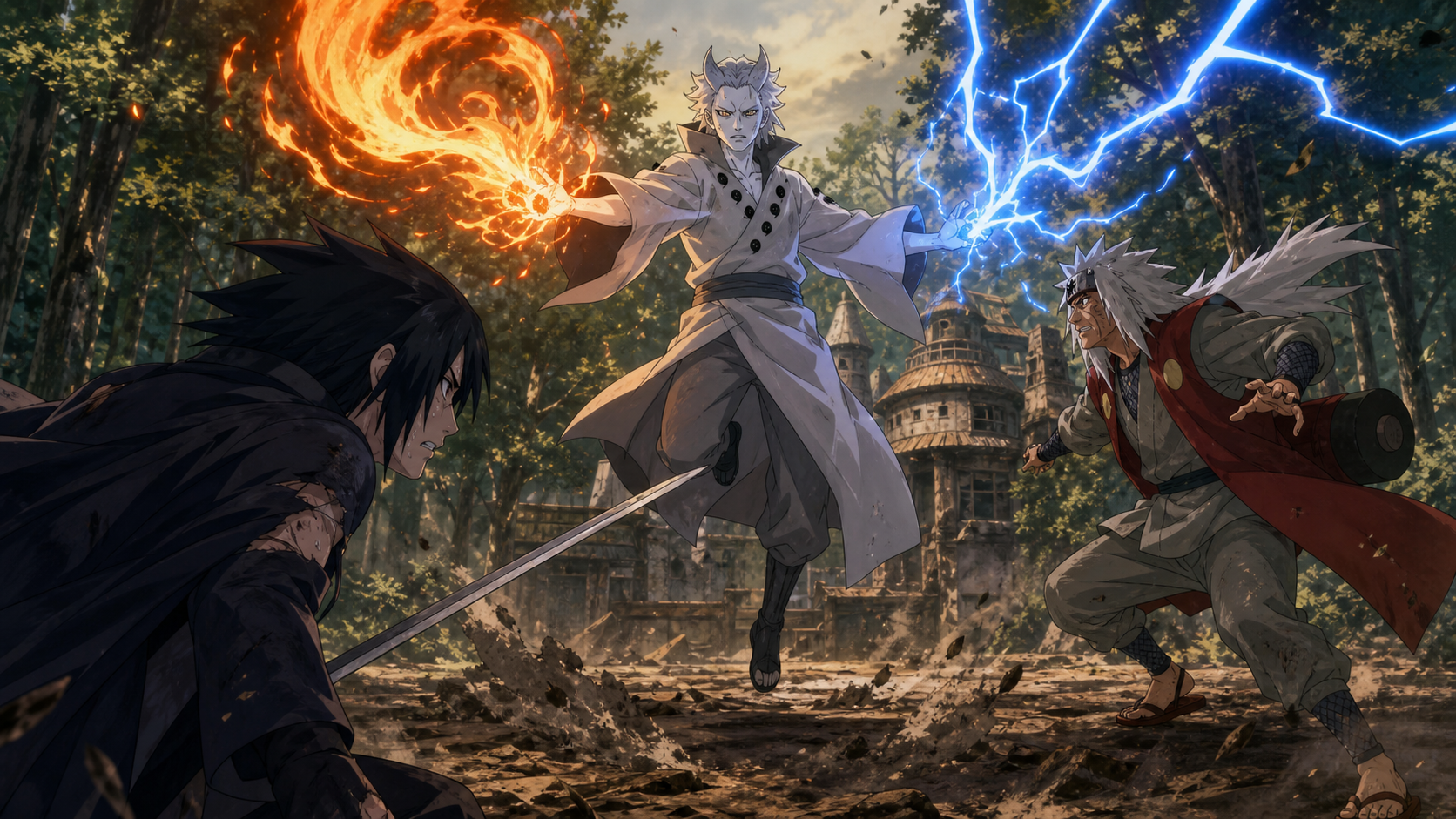
A Village Without Sasuke
Boruto asks young Naruto why Sasuke abandoned Konoha while adult Sasuke watches the damage he caused and Urashiki turns stolen chakra into a weapon.
Series: Boruto: Naruto Next Generations
Episode: 133 · A Village Without Sasuke
Arc: Time Slip Arc
Release: 2019-11-24
Previous: Episode 132 · Jiraiya’s Assignment
Directory: All 293 Boruto episodes
Bottom line
Boruto Episode 133 lets a son ask the question his father spent years answering with his whole life: why did Sasuke leave? Young Naruto does not have the clean historical explanation Boruto already knows. He has anger, loyalty, guilt, and a stubborn belief that Sasuke can still come home. That answer teaches Boruto more about his father than another speech about the Hokage ever could.
The episode also lets adult Sasuke stand inside the damage his younger self created. Sakura is chasing a wet note because any scrap connected to Sasuke matters. Naruto talks about their bond as if recovery remains a promise instead of settled history. Jiraiya has already guessed who the stranger probably is. Sasuke cannot correct the past without risking the future, so he has to listen while everyone carries consequences he caused.
Urashiki ends the conversation with a cruel demonstration. He attacks Sasuke using chakra stolen from Sasuke, then claims his eyes can see the future. The fight is not the episode's strongest animation showcase, but the theft fits the emotional argument. Sasuke has returned to a period when his choices hurt everyone around him, and an enemy literally weaponizes pieces taken from him.
Jiraiya knows enough and chooses the mission
Jiraiya opens by easing the pressure from his direct question. He tells Sasuke to treat the suspicion as a joke, then makes clear that he will stop prying if Sasuke helps defeat Urashiki. That response does not mean Jiraiya believes the traveling-performer story. The Rasengan, Boruto's resemblance to Naruto, Sasuke's knowledge, and their strange chakra have already given him a working answer.
Jiraiya chooses restraint because Naruto's safety matters more than satisfying his curiosity. That decision shows the intelligence hiding beneath his foolish public behavior. A weaker spy would demand the whole confession. Jiraiya understands that forcing the truth could make Sasuke disappear or damage whatever operation brought him to the past.
He also understands lonely children. Jiraiya tells Sasuke that Naruto feels close to him like a younger brother because Jiraiya never had parents or siblings of his own. The admission gives his protection of Naruto a personal shape without pretending he has been a perfect guardian.
Sasuke admits how vulnerable he really is
Sasuke explains that Urashiki failed to steal more chakra during their recent encounter, but the chakra taken earlier still has not returned. His reserves remain low, and Urashiki can tell. That limitation matters because adult Sasuke normally enters a fight carrying power that would overwhelm most threats from this era.
The Time Slip Arc needs a reason Sasuke cannot solve every problem alone. Low chakra supplies that reason, but the episode makes the weakness part of the strategy instead of hiding behind a vague power drop. Jiraiya wants to create an opening for a sealing technique. Sasuke has to cooperate with a shinobi who cannot know his full identity.
Adult Sasuke once rejected bonds because he believed attachment weakened him. Now survival depends on trusting Jiraiya, protecting Naruto, and coordinating with Boruto. The irony is not subtle, and the episode does not need subtlety here.
Naruto and Boruto finally find the rhythm
Naruto and Boruto return to the rubber-ball exercise. Naruto remembers the Leaf Concentration Practice, the training method that uses a leaf on the forehead to focus chakra. Applying a familiar foundation helps them move past the emotional mess that broke their earlier attempts.
The rubber ball begins to respond. Their chakra flow is not perfect, but father and son finally produce visible progress. The result arrives because Boruto stopped reducing Naruto to the frightening red shroud and Naruto stopped assuming Boruto's fear meant permanent rejection.
Shared blood gave them compatibility. Shared work gives them control. That distinction matters. Families can resemble one another and still fail to communicate. Naruto and Boruto have to learn each other's rhythm rather than demand instant understanding because they are related.
Boruto asks about the friend nobody could retrieve
Boruto takes the risk and asks why Sasuke deserted the village. The question sounds historical to him because he knows the adult who returned. For young Naruto, Sasuke's departure is an open wound and a current failure.
Naruto explains that Sasuke was driven by revenge against the brother who killed his clan. Sasuke sought power from Orochimaru and believed cutting his bonds would make him stronger. Naruto does not excuse the betrayal, but he refuses to describe Sasuke as a lost cause.
That refusal is the answer Boruto really needs. His father did not save Sasuke through one speech or one fight. Naruto kept the relationship alive across years of rejection, violence, war, and disappointment. Boruto admires adult Sasuke's calm skill without fully understanding the labor behind his return.
Naruto tells the story from inside the loss
Adult accounts often turn Sasuke's history into a neat redemption line: massacre, revenge, desertion, war, return. Naruto speaks before the return exists. He cannot promise that friendship will win because he has no proof yet.
What Naruto has is conviction. He believes abandoning Sasuke would make every claim about friendship meaningless. Naruto also carries guilt because he could not stop Sasuke at the Valley of the End. The headband scratch, the broken promise to Sakura, and the empty place on Team 7 remain personal.
Boruto gets to hear hope before history rewards that hope. The conversation explains why Naruto later tolerates distance, protects Sasuke's place in the village, and trusts him with missions nobody else can perform. Their adult partnership grew from a teenage refusal that looked unreasonable for years.
A village without Sasuke still revolves around him
The title describes more than physical absence. Sasuke is gone, but Naruto trains because of him, Sakura searches for him, Jiraiya watches the consequences around Naruto, and the future version of Sasuke walks through Konoha hiding his name.
Absence can organize a community as strongly as presence. Team 7 cannot return to normal, so every member builds a life around the missing person. Naruto turns loss into pursuit. Sakura turns uncertainty into attention to every clue. Kakashi carries responsibility for students he could not keep together.
Adult Sasuke has to see that structure without asking anyone to forgive him early. The episode gives him no convenient confession scene. Silence becomes part of his punishment.
Sakura will not ignore the damaged note
Sakura studies the paper Sasuke dropped in the puddle. Most of the writing is ruined, but names including Sasuke and Sarada remain visible. Boruto tries to dismiss the clue by suggesting another person could share the name.
The lie is terrible because Sakura knows how rare the name has become. Sasuke is the surviving Uchiha child she has spent years beside. A random second Sasuke attached to a mysterious stranger does not offer a believable explanation.
Sakura decides to ask the traveler directly. Her persistence is not comic nosiness. She has been left with almost no reliable information about the person she loves and the teammate she wants back. A damaged paper becomes important because the village has given her nothing better.
Sarada's name nearly collapses the disguise
Sarada does not exist in this period, yet her name links adult Sasuke, Boruto, and Sakura on one physical object. The paper carries proof of a family Sakura cannot imagine and Sasuke cannot acknowledge.
Boruto has already leaked future technology and shown knowledge a performer should not possess. Sasuke has used advanced techniques and moved like a shinobi with deep ties to Konoha. Sarada's name adds a clue rooted in intimacy rather than combat.
The danger is not only timeline damage. Sakura could learn that she eventually has a daughter with Sasuke while still experiencing his desertion. That knowledge could distort every decision she makes around him. Sasuke has good reason to keep the future closed, even when silence hurts.
Barbecue gives Boruto a glimpse of ordinary childhood
Naruto and Boruto join Shikamaru, Choji, and Ino for barbecue. The meal gives Boruto another look at the friendships surrounding his father before titles, marriages, and parenthood changed the group.
Young Naruto's life was lonely, but loneliness did not mean every day contained only rejection. Team meals, arguments, missions, and small invitations built a network around him. Boruto needs that fuller picture. Pity flattens Naruto into the abandoned child. Friendship shows how Naruto participated in making a home.
The scene also reminds us how much Boruto knows about everyone's future. He sits with adults he has always treated as family friends while they see him as a strange visitor. Familiarity keeps slipping through his disguise.
Urashiki attacks when their guard lowers
Urashiki teleports into Naruto and Boruto's training area. Sasuke senses the danger and moves with Jiraiya to intercept him. The timing proves why Jiraiya prioritized planning over interrogation.
Naruto remains the target because the Nine-Tails chakra offers Urashiki an enormous prize. Boruto's presence complicates the attack, while Sasuke's low reserves prevent the future shinobi from controlling the fight.
The interruption also tests the training immediately. Naruto and Boruto have begun synchronizing, but practice success inside a rubber ball is not battle readiness. Their new cooperation still needs pressure, timing, and trust.
Stolen chakra becomes Urashiki's favorite insult
Urashiki attacks with Fire Release and Lightning Release taken from Sasuke. He does more than borrow power. He taunts Sasuke by displaying the theft in front of him.
Chakra theft turns technique into inventory. Training history, clan inheritance, and personal mastery become tools Urashiki can pull from a collection. The violation fits an enemy who treats human experience as something to harvest.
For Sasuke, the humiliation carries another layer. He spent his youth pursuing stolen and inherited power, accepted Orochimaru's curse mark, and tried to sever every relationship that might restrain him. Adult Sasuke now faces an enemy who takes power without responsibility and sees no person behind the technique.
Jiraiya's sneak attack fails
Jiraiya tries to exploit Urashiki's attention, but Urashiki anticipates the movement and drives a chakra rod through him. The hit lands hard because Jiraiya entered the fight as the strategist most likely to create a sealing opportunity.
The failure does not make Jiraiya foolish. Sneak attacks are part of shinobi combat, and a coordinated distraction should work against an opponent focused on Sasuke. Urashiki's response reveals the mechanism that changes the tactical problem.
Sasuke, Boruto, and Naruto now have to protect an injured ally while facing an enemy who appears to know their next move. Raw aggression will only feed Urashiki predictable options.
Urashiki claims he can see the future
Urashiki says his eyes can see what will happen. The claim reframes every successful dodge and counter. If he reads several seconds ahead, ordinary feints and ambushes lose value.
Future sight also twists the arc's central idea. Sasuke and Boruto possess broad knowledge of history, but they cannot safely use most of that knowledge. Urashiki claims immediate tactical certainty and uses future information as a weapon.
The distinction matters. Boruto has learned that knowing someone's future does not make present relationships easy. He knows Naruto becomes Hokage and Sasuke returns, yet young Naruto's pain remains real. Urashiki treats foresight as permission to dominate the present.
The fight exposes the episode's production weakness
The emotional writing carries more force than the battle animation. Urashiki's stolen techniques and future sight should create a frightening combat puzzle, but several exchanges lack the speed, impact, and spatial clarity the concept deserves.
That criticism does not erase the setup. Sasuke is depleted, Jiraiya is injured, Naruto remains the target, and Boruto has only begun synchronizing with his father. The pieces are positioned for a desperate continuation.
Boruto sometimes asks dialogue and lore to compensate for action that feels less dangerous than the script claims. Episode 133 falls into that pattern. The ideas work. The staging needed sharper movement and heavier consequences.
Adult Sasuke witnesses the emotional debt carried by everybody else
Naruto remembers the promise. Sakura protects scraps of connection. Jiraiya monitors the damage. The village organizes around the boy who left even when the boy is physically absent.
Sasuke cannot repair any of that without threatening the timeline. Silence becomes punishment and protection at once.
The episode gains power from restraint. An apology would satisfy the adult and burden the children with impossible knowledge. Watching forces Sasuke to encounter consequences before he can explain himself away.
The future mentor Boruto admires exists partly because other people carried faith while Sasuke rejected them.
Naruto’s account belongs to the person who was left behind
Boruto asks about Sasuke from the perspective of someone who knows the man returned. Young Naruto speaks from uncertainty, injury, anger, and refusal to surrender the bond.
That version corrects heroic hindsight. Pursuing Sasuke was not a clean march toward an outcome everyone knew would work. Naruto risked his body and identity while friends questioned whether hope had become obsession.
Boruto should hear the courage and the cost. Admiring the successful adult cannot erase what the teenager did to the people trying to reach him.
Context makes Sasuke more complete, not less worthy of love.
Sakura’s damaged note makes the disguise a continuing risk
She notices handwriting, context, and fragments the travelers would prefer to dismiss. Her persistence shows intelligence rather than romantic foolishness.
Sasuke and Boruto need an evidence-control plan. Every written clue, unfamiliar object, chakra trace, and overheard name can destabilize the cover.
The temptation is to manipulate Sakura because she wants an answer. Doing so repeats Sasuke’s old habit of treating her attachment as something useful when convenient.
Timeline protection should use the narrowest deception possible and acknowledge the harm later if memory must be altered.
Sarada’s name nearly reveals a future built from choices nobody expects
Young Naruto and Sakura know no Sarada. The name links Sasuke, Sakura, marriage, parenthood, and a future village role in one small sound.
Boruto’s near-slip shows how difficult concealment becomes during ordinary conversation. Facts attached to affection escape faster than mission data.
Sasuke hears the risk differently because the name belongs to his daughter. Protecting the timeline means pretending the most important relationships of his life do not exist.
The scene makes secrecy personal without requiring a full reveal.
Barbecue shows Boruto the childhood Naruto almost had
Friends gather, eat, joke, and occupy time without an official ceremony. The meal offers a version of childhood not defined entirely by loneliness or combat.
Sasuke’s absence remains present, but the group still creates ordinary belonging around Naruto. Boruto sees the support network his father rarely explains at home.
The scene also complicates Naruto’s later parenting. He knows how much shared food and casual attention mattered. Hokage duty still allowed those ordinary practices to disappear from his own household.
Understanding the past should help Boruto ask for ordinary time in the present.
Jiraiya chooses protection over solving the identity mystery
He has enough clues to press Sasuke, expose Boruto, or demand the future. Instead, Urashiki and Naruto’s safety remain the priority.
That choice demonstrates disciplined curiosity. A good intelligence operative does not confuse an interesting answer with the most urgent objective.
Jiraiya still prepares contingencies because trust without verification would be careless. He watches behavior, tests claims, and keeps the suspicious travelers close enough to help.
His restraint contrasts with Urashiki’s use of knowledge as domination. Jiraiya wants truth and refuses to make truth more important than people.
The production weakness makes Urashiki’s claim harder to believe
Future sight should transform space into a trap where every feint, angle, and rescue attempt becomes dangerous. The staging often lacks the speed and consequence needed to sell that advantage.
When the animation cannot show why a counter succeeds, the dialogue has to insist that Urashiki is overwhelming. Insistence weakens suspense.
Stronger choreography could track repeated positions, stolen techniques, blood evidence, and shrinking safe routes. Viewers would then experience the puzzle before Boruto names the puzzle.
Criticizing execution does not reject the concept. The concept deserved a clearer visual argument.
Stolen chakra turns Sasuke’s history into a weapon against his family
Urashiki attacks using power removed from Sasuke, converting past mastery into present danger for Naruto and Boruto.
The insult is personal because Sasuke has spent years trying to use power in service of the village and his family. Theft separates ability from intention.
Teamwork becomes the answer because relationships restore context to power. Sasuke’s chakra alone can be stolen. Sasuke’s knowledge, Sakura’s care, Jiraiya’s tactics, and the boys’ trust cannot be carried in one container.
Urashiki collects techniques and misses the systems making techniques meaningful.
Sasuke’s inability to apologize now does not cancel the obligation to repair later. Returning to the future should mean showing Naruto, Sakura, and Sarada through sustained conduct that he understands what his absence cost. Timeline silence is temporary mission discipline. Emotional silence cannot remain the permanent family policy.
Final reaction
“A Village Without Sasuke” is strongest when adult Sasuke has to witness the shape of his absence. Naruto still believes in a friend who left him bleeding. Sakura chases a ruined note because scraps are all she has. Jiraiya has guessed the truth but chooses Naruto's safety over a confession. Sasuke cannot thank, apologize, or explain without putting the timeline at risk.
Boruto's conversation with Naruto adds necessary weight to his admiration for Sasuke. The cool wandering mentor exists because Naruto refused to accept the violent teenager as the final version of him. Boruto inherits the result without having lived through the years of pursuit.
The training progress matters for the same reason. Family resemblance gives Naruto and Boruto a route toward synchronized chakra, but trust makes the route usable. Their relationship improves when both boys stop treating fear as a final verdict.
Urashiki's arrival turns those emotional lessons into an immediate threat. He steals techniques, attacks Sasuke with his own chakra, injures Jiraiya, and claims control over the next moment. The next episode has to prove that cooperation can create choices even an enemy watching the future cannot easily contain.
Sources and lawful viewing
Official episode reference: Naruto Official episode guide
Licensed episode route: Crunchyroll licensed series page