
Shukaku's Trick
Shukaku wants Himawari’s secret for embarrassing Kurama, but his petty investigation ends inside a scrap-yard compactor and reveals a much bigger Byakugan question.
Series: Boruto: Naruto Next Generations
Episode: 126 · Shukaku's Trick
Arc: One-Tail Escort Arc
Release: 2019-09-29
Previous: Episode 125 · Boruto and Shinki
Directory: All 293 Boruto episodes
Bottom line
Boruto Episode 126 turns the end of an Otsutsuki attack into a family comedy about a Tailed Beast hiding in a tea kettle, which sounds like nonsense until the episode remembers that Shukaku and Kurama are people with centuries of history, grudges, loneliness, and a shared weakness for the Uzumaki family's chaos. Shukaku stays at Naruto's house while the Kage decide how to protect the remaining Tailed Beasts. Himawari calls him “Shu-kaaku,” adopts him on sight, and makes the proud One-Tail regret every choice that brought him into the kitchen.
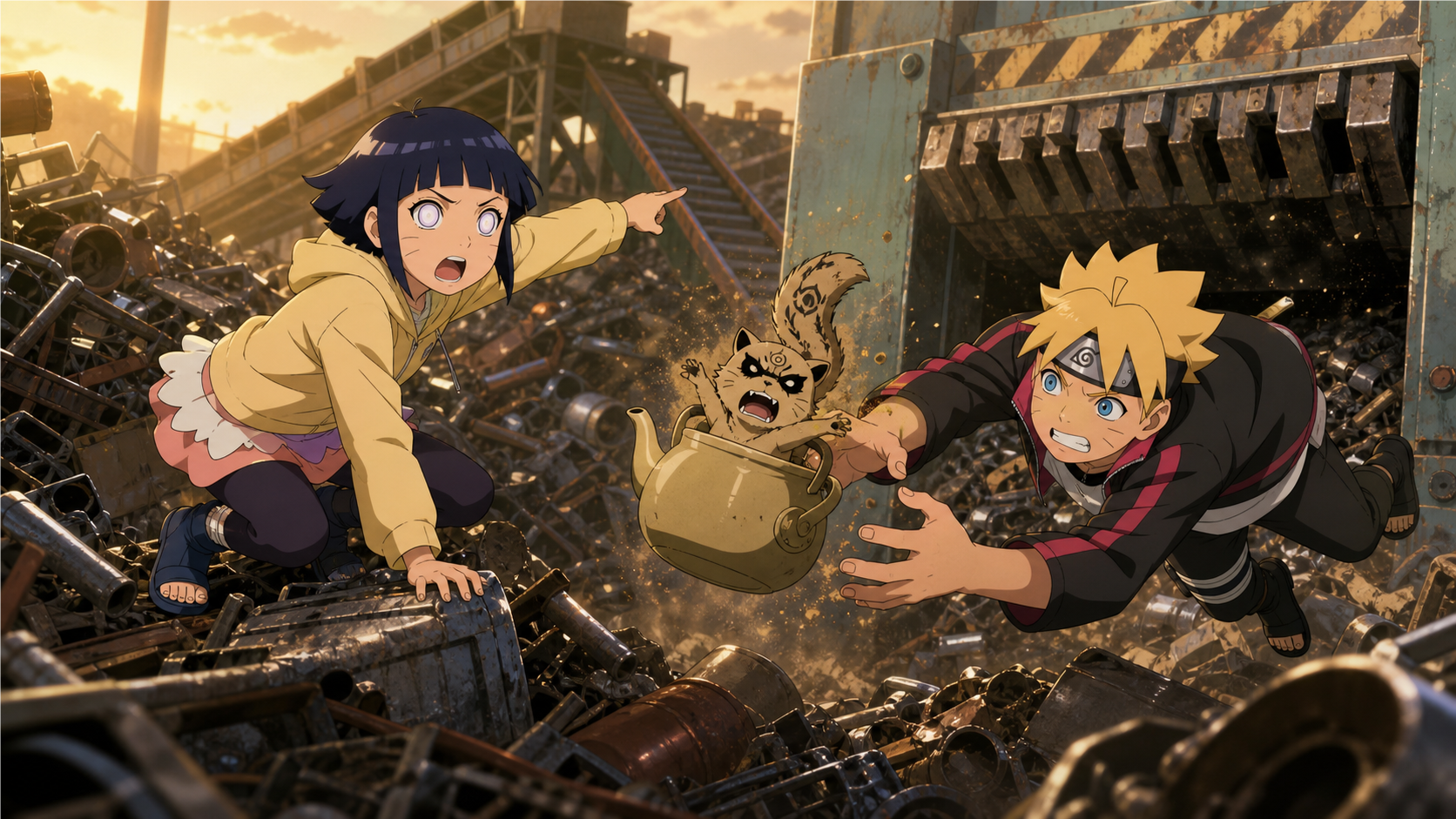
Shukaku learns that Himawari once knocked out Naruto and Kurama on the day of Naruto's Hokage inauguration, so naturally he wants the secret. The investigation becomes a day at Senju Park, a lost kettle, and a race to stop a trash compactor. Himawari activates the Byakugan under stress, locates Shukaku through a mountain of scrap, then forgets the whole event again. The rescue is funny. The continued decision to treat Himawari's unexplained power as a punch line is less funny, especially one episode after Boruto's Jōgan helped predict dimensional portals and everybody immediately moved on.
The strongest scene comes after the adventure, when Shukaku and Kurama admit that the Uzumakis are exhausting and never boring. Two beings who were treated as weapons for generations get to complain about domestic life like irritated relatives. No seal, village, or shinobi council can manufacture that kind of belonging. The episode is light, but the best joke carries the same old Naruto argument: freedom does not always look grand. Sometimes freedom looks like being annoyed because a little girl gave you a nickname and cared whether the garbage truck took you away.
Urashiki changed the security problem
Naruto, Sasuke, and Shikamaru begin with the serious consequence left by the escort arc. Urashiki wants enormous amounts of chakra, and Shukaku is not the only Tailed Beast who could become a target. The villages cannot treat the attack as one failed kidnapping. An enemy who crosses dimensions and steals techniques can choose another isolated Beast, another jinchūriki, or another village before the Kage finish congratulating themselves for protecting one kettle.
The discussion moves toward a wider warning and coordination between the Kage. That response respects the larger threat even though Episode 126 spends most of its running time on comedy. Shukaku overhears enough to understand that his stay in Konoha will continue. The arrangement is safer than traveling back to the Sand while Urashiki remains loose, but safety means sharing a house with Kurama's jinchūriki. For a creature whose pride survived centuries of seals, being stored in a tiny tea kettle near his old rival is a special kind of insult.
The premise also says something useful about Tailed Beast protection. Nobody can hide them forever as objects in secure rooms. They have opinions, relationships, homes, and the ability to participate in their own safety. Shukaku tolerates the kettle because Gaara asked and because Urashiki is a genuine threat. Cooperation does not turn him into luggage. The comedy works best when the episode remembers the person inside the container.
Himawari adopts the One-Tail immediately
Himawari sees Shukaku and becomes delighted before he can establish any dignity. She calls him “Shu-kaaku,” treats his kettle-sized form as adorable, and pays no attention to the fact that he is an ancient mass of chakra feared by nations. Shukaku finds her attention unbearable. That mismatch carries most of the episode's charm because neither character has to become somebody else for the relationship to work. Himawari is sincerely affectionate. Shukaku is sincerely annoyed. Both reactions can exist in the same kitchen.
Boruto has enough experience with Shukaku to understand the danger and enough experience with his sister to know that warnings will not reduce her curiosity. Naruto answers questions about the Tailed Beasts and the history of jinchūriki, which gives the domestic scene more weight than a pet joke. The Uzumaki children grew up after the villages began speaking about the Beasts as allies. Naruto grew up when adults discussed Kurama as a disaster inside a child. The difference between those childhoods is enormous, and Himawari's fearless affection shows how much the social language has changed.
That progress does not erase Shukaku's memory. Cute treatment can become another way of ignoring who he is if everybody reduces him to a mascot. The episode walks close to that line, but Himawari's concern later saves the relationship. She does not only like the funny little kettle. She feels responsible when he disappears, searches for him, and refuses to accept that the adults may have carried him away as trash.
Shukaku wants the secret that flattened Kurama
The family story about Naruto's Hokage inauguration catches Shukaku's full attention. Himawari became angry over a damaged stuffed toy, awakened the Byakugan, struck Naruto's chakra point, and knocked out both Naruto and Kurama. Shukaku hears one essential detail: a small child defeated his old rival. Centuries of rivalry reduce his investigation to the most relatable bad idea in the episode. He wants to know how she did that so he can tease Kurama forever.
Shukaku's motive is petty, and the pettiness is perfect. The Tailed Beasts do not need every conversation to carry solemn mythology. They know one another well enough to be childish. Kurama spent years mocking Shukaku's number of tails, while Shukaku resented the idea that more tails meant more power. Learning that Himawari knocked Kurama unconscious is not merely useful information. That story is premium family gossip for an immortal creature who has waited a very long time for material.
Boruto and Shukaku question Himawari, but she cannot explain the Byakugan activation or remember the strike clearly. Her power remains tied to extreme emotion and disappears with the memory of what happened. Shukaku initially dismisses her because the secret cannot be reproduced on command. That dismissal sets up the rescue, but the pattern also raises a larger concern. Himawari has a dōjutsu powerful enough to disable Naruto and perceive Shukaku through compacted scrap. The adults still treat the ability as a strange childhood episode instead of a medical, clan, or training question.
A family day hides an investigation
The group spends time together at Senju Park, and Naruto eventually falls asleep. Shukaku watches Himawari for another sign of unusual power while she behaves like an ordinary child enjoying a day with her father and brother. The investigation gives him no answer because extraordinary ability does not erase ordinary needs. Himawari wants attention, play, and a chance to show her new friend the park. She is not a demonstration machine waiting for a Tailed Beast to press the correct emotional button.
Naruto sleeping in public is a small but telling family image. The Hokage carries an impossible workload, recently learned that an Otsutsuki targeted the Beasts again, and still tried to give his children a day outside. The nap shows the cost without turning the episode into a lecture about work-life balance. Boruto once read every missed family moment as proof that the office mattered more than he did. Now he can see exhaustion and responsibility without pretending the missed time never hurt.
Shukaku falls asleep too, still inside a container that looks like discarded metal to anybody outside the family. The joke becomes dangerous because the protective disguise has a practical weakness. A hidden Tailed Beast is safe from a chakra thief only while ordinary workers know the kettle is not rubbish. Security plans fail through mundane systems all the time. Nobody at the park is evil or careless beyond belief. A worker sees abandoned trash and sends the container where abandoned trash goes.
The garbage system follows the route workers designed
Boruto and Himawari discover that Shukaku's kettle is missing and ask a park employee what happened. The trash has already gone to a scrap yard. That answer launches the rescue, but the scene deserves more credit than a random comedy accident. The worker follows the visible evidence. A small battered kettle sat unattended in a public place. No label identified a protected diplomatic guest. No seal warned municipal staff. The shinobi world's secret plan collides with a sanitation route, and the sanitation route wins.
The mistake belongs to the people responsible for watching Shukaku, not the employee who cleared the park. Himawari blames herself immediately because she promised attention and lost track of him. Boruto moves toward the solution rather than letting guilt become the whole scene. They trace the load to the scrap yard and arrive while machinery is processing the discarded metal. Shukaku, an ancient Tailed Beast who survived jinchūriki systems and an Otsutsuki pursuit, may be flattened because everybody assumed a tea kettle was a foolproof hiding place. I respect a series willing to let logistics humble mythology.
The danger also restores Shukaku's agency. He cannot simply burst free without risking exposure, damage, or another security problem. The small form that protected him now limits him. Hiding always carries a cost, and the episode gives that cost a very literal metal press.
Himawari's Byakugan answers fear, not curiosity
Himawari watches the trash compactor and believes Shukaku may be crushed because she failed to protect him. Stress activates the Byakugan. She looks through the scrap, finds the chakra signature inside the kettle, and gives Boruto the location they could not identify from outside. Shukaku finally sees the power he wanted to investigate, but the answer arrives under conditions no decent person would want to recreate.
The scene clarifies that Himawari's ability responds to fierce protective emotion. Anger over her damaged toy triggered the first famous incident. Fear for Shukaku triggers this activation. Her power is not a party trick and cannot be summoned because an ancient Beast wants ammunition against Kurama. Himawari acts when somebody she loves may be hurt. That emotional pattern fits the Hyūga visual legacy and the Uzumaki family's reckless instinct to move toward danger for another person.
Boruto catches the falling kettle and protects Himawari during the rescue. The siblings work without jealousy or competition. Himawari supplies the perception. Boruto supplies movement and the final catch. Shukaku wakes amid the chaos and recognizes the Byakugan before the eye fades. Himawari again cannot remember using the power. Everybody celebrates the rescue, but the memory gap remains sitting in the scene without a serious answer.
The Byakugan joke needs follow-through
Episode 126 wants Himawari's power to be surprising, adorable, and funny. The approach works in the moment. Shukaku spends a day hunting for Kurama's embarrassing weakness, finally witnesses the legendary eye, and learns nothing he can reproduce for a rematch. The joke lands because his petty plan fails while Himawari succeeds for a reason that has nothing to do with rivalry.
The larger series has now created a pattern that deserves criticism. Boruto used the Jōgan to read Urashiki's portals in Episode 125, and the next episode barely treats that event as a question. Himawari activates a Byakugan strong enough to locate a sealed Tailed Beast and once disabled Naruto, but the family still files the event under mysterious childhood behavior. These eyes affect combat, safety, identity, and clan inheritance. The story cannot keep presenting major dōjutsu events as fireworks that vanish when the next episode begins.
Himawari does not need immediate formal training or a predetermined shinobi career. She does need adults to take the ability seriously. Hinata understands the Byakugan. Naruto has access to the Hyūga family and Konoha's medical system. A careful conversation would not ruin the comedy or force Himawari into a role she did not choose. Follow-through would show that the family respects her body and her power instead of waiting for the next emergency to reveal both.
Shukaku and Kurama sound like family
At night, Shukaku and Kurama speak without the children turning the exchange into a spectacle. Their rivalry remains sharp, but the tone has changed. They complain about the Uzumakis, recognize that the family drives them crazy, and admit that life around them is never boring. That conversation is the episode's best reward because both Beasts have spent generations being discussed as power sources, disasters, weapons, and seals. Here they get to sound like relatives comparing notes about the humans who adopted them without permission.
Kurama's relationship with Naruto took years of hatred, negotiation, shared danger, and earned trust. Shukaku's relationship with Gaara followed another painful route out of weaponization. Neither Beast became tame. Their freedom includes the right to be rude, suspicious, petty, affectionate, and tired. Domestic annoyance may look smaller than a battlefield alliance, but domestic annoyance proves that the relationship survives when nobody needs a giant chakra attack.
Himawari's nickname becomes part of that freedom. Shukaku hates “Shu-kaaku,” yet somebody gave him a name because she liked him, not because a village needed his power. That kind of attention can be irritating and still matter. The final bond does not require him to admit that he enjoyed the day. His conversation with Kurama says enough.
The tea kettle protects Shukaku by making everybody forget his personhood
The disguise works because nobody looking at the kettle sees a diplomatic guest, ancient chakra being, or survivor of multiple jinchūriki systems. Ordinary people see an object. That invisibility hides Shukaku from Urashiki and creates the exact condition that sends him to a scrap yard.
Security through objectification carries a built-in failure. The plan asks Shukaku to remain quiet, compact, and dependent on humans who may leave him on a bench. His consent matters because Gaara asked him to cooperate, but cooperation does not make the humiliation imaginary. A proud being who can reshape a battlefield must trust a family not to lose the container holding him.
The municipal worker does nothing wrong. The kettle lacks a protected marker, escort, or handoff procedure. Blaming sanitation would repeat the same refusal to see the planning failure. Naruto's household accepts responsibility for a living guest, then treats the container like something that can sit unattended in public.
The rescue restores the relationship only because Himawari refuses to treat Shukaku as replaceable property. She searches for the person she promised to watch. Her care supplies the personhood the disguise erased.
Himawari should control what happens after the Byakugan appears
Taking Himawari's eye seriously does not mean assigning her a shinobi career before she chooses one. The adults can document the trigger, ask what she remembers, check for pain or chakra strain, and offer Hyūga guidance without turning guidance into obligation. Respect includes investigation and consent.
The memory gap deserves special attention. Himawari cannot describe the inauguration strike or the scrap-yard activation afterward. Losing awareness during a powerful dōjutsu event creates a safety issue for her and anyone nearby. Naruto knows what uncontrolled power feels like. Hinata knows the eye's physical discipline. Their experiences should make a calm follow-up obvious.
The family also needs to avoid rewarding emergencies as the only route to power. Himawari activates when someone she loves appears threatened. Recreating fear would be cruel and dangerous. Training should begin with body awareness, choice, and stopping safely, not with adults trying to provoke another dramatic result.
Himawari's ability belongs to Himawari. The Hyūga legacy, Uzumaki chakra, and fan curiosity do not own her future. Serious care can protect that autonomy better than pretending the eye never appeared.
Tailed Beast diplomacy should include the Beasts in the plan
Naruto and the Kage discuss how to protect the remaining Tailed Beasts after Urashiki's attack. The conversation marks progress because villages once discussed where to station jinchūriki weapons. The next step is letting each Beast define acceptable protection, communication, and relocation.
Shukaku knows his own chakra, enemies, terrain, and relationship with Gaara. Kurama understands Naruto's defenses and can communicate across the shared mental space. Other Beasts have different hosts, homes, and preferences. A single hiding strategy cannot respect every case.
Urashiki's mobility also makes centralized protection risky. Gathering chakra targets may give him one location worth attacking. Isolation creates a different weakness by leaving a Beast without immediate allies. The Kage need distributed warnings, voluntary safe routes, and direct contact with the Beasts rather than orders passed only through human representatives.
The episode does not build that policy on screen, but the domestic comedy reveals why policy matters. Shukaku is not cargo waiting for the Sand to request return. He has an opinion about the kettle, Kurama, Himawari, and the danger. Protection works better when the protected person can complain loudly enough to change the plan.
Domestic annoyance is one of Naruto's clearest pictures of peace
The franchise often measures peace through treaties, rebuilt villages, and children who do not know the last war firsthand. Episode 126 offers a smaller measure. Shukaku and Kurama can waste time insulting each other because nobody currently forces them to fight, seals them for extraction, or demands battlefield power.
Himawari's nickname would mean nothing during captivity. In a household, the nickname becomes evidence that someone expects Shukaku to remain long enough for familiarity. He can hate the sound and still recognize the attachment behind the sound.
Naruto's family does not heal centuries of weaponization through one park visit. They offer a social role outside weapon and prisoner. Shukaku becomes an irritable guest, a target of sibling rescue, and material for Kurama's teasing. Those roles are ordinary enough to look unserious. Ordinary life is exactly what the Beasts were denied.
Peace should allow ancient beings to become bored, petty, loved, and inconvenient. A tea-kettle crisis can carry that argument better than another speech about harmony.
Final reaction
“Shukaku's Trick” works because the episode lets a security crisis become a family story without forgetting the history underneath the jokes. Shukaku stays with Naruto because Urashiki changed the risk facing every Tailed Beast. Himawari welcomes him because her generation did not inherit the same reflexive fear. Boruto protects both of them because the escort taught him that responsibility includes people, timing, and follow-through.
The scrap-yard rescue is wonderfully stupid in a believable way. A municipal worker sees trash and follows the trash route. A secret container has no useful label. The children lose track of the one object everybody crossed countries to protect. Ancient chakra meets a garbage compactor, and ordinary infrastructure nearly wins. That is comedy built from the world instead of jokes pasted on top.
Himawari's Byakugan provides the rescue and the main frustration. Her power responds to protective fear, locates Shukaku, and vanishes from her memory. The scene gives fans meaningful evidence while the larger story refuses to investigate what that evidence means. After Boruto's Jōgan in the previous episode, another unexplained eye should not be treated as disposable surprise. The children deserve more than adults waiting for the next crisis.
Shukaku and Kurama rescue the ending from becoming only a cute Himawari episode. Their private complaints reveal what peace offers beings who spent centuries as weapons. Peace offers enough safety to be irritated by family. Shukaku came to Konoha hidden in a tea kettle because an Otsutsuki wanted his chakra. He ends the day alive, annoyed, nicknamed, and included in a conversation that has nothing to do with using his power. That is a good day, even if he would rather eat sand than admit the truth.
Sources and lawful viewing
Official episode reference: Naruto Official episode guide
Licensed episode route: Crunchyroll licensed series page