
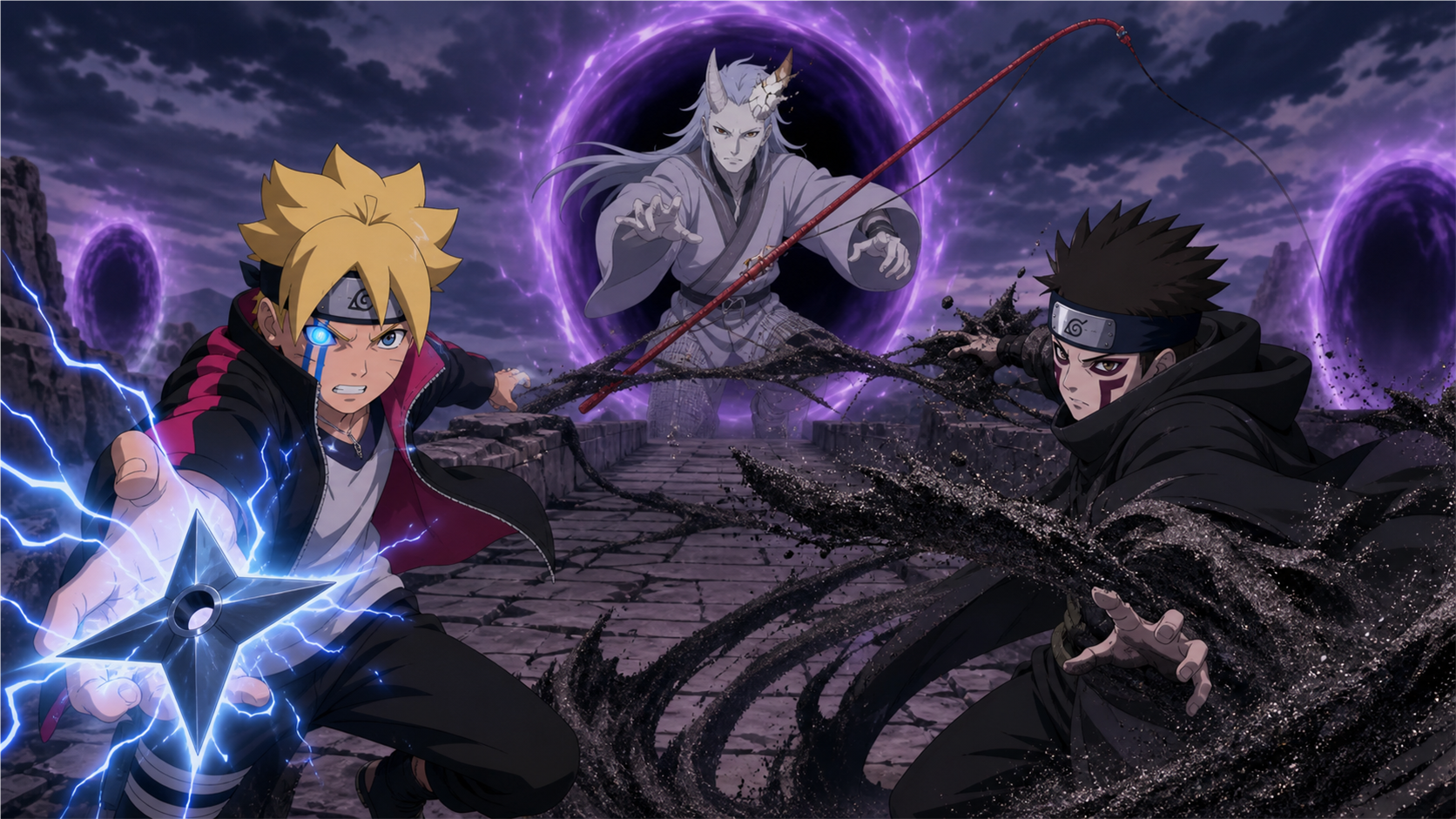
Boruto and Shinki
Shinki gets Shukaku to Naruto before returning to the bridge, where Boruto’s Jōgan and Iron Sand finally give Urashiki a fight he cannot laugh away.
Series: Boruto: Naruto Next Generations
Episode: 125 · Boruto and Shinki
Arc: One-Tail Escort Arc
Release: 2019-09-22
Previous: Episode 124 · Decision Time
Directory: All 293 Boruto episodes
Bottom line
Boruto Episode 125 finishes the One-Tail escort by letting Shinki complete the mission before he returns for the person who made success possible. That order matters. Shinki reaches the Land of Fire, gets past Mirai's reasonable security challenge with Sai's help, and places Shukaku under Naruto's protection. Only then does Shinki run back toward the bridge. Boruto has spent the last several episodes arguing that protecting a person and completing a mission do not have to be enemies. Shinki finally proves the argument with his own feet.
The fight with Urashiki is clever, satisfying, and a little ridiculous. Boruto sends lightning through the villain's fishing rod, the Jōgan predicts dimensional exits, and Shinki uses Iron Sand to turn those predictions into traps. The boys even break one of Urashiki's horns. I cheered. I also remembered that Sasuke and Gaara struggled to contain this man while two injured genin suddenly had him scrambling. The episode earns the emotional victory more cleanly than the combat math. Sasuke's arrival keeps that weakness from becoming complete nonsense because Boruto and Shinki hurt Urashiki, but an adult still has to stop the killing blow.
The real ending arrives three days later at the station. Shinki insists that he learned nothing from Boruto while smiling like a child who knows the lie fooled nobody. He has not become loud, sentimental, or magically easy to read. He remains Gaara's disciplined son. The change is smaller and better: Shinki completed his duty, returned for a friend, trusted information he could not personally verify, and accepted that caring about somebody did not make him careless.
Shinki completes the mission first
The episode opens with the bridge battle visible through distant destruction while Shukaku worries about the boy left behind as bait. Shinki keeps moving toward the Land of Fire. Somebody could read that choice as cold, but the entire plan depends on one person refusing to turn around too early. Boruto volunteered to draw Urashiki away from the real kettle. Shinki honors that risk by finishing the part Boruto cannot finish. A rescue halfway through the route would feel loyal for about five seconds, right before Urashiki took the One-Tail and made every sacrifice pointless.
Mirai Sarutobi challenges the unfamiliar Sand genin at the border instead of letting an injured child with a sealed kettle run directly toward Konoha. Her caution is correct. Urashiki has already used surveillance, transformations, stolen techniques, and dimensional travel during this pursuit. Allied villages still need security, especially when the emergency sounds unbelievable. Sai arrives quickly enough to identify the crisis and move the handoff forward. That adult support matters because international trust cannot require every exhausted child messenger to explain an Otsutsuki attack without help from anybody who has authority.
Shukaku finally reaches Naruto, the safest destination Gaara could name. Naruto understands Tailed Beasts as people, strategic targets, friends, and survivors of the same system that shaped his childhood. The delivery closes the formal mission. Shinki could remain in Konoha, receive treatment, and call the escort a success. Nobody could accuse him of failure. He returns anyway, but he returns after Naruto has the kettle. Episodes 122 through 124 kept forcing duty and attachment into the same argument. Episode 125 solves the argument with sequence. Shinki protects the larger mission first, then answers the human responsibility that still remains.
Urashiki turns the decoy into a hostage plan
Boruto uses clones and an empty kettle at the bridge to keep Urashiki focused on the false target. The trick buys the time Shinki needs, but deception never promised Boruto a safe exit once Urashiki understood what happened. Success leaves a very angry Otsutsuki standing across from the child who embarrassed him. Urashiki responds like a bully with too much power: he pretends the humiliation gave him a better idea, then decides that Naruto's son can become leverage to pull Shukaku back out of hiding.
The cruelest detail is not the hostage threat by itself. Urashiki uses chakra stolen from Shikadai to immobilize Boruto with Shadow Imitation. Chakra theft sounds abstract until the villain starts wearing pieces of other people's training. Shadow Imitation belongs to Nara family knowledge, discipline, planning, and team coordination. Shikadai learned that technique inside relationships. Urashiki strips away the history and treats the result like a tool pulled from storage. Losing chakra hurts. Watching an enemy use your friend's inheritance against you feels personal in a different way.
Urashiki's hostage logic also exposes how he understands attachment. He assumes Naruto and the others will trade the larger mission for one beloved child because bonds are useful pressure points. The assumption is cruel, but the assumption is not foolish. Boruto built the decoy around the same basic truth: people move when somebody they care about stands in danger. The difference sits in what each person does with that knowledge. Boruto risks himself to protect Shukaku and Shinki. Urashiki threatens Boruto to control everyone else.
Shinki comes back with the answer Boruto needed
Shinki arrives before Urashiki can use the fishing rod against Boruto. Iron Sand blocks the theft and changes the numbers on the bridge. More important, Shinki tells Boruto that Shukaku reached Konoha safely. Boruto accepted the decoy assignment without knowing whether his gamble worked. That confirmation frees both boys from protecting the kettle. The fight can now become escape, survival, and resistance instead of an escort mission pretending to continue after the package has already reached the destination.
Shinki's presence says what his controlled face refuses to say. Boruto became part of the mission too. Shinki did not abandon the One-Tail midway through the route, and he did not leave Boruto behind once that duty ended. The two responsibilities were never natural enemies. Bad timing would have made either choice reckless. Good timing lets Shinki honor both. Gaara raised a child who treats orders seriously, and Boruto has not erased that discipline. Friendship has expanded what Shinki believes the completed mission includes.
Urashiki breaks through the first Iron Sand restraint because Shinki's strongest material cannot become a magic answer every time the boys need one. The Otsutsuki fought Sasuke and Gaara, escaped major seals, stole several techniques, and crossed dimensions. Ordinary force will not hold him for long. Boruto and Shinki need brief openings, and they need to use every opening before Urashiki understands the combination.
Lightning, portals, and one very useful eye
Boruto throws a Lightning Release shuriken, and Urashiki blocks with the fishing rod. The charge travels through the weapon anyway. That is the kind of Boruto tactic I believe against a stronger opponent. He does not win by suddenly punching harder than the power scale allows. He attacks the system around the enemy. Urashiki's defense becomes a conductor, and arrogance gives Boruto the second he needs. The move will not defeat an Otsutsuki, but the move proves that overwhelming strength does not protect a person from every consequence of a bad decision.
The dimensional portals create the next problem. Urashiki can disappear from one angle and emerge from another before a normal counter lands. Shinki controls wide areas with Iron Sand, but he cannot bind a body whose route ignores the space between two points. Boruto's Jōgan activates and gives the partnership the missing information. His right eye perceives where the next portal will open. Reaction becomes prediction, and prediction gives Shinki somewhere real to place the trap.
Shinki does not stop the fight to demand a full explanation of an eye that the anime itself still refuses to explain properly. Boruto's calls keep matching the battlefield, so Shinki adjusts. That choice is trust in practical form. He accepts sensory information he cannot personally verify because the evidence keeps arriving where Boruto says the portal will open. Boruto supplies clones to expose Urashiki's timing, the Jōgan identifies the exits, and Iron Sand controls the available movement. Neither boy possesses a complete answer. Together they create a few seconds where Urashiki has to react to them.
Breaking the horn feels good, even when the math does not
The coordinated attack breaks one of Urashiki's horns. The damage gives the fight a concrete result beyond surviving another minute. Urashiki has spent this arc smiling at human effort as if everybody below him exists for entertainment. Watching that smile disappear has value. A broken horn also carries the right visual insult for an Otsutsuki who treats inherited power as proof of natural superiority. Two children from villages his clan would dismiss have forced him to bleed and lose part of the image he performs.
Now for the problem. Gaara and Sasuke struggled to contain Urashiki, while two exhausted genin manage to corner and injure him. Jōgan prediction, surprise, arrogance, and cooperation explain part of the result. They do not explain everything. Urashiki has dimensional portals, the Byakugan, stolen chakra, multiple Rinnegan abilities, lethal speed, and enough battlefield experience to know that children become dangerous when adults underestimate them. The episode pushes credibility because the emotional payoff needs Boruto and Shinki to accomplish something together before Sasuke arrives.
Fans can enjoy the choreography and still call the power relationship messy. Those reactions do not cancel each other. The fight works as character writing because Boruto and Shinki solve different halves of the same tactical problem. The fight works less well as a measurement of what Urashiki should be able to withstand. The cleanest reading is that they surprise and injure him during a narrow window, not that they suddenly become his equals. Once the horn breaks and his playful mood disappears, they have no second escalation available.
Sasuke restores the boundary
Urashiki moves to kill both boys, and Sasuke blocks the strike. He recovered enough chakra in the other dimension to track the repeated Space-Time Ninjutsu and return, but the rescue uses what he recovered. Sasuke can protect the children or chase Urashiki. He cannot do both. That limitation preserves the dimensional exile as a real cost instead of letting the climax hand him a full battery because the script wants one more fight.
The intervention also restores the scale that the horn-breaking sequence stretched. Boruto and Shinki create damage, time, and proof that Urashiki can be surprised. They do not defeat him. The adult who has been tracking the portals prevents courage from becoming a funeral. That boundary matters in a series where children regularly face military danger. Letting young shinobi make meaningful choices should not require pretending adult protection has become useless.
Urashiki escapes through the Origami Replacement Technique, leaving red chakra cranes instead of the familiar portal signature. Sasuke cannot follow a trail that never forms, and he lacks the chakra for another pursuit anyway. The red paper forms make retreat look elegant, which is irritatingly on brand for a villain who treats every entrance and exit like theater. Shukaku remains safe, so the escort succeeds even though the hunter escapes. Boruto and Shinki collapse beside each other after the threat leaves, and their bodies finally collect the bill for poison, running, clones, lightning, Iron Sand, dimensional attacks, and one terrible decoy plan.
Survival does not erase the cost
Gaara wakes in the Sand hospital with Yodo and Araya nearby. Kankurō is battered but alive, and the news reaches Temari and Shikadai. I am relieved because Kankurō deserved better than an offscreen explosion, but survival does not erase what his apparent death forced the children to carry. Boruto and Shinki had to choose without certainty. The fear, anger, and disagreement remain part of their growth even after the search party finds him.
Naruto wants to move immediately when Shukaku explains what happened. His son stood on a bridge as bait while the adults arrived late, so the impulse makes emotional sense. Sasuke stops him because a rushed pursuit without a dimensional trail creates another target instead of a rescue. The older generation is having the same argument the boys just survived, only with more control and better information. Caring about somebody does not remove the need for a plan. A plan does not excuse leaving somebody behind when a real route back exists.
Three days later, Naruto and Gaara discuss warning the other Kage. Urashiki is no longer one village's private problem. He moves across borders and dimensions, steals techniques from several nations, and targets Tailed Beasts as resources. International cooperation becomes the responsible answer. The escort succeeded because trust between the Sand and Leaf already existed. The next response requires expanding that trust before Urashiki chooses another isolated target.
Boruto refuses to let Shinki leave quietly
Shikadai tells Boruto that Shinki has been discharged and is leaving, and Boruto runs to the station for a proper goodbye. The sprint has the old Boruto energy without the old selfishness. He is not chasing forbidden training, secret information, or another chance to prove himself. He is chasing a friend who would otherwise leave with too much unsaid. Saving a village-level mission does not replace the smaller human courtesy of looking somebody in the face before they go home.
Gaara asks Shinki about the lesson Kankurō believed Boruto could teach him. Shinki claims that he still does not understand the Leaf boy. The answer is technically believable and emotionally dishonest. Understanding another person does not mean predicting every reckless choice. Shinki returned for Boruto, trusted the Jōgan calls, combined techniques, and stayed long enough to hear Boruto use the word friend. He understands enough to make different decisions than the boy who began this escort.
The smile gives him away without rewriting his personality. Shinki remains controlled, blunt, proud, and uncomfortable with open attachment. The story does not force him into an emotional speech because Boruto became important. That restraint respects the character Gaara raised. Friendship does not have to make Shinki act like Boruto. Friendship only has to change what Shinki is willing to do, and the whole episode has already shown that answer.
Shinki proves that attachment can improve discipline
Shinki began the escort treating emotion as interference. Orders created safety because orders reduced uncertainty. Boruto kept introducing variables: Kankurō might need help, Temari deserved information, Shukaku was a person rather than cargo, and a teammate left behind still counted after the handoff. Shinki heard those concerns as threats to completion.
Episode 125 does not make him abandon discipline. He completes the mission before returning. The change comes from expanding the definition of completion. Delivering Shukaku satisfies the formal order. Returning for Boruto satisfies the responsibility created by accepting Boruto's sacrifice as part of the plan.
That distinction matters because fandom stories often frame caring and professionalism as opposites. Shinki shows a better model. Attachment supplies information about what duty includes. Discipline supplies the sequence that keeps attachment from destroying the larger objective.
Gaara understands that lesson from his own life. Isolation made him powerful and unstable. Bonds did not weaken his judgment; bonds gave his power a reason beyond survival. Shinki's station smile shows the same movement at a smaller scale. He remains controlled because connection has not erased him.
The Jōgan keeps solving crises while adults keep avoiding the file
Boruto's right eye predicts Urashiki's portal exits with enough precision for Shinki to place Iron Sand before the villain appears. That contribution is not visual decoration. The Jōgan changes an unwinnable timing problem into a coordinated trap and helps produce the first meaningful damage the boys land.
The series still refuses to give the eye proper follow-through. Boruto cannot explain activation, limits, cost, or origin. Adults have witnessed enough unusual events to begin systematic observation, yet each incident fades once the immediate battle ends. That pattern weakens both worldbuilding and family care.
A responsible response would record triggers, sensory range, aftereffects, and connections to Otsutsuki space-time techniques. Sasuke has direct experience with dōjutsu and dimensional travel. Naruto can arrange medical examination without treating his son like a specimen. Hinata brings Hyūga knowledge and a parent's awareness of Boruto's physical baseline.
Mystery can remain while characters act intelligently. Nobody needs a complete answer after Episode 125. They need to stop behaving as though an unexplained eye that predicts hostile portals requires no investigation.
Urashiki loses because he treats bonds as predictable weakness
Urashiki understands that people move for someone they love. He uses that knowledge to build hostage plans and expects attachment to make opponents careless. Boruto and Shinki use the same knowledge differently. Boruto trusts Shinki to complete the delivery. Shinki trusts Boruto's sacrifice long enough to finish the handoff. Then he returns because the mission no longer requires abandonment.
The villain misreads cooperation as a pressure point rather than a source of adaptive strategy. Boruto's concern creates the decoy. Shinki's discipline protects the real kettle. Their trust lets impossible sensory information become a working trap without a committee meeting in the middle of combat.
Urashiki still escapes because the power gap remains real. His mistake costs a horn, time, and control of the encounter. The boys do not prove bonds magically defeat stronger enemies. They prove relationships can generate information and timing that raw superiority overlooks.
That result fits Naruto better than a sudden genin power jump. Clever cooperation should embarrass arrogance. An adult intervention should still prevent the embarrassment from becoming a fake complete victory.
Kankurō's survival does not refund the choices made under grief
Finding Kankurō alive offers relief, but the escort party made decisions while believing he might be dead. Boruto carried anger and urgency. Shinki used the apparent loss as evidence that stopping would waste Kankurō's sacrifice. Shukaku watched children argue over whether loyalty meant returning or continuing.
Those choices remain morally significant because certainty was unavailable. A later rescue cannot transform one side into the obvious correct answer after the fact. Boruto was right that a person should not disappear from the mission ledger. Shinki was right that abandoning Shukaku could make every injury meaningless.
The arc becomes stronger when survival does not erase that conflict. Young shinobi need adults to debrief what they believed, what information they lacked, and how the team might handle another separated escort. Celebration alone leaves trauma and resentment to settle without language.
Kankurō also deserves to hear how his stand shaped the mission. His survival gives the Sand a chance to discuss the cost instead of turning an apparent death into motivational mythology.
Final reaction
“Boruto and Shinki” closes the escort with the exact sequence Shinki needed. He delivers Shukaku, confirms the mission, and returns. Duty and friendship stop behaving like competing gods because Shinki finally understands that responsibility has an order. Boruto's willingness to become bait would have meant very little if Shinki had thrown away the handoff. Shinki's perfect mission record would have felt empty if he had used the completed order as permission to abandon Boruto.
The tactical partnership is the strongest part of the episode. Lightning turns the fishing rod against Urashiki. The Jōgan identifies portal exits. Clones reveal the movement pattern. Iron Sand converts information into contact. The sequence gives both boys necessary work and avoids making one character the assistant inside somebody else's victory. The broken horn is fun, but the cooperation that breaks the horn matters more than the damage.
The power scaling remains shaky. Urashiki has survived too much for two exhausted genin to pressure him this easily, even with arrogance and surprise helping them. Sasuke's arrival prevents the episode from crossing the worst line. Boruto and Shinki earn an injury and a few seconds. They do not earn a complete Otsutsuki defeat. That distinction keeps the emotional result intact without asking fans to forget every earlier fight.
Shinki's smile is still the real ending. He can say that he learned nothing, but the audience watched him complete the mission, return for Boruto, trust an impossible eye, coordinate without controlling every variable, and accept friendship without walking away faster. The lie is terrible. The smile is perfect.
Sources and lawful viewing
Official episode reference: Naruto Official episode guide
Licensed episode route: Crunchyroll licensed series page