
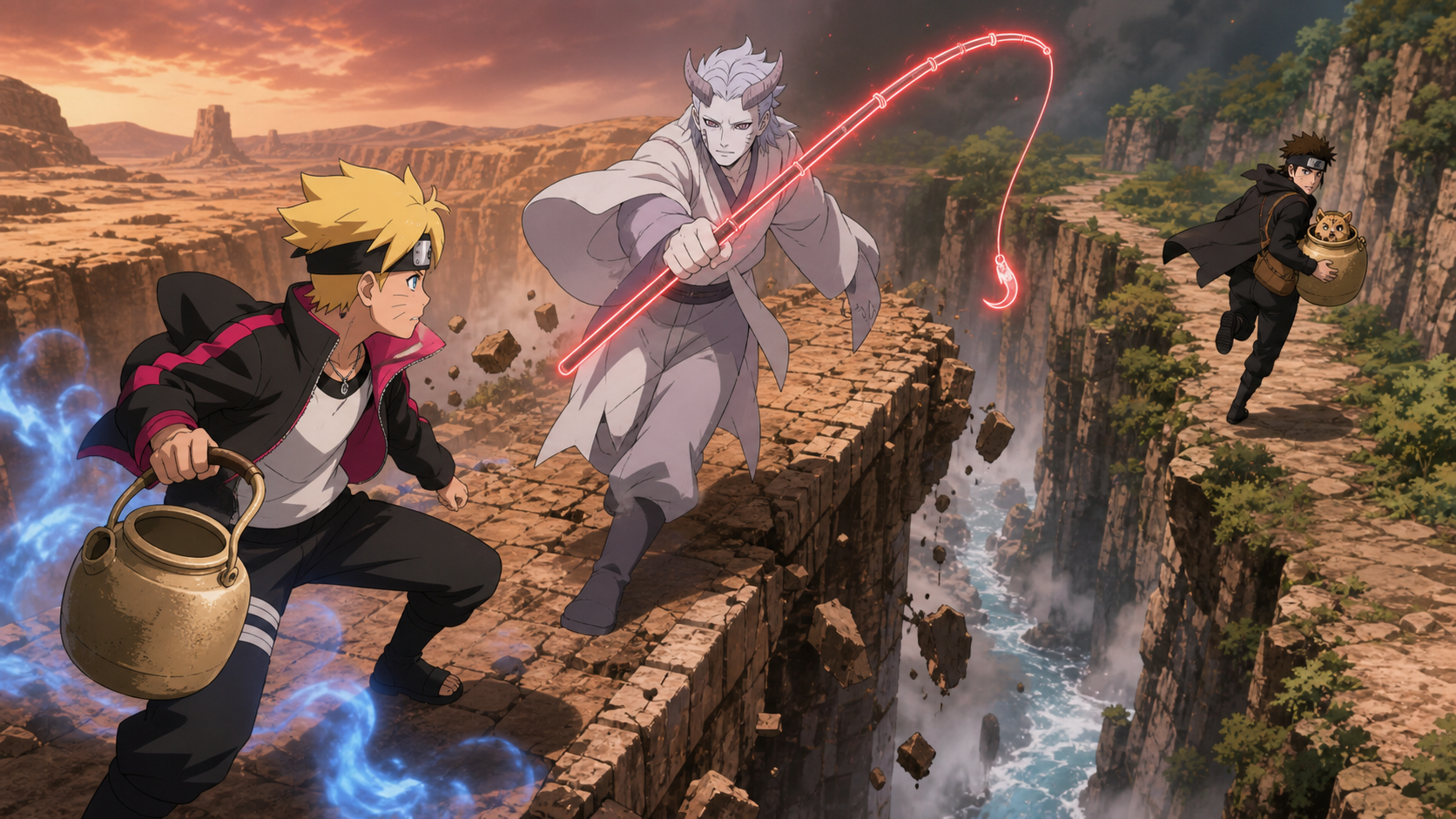
Decision Time
Boruto and Shinki can no longer outrun Urashiki together, so Boruto carries a decoy kettle onto the bridge while the real Shukaku takes the hidden route.
Series: Boruto: Naruto Next Generations
Episode: 124 · Decision Time
Arc: One-Tail Escort Arc
Release: 2019-09-15
Previous: Episode 123 · Urashiki Returns
Directory: All 293 Boruto episodes
Bottom line
Boruto Episode 124 finally lets Boruto and Shinki solve a mission problem together instead of arguing over which personality should control the route. Urashiki catches them near the Land of Fire, reveals that his puppets tracked Shukaku despite the tea kettle suppressing chakra, and boasts about stealing Temari and Shikadai's chakra. Shinki traps him with the Black Iron sealing technique, knowing the restraint will last even less time than Gaara's seal. They change direction to escape the Byakugan, discover Urashiki has attacked Gojō and Isago while searching for them, and lose the transmitter that could have brought backup. One bridge offers the obvious route into the Land of Fire. A longer local path offers distance but not enough time before Urashiki notices the trick. Boruto proposes using both. Shinki takes the real Shukaku along the hidden path while Boruto carries a decoy kettle to the bridge and becomes bait. The child who once entered the battle as a liability now chooses the dangerous position so the mission can survive without him.
Green vegetation announces the border
The desert begins giving way to plants as Boruto, Shinki, and Shukaku approach the Land of Fire. The environmental change makes Konoha feel close enough to touch.
Relief would be reasonable after puppets, poison, separation, and Urashiki's temporary absence. The episode refuses relief because the safest-looking part of a journey is often where attention slips.
The border becomes a promise and an ambush point at the same time.
Urashiki finds the kettle anyway
Shinki believed the tea kettle's seal suppressed Shukaku's chakra. The transport plan should have made direct sensing difficult.
Urashiki explains that the puppets were also surveillance. Their pursuit mapped the escort even when chakra concealment worked.
The correction matters because security fails when a team protects only the signal they know how to hide. The enemy watched behavior instead.
The Byakugan makes distance temporary
Urashiki reveals the Byakugan and turns open country into a search field. Trees, rocks, and ordinary changes of direction cannot provide reliable concealment while the eye remains in range.
Boruto has grown up around the Hyūga clan, so he understands how dangerous that vision can become.
Escaping sight requires more than ducking behind terrain. They have to manipulate what Urashiki expects to see.
Stolen chakra becomes a taunt
Urashiki enjoys mentioning the chakra taken from Temari and Shikadai. He knows Boruto cares about them and uses that concern to provoke a reckless attack.
The fishing-rod weapon does not only harvest power. Urashiki turns each theft into proof that protecting people creates exploitable openings.
Boruto takes the bait emotionally before Shinki pulls the mission back into focus.
Shinki says what the battlefield requires
Neither Sasuke nor Gaara is present. The two genin cannot defeat Urashiki through confidence alone, especially after Shinki's poison injury and chakra loss.
Keeping a cool head does not mean accepting what happened to Temari and Shikadai. Calm protects the chance to keep anybody else from joining the list.
Shinki's discipline becomes useful because Boruto now listens long enough to use the information.
Shukaku asks to be released
The One-Tail wants to fight instead of remaining inside the kettle while children absorb the danger meant for him.
That impulse has dignity. Shukaku is powerful, experienced, and tired of being carried like property.
Shinki refuses because releasing a full Tailed Beast near Urashiki could expose exactly the chakra the enemy came to steal. Respecting Shukaku does not require accepting every battle choice.
Boruto buys time for Shinki's plan
Shinki asks Boruto to keep Urashiki occupied. The request proves their partnership has moved beyond reluctant proximity.
Boruto uses shadow clones, movement, and feints instead of charging with one obvious Rasengan. His job is not to win. His job is to create the opening Shinki needs.
The distinction shows real mission growth after Episode 120's disastrous interruption.
Iron Sand becomes protection instead of isolation
Shinki shapes his defense around Boruto and the kettle. The same power he once used to keep people at a distance now protects a partner working inside the danger zone.
Their techniques do not match visually or emotionally. Boruto's movement is loud and improvisational. Shinki's control is measured and exact.
The combination works because difference becomes coverage rather than conflict.
The disguised kunai creates the opening
Boruto sells an attack in a form Urashiki believes he can read. The feint pushes the Otsutsuki toward the position Shinki prepared.
Urashiki's confidence is part of the trap. He has watched the boys, measured their chakra, and decided their options are boring.
Predictability cuts both ways. A watcher can learn habits, while the watched can exploit what the watcher thinks he knows.
Black Iron closes around Urashiki
Shinki combines puppet technique and Iron Sand into a sealing attack. The visual is one of his strongest moments in the arc.
Urashiki reacts with boredom because Gaara already sealed him once. That arrogance does not make the technique meaningless.
The boys need minutes, not a permanent prison. A short restraint can save the mission when everybody plans honestly around the short duration.
Shinki leaves Third Eyes behind
He plants surveillance so they can track the moment Urashiki escapes. The escort finally answers surveillance with surveillance.
Shinki does not assume his seal will match Gaara's. He knows the difference in power and builds the next decision around that limit.
Competence looks less glamorous than confidence because competence keeps asking what fails next.
They change direction before the seal breaks
Urashiki expects the shortest route toward Konoha. Boruto and Shinki move elsewhere while enough distance exists to escape the Byakugan's immediate reach.
The detour works because they act before confirmation of failure. Waiting to see Urashiki free would sacrifice the only advantage the seal created.
Planning becomes anticipation rather than reaction.
Urashiki rushes ahead on the obvious path
Once free, he continues toward the Land of Fire along the route the escort should logically take. Their change of direction buys time because expectation guides his speed.
The boys have not become invisible. They have made the wrong information more attractive than searching every possibility.
Deception works best when the false answer feels reasonable to the person being deceived.
Shinki's chakra starts failing him
The puppet fight, poison injury, Iron Sand, Black Iron seal, and Third Eyes carry a physical cost. He cannot keep producing advanced techniques without consequence.
Boruto supports him while they move. The gesture matters after several episodes where Shinki treated reliance as weakness.
Mission efficiency now includes admitting that the strongest route may require another person's shoulder.
Gojō's transmitter offers hope
Boruto remembers the farm from his trip toward Sasuke. Gojō has communication equipment that could bring help or warn Konoha.
Returning to a civilian relationship becomes a tactical choice. The detour from Episode 120 created knowledge useful to the current mission.
Boruto's habit of connecting with people finally produces more than emotional insight.
Urashiki has already attacked the farm
They find the property damaged and Gojō trapped beneath debris while Isago tries to free him. Urashiki searched the place because Boruto's earlier visit connected the family to his route.
The scene makes collateral damage personal. A kind civilian who once rescued Boruto pays for proximity to a shinobi crisis.
Heroic missions leave footprints, and enemies can follow those footprints into ordinary homes.
Shinki asks the useful question too quickly
He wants to know whether Urashiki caused the destruction. The answer determines enemy position and timing.
Boruto hears a boy questioning witnesses while an injured man remains under rubble. He calls out the lack of immediate help.
Both priorities matter. Shinki corrects the order by rescuing Gojō before returning to the intelligence problem.
Rescuing Gojō shows Shinki has changed
He does not deliver a speech about compassion. He uses his strength to lift the debris and free the man.
Action carries the growth more honestly than a polished confession would. Shinki sees the need, accepts Boruto's criticism, and helps.
The mission does not become weaker because a civilian receives care. The rescued witness provides the information they need.
The transmitter is destroyed
Urashiki removes the simplest path to backup. No warning can reach Naruto through the equipment Boruto remembered.
The destroyed device turns the farm visit into a rescue and information stop rather than a solution.
The episode keeps rewarding human connection while refusing to let one convenient object erase the chase.
One bridge controls the obvious crossing
The map shows a major bridge between the Lands of Wind and Fire. Urashiki can wait there because geography narrows the route.
Borders are not lines floating on paper. Canyons, rivers, roads, and infrastructure determine where people can move.
The enemy does not need to search the whole country when one crossing concentrates the travelers.
Gojō knows a longer local path
Civilian knowledge creates an alternative the shinobi map does not emphasize. Residents understand routes built from work, survival, and daily movement.
The hidden path offers distance from Urashiki, but the detour takes time. Waiting at the bridge will eventually tell him the escort chose another route.
Local knowledge creates an option, not automatic safety.
Boruto proposes using both routes
The plan joins Shinki's focus on the mission with Boruto's willingness to take personal risk. One traveler will make the obvious route look real while the other carries Shukaku along the local path.
The idea does not come from a sudden genius label. Boruto understands shadow clones, misdirection, Urashiki's expectations, and the emotional temptation to chase visible bait.
He builds the plan from everything the journey taught them.
The decoy kettle needs a visible escort
An empty container alone would not convince Urashiki. The bait needs a person behaving like the real mission still depends on the bridge.
Boruto can create clone support and move unpredictably long enough to hold attention.
His strengths finally match the dangerous job instead of disrupting somebody else's battle.
Shinki takes the real Shukaku
The more controlled fighter carries the true target along the path known only to locals. His job requires endurance, silence, and refusing to turn back when explosions begin.
Shinki does not like leaving Boruto against an Otsutsuki. Agreement shows how much trust has developed despite the fear.
He accepts that Boruto understands the risk and has chosen the position deliberately.
Boruto becomes bait by choice
Episode 120 placed Sasuke in danger because Boruto demanded attention inside a fight he did not understand. Episode 124 reverses that dynamic.
Boruto now asks the enemy to look at him so a protected person can escape. He still acts boldly, but the boldness serves a shared plan.
Responsibility does not erase his personality. Responsibility gives the same personality a better target.
Urashiki attacks at the bridge
The decoy reaches the expected crossing, and Urashiki responds exactly as planned. Falling debris crashes toward the river while the battle announces itself across the canyon.
Boruto has no realistic path to defeat him alone. Success means preserving the deception and surviving long enough.
The mission measures victory in distance gained by somebody who is not visible on this battlefield.
Shukaku asks Shinki about regret
From the longer route, they see evidence of the bridge attack. Shinki has to keep moving while knowing Boruto may be crushed, captured, or drained.
Shukaku presses the emotional question because duty no longer hides Shinki's attachment.
Regret does not automatically mean the plan was wrong. Regret proves the decision cost something real.
Sasuke's chakra begins returning elsewhere
Inside the other dimension, Sasuke recovers enough power to consider opening a route back. The mentor has not abandoned the crisis.
His recovery offers hope without rescuing Boruto before the decoy choice matters.
The episode lets the child carry responsibility while keeping the larger adult fight alive beyond the current frame.
A decoy plan needs consent, limits, and an extraction route
Boruto volunteers to become visible bait, which gives the decision moral weight. Shinki does not order a weaker teammate to absorb danger while carrying the safer assignment. Boruto proposes the role because clones, improvisation, and Urashiki's personal interest make him the believable escort on the bridge.
Consent does not make the plan safe. Boruto cannot defeat Urashiki, the canyon limits escape, and communication between routes may fail. A responsible plan should define how long the deception must hold, what signal ends the attempt, and where Boruto moves if the bridge collapses. The episode gives the purpose clearly and leaves the extraction details thin.
That gap matters because shinobi stories often celebrate voluntary sacrifice without asking whether commanders accepted unnecessary risk. Boruto's willingness proves growth. Shinki's responsibility includes refusing a plan that only sounds brave. He accepts because the alternative routes all expose Shukaku and because Boruto's skill set offers a plausible delay.
The choice works as a desperate field decision, not as a model adults should casually repeat. Afterward, Naruto and Sasuke should ask whether the same objective could have used remote clones, delayed traps, or another handoff point without leaving a child alone against an Otsutsuki.
Gojō's farm records the civilian cost of a shinobi route
Gojō and Isago help because travelers arrive injured and need shelter. Their reward is an Otsutsuki tracing the escort through their home, destroying equipment, and leaving Gojō under rubble. The farm becomes part of the battlefield without the residents choosing a military role.
Boruto recognizes the obligation immediately. Shinki first asks whether Urashiki passed through because the mission clock keeps running. Efficiency explains the question. Efficiency does not make stepping over an injured civilian acceptable. When Boruto challenges him, Shinki changes course and helps lift the debris.
That correction is growth because Shinki does not need a long moral conversion. He receives new information about what the mission includes and acts. Protecting Shukaku matters. Protecting people harmed because they helped the escort also matters.
The villages owe more than gratitude after the crisis. Repairing the transmitter, rebuilding damaged structures, replacing lost supplies, and explaining why the farm became a target belong in the mission cost. Civilians should not subsidize shinobi operations through ruined homes and unpaid courage.
Shukaku participates in the choice instead of traveling as cargo
Shukaku asks to be released when Urashiki closes in. The request comes from a being who can fight, assess danger, and decide whether confinement still offers protection. Boruto and Shinki have reasons to refuse because exposing the One-Tail could hand Urashiki the exact chakra source he wants. Refusal still needs to acknowledge Shukaku's agency.
The kettle format creates a dangerous visual habit. Characters carry, hide, lose, and defend the container as though the mission concerns an object. Shukaku keeps interrupting that framing through advice, complaints, questions, and deliberate cooperation. He is the protected person and a member of the planning group.
His question about regret also tests Shinki rather than merely commenting on him. Shukaku knows Gaara's history and understands what emotional isolation did to a child raised as a weapon. He watches Gaara's son use duty to manage fear, then pushes him to name the cost of leaving Boruto.
Shukaku does not demand that Shinki turn around. He demands honesty about what continuing means. That distinction respects mission necessity while refusing the fantasy that a necessary choice feels clean.
Shinki's retreat is disciplined because the attachment remains visible
Earlier Shinki could continue alone and claim that only the objective mattered. Episode 124 removes that shelter. He sees the bridge attack, knows Boruto may be injured, and keeps moving because the entire decoy depends on the real kettle gaining distance.
Continuing becomes harder after friendship, not easier. The pain proves that Shinki now recognizes Boruto as more than an unpredictable variable. Discipline means carrying the pain without letting the pain collapse the plan. Coldness would mean feeling no conflict or treating Boruto as expendable.
The next episode must complete the lesson by letting Shinki return after the handoff. Otherwise the story would reward suppression and call the result maturity. Finishing the protected route first and answering the personal duty second allows both responsibilities to exist.
Gaara's influence sits behind that sequence. The Kazekage knows that attachment can guide responsibility rather than sabotage responsibility. He wants Shinki to learn something from Boruto because perfect control cannot teach when a person belongs inside the mission definition.
Urashiki sees the obvious route because arrogance narrows his attention
The Byakugan should make a simple kettle swap difficult. Urashiki can inspect chakra networks, scan wide areas, and move across space. The plan works because sealing disguises Shukaku, geography funnels expectations toward the bridge, and Boruto performs the visible escort convincingly.
Arrogance supplies the remaining weakness. Urashiki wants Boruto to know he has been found. He enjoys fear, explanation, and the performance of superiority. A quiet scan of every alternate route would be more effective and much less satisfying to him.
That character flaw keeps the decoy plausible without erasing the power-scaling complaint. The boys do not fool an omniscient sensor through costume logic. They give a vain hunter the story he already wants to believe: desperate children took the obvious road and failed to hide the prize.
The bridge confrontation therefore depends on psychology as much as ninjutsu. Boruto becomes credible bait because Urashiki has already decided Boruto deserves personal punishment.
Final reaction
“Decision Time” earns the title because the episode stops using choice as a dramatic word and shows what a real decision costs. Boruto and Shinki cannot choose a route where everybody stays together, backup arrives, Gojō remains untouched, Urashiki loses the Byakugan, and Shukaku reaches Konoha without risk. Every available path leaves somebody exposed.
The opening confrontation shows how much the boys have learned. Boruto buys time instead of hijacking the fight. Shinki uses Black Iron as a temporary seal and immediately plans for failure. The restraint does not need to defeat Urashiki forever. The technique only needs to create enough distance for the next move. That practical scale makes the teamwork more believable than pretending two genin suddenly overpower an enemy who escaped Gaara.
The farm sequence gives the episode a necessary moral bruise. Gojō and Isago helped Boruto, and Urashiki turns that connection into danger. Civilians do not disappear when the shinobi plot moves forward. Gojō's destroyed transmitter and damaged home show the cost of enemies tracing heroic routes through ordinary lives. Shinki asking about Urashiki before lifting the rubble is efficient and ugly. Boruto's correction matters, and Shinki's immediate rescue matters more.
The bridge problem is the strongest writing in the episode. Geography creates the trap. Local knowledge creates the longer path. Time makes the longer path insufficient by itself. Boruto solves the full problem by using both routes and giving Urashiki the visible answer he expects.
Boruto choosing himself as bait completes the growth that began with his reckless trip toward Sasuke. He once entered a battle because he wanted his mentor's attention. Now he holds an enemy's attention so Shinki and Shukaku can leave. Same nerve, same refusal to stay out of danger, completely different responsibility.
Shinki's side of the plan hurts because he has to continue. Several episodes ago he could hide that choice behind mission language. Now Boruto is a partner, and the bridge attack makes the cost visible. Shukaku asks about regret because the One-Tail knows duty without attachment was never the future Gaara wanted for his son.
The plan may rely on Urashiki being arrogant enough to accept visible bait despite the Byakugan, and that logic deserves scrutiny. The kettle's seal and clone deception provide some cover, but a more careful Otsutsuki should question the obvious route. Urashiki's habit of playing with targets helps the trick work and also makes him less frightening than his power deserves.
Even with that complaint, Episode 124 gives Boruto and Shinki meaningful growth without sanding away their differences. Shinki plans for failure. Boruto plans around people. Together they create a route neither boy would have found alone.
Sources and lawful viewing
Official episode reference: Naruto Official episode guide
Licensed episode route: Crunchyroll licensed series page