
Konohamaru’s Ninja Way
Konohamaru cannot save Remon without hurting her, cannot destroy Sōma without losing her memories, and cannot turn her sacrifice into a demand that she remember him.
Series: Boruto: Naruto Next Generations
Episode: 119 · Konohamaru’s Ninja Way
Arc: Konohamaru’s Love Arc
Release: 2019-08-11
Previous: Episode 118 · Something That Steals Memories
Directory: All 293 Boruto episodes
Bottom line
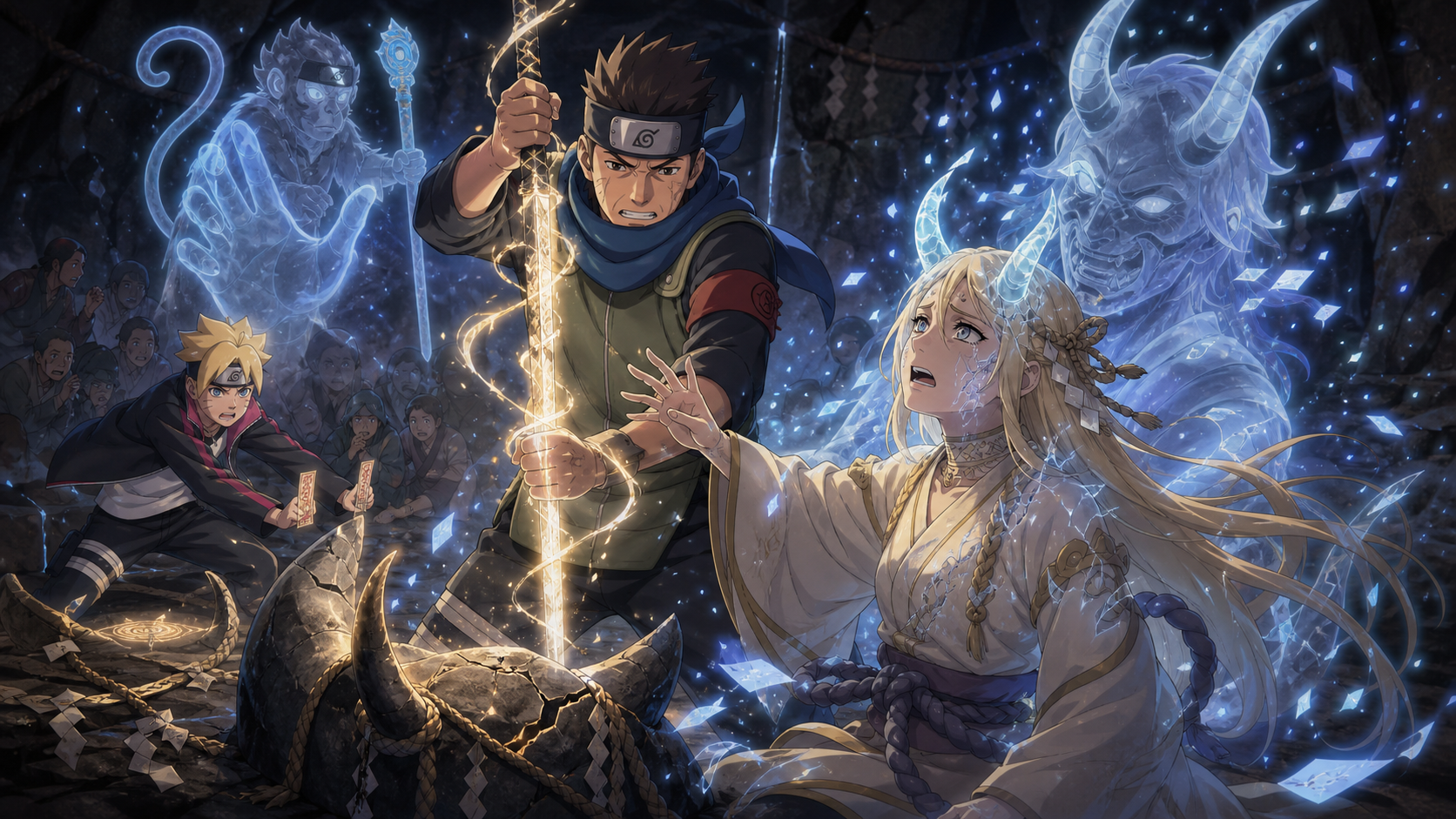
Boruto Episode 119 closes the Konohamaru and Remon arc by making the romantic hero perform the cruelest part of the rescue. “Konohamaru's Ninja Way” begins with Kankitsu sabotaging the wedding ritual and releasing Sōma. Boruto and Konohamaru arrive after the seal breaks. Ordinary weapons pass through the memory-eating spirit, villagers lose themselves, and Konohamaru's inherited sealing technique fails when his chakra cannot hold Enra's spectral restraint. Remon then chooses Kuen's original method: she seals Sōma inside herself and asks Konohamaru to cut the growing horns before the spirit consumes her. He does, destroying Sōma and saving the village at the cost of Remon's entire memory. Konohamaru refuses a goodbye because introducing himself again would turn her sacrifice into his request for emotional recognition. A lemon burger makes her cry without knowing why. The ending does not reward Konohamaru with romance. His ninja way means protecting Remon's choice even when the protection erases him from the life he wanted to join.
The wedding starts as village maintenance
Remon and Kankitsu stand before the horned sealing stone while the community watches. Their marriage is not being celebrated as two people choosing a shared future. The ceremony exists to renew a supernatural barrier.
They join marked hands and receive swords for cutting the stone's horns. Every movement treats their bodies as inherited tools.
Remon arrives willing because she believes the village needs her. Willing sacrifice still deserves the truth about what the other participant plans.
Kankitsu cuts the binding ropes
Instead of cutting the horns, he strikes the ropes holding Sōma's seal. The act shocks everyone because the trusted descendant has become the mechanism of release.
Sōma did not need to invade the ceremony from outside. The spirit corrupted the person standing inside the ritual.
Tradition provided access, authority, and the perfect disguise.
Remon's hand is forced through the ceremony
Kankitsu grabs her and continues the motions after sabotaging the seal. Whatever choice Remon made before entering the shrine has been replaced by physical control.
The episode leaves no room to call this a complicated romance triangle. Kankitsu is possessed, Remon is endangered, and the ritual has become an attack.
The childhood friend remains somewhere underneath, but Sōma controls the body in front of her.
Boruto and Konohamaru arrive one step late
They rush back to Daidai Village after reconstructing the danger, only to find the binding already broken.
Heroic timing does not pause the ceremony until the protagonists enter. Their delay matters because Boruto lost memory and Konohamaru lost freedom to house arrest.
Kankitsu used those stolen hours exactly as intended.
Kankitsu declares his work finished
Once Sōma can manifest, Kankitsu says he fulfilled his role and collapses.
The line clarifies possession without absolving the damage. Sōma used Kankitsu to remove the ornament, erase Asaki, file the complaint, accelerate the wedding, and break the seal.
The human vessel falls only after the spirit no longer needs him.
Sōma attacks the people who preserved the ritual
The released spirit does not honor the village for centuries of obedience. Sōma immediately targets Remon, Kankitsu, and the gathered residents.
Fear convinced everyone that following the ceremony exactly would protect them. Sabotage exposes how fragile that faith was.
Tradition can preserve knowledge, but repetition without independent safeguards leaves one corrupted participant able to destroy everything.
Konohamaru saves Remon and Kankitsu together
He pulls both descendants out of Sōma's first attack. Jealousy never enters the decision.
Konohamaru likes Remon. Kankitsu is her fiancé and the person whose possessed actions released the monster. A lesser romance story might use the moment to punish the rival.
Konohamaru sees two people who need saving.
Boruto discovers that physical attacks mean nothing
Kunai pass through Sōma. Wind Release cannot damage a spirit without an ordinary body.
Boruto's direct solution from Episode 117 finally receives a practical answer. Courage cannot turn the wrong tool into the right tool.
The failure does not make his attack foolish. Testing the enemy teaches them what the next plan must account for.
Villagers begin losing their memories
Sōma moves through people inside the cave and consumes the relationships, names, and knowledge holding their lives together.
The threat becomes immediate chaos. Residents who came to watch a protective ritual can no longer remember why they gathered.
The village is not facing death at some future century marker. Identity is disappearing in the room.
Boruto handles evacuation
Konohamaru orders him to move civilians out while the jōnin holds Sōma's attention.
Boruto would rather help attack, but getting people away from the spirit is the mission with the greatest immediate value.
Ninja work often means doing the job that saves lives while somebody else receives the dramatic confrontation.
Sōma keeps returning to Remon
The spirit recognizes the marked descendant as the path toward full survival. Remon remains both target and potential vessel.
Konohamaru repeatedly places himself between them. His protection does not depend on Remon remembering yesterday or choosing him tomorrow.
He defends her because she is a person in danger, not because romance created ownership.
Konohamaru reaches for Hiruzen's sealing legacy
Shadow clones position tags around Sōma while Konohamaru prepares a technique connected to his grandfather's knowledge.
The moment finally gives his Sarutobi inheritance functional weight. Hiruzen's legacy is not only a face on the mountain or a story that inspired Remon.
Konohamaru has studied enough to adapt family sealing knowledge against an enemy ordinary ninjutsu cannot touch.
Enra turns into the staff
Konohamaru summons Enra, a monkey partner who transforms into a staff for the sealing formation.
The connection recalls Hiruzen and Enma without making Konohamaru a copy. Enra is younger, more conversational, and part of Konohamaru's own working method.
Inheritance becomes useful when the next generation builds a relationship rather than borrowing an old legend's pose.
The spectral monkey hand almost holds Sōma
Tags and staff form the seal. A massive spiritual hand catches the memory-eating entity and briefly proves that Sōma can be restrained.
For one breath, Konohamaru looks ready to end the arc through skill, research, and family technique.
Then Enra says the chakra supply is not enough.
Konohamaru's seal fails without diminishing the attempt
The restraint breaks, and Enra's transformation and summoning end. The failure has frustrated viewers because the episode builds a strong Konohamaru showcase before denying him the finish.
Still, the attempt changes the situation. He buys time, proves a sealing principle, and keeps Sōma occupied long enough for Remon to act.
Heroism is not cancelled because somebody else completes the solution.
Remon returns with the protective ornament
She takes back the hair piece that protected Boruto and uses the opening to approach Sōma.
The object has traveled through every stage of the arc: family duty, Konoha freedom, Kankitsu's control, Boruto's evidence, and now Remon's final choice.
Protection returns to the person the ornament was created to protect.
Remon chooses Kuen's original seal
She pulls Sōma into herself, repeating the desperate method used by her ancestor four centuries earlier.
No character forces her hand in the moment. The village's inherited burden created the circumstances, but Remon makes the active decision after watching Boruto and Konohamaru fight for people they barely know.
Her courage is real even when the situation is brutally unfair.
The horns begin growing from Remon
Sōma struggles inside her, and physical horns mark the spirit's attempt to consume memory and escape.
Remon knows the remaining step. Somebody must cut the horns before the sealing process takes everything.
She asks Konohamaru because she trusts him to act when love would make hesitation easier.
Konohamaru has to hurt the person he came to save
Cutting the horns destroys Sōma but confirms the cost of Kuen's method. Konohamaru remembers the rooftop rescue, lemon burger, handkerchief, market walk, and Hokage Rock while Remon loses access to those same moments.
The strike is not a romantic gesture. The strike is duty stripped of every comforting reward.
His ninja way requires choosing Remon's life over his place in her memory.
Sōma dies and Remon's memories go with the spirit
The village survives. Kankitsu returns to himself. Asaki remains beside Remon. The curse ends.
Remon wakes without recognizing any of them or even knowing who she is.
Victory has a body count made of relationships rather than corpses.
Kankitsu accepts responsibility for the life after
The childhood friend stays with Asaki and commits to helping Remon rebuild. He was possessed, but the damage moved through his hands and his household.
His role after the battle is care, not romance automatically restored by history.
Remon must be allowed to become somebody new rather than pressured to perform the relationships she forgot.
Boruto wants Konohamaru to say goodbye
Boruto cannot understand why they leave without seeing Remon. After fighting so hard, surely Konohamaru deserves one final conversation.
That desire is human and focused on the survivor who remembers.
Remon does not owe a goodbye to a stranger merely because the stranger carries a shared past she cannot access.
Konohamaru refuses to make her sacrifice comfort him
Introducing himself again could help Remon someday. In this immediate moment, the visit would ask a traumatized woman to hold his grief while she cannot even hold her own identity.
Konohamaru walks away because his feelings belong to him now.
Restraint becomes the final proof that his affection was never possession.
The lemon burger reaches Remon again
Kankitsu brings the absurdly sour food from Konoha. Remon enjoys the taste and begins crying without knowing why.
Her explicit memories are gone, but emotion leaves an echo. The scene does not magically restore the romance or erase the cost.
The body recognizes a small piece of freedom before the mind can name the afternoon.
Boruto brings the same burger to Konohamaru
They sit near Hiruzen's face on the Hokage Rock, returning the arc to the story that first connected Remon and Konohamaru.
Boruto cannot restore what Sōma took. He can sit beside his teacher and share the taste linked to the missing person.
Fandom grief often looks exactly that ordinary: food, a familiar place, and somebody who remembers with you.
Remon's wedding proves tradition without consent is captivity
The village calls the ceremony duty, protection, and continuity. Remon's body tells a different story. Her hand is forced, her movement is controlled, and the people around her treat inherited obligation as permission to override present choice.
The ritual exists because Sōma is real and because Kuen's sacrifice once protected everyone. Historical necessity explains why the village fears change. Historical necessity does not make every descendant available for the same use without consent.
Kankitsu's possession complicates individual blame, but the social structure was ready to move Remon through the ceremony before anyone understood the full manipulation. A system built around one family's sacrifice makes coercion look normal whenever danger returns.
Protecting a community cannot mean designating one young woman as renewable sealing material. If the village depends on Remon's bloodline and memory, the village owes her honest information, meaningful alternatives, training, and a voice in how the burden is carried.
Konohamaru reaches for family knowledge without pretending inheritance guarantees mastery
Hiruzen's techniques belong to a legacy Konohamaru has spent years chasing and resisting. Summoning Enra and shaping the staff show real growth. Attempting the seal shows courage and preparation. Failure shows that bloodline and admiration do not automatically reproduce another shinobi's mastery.
That limit strengthens the scene. Konohamaru does not become the Third Hokage because the episode title needs a victory. He uses available knowledge, tests a plausible method, and remains present when the method fails.
Inherited technique should work this way. Family history offers tools, examples, and pressure. The living shinobi still needs training, judgment, and adaptation. Konohamaru's ninja way cannot become Hiruzen cosplay.
The attempt also gives Remon time and information. A failed seal can still contribute when the user understands the objective and the team continues working rather than treating failure as personal disgrace.
Boruto contributes through evacuation instead of stealing the climax
Sōma ignores ordinary physical attacks, which removes Boruto's favorite direct answers. The episode gives him a job the crisis actually needs: move villagers, recognize spreading memory loss, and keep the battlefield from collecting more victims.
That work matters even though Boruto does not land the final blow. Evacuation requires communication, speed, awareness, and the ability to act while people forget why they are running. A genin protecting civilians can be more useful than another Rasengan thrown at an intangible enemy.
The role also respects Konohamaru's story. This arc tests the teacher's judgment, inherited techniques, and feelings for Remon. Boruto supports the mission without becoming the only person allowed to solve every problem.
Heroism includes making sure ordinary people survive long enough for specialists to finish the supernatural work.
Memory loss makes survival an unequal ending
Remon lives, but the seal takes her memories connected to Sōma and the people involved in the crisis. Konohamaru and Boruto keep the shared history. Remon loses access to the relationship that made her sacrifice emotionally legible.
That imbalance prevents a clean romantic ending. Konohamaru cannot approach her as though his memories create a claim on her future. He remembers affection, danger, promises, and goodbye. She encounters a stranger carrying emotions she cannot verify.
Kankitsu faces another version of the same problem. He knows what possession made him do and accepts responsibility for supporting Remon's life afterward. Care must not become ownership or a demand that she recover a bond on his preferred schedule.
The village also owes Remon records. Losing personal memory should not mean losing the right to know what happened to her body, family duty, and choices. Information can be offered without forcing emotional reconstruction.
Konohamaru's refusal to say goodbye respects Remon's present self
Boruto wants a farewell because narrative closure feels kind. Konohamaru understands that the farewell would primarily comfort the people who remember. Remon cannot consent to an intimate goodbye based on a relationship removed from her mind.
Walking away hurts, but pain does not make the choice wrong. Konohamaru refuses to turn her sacrifice into permission for one last romantic scene. He accepts that loving someone may require leaving her free from feelings she no longer shares.
This restraint separates care from possession. Konohamaru saved Remon, fought for her choice, and developed genuine affection. None of those facts grants access after the memory loss.
The lemon burger becomes a gentler connection because Remon can encounter the taste without pressure. Familiar pleasure reaches her through the present rather than a stranger demanding recognition from the past.
Kankitsu's responsibility begins after possession ends
Sōma controlled Kankitsu, which reduces his agency during key acts. The aftermath still leaves damaged relationships, a frightened village, and Remon facing a changed life. Kankitsu chooses to remain accountable for repair without claiming every possessed action as freely chosen guilt.
That distinction matters. Accountability can include explaining events, rebuilding trust, supporting Remon's autonomy, and helping reform the ritual system. Self-punishment alone would place attention on his suffering while leaving practical needs untouched.
He must also avoid turning lifelong care into another cage. Remon deserves options outside a marriage justified by danger or gratitude. Supporting her means accepting choices that may not center him.
The episode offers the beginning of that responsibility rather than proof that every consequence has been resolved. A village tradition old enough to normalize coercion needs more than one defeated spirit.
Final reaction
“Konohamaru's Ninja Way” gives Konohamaru a strong battle showcase and then refuses the easy victory. He summons Enra, uses shadow clones, lays out a sealing formation, and reaches into Hiruzen's legacy for a technique that can touch Sōma. His chakra fails before the seal finishes. That failure stings because the episode wants the audience to feel how badly he wants to save Remon without asking her to pay Kuen's price.
Remon finishes the fight because this remains her inherited crisis and her decision. The arc has trapped her inside family duty from the beginning, yet the climax restores agency within an unfair choice. She sees two outsiders risking themselves for her village and chooses the method that can end the cycle permanently.
Konohamaru's defining action is not the summon or the spectral monkey hand. The defining action is cutting the horns after Remon asks. He has to destroy the spirit while watching the memories they made become collateral damage. Refusing would protect his feelings and condemn her.
The goodbye he does not request matters just as much. Remon wakes without a past. Konohamaru could introduce himself, explain their connection, and place a romance-shaped obligation inside the first hours of her new life. Instead, he leaves the care to people she once knew and carries his grief home.
I wish the arc had given Remon more future beyond becoming the beautiful woman who teaches Konohamaru sacrifice. I wish the village had faced harder questions about a system that scheduled descendants for marriage and memory loss. I also wish Konohamaru's seal had contributed more directly after such a good setup.
Still, the lemon burger ending lands. Remon cries because some part of the afternoon remains. Konohamaru eats the same ridiculous food beside Hiruzen's stone face because some memories now belong only to him. They shared something real even though the story refuses to turn reality into ownership.
Remon's aftercare should belong to more than family duty
Memory loss, supernatural possession, forced ritual participation, and physical transformation require medical and psychological follow-up. Leaving every consequence inside the same family that maintained the ritual risks rebuilding the old system under kinder language.
Remon needs independent records of the incident, access to healers who understand chakra and memory, and a choice about who receives updates. The village should preserve testimony from Konohamaru, Boruto, Kankitsu, and witnesses while separating factual history from pressure to feel a certain way about that history.
The community also needs to reform the protection plan before another descendant faces the same demand. One successful seal cannot become an excuse to postpone institutional change. Researchers can study Kuen's method, train multiple protectors, and develop evacuation or containment options that do not depend on marriage and inherited sacrifice.
Remon paid the immediate cost. The village owes her a future where survival does not quietly return her to the role that endangered her.
Sources and lawful viewing
Official episode reference: Naruto Official episode guide
Licensed episode route: Crunchyroll licensed series page