
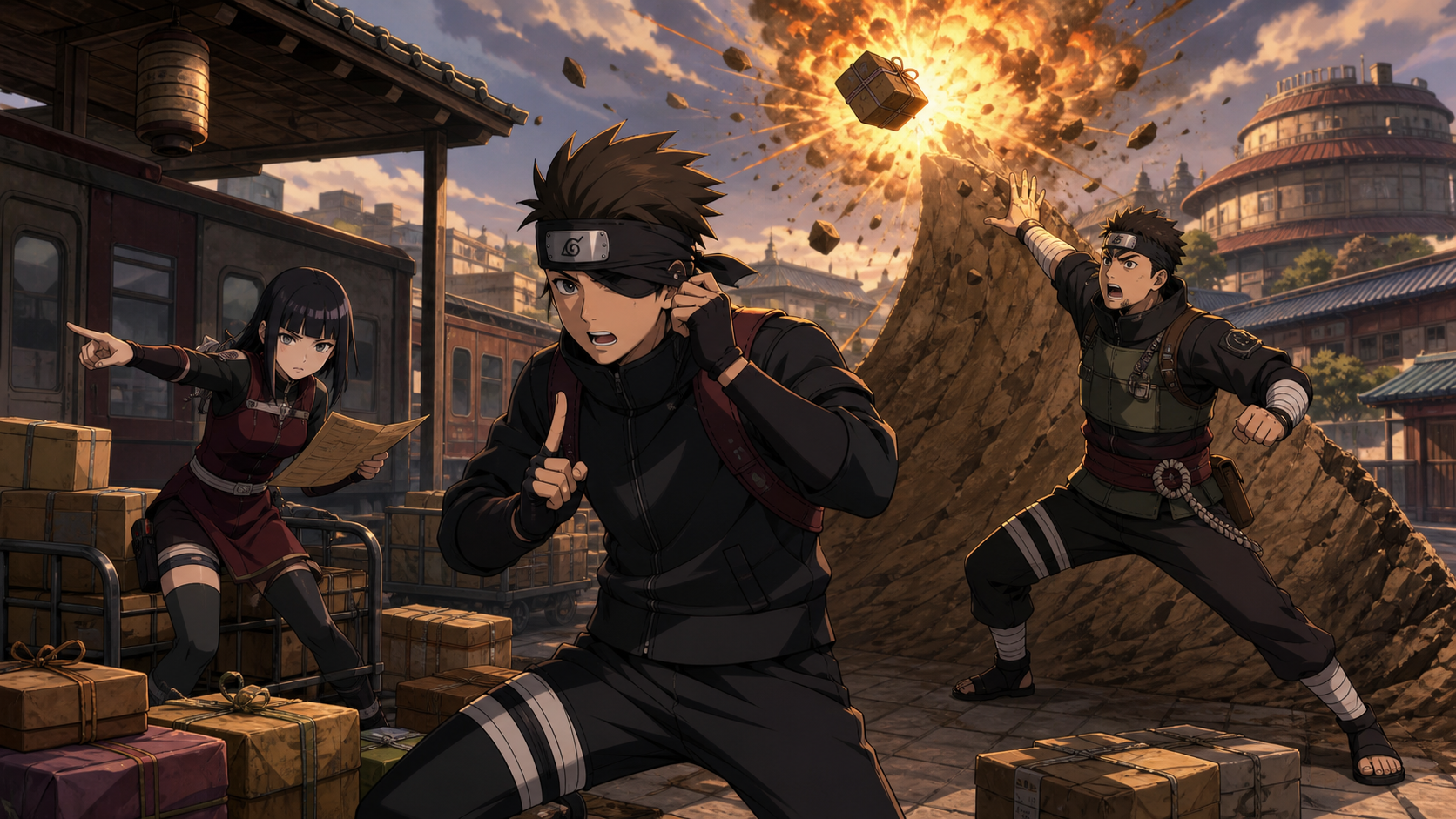
Team 25
Hōki, Hako, and Renga were never a useless squad. Konoha kept giving an intelligence team the wrong job and blaming the children for looking ordinary.
Series: Boruto: Naruto Next Generations
Episode: 115 · Team 25
Arc: Team 25
Release: 2019-07-14
Previous: Episode 114 · X Cards Proxy War!
Directory: All 293 Boruto episodes
Bottom line
Boruto Episode 115 finally pulls Team 25 out of the Academy-background crowd and gives Hōki Taketori, Hako Kuroi, and Renga Kokubō a proper reason to exist. “Team 25” starts with three genin failing a mail-sorting mission because Hōki gives orders nobody understands, Hako ignores him, and Renga tries to solve every problem with muscle. Kakashi investigates under his Sukea disguise and discovers something more interesting than three weak rookies: Hōki remembers details with frightening accuracy, Hako reads people and situations quickly, and Renga can protect an entire area when brute force has a purpose. A bomb threat turns their postal punishment into a real emergency. The team succeeds only after Hōki stops imitating the shape of a leader and trusts the other two to lead where their skills fit. Kakashi then recommends Sai as their captain because Team 25 belongs in intelligence work. That ending does more than rescue three neglected side characters. The episode argues that a team can look useless when leadership keeps measuring everybody against the wrong job.
Konoha has a bomb threat and Sai has paperwork
The Hokage's office is almost empty because village personnel are chasing a reported bomber. Sai remains behind with a map and the administrative mess that never disappears just because danger arrives.
Kakashi notices a complaint from the post office about Team 25. The mission sounds laughably small beside a bomb investigation, which is exactly why the complaint matters. Genin still need supervision, ordinary work still needs doing, and neglected details have a habit of joining the emergency later.
Kakashi volunteers because retirement apparently means finding new ways to work without admitting he came to work.
Sukea returns because Kakashi enjoys a disguise too much
Kakashi approaches the post office as Sukea, the freelance journalist disguise he has used before. Hōki recognizes him immediately from an Academy interview.
That recognition is the first clue that Hōki is not merely a nervous child dressed like Kakashi. Years have passed, yet he recalls Sukea's face and the exact encounter without hesitation.
Kakashi could have arrived as the Sixth Hokage and made every child stand straighter. Sukea lets him watch the failure without rank changing the behavior first.
Team 25 is losing a fight with cardboard boxes
Hōki scolds Hako for abandoning his plan and Renga for carrying too much. Renga drops the boxes. The postal worker has reached the end of his patience and threatens to request different genin.
Nobody looks competent. Hōki sounds controlling, Hako acts detached, and Renga creates the exact mess Hōki warned about. Their failure is funny until the blame starts moving in circles.
Hako and Renga say Hōki's instructions make no sense. Hōki says they refuse to follow instructions. All three are describing the same broken system from different seats.
Hōki copied Kakashi's look before understanding his leadership
Sukea asks about Hōki's mask and covered eye. Hōki admits he admires the Sixth Hokage. The influence could not be more visible unless he carried an orange book and arrived late with a terrible excuse.
The outfit makes Hōki memorable, but admiration has trapped him inside performance. He wants to be the cool, capable leader who already knows the answer. He does not want teammates to see uncertainty.
Kakashi's appearance was never the source of his authority. His judgment came from failure, grief, field experience, and learning that comrades matter more than the mission rulebook.
Their missing jōnin explains part of the mess
Team 25's supervising jōnin is recovering from an injury, and Konoha lacks an available replacement. The village sends the children on D-rank work without the guidance a new team still needs.
Hōki fills the vacuum because somebody has to. He has no training for that responsibility and no adult beside him to correct bad habits before frustration hardens them.
The complaint belongs to Team 25, but the village also created the conditions. Konoha cannot remove a teacher, hand leadership to a genin by default, and act shocked when the child struggles.
Hōki thinks leadership means carrying every answer
He describes Hako as somebody who wanders off and Renga as somebody who only understands force. That judgment contains truth and misses the point.
Hako notices details Hōki overlooks. Renga commits his whole body when action is required. Their habits become liabilities because Hōki treats difference as disobedience instead of information.
He builds the plan alone, delivers unclear orders, and reads every deviation as proof that he needs tighter control. That cycle can ruin a grown team, never mind three children sorting parcels.
Kakashi talks about mistakes without revealing himself
Sukea tells Hōki that the Sixth Hokage made serious mistakes and lost a friend. The advice lands because Hōki worships an idealized Kakashi who seems incapable of uncertainty.
Kakashi does not offer the pretty version of mentorship. He points toward the cost of believing one person must decide everything alone.
The story of Obito remains carefully indirect, but the wound behind the lesson gives the conversation weight. Hōki does not need to become a flawless miniature Kakashi. He needs to learn the lesson Kakashi paid for.
One stickerless package changes the mission
Boruto and Sarada help identify a suspicious parcel connected to the bomb threat. Hōki explains why the package stands out: department-store wrapping should carry the store's sticker, and this parcel does not.
Then his memory supplies the dangerous part. He saw other stickerless packages earlier.
The child who could not organize a mail shift has quietly stored the visual details needed to expose a wider attack. His ability did not suddenly appear. The assignment finally presented a problem suited to his mind.
The bomber counted on everybody relaxing
The first discovered explosive could make investigators believe the danger had passed. Multiple parcels exploit that relief.
Team 25 realizes the attacker sent several bombs through the postal system. Ordinary delivery routes have become moving threats, and one package has already left the building.
The episode turns paperwork and wrapping labels into evidence. No glowing eye or giant summon solves this stage. Memory, observation, and process knowledge keep the village from losing track of the final bomb.
Hōki finally tells Hako and Renga what he does not know
The undelivered parcels can be checked, but the package already in transit has no guaranteed destination order. The postal worker chooses his route.
Hōki cannot calculate the answer alone. Instead of pretending otherwise, he gives Hako and Renga the facts and asks for help.
That confession is his first successful leadership decision. Trust begins when the leader stops hiding the edge of his own knowledge.
Hako should lead the deduction
Hōki asks Hako to take charge because her perception makes her the best person to assign the next steps. This is not surrender. This is actual command.
Hako has watched the clerks during their work and understands their behavior. Hōki remembers which worker has the relevant delivery. Hako uses that knowledge to predict the train station.
Neither ability solves the problem alone. Memory provides the data. Perception gives the data meaning.
Renga's strength was never the problem
The team finds the bomb but cannot deactivate the device before detonation. Renga has the package thrown upward and creates a protective wall around the blast area.
Earlier, his instinct to carry everything at once caused chaos. During the emergency, his willingness to commit fully becomes the reason civilians survive.
Brute strength needs direction, not contempt. Hōki spent the morning trying to make Renga work like Hōki. The bomb requires Renga to work like Renga.
Their three abilities form an intelligence unit
Hōki has near-photographic recall. Hako reads small behavioral clues and assigns actions quickly. Renga supplies defense strong enough to protect the team when information work becomes dangerous.
That combination is not a conventional assault squad. The three can observe, reconstruct, predict, and survive.
Konoha kept giving them simple physical errands and reading poor results as lack of promise. Wrong assignments can make specialized talent look mediocre.
Kakashi does not steal their victory
Kakashi arrives after the blast and claims Sukea told him what happened. Hōki never learns that his hero personally watched the entire turnaround.
That choice matters. Kakashi could reveal himself and turn Hōki's growth into a reward for fandom. Instead, he lets the team own the success.
Hōki changed because the advice made sense, not because the Sixth Hokage handed him a dramatic approval scene.
Switching leaders mid-mission was risky
Kakashi acknowledges that Hōki's decision to let Hako lead could have created more confusion. A leader cannot dodge responsibility every time pressure rises.
Hōki did not dodge. He matched authority to ability while remaining responsible for the whole team.
The difference separates delegation from panic. Hōki understood why Hako should direct that phase and trusted Renga when the crisis became physical.
The apologies work because everybody owns a piece
Hōki apologizes for poor communication and for trying to control the team. Hako and Renga admit they left too much responsibility on him because ignoring the plan was easier than helping build a better one.
Nobody receives the convenient role of sole villain. Hōki overmanaged. The other two disengaged. The missing adult supervision allowed both patterns to grow.
Their repair feels earned because the episode never pretends one speech erases every future disagreement. They have finally named the work.
Sai is the right captain, not the consolation prize
Kakashi recommends Team 25 to Sai, who recognizes that their abilities suit intelligence missions. That appointment is not a random ending designed to give Sai screen time.
Sai understands observation, infiltration, coded information, emotional distance, and the danger of treating teammates like tools. His own history inside Root makes him unusually qualified to train children whose talents could attract secretive work.
He can teach them how to gather intelligence without losing the human bonds Hōki almost smothered under procedure.
Hōki's Kakashi fandom finally becomes useful
Copying a mask did not make Hōki a leader. Listening to the painful lesson behind Kakashi's reputation moves him closer.
Fandom can stop at costume, trivia, and imitation. Hōki lets admiration become instruction. He accepts that the hero he worships failed, changed, and learned to trust a team.
That version of Kakashi is worth following because perfection would give Hōki nothing honest to use.
Side characters need episodes like this
Boruto has a crowded generation, and many classmates remain decorative until the story needs another body in a group shot. “Team 25” proves a single focused episode can turn three designs into a team with a clear narrative purpose.
Hako's calm strangeness, Renga's physical confidence, and Hōki's obvious Kakashi obsession already existed. The episode connects those traits to a working unit instead of inventing personalities from nowhere.
Konoha feels larger when Boruto is not the only child allowed to discover a future.
The postal mission was exactly the right test
A flashier assignment would have hidden the episode's point. Sorting and delivering mail sounds beneath heroic attention, yet the work demands accuracy, coordination, memory, and awareness of routine.
The bomb threat transforms the same environment without changing the core skills. The children do not abandon the boring mission to become useful somewhere else. They discover that the boring mission contained the evidence.
Ninja work cannot consist only of battles dramatic enough for an opening sequence.
Their former captain's withdrawal should trigger support, not quiet replacement
Team 25 loses jōnin leadership because their captain becomes unable to continue after injury and shaken confidence. The episode uses that absence to explain why the genin drift, but the village response deserves scrutiny.
Young shinobi should receive a clear transition plan, temporary supervision, and an honest explanation appropriate to their rank. Leaving them with minor duties and no stable mentor teaches that a team becomes administrative debris when an adult can no longer serve.
The former captain also needs care beyond removal. Physical recovery, trauma support, retraining, or a non-field role should remain possible. A military village that treats injured leaders as failed equipment will teach every subordinate to hide symptoms until someone gets hurt.
Sai's assignment helps Team 25. The transfer should not erase the person who led them before or the system that allowed the gap to continue.
Hōki mistakes visible certainty for leadership
Hōki admires Kakashi's competence, appearance, and reputation. He copies the mask and covered eye before understanding that Kakashi's strongest leadership often involved reading teammates, changing plans, and admitting when an old rule no longer served the people in front of him.
Trying to supply every answer makes Hōki less useful. He withholds uncertainty, assigns roles without enough discussion, and turns teammates into extensions of his plan. The behavior looks decisive until the mission presents information he cannot process alone.
Leadership begins improving when Hōki tells Hako and Renga what he does not know. That admission creates room for their abilities and observations. Authority does not disappear because a leader asks for help. Authority becomes credible when the leader stops pretending one perspective covers every risk.
Kakashi fandom becomes useful only after Hōki copies the underlying flexibility rather than the costume.
Hako's analytical strength deserves command authority
Hako notices details, organizes evidence, and understands patterns inside the suspicious packages. The mission needs those skills more than another loud declaration from whoever currently holds the leader label.
Letting Hako lead the deduction does not humiliate Hōki. Teams should shift operational control toward the person with the best information for the current problem. A fixed hierarchy can preserve accountability while still allowing expertise to direct action.
The episode risks presenting her insight as support for Hōki's growth rather than a leadership capability in its own right. Team 25 becomes stronger when Hako's analysis shapes future intelligence work, briefings, and mission planning beyond this one bomb threat.
Recognition should include responsibility, training, and credit. Quiet competence should not remain invisible because another teammate wears the obvious protagonist cosplay.
Renga's strength becomes useful after the plan stops treating him like cargo equipment
Renga brings physical power and defensive capability. Early team dysfunction reduces that contribution to moving boxes or following Hōki's instructions. Strength without information becomes easy to waste.
Once the team communicates, Renga can protect routes, move dangerous material, and create safe space for Hako's deduction. His role depends on timing and shared understanding rather than raw force alone.
The shift shows why balanced teams need more than different jutsu on a roster. Members need enough context to decide when their skill helps and when using the skill creates another hazard.
Renga apologizes because he contributed to the friction. The apology should not suggest that questioning poor leadership was disloyal. Teams improve when disagreement becomes specific and usable.
Kakashi's disguise creates useful distance and questionable consent
Kakashi returns as Sukea, which lets him observe Team 25 without the pressure his Hokage identity and reputation would create. Hōki can speak to a photographer more honestly than to the hero he imitates.
The disguise also means the children do not know who is evaluating, guiding, and entering their mission space. Kakashi withholds identity to produce a lesson, a habit the franchise treats as charming because Kakashi usually means well.
Good results do not remove the ethical question. Sai and village leadership can authorize observation, but Team 25 deserves a later explanation that Sukea was Kakashi and that their behavior contributed to a command decision.
Mentorship built through deception should end with disclosure. Otherwise students learn that trusted adults may test them under false identities without accountability.
Switching leaders mid-mission works because the team names the reason
Changing command during a bomb investigation could create hesitation and conflicting orders. Hōki steps back because Hako has the better analytical route, not because panic makes leadership random.
The team understands the shift once communication improves. Renga knows which directions to follow. Hōki contributes memory and observation without trying to reclaim control. Hako can finish the deduction because the others protect the space around her work.
That process offers a practical model for distributed leadership. Name the problem, identify the relevant expertise, state who directs the current phase, and return to the broader chain of responsibility afterward.
Team 25 succeeds because flexibility becomes explicit rather than because three people improvise separately and happen to land on the same answer.
Sai fits the team because intelligence work values their actual strengths
Sai understands surveillance, infiltration, coded communication, unconventional observation, and the emotional difficulty of learning teamwork after isolation. Team 25's combination of memory, analysis, and physical support aligns naturally with intelligence work.
Assigning Sai should not read as placing an unwanted team under a spare adult. He can teach them how to gather information lawfully, preserve evidence, report uncertainty, and distinguish observation from assumption.
Hōki's admiration for Kakashi may also mature under a captain who refuses to imitate Kakashi. Sai has his own history, methods, humor problems, family, and command style. A good mentor expands the student's model rather than competing with the hero poster already on the wall.
The transfer gives Team 25 a purpose the village failed to name earlier. Purpose should arrive with support, not another expectation that talented children repair institutional neglect by performing well.
Final reaction
“Team 25” is the kind of Boruto episode I want more often. The story notices three neglected genin, gives each child a specific strength, and builds a crisis that requires all three. No destiny speech arrives. No famous bloodline wins the day. A wrapping sticker, a remembered delivery worker, a sharp read of human habits, and one defensive wall stop a bombing.
Hōki begins as the most irritating version of a young leader: insecure, controlling, and convinced that admitting uncertainty will expose him. His Kakashi cosplay makes the flaw funnier because Kakashi's greatest lesson was never about looking composed. Kakashi learned that abandoning comrades destroys the meaning of the mission. Hōki begins to understand that lesson when he lets Hako lead the deduction and trusts Renga with the defense.
Hako and Renga also needed the correction. A bad leader does not excuse checking out. They allowed Hōki to carry the responsibility, then blamed him when the plan failed. The apology scene works because everybody has something real to apologize for.
Sai's appointment completes the episode beautifully. Team 25 was not a failed general-purpose squad waiting to be fixed into Team 7. They were an intelligence team waiting for somebody to recognize the pattern. Their problem was not lack of talent. Konoha kept looking for the wrong kind.
That distinction matters far beyond one side-character episode. People can spend years looking average inside systems that only reward one visible strength. Give them the right problem, let them trust one another, and suddenly the supposed weak link becomes the person who remembers the missing sticker that saves a village.
Sources and lawful viewing
Official episode reference: Naruto Official episode guide
Licensed episode route: Crunchyroll licensed series page