
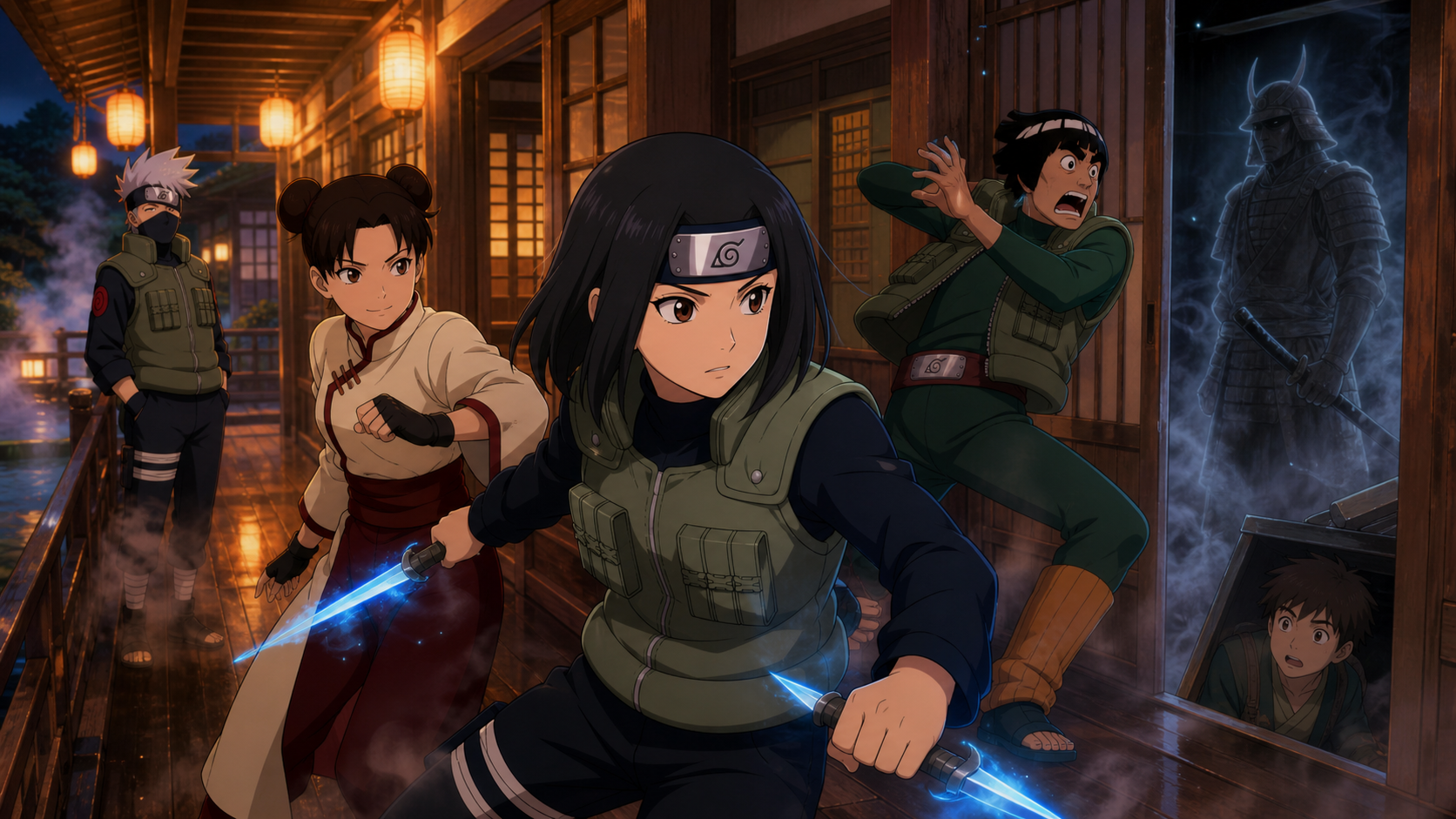
The Steam Ninja Scrolls: The Haunted Inn!
Guy sees a ghost, Mirai finds a tunnel, and a frightened traveler turns the mystery into a story about daughters carrying unfinished grief.
Series: Boruto: Naruto Next Generations
Episode: 108 · The Steam Ninja Scrolls: The Haunted Inn!
Arc: Steam Ninja Scrolls
Release: 2019-05-26
Previous: Episode 107 · The Steam Ninja Scrolls: The Dog and Cat War!
Directory: All 293 Boruto episodes
Bottom line
Boruto Episode 108 lets Might Guy scream about a ghost, lets Tenten enjoy his panic far too much, and then quietly gives Mirai one of her best character decisions in the Steam Ninja Scrolls arc. “The Steam Ninja Scrolls: The Haunted Inn!” begins like a vacation comedy. Snacks disappear. A ping-pong ball moves by itself. An old inn carries stories about an armored spirit. Guy sees something in his room and reacts with the full force of a man who can kick through a wall but cannot negotiate with the supernatural. Mirai refuses the ghost story, investigates the building, discovers wartime passages, and flushes a frightened traveler named Tatsumi out of hiding. That solve would have been enough for a cute mystery. The episode goes further. Mirai hears why Tatsumi has been traveling without money, understands that the girl is trying to complete a hot-spring pilgrimage for her late mother, and invites her along. Mirai spends most of this arc chasing information about the father she never knew. When she meets another daughter carrying unfinished grief, she does not lecture, arrest, or embarrass her. She makes room. The ghost mystery is fun. Mirai recognizing Tatsumi is the episode.
Tenten arrives with the clothes Mirai actually needs
Mirai began this mission packed for two days because she heard the duration she expected rather than the twenty days Kakashi said. Tenten brings the missing clothes to the inn, which saves Mirai from pretending that one travel outfit can survive an entire hot-spring tour.
The favor also brings a familiar adult woman into the group. Kakashi and Guy know Mirai through Asuma, Kurenai, duty, and the war generation. Tenten can share a bath with her, tease her, and notice the young woman underneath the professional posture. That shift matters because Mirai has spent the trip trying to prove she belongs on a mission she misunderstood.
A quiet bath lasts exactly long enough for Guy to scream
Tenten planned to take a few days off, so joining Mirai at the springs works for both of them. Their conversation barely settles before Guy's voice tears through the inn. He claims a ghost appeared in his room.
Mirai runs out before finishing the basic task of getting dressed. Tenten has to remind her about the clothes. The joke lands because Mirai's instincts are always sprinting several steps ahead of her ordinary needs. Danger, even ridiculous danger, gives her permission to become the hyper-serious guard she thinks the mission requires.
Guy can open the Eight Gates and face Madara. A possible ghost still takes him out. Naruto has always understood that courage is specific. Somebody can stand against physical pain and still hate whatever cannot be punched, named, or verified.
Kakashi returns with snacks and immediately enjoys himself
Kakashi finds the group after buying replacement snacks. The original sweets vanished from the room, and he had assumed Guy ate them. Once ghost talk enters the conversation, Kakashi does not rush to restore order. He watches Guy's fear with the calm amusement of a lifelong friend who has earned the right to be annoying.
That reaction keeps the episode from becoming a standard haunted-inn plot. Kakashi knows Guy's theatrical range. Tenten knows Guy's theatrical range. Both understand that teasing him will produce better entertainment than reassuring him.
Mirai does not have that luxury. She is responsible for Kakashi and Guy, so every unexplained event becomes evidence that she missed a threat.
Mirai does not believe in ghosts for a painful reason
Her skepticism is not just the rational pose of a detective character. Mirai lost Asuma before she could know him. If spirits could casually return to inns, steal food, and rattle doors, why has her father never appeared for her?
That question gives the comedy a bruise. Mirai cannot accept a world where random guests get supernatural visits while she receives stories, photographs, and secondhand memories. Disbelief protects her from hoping for a reunion the series cannot honestly give her.
The receptionist expresses a similar ache when she says that her father would have visited if ghosts truly wandered the inn. Two daughters use absence as evidence. The episode never turns that grief into a speech. A few lines carry the entire argument.
The inn has history before the group arrives
Staff members explain that the building dates back to wartime and once carried stories about an armored ghost. Rumors faded after a major exorcism, but old architecture keeps old possibilities alive.
The detail matters beyond spooky atmosphere. Peaceful tourist spaces in Naruto often sit on top of infrastructure built for conflict. Evacuation routes, shelters, sealed rooms, and hidden corridors do not disappear because brochures now promise relaxation.
Mirai treats history as a practical clue. A ghost does not need a hallway. A hungry person hiding inside an old building does.
A moving ping-pong ball is evidence, not proof
The episode lays out small disturbances designed to reward whichever belief the characters already hold. Tenten sees a ball move and reads supernatural activity. Mirai notices the draft.
Neither reaction makes Tenten foolish. She is having fun, and Guy's panic gives her a target. Mirai needs the natural explanation because her job and her grief both demand one.
The important part is that Mirai checks. She does not declare victory after finding one breeze. Skepticism without investigation would be another form of laziness. She examines the inn, maps the old passages, and looks for signs of recent human activity.
Tenten becomes the episode's cheerful menace
Tenten believes Guy saw something, but she also cannot resist making his fear worse. She helps stage the atmosphere and enjoys watching a famously fearless shinobi try to maintain dignity around a possible apparition.
I love seeing her allowed to be funny. Tenten spent too much of the original series waiting outside the emotional center of her own team. Here, her history with Guy shapes every grin. She knows precisely which button to press because she trained under him.
The episode does not need a major weapons showcase to justify her appearance. Personality is enough. Familiarity is enough. Tenten gets to feel like a former student who has grown into an adult capable of loving her teacher and tormenting him in the same breath.
Mirai turns the haunted inn into a controlled operation
Once Mirai finds the wartime tunnels, she identifies evidence that somebody has been using them. She blocks every exit except one and asks the inn staff to fumigate the passage system.
That solution is wonderfully unromantic. No mystical chant. No reckless chase through blind corridors. Mirai studies the environment, limits the suspect's choices, and forces a safe reveal.
She also shows the kind of command judgment the escort mission has been teaching. Mirai coordinates civilians, controls space, and avoids turning uncertainty into violence. Her chakra blades remain available, but deduction does most of the work.
The ghost under the statue is a scared girl
Smoke pushes Tatsumi from hiding near the statue. Mirai reacts fast and cuts through the obstacle with her chakra blades. The entrance looks dramatic, but the supposed haunting collapses into a practical story: a traveler with no money found shelter in forgotten passages and took food because she was hungry.
The reveal reframes every disturbance. Missing snacks were meals. Movement in old halls came from somebody trying not to be seen. The frightening unknown becomes a young person surviving badly.
Mysteries often end by humiliating the person under the mask. Episode 108 refuses that easy victory lap.
Kakashi warns Mirai about the blades because walls cost money
Mirai's investigation works, but her final strike cuts more than the problem required. Kakashi reminds her to be careful with the chakra blades.
That correction is small and useful. Competence does not mean every choice was perfect. Mirai can solve the case and still owe the inn an apology for turning architecture into collateral damage.
Kakashi's note also keeps the scene grounded after the reveal. The mystery may be over, but somebody owns that statue and somebody has to repair the room.
Tatsumi is traveling for her mother
Tatsumi asks the group not to turn her over to authorities. Her mother died before completing the hot-spring journey she wanted, so Tatsumi has been visiting those places in her memory.
Money ran out before grief did. The secret passages offered shelter, and hunger turned the inn's snacks into temptation. None of those facts make trespassing harmless. They do make punishment alone feel useless.
Tatsumi is not a criminal mastermind hiding behind folklore. She is a daughter trying to finish a promise without the resources to carry the promise safely.
Mirai recognizes a daughter carrying unfinished grief
Mirai invites Tatsumi to travel with the group and offers to cover her expenses. The decision comes quickly because recognition comes quickly.
Mirai has spent the trip collecting fragments of Asuma from people who knew him. Tatsumi is also moving through places shaped by a dead parent, trying to build contact from an itinerary that cannot answer back. Their grief is not identical, but the emotional grammar is familiar.
This is where Mirai sounds most like herself rather than a collection of inherited traits. Asuma's compassion and Kurenai's perception may inform her, but nobody instructs her to help. She sees Tatsumi, measures the real danger, and chooses a response that prevents more harm.
Compassion does not erase the investigation
The episode avoids claiming that kindness means ignoring what happened. Mirai still uncovers the passages, protects the inn, and ends the thefts. Compassion arrives after the facts, not instead of them.
That distinction matters. Mirai does not need to pretend Tatsumi made good decisions. She gives the girl a better available decision. Travel with people who can pay. Stop hiding. Finish the memorial journey without frightening workers and stealing meals.
Accountability works better when a person has a route forward. Handing Tatsumi to authorities might satisfy procedure. Bringing her into the group solves the condition that produced the trouble.
The actual ghost question stays slightly open
Guy finally explains that he saw an armored warrior, not Tatsumi. Mirai remembers removing old protective tags from his room because she thought they were rubbish.
That final beat refuses to close every door. Tatsumi explains the food and passages. She does not fully explain the armored figure. The inn's old story may have carried one last visitor after all.
Mirai does not get a clean philosophical answer about spirits. Neither does the audience. That restraint works. A story about grief should not prove or disprove the afterlife because one frightened man saw armor in a hallway.
Tenten leaves after giving the arc exactly what she had
The group departs the next day, and Tenten splits off after her short vacation. Her appearance reconnects Guy to his student and gives Mirai companionship outside the older men's friendship.
She also leaves before the Steam Ninja Scrolls arc changes direction through Tatsumi. Tenten belonged to the haunted-inn chapter: spare clothes, bath conversation, ghost enthusiasm, and expert-level Guy harassment.
Not every returning character needs to seize the plot. Tenten arrives, feels fully herself, changes the group chemistry, and exits before the cameo grows stale.
Guy's fear makes him more human, not less heroic
The joke never cancels his courage. Guy is terrified because a ghost sits outside the physical rules he understands. Give him an enemy with a body and he will fight until his own body breaks. Give him a disappearing armored shape and he wants witnesses.
That contradiction makes him lovable. Heroism is not a permanent facial expression. Guy can be brave enough to face death and still need his friends when a room feels wrong.
Kakashi and Tenten tease him because they know that fear will not define him. Their cruelty has the soft edge of family.
The episode gives Mirai detective work and emotional work
Mirai solves the practical mystery through observation, architecture, planning, and controlled pressure. She resolves the human problem through listening and generosity.
Both skills belong in shinobi work. Naruto's peaceful era needs fewer battlefield weapons and more people capable of noticing why a frightened civilian made a dangerous choice.
Mirai wanted a grand assignment worthy of Asuma's name. Episode 108 gives her missing cakes, an old tunnel, and a girl with an impossible pilgrimage. She proves herself by taking all three seriously without pretending they are the same kind of threat.
Mirai's skepticism protects her and narrows what she is willing to feel
Mirai rejects ghosts because the subject touches Asuma. Believing the dead can remain present would reopen questions about why her father never appeared and whether his absence means something about her.
The skepticism has a rational foundation. Moving objects, noises, drafts, animals, hidden passages, and frightened people can explain many supposed hauntings. Mirai also uses disbelief as emotional armor.
That combination makes her investigation stronger and more vulnerable. She will test claims carefully, but a promise connected directly to Asuma may bypass the distance she maintains around generic ghost stories.
Episode 108 prepares that risk without mocking her. A person can demand evidence and still carry one grief-shaped exception.
A moving object creates a question, not a supernatural conclusion
The ping-pong ball moves without an obvious hand, which gives the group evidence that something needs explanation. The observation does not identify a ghost, motive, or danger.
Mirai's controlled response models good investigation. Mark positions, limit access, watch routes, test ordinary causes, and avoid contaminating the scene through panicked movement.
Tenten and Guy enjoy the haunted framing, while Kakashi watches reactions and details. Different attitudes do not prevent useful work as long as nobody treats excitement as proof.
The episode keeps a little ambiguity after finding the girl. That choice works because solving one event does not require declaring every local story false or true.
Property safety belongs inside the mission plan
Mirai responds to uncertainty with chakra blades, and Kakashi reminds her that walls, fixtures, and other people's businesses cost money. A security response that destroys the inn may solve the wrong problem.
Before using force, the team should clear guests, identify load-bearing structures, choose non-destructive detection methods, and coordinate with the owner. Shinobi skill includes controlling damage rather than merely overpowering a threat.
Kakashi's warning is funny because Mirai looks ready to duel architecture. The lesson matters beyond comedy. Villages and clients absorb repair costs when shinobi treat every location like a disposable battlefield.
Precision protects civilians, livelihoods, and the trust that makes future missions possible.
The frightened girl needs safety before interrogation
The figure beneath the statue is a child hiding, not a monster staging an attack. Mirai changes posture once the evidence changes, which proves skepticism did not become cruelty.
A scared child may run, lie, or stay silent because adults, punishment, or exposure feel dangerous. The team should establish immediate safety, ask whether anyone is pursuing her, and involve appropriate caregivers without returning her automatically to a harmful situation.
The inn's ghost story gave the girl cover because guests interpreted signs through folklore. Solving the mystery should not erase the reason she needed cover.
Compassion and investigation work together when the goal is understanding what happened rather than winning an argument about ghosts.
Tatsumi's story turns an amusing case into preparation for exploitation
Tatsumi travels because her mother died before their last conflict could be repaired. She wants movement, meaning, and a way to carry unfinished words.
Mirai recognizes the wound because Asuma's death left her with questions no direct memory can answer. Their bond grows from different versions of daughterhood after loss.
The haunted-inn episode lets Tatsumi speak without anyone selling a solution. That safe conversation matters because Episode 110 will introduce someone promising literal contact with the dead.
Wanting contact does not make Tatsumi foolish. The earlier honesty shows exactly why a resurrection claim can reach her and why Mirai will follow despite better judgment.
Tenten's visit supplies care disguised as chaos
Tenten brings clothing Mirai actually needs, participates in the investigation, and keeps the atmosphere from collapsing under every serious feeling. Her enthusiasm can become disruptive, but her presence also widens the support network around Mirai.
The episode gives her less long-term development than she deserves. Tenten has weapons expertise, business experience, war history, and connections across the older generation. A cameo should not reduce all of that to cheerful ghost hunting.
Her practical contribution remains important. Someone noticed Mirai's packing problem and fixed the problem without turning care into a speech.
Friendship often looks like arriving with appropriate clothes and enough energy to make a haunted inn everybody's problem for one afternoon.
Guy's fear and Kakashi's amusement reverse the expected power display
Guy has survived war, injury, and a technique that nearly killed him. A ghost story still terrifies him. Fear does not cancel courage because courage has never required identical reactions to every threat.
Kakashi enjoys the situation partly because he understands Guy well enough to predict the performance. His calm also comes from reading the environment rather than assuming every noise deserves combat.
Their dynamic lets Mirai see legendary adults as people with habits, jokes, and irrational edges. That humanity matters during an arc where she keeps measuring herself against Asuma's idealized absence.
Heroes can scream at ghosts, worry about repair bills, eat snacks, and remain capable when a real danger appears.
Final reaction
“The Steam Ninja Scrolls: The Haunted Inn!” is a comedy mystery with grief tucked inside the walls. Guy's screaming, Tenten's delighted menace, Kakashi's snack priorities, and Mirai's stubborn skepticism keep the episode light. The wartime passage gives the mystery enough structure to reward investigation rather than magic guessing.
Tatsumi changes the meaning of the episode. Mirai could end the case by identifying the culprit and handing her over. Instead, she asks what happens next. A broke traveler remains broke after punishment. A grieving daughter remains alone after exposure. Mirai offers food, company, and a safe way to continue.
That choice carries more of Asuma than a borrowed combat move ever could, but the episode does not announce the comparison with a spotlight. Mirai helps because she understands what absence can make a daughter chase. She cannot bring Tatsumi's mother back. She cannot summon Asuma into an inn corridor. She can keep another person from walking the rest of the road alone.
The armored ghost gets the final laugh, and Mirai may have thrown away the only tags holding the haunting back. Good. A ghost story should leave one floorboard creaking after the detective packs her bags. The mystery is solved enough for the inn. Mirai's larger question about who remains after death stays unanswered, which is exactly where the arc needs that question to live.
Sources and lawful viewing
Official episode reference: Naruto Official episode guide
Licensed episode route: Crunchyroll licensed series page