
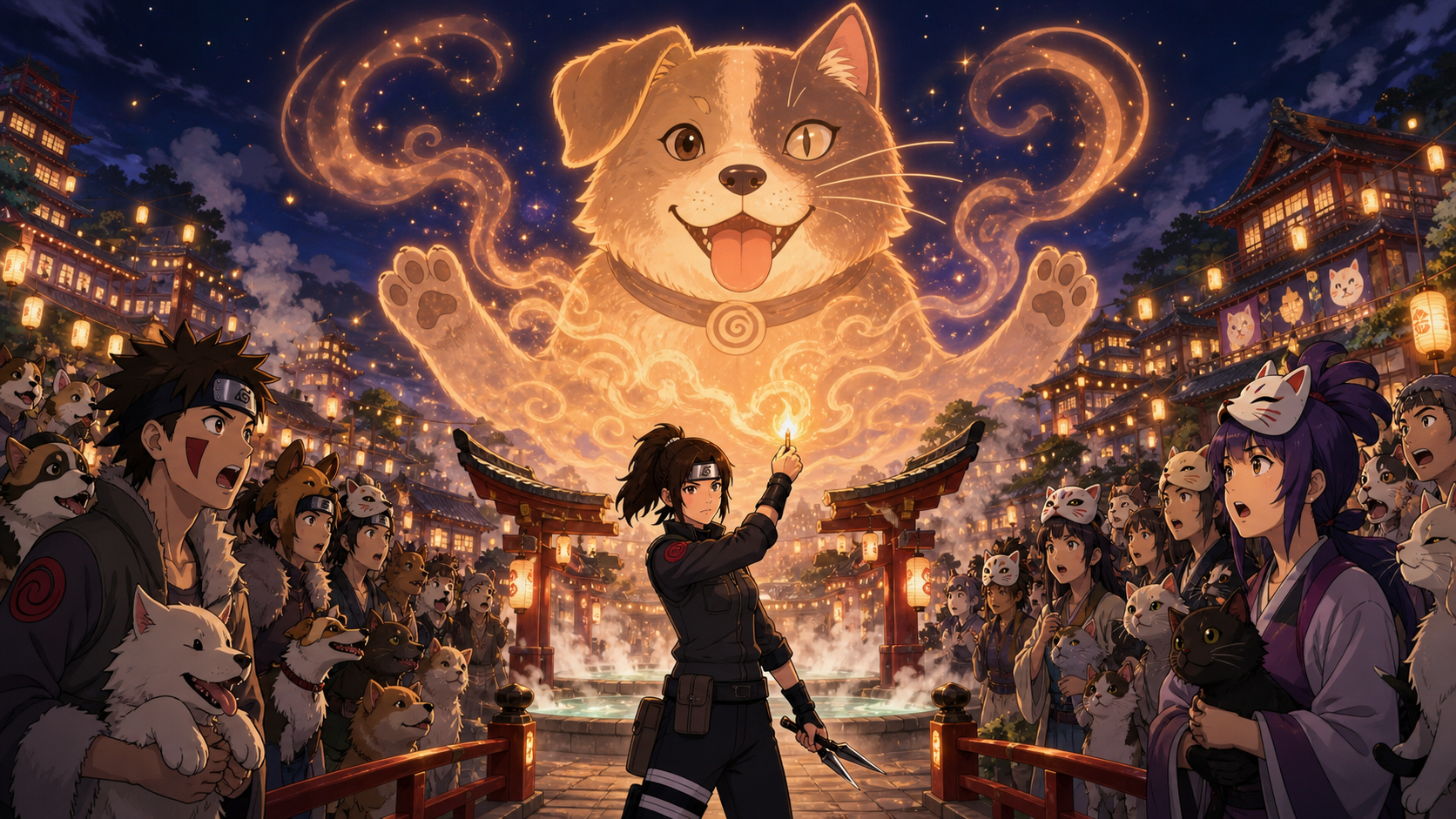
The Steam Ninja Scrolls: The Dog and Cat War!
Kiba and Tamaki ruin their own date so thoroughly that Mirai has to invent a new god and let Might Guy remodel the baths.
Series: Boruto: Naruto Next Generations
Episode: 107 · The Steam Ninja Scrolls: The Dog and Cat War!
Arc: Steam Ninja Scrolls
Release: 2019-05-19
Previous: Episode 106 · The Steam Ninja Scrolls: The S-Rank Mission!
Directory: All 293 Boruto episodes
Bottom line
Boruto Episode 107 takes a relationship argument between Kiba and Tamaki, hands both sides masks, shrines, crowds, and religious folklore, then watches a bad date become municipal unrest. “The Steam Ninja Scrolls: The Dog and Cat War!” is ridiculous by design, but the episode gives Mirai a real peacetime mission hidden inside the nonsense. Nobody needs her to defeat an invader. A town needs somebody to stop two groups from destroying their own festival over competing origin stories and a couple who cannot say what they are actually mad about. Mirai tries direct mediation, an apology gift, and individual conversations. Every reasonable method fails because public pride has swallowed the private disagreement. She finally combines Kurenai's genjutsu with Asuma's fire nature to invent a half-dog, half-cat destruction deity large enough to scare both factions into seeing how stupid they look. Might Guy then kicks through the wall dividing the baths because subtlety has never lived in that man's house. The crowd reads the destruction as divine instruction, Kiba and Tamaki reconcile, and Mirai gets her hot spring. Kakashi tells her that the solution used both parents' techniques. That is the part I love. Mirai does not honor Asuma by copying a dead man's exact moves. She uses what she inherited from Kurenai and Asuma to solve a problem neither parent ever faced.
Twenty days requires more clothes than Mirai packed
The episode opens with Mirai still processing the difference between two days and twenty. Her careful mission preparation did not include enough clothing because anxiety made her hear the number she expected.
Kakashi and Guy offer competing advice, neither especially helpful. The exchange keeps the road light while showing that Mirai's greatest obstacle remains her refusal to admit a normal problem can have a normal solution.
Kakashi and Guy recognize both parents in her
They discuss the traits Mirai inherited from Kurenai and Asuma, including genjutsu aptitude and chakra nature. Their memories give her information she cannot get from photographs.
The comparisons still create pressure. Mirai wants knowledge about her parents, but every answer risks becoming another instruction about who she should resemble.
The hot-spring town is much louder than Guy remembers
The group reaches a town near the Land of Fire and Land of Hot Water border. Guy expected a quiet stop. Instead, animal masks, travelers, vendors, and rival groups fill the streets.
The crowd turns relaxation into another assignment before Mirai has even unpacked. Peace does not mean stillness. Tourism creates its own traffic, rituals, disputes, and security problems.
Competing legends built one festival
Kakashi explains that residents tell different stories about the town's origins. One tradition honors a dog deity. Another honors a cat deity. A third story warns about a destructive being that belongs to neither side.
The folklore already contains the solution Mirai will later use. The town remembers conflict through ritual, then repeats conflict during the ritual because everybody prefers the version that flatters their group.
Dog lovers and cat lovers arrive ready to be right
Visitors travel from multiple regions and gather around the competing shrines. Masks, chants, and group identity turn pet preference into public allegiance.
Loving one animal does not require despising another. Festival competition creates permission to behave as though affection has limited supply.
Kiba and Tamaki came here on a date
Mirai discovers Kiba leading the dog faction and Tamaki leading the cat faction. They did not arrive as political organizers. They wanted rare time together.
That detail makes the escalation funnier and sadder. A couple with opposite animal loyalties chooses the one festival guaranteed to turn their difference into a scoreboard.
Tamaki wanted time, not a debate victory
She explains that Kiba's Police Force schedule makes shared days difficult. The festival was supposed to be a date, which means the real grievance is disappointment and neglect rather than cats winning a theological argument.
Tamaki wants Kiba to notice that limited time has been swallowed by his need to perform for strangers.
Kiba gets drunk on public admiration
The dog faction celebrates his history, skills, and connection to Akamaru. Kiba enjoys the praise enough to stop listening to the person he came with.
He has always loved recognition. Naruto became Hokage, Shino became a teacher, and other classmates built highly visible roles. A crowd treating Kiba like the greatest dog authority alive hits every neglected button at once.
Kakashi and Guy call the argument private
Mirai initially wants to intervene, but her clients warn that a couple's dispute is not automatically shinobi business. They are right at first.
The boundary changes when the quarrel begins controlling whether the town can safely operate and whether the escort group can use the inn. Private conflict becomes public responsibility after the crowd adopts the fight.
Mediation starts with listening to each person alone
Mirai speaks with Tamaki, then approaches Kiba. She tries to identify what each person needs rather than argue about which animal deserves victory.
The method is sensible. The timing is bad. Both have already attached personal hurt to a public faction that rewards them for refusing compromise.
Kiba cannot retreat while the dog crowd is cheering
Backing down would feel like disappointing supporters and admitting that Tamaki matters more than the identity they handed him. That should be an easy choice on a date. Pride makes the choice look humiliating.
Public audiences can freeze an argument in place. A person who might apologize in private performs certainty when strangers are watching.
Mirai's peace offering makes everything worse
She attempts to pass a conciliatory gesture as though Kiba sent the gift. The deception is meant to create an opening without forcing him to lose face.
The plan backfires because indirect repair cannot replace an honest apology. Tamaki needs Kiba to choose the relationship himself, not evidence that another person managed his feelings for him.
The shrine fight turns festival theater into danger
At night, both factions gather for the confrontation built into local tradition. Rivalry that looked colorful during daylight becomes destructive once the crowd believes conflict is the expected climax.
Mirai now has a clear mission. She has to interrupt mass behavior without treating ordinary festival visitors like enemy soldiers.
Kakashi jokes that destruction might force cooperation
He suggests that people sometimes reconsider division after losing everything. The comment is dark coming from a man who watched war repeatedly flatten homes and friendships.
Mirai hears a tactical idea rather than a philosophical warning. If both factions fear one shared threat, they may stop fighting each other long enough to listen.
A lighter becomes the bridge to Asuma
Mirai asks Guy for a flame and uses fire nature to strengthen the illusion. The small lighter recalls Asuma without copying his smoking habit or turning a cigarette into sentimental merchandise.
Fire is one part of the technique. The deception holding the crowd comes from Kurenai's genjutsu tradition.
The destruction deity is half dog and half cat
Mirai projects a massive hybrid spirit above the shrine. The image satisfies the third legend while refusing to choose either faction.
The creature looks powerful enough to become divine evidence and goofy enough to match the fight that summoned the idea. That tonal balance is hard, and the episode lands the joke.
Might Guy destroys the wall because of course he does
Guy attacks the apparition and breaks the barrier separating the cat and dog bathing areas. He gives the performance a physical consequence the crowd cannot dismiss as smoke.
Nobody discussed demolition permits. Guy sees a dramatic entrance and treats architecture as optional.
The crowd invents a message from the wreckage
Festival participants decide Guy must be the messenger of the destruction deity. The broken wall becomes a command to stop division and celebrate together.
Mirai does not correct the interpretation. Successful peace work sometimes means letting people adopt a story that allows retreat without humiliation.
Kiba and Tamaki finally choose the date again
Once the public contest loses energy, they reconcile. The solution does not erase the original issue: Tamaki still wants shared time, and Kiba still needs to manage how praise pulls his attention.
The immediate repair works because both can leave the faction performance and return to being two people who actually like each other.
Making up does not solve the scheduling problem
The kiss-and-calm ending closes the festival emergency, but Tamaki's original complaint remains practical. Kiba works long Police Force hours. She cannot build a relationship from rare dates that become fan-club appearances whenever somebody praises his dog credentials.
Kiba needs to protect shared time with the same seriousness he gives patrol duty. Tamaki also needs to tell him that disappointment directly before irritation attaches itself to a cat-versus-dog argument. Neither person is wrong for loving different animals. Both are responsible for explaining what the difference has started representing.
That unfinished work makes the reconciliation more believable. Mirai can remove the crowd, interrupt the shrine fight, and give them a face-saving route back to each other. She cannot manage their calendar or speak honestly on their behalf. Peacemaking ends the public crisis. Relationship repair continues after everybody takes off the masks.
Mirai earns the bath she kept postponing
She finally enters the hot spring after resolving the conflict. Relaxation becomes the outcome of completed work rather than a threat to her professional identity.
The episode gently teaches her that rest does not cancel vigilance. A shinobi can protect people and use the bath before closing time.
Kakashi names both parents in her solution
He explains that Mirai combined Kurenai's genjutsu with fire nature associated with Asuma. The technique belongs to her because the combination and application were hers.
That observation gives Mirai a better form of inheritance. She is not a copy of either parent. She is the place where their strengths can meet and become something new.
Mirai wants more than technique stories
Kakashi leaves for another bath while Mirai wishes she could learn more about Asuma. Combat details have opened the door, but she wants the human being behind them.
The desire keeps the arc moving. Every story may fill one missing corner without ever replacing the years father and daughter lost.
Peacetime missions require social intelligence
Mirai solves the town's crisis through observation, folklore, mediation, performance, and inherited techniques used without lethal force. That combination is shinobi work adapted to peace.
She wanted an S-rank enemy. The actual challenge was persuading civilians to stop turning identity into permission for destruction.
The festival turns private affection into public team selection
Kiba and Tamaki arrive wanting time together. The crowd immediately assigns them symbolic roles in a dog-versus-cat rivalry neither person came to settle.
Public admiration changes the emotional stakes. Kiba enjoys being praised by dog supporters and starts performing certainty he may not feel privately. Tamaki faces pressure to defend cats or appear disloyal to people cheering her side.
A relationship cannot solve a community argument merely because each partner owns a different animal. Turning them into mascots removes the date they chose and replaces the date with unpaid public labor.
The first mediation goal should be returning agency: ask whether they want involvement, create a private space, and stop crowds from treating the couple's disagreement as festival entertainment.
Listening separately gives each person room to step out of performance
Mirai speaks with Kiba and Tamaki away from the loudest supporters. Separate conversations can reveal needs that neither person feels safe naming in front of a partner or cheering crowd.
Kiba can admit he wants admiration without making that desire the official position of every dog owner. Tamaki can say she wanted time together rather than a debate victory.
Private listening should not become secret alliance-building. A mediator needs to summarize concerns accurately, confirm consent before sharing sensitive details, and bring the people together around the actual decision.
Mirai begins well because she recognizes that the visible argument contains social pressure beyond the words Kiba and Tamaki exchange.
Kiba's confidence becomes harder to revise while supporters reward escalation
Crowds clap when Kiba defends dogs, so every stronger statement receives immediate social payment. Changing his mind would feel like disappointing people who just turned him into their champion.
That dynamic explains the escalation without excusing disrespect toward Tamaki. Public support can make a person less able to hear the relationship directly in front of him.
Kiba needs to separate three questions: which animal he personally prefers, whether the festival requires one winner, and what kind of day Tamaki asked to share.
The date only depends on the third question. The crowd keeps forcing the first two into the relationship because rivalry is more entertaining than scheduling.
Mirai's peace offering fails because symbols cannot replace agreement
The attempt to blend dog and cat imagery looks balanced from outside. Supporters interpret the gesture through competitive loyalty and search for which side received the insult.
Compromise designed before identifying the underlying need often satisfies nobody. Kiba and Tamaki do not need a hybrid mascot. They need uninterrupted time and freedom from public representation.
The failure teaches Mirai that visible symmetry is not the same thing as mediation. Equal pieces of two symbols can still preserve the false premise that one festival display must settle a private relationship.
A better solution changes the frame rather than decorating the argument.
Shrine destruction is not a relationship tool
The fight damages shared property and creates danger for bystanders. Kakashi jokes that destruction may force cooperation, and Guy contributes exactly the amount of wall-breaking everyone expected from him.
Emergency collaboration can interrupt a feud because people suddenly share a practical problem. Deliberately allowing damage would be irresponsible. Residents, workers, and shrine custodians absorb the repair burden.
The team should secure the area, stop the fight, document damage, and arrange restitution. A funny resolution does not convert vandalism into wise conflict strategy.
Kiba and Tamaki reconciling afterward matters. The reconciliation should include responsibility for what their public performance helped escalate.
The half-dog, half-cat deity reveals how communities manufacture tradition
Once the wall breaks, the crowd interprets the combined image as proof that dogs and cats were always meant to coexist. The new reading resolves tension because people want a story that allows retreat without humiliation.
The discovery may preserve a forgotten local history, or the crowd may be inventing certainty from convenient wreckage. The episode leaves enough comedy around the reveal to support both readings.
Communities often treat symbols as ancient instructions when the interpretation serves a present need. That habit can create peace and can also overwrite evidence.
Historians and shrine keepers should examine the image before festival organizers print the new legend on every banner by morning.
Kiba and Tamaki choose the date after the crowd loses control
Their reconciliation works because both people return to the relationship rather than proving an animal preference. Tamaki wanted time. Kiba finally recognizes how admiration distracted him from the person who traveled with him.
Choosing each other does not mean they stop loving different animals or never argue again. The relationship needs scheduling, attention, and boundaries around family and fan communities.
The episode admits that making up does not solve logistics. That small honesty keeps the ending from pretending one kiss or apology fixes every recurring conflict.
They recover the date by deciding the date belongs to them.
Mirai's social judgment belongs inside shinobi competence
Mirai expected an S-rank threat and keeps waiting for combat to justify the assignment. The dog-and-cat conflict demands observation, private listening, crowd control, safety decisions, and adaptation after a failed compromise.
Those skills protect people before blades become necessary. Peace creates missions where social escalation can cause property damage, injury, and lasting community division even without an enemy army.
Kakashi sees Kurenai's perceptiveness and Asuma's direct care in Mirai's approach. The comparison matters because she blends inherited strengths without reproducing either parent exactly.
Mirai earns the bath through emotional and operational work. The mission does not become trivial because nobody needed a killing technique.
Final reaction
“The Steam Ninja Scrolls: The Dog and Cat War!” is shamelessly silly, but the episode earns the silliness by giving Mirai a complete problem-solving arc. She starts by treating relaxation like negligence. She ends by saving a festival, repairing a relationship, combining her parents' techniques, and finally taking the bath she came to guard.
Kiba and Tamaki are frustrating because their real problem is easy to name. She wanted scarce time together. He let applause become more important than the date. The dog-versus-cat theology gives both of them a public excuse to avoid that conversation. Mirai cannot force honesty, so she changes the crowd around them.
The cat-dog deity is exactly the kind of solution a fandom episode should remember. The trick is visually ridiculous, culturally tailored, nonlethal, and technically specific to Mirai. Kakashi sees Asuma's fire. The genjutsu carries Kurenai. Mirai decides how both pieces work together. She came on the trip desperate to prove that she deserved a famous family name. Episode 107 shows that her best work begins when she stops performing inheritance and starts using what belongs to her.
Reconciliation should include repair after the festival ends
Kiba and Tamaki choose each other again, but the shrine, vendors, residents, and supporters remain after the date resumes. A private apology between the couple cannot cover every public consequence.
They should help document damage, contribute to repairs, and clarify that neither animal community needs to continue the rivalry in their names. Festival organizers should review crowd control and stop assigning visiting couples as symbolic champions without consent.
Mirai also deserves a debrief about the failed peace offering and the successful de-escalation. Learning which parts changed the conflict will help her handle future disputes without waiting for property damage to create a shared problem.
Peace becomes durable when the people involved repair systems as well as feelings. Otherwise next year's banners can restart the same argument with a freshly painted wall.
Sources and lawful viewing
Official episode reference: Naruto Official episode guide
Licensed episode route: Crunchyroll licensed series page