
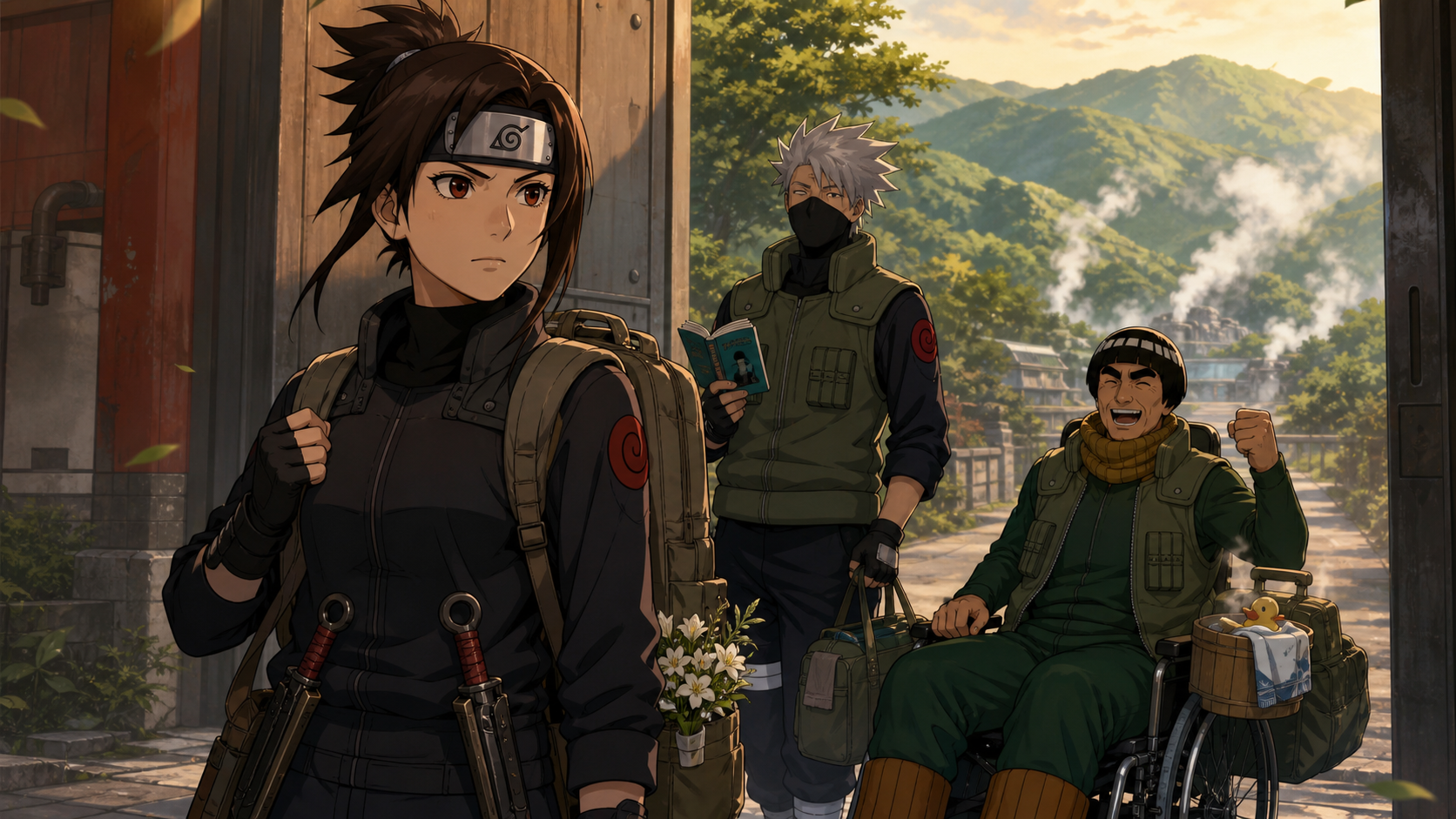
The Steam Ninja Scrolls: The S-Rank Mission!
Mirai wants one mission big enough to prove the Sarutobi name belongs to her. Kakashi and Guy packed for hot springs.
Series: Boruto: Naruto Next Generations
Episode: 106 · The Steam Ninja Scrolls: The S-Rank Mission!
Arc: Steam Ninja Scrolls
Release: 2019-05-12
Previous: Episode 105 · A Wound on the Heart
Directory: All 293 Boruto episodes
Bottom line
Boruto Episode 106 hands the story to Mirai Sarutobi and immediately exposes the problem sitting under her perfect posture: everybody remembers Asuma except his daughter. “The Steam Ninja Scrolls: The S-Rank Mission!” is funny because Mirai believes Naruto has assigned her a secret, high-level operation while Kakashi and Guy show up packed for hot springs, paperback nonsense, and the relaxed retirement trip they have earned several times over. The joke works, but the episode is not laughing at Mirai for caring about her work. She grew up beneath the names Sarutobi, Asuma, Hiruzen, and Kurenai. Older shinobi keep telling her that she looks, fights, thinks, or worries like a father she cannot remember. Of course she wants one mission big enough to prove that her uniform belongs to her. Kakashi recognizes the tension before Mirai can name the problem. He also understands that peaceful eras can make young shinobi wonder whether training still has meaning. The answer is not that Mirai needs a war. Her job is to protect two veterans through a border journey, observe what other people miss, and learn that care does not become less serious because nobody bleeds. Then Kakashi points toward the Land of Hot Water, where Hidan came from, and the vacation route suddenly crosses the geography of Asuma's death. Mirai wanted an S-rank threat. She is walking toward a wound her family never got to explain.
The arc begins as a novel adaptation, not random filler
The Steam Ninja Scrolls episodes adapt *Konoha Shinden*, a side-story centered on Mirai traveling with Kakashi and Guy. That origin matters because this stretch is designed around an older generation processing peace and a younger shinobi inheriting memories she never lived.
Boruto appears briefly, but the title character is not the center. Mirai gets the room usually reserved for children of the main cast whose parents already dominate the franchise.
Mirai says goodbye to Kurenai and Asuma
Before leaving, Mirai speaks with her mother and visits the memorial connected to her father. She carries Asuma's chakra blades, but the objects cannot give her the memories everyone else seems to possess.
The departure makes her ambition personal. She is not merely excited about rank. A successful mission might give her something that feels earned rather than inherited.
Her name becomes another question from a dead parent
Mirai wonders why Asuma chose a name meaning future. The word sounds hopeful, but she cannot ask what kind of future he imagined.
That missing answer follows her into a peaceful era Asuma helped create but never saw. Mirai lives inside his future while knowing him mainly through other people's stories.
Shikamaru knows the father she never met
On the way out, Mirai encounters Shikamaru with Boruto and Shikadai. He notices Asuma's chakra blades and asks about her progress using them.
Shikamaru was Asuma's student, friend, and the person who carried his final strategy into the fight against Hidan. His casual knowledge gives Mirai useful guidance and quietly reminds her that another household holds pieces of her father.
Wind chakra should belong to Mirai too
She worries that she cannot use the trench knives the way Shikamaru does. He points out that Mirai shares Asuma's wind nature, so the blades may suit her better once she stops treating mastery like an inherited performance test.
That advice separates lineage from imitation. Mirai does not need to reproduce Asuma's exact style. The same nature can become her own technique.
The quiz reveals how hard she overthinks everything
Mirai offers an answer to a question Shikamaru gave her, and the answer is wrong because she built complexity where a simpler reading would work.
The pattern repeats across the episode. A two-day escort becomes a secret S-rank operation. A vacation becomes cover. Casual behavior becomes evidence of hidden danger. Mirai is intelligent, but anxiety keeps turning every open space into another test.
Naruto's assignment sounds larger than ordinary guard duty
The Seventh Hokage personally authorizes Mirai to escort Kakashi and Guy outside Konoha. The clients include a former Hokage and one of the strongest taijutsu specialists alive.
Mirai concludes that no sensible leader would place those names on an ordinary trip. She assumes the vacation story must conceal intelligence work, border trouble, or a threat nobody can discuss openly.
Kakashi arrives with a book instead of battle plans
The retired Sixth Hokage meets her in travel mode. His attention keeps drifting toward locations connected to the *Make-Out* series and the possibility of enjoying the road.
Mirai reads relaxation as operational disguise because admitting the truth would make her assignment feel smaller. Kakashi has no need to prove that every day remains dangerous.
Guy brings vacation energy and a body shaped by war
Might Guy travels in a wheelchair after opening the Eight Gates against Madara. His enthusiasm remains enormous, but the chair records the permanent cost behind that optimism.
Protecting him is not pretend work. Guy can still fight, yet travel, terrain, access, and fatigue create real needs. Mirai's escort duty matters even when no enemy attacks.
There is no hidden S-rank operation
Kakashi and Guy explain that the trip is genuinely a hot-spring vacation. Mirai looks personally betrayed by the concept of leisure.
The misunderstanding is hilarious because she has already constructed an entire classified mission inside her head. The embarrassment also exposes how badly she wants danger to validate her training.
The S-rank fantasy gives Mirai a scoreboard
Mission rank offers the clean measurement she cannot get from family history. An S-rank assignment would tell Mirai that the Hokage trusts her, the village needs her, and years of training produced a shinobi worthy of the Sarutobi name. Guarding tourists does not sound impressive enough to quiet that fear.
The ranking system cannot answer the question she is really asking. A dangerous assignment may prove that Mirai can survive danger. Such a mission cannot prove that she understands Asuma, deserves his blades, or has built an identity separate from him. Those answers grow through choices nobody stamps with a letter.
Kakashi knows the difference because he earned every rank while still believing he had failed people he loved. Guy knows because the strongest moment of his career permanently changed his body. Their presence makes Mirai's S-rank dream look understandable and painfully incomplete. Accomplishment matters. A title cannot carry grief, purpose, or self-respect on her behalf.
Peace has made Mirai suspicious of usefulness
She wonders what shinobi are for when major wars and constant village conflict no longer define daily life. Her generation trains under systems built for catastrophe but often receives guard, patrol, escort, and community work.
That tension belongs in *Boruto*. Peace is the victory Naruto's generation fought for. Peace also leaves children of warriors asking how to honor sacrifice without recreating the conditions that required sacrifice.
Guarding a vacation is still guarding people
Mirai watches the roads, checks surroundings, and refuses invitations to relax. Her seriousness keeps Kakashi and Guy safe, even when the men do not share her threat level.
The mission is not fake because the clients are having fun. Security work often succeeds by preventing an event nobody else notices.
Kakashi notices Asuma in her posture
At dinner, Kakashi invites Mirai to join them rather than watch from a distance. Her insistence on remaining formal reminds him of Asuma.
That comparison lands differently from casual praise. Kakashi knew Asuma as a peer, not a legend frozen inside family grief. He recognizes habits Mirai did not know she inherited.
Everyone owns an Asuma story except Mirai
She finally admits that hearing constant comparisons feels strange because other people remember her father directly. They can recall his jokes, temper, smoke, teaching, food, and failures. Mirai receives conclusions.
Her frustration is fair. “You are just like him” sounds loving from the speaker and incomplete to the child who cannot verify the resemblance.
Kurenai raised the future after the funeral
The episode does not spend enough time on Kurenai, but her presence frames everything Mirai carries. She raised their daughter after losing Asuma during pregnancy.
Mirai's discipline did not grow from a dead father's reputation alone. A living mother built the household where that reputation could become something other than grief.
Two days becomes twenty
Mirai eventually learns that she misheard the mission length. The escort lasts around twenty days, not two.
Her horror is wonderfully ordinary. She packed expectations, discipline, and probably every contingency except the actual amount of underwear required for a long vacation.
The hot springs close before Mirai can use them
Kakashi suggests that she relax, but her refusal lasts until the baths have closed. Duty protects her from enjoyment so thoroughly that she misses the opportunity after finally considering the idea.
That small loss previews the arc. Mirai will keep discovering that vigilance without flexibility can make a person absent from the life being protected.
Kakashi and Guy model survival after legend
Both men carry enormous losses. Kakashi lost his father, teammates, teacher, and much of his generation. Guy permanently injured himself fighting for the world.
Their laughter is not proof that the past stopped mattering. Leisure is part of how they continue living after giving more than any village should have asked.
The Land of Hot Water changes the emotional map
Kakashi points toward the next destination and identifies the Land of Hot Water. Mirai knows the country as Hidan's birthplace.
A vacation route now intersects the origin of the man whose ritual killed Asuma. The geography turns family history into a place she can enter rather than another story told by adults.
Hidan does not represent an entire country
Mirai's association is understandable, but one killer cannot define every town, worker, inn, faith, or family in the Land of Hot Water. The coming journey gives her a chance to see a country beyond the worst person connected to her father.
That distinction matters in a franchise where villages often inherit blame across generations. Mirai can confront history without flattening everybody who lives near the source.
The episode builds a mission out of emotional inheritance
Mirai wanted a visible enemy. Instead, she receives time with people who knew Asuma and a road leading toward the country tied to his death.
No official rank can measure that work. She has to decide what being Asuma's daughter means when the answer cannot come from copying his blades or chasing his killer's shadow.
Mirai inherits stories from a father she cannot remember
Asuma exists for Mirai through Kurenai, Shikamaru, Chōji, Ino, photographs, weapons, village history, and the habits other people say resemble him. Everyone around her holds a piece she cannot verify through personal memory.
That inheritance creates affection and frustration. She loves a father assembled from testimony and fears that her own identity is being graded against a man she never knew directly.
The trip matters because Kakashi and Guy knew Asuma as a peer rather than only as a martyr. Ordinary stories, irritating habits, and mission memories can return texture that memorial language removes.
Mirai needs those stories without becoming a container for everyone else's grief. Learning Asuma should expand her choices, not dictate which shinobi she must become.
Kurenai raised Mirai while carrying grief the village could not share equally
Kurenai lost her partner during pregnancy and then built a home where Mirai could grow after the funeral ended for everyone else. Friends offered support, but daily parenting, explanation, and the repeated absence belonged to her household.
Mirai's goodbye scene acknowledges that relationship without giving Kurenai enough narrative space. The arc often frames Asuma as the missing source of identity while Kurenai stands alive, skilled, observant, and responsible for the person Mirai became.
Mirai's genjutsu foundation comes through Kurenai. Her emotional intelligence also grows from a mother who had to answer impossible questions without turning Asuma into either saint or wound.
Fandom coverage should keep Kurenai visible when celebrating paternal legacy. The future survived because she raised the future.
The mission briefing fails because Mirai leaves with the wrong scope
Mirai believes the assignment is a two-day S-rank operation. Kakashi and Guy expect a longer vacation escort. The misunderstanding changes clothing, supplies, risk expectations, and the way Mirai interprets every ordinary event.
Before departure, a written brief should state duration, route, clients, medical needs, likely threats, communication schedule, lodging, authority, and criteria for changing plans. Comedy does not make ambiguity good command practice.
Kakashi may want to observe Mirai without overexplaining the trip. Hidden evaluation still requires a safe logistical baseline.
Clear instructions would not remove character growth. Clear instructions would let the test measure judgment rather than whether Mirai packed enough underwear for a mission nobody described correctly.
Mirai uses S-rank danger as proof that her work matters
She has trained inside a generation where the famous adults survived war, Akatsuki, tailed beasts, and world-ending enemies. Routine protection can feel small beside inherited legend.
Imagining a hidden S-rank threat gives Mirai a scoreboard. If danger is enormous, vigilance proves she belongs. If clients only want rest, she fears professional skill has become unnecessary.
Peace creates that identity problem for children of war heroes. The success of the older generation removes the crises younger shinobi think they need to equal.
Protecting ordinary life is not lesser work. Ordinary life was the objective behind every dramatic sacrifice the memorial stories celebrate.
Guarding Kakashi and Guy requires attention to real needs, not fantasy enemies
Kakashi remains highly capable, but former office, accumulated injury, and public recognition create risks. Guy uses a wheelchair and carries physical limits after opening the Eighth Gate. Neither man becomes helpless because the trip is recreational.
Mirai should plan accessible routes, rest, medication or supplies, crowd management, lodging security, emergency communication, and evacuation. Watching only for assassins may leave the clients struggling with predictable travel barriers.
Professional protection begins with asking people what support they want. Guy's disability does not authorize Mirai to decide every movement for him. Kakashi's strength does not justify ignoring security because he could probably solve most attacks himself.
The escort succeeds when both men travel with dignity and without turning their vacation into another mission they must manage for the guard.
Guy's body shows survival without turning disability into tragedy
Guy nearly died using the Eighth Gate and now lives with permanent consequences. The wheelchair records that history without reducing his present life to loss.
He remains loud, competitive, affectionate, adventurous, and capable of contributing. Accessibility and assistance can exist beside agency. The episode often uses physical comedy around him, so the writing must avoid making the chair the joke.
Kakashi and Guy model a future after legendary sacrifice. Survival includes changed bodies, friendship, travel, boredom, and joy rather than a permanent heroic pose.
Mirai needs that model because she imagines Asuma's death as the standard proving ground. Guy shows that living after the battle also requires courage and adaptation.
Kakashi's book and relaxed posture are not evidence that he stopped observing
Kakashi arrives reading because leisure has always been part camouflage, part genuine habit, and part refusal to perform seriousness for other people. Mirai sees a client failing to respect the supposed S-rank danger.
He notices her posture, planning, overthinking, and resemblance to Asuma while appearing distracted. That observational distance lets Mirai make choices without constant correction.
The method can become frustrating when mentorship hides the test. Kakashi should eventually explain what he watched and why he allowed certain mistakes to develop.
Relaxation and vigilance can coexist. Mirai must learn the difference between visible tension and actual attention.
The Land of Hot Water should not remain defined by Hidan
Hidan came from Yugakure, abandoned the village's peaceful direction, and joined Akatsuki. Mirai's family history makes that origin emotionally unavoidable.
One killer cannot represent every resident, inn, shrine, worker, traveler, or local tradition. Treating the entire country as an extension of Hidan would repeat the same flattening Mirai fears when people see only Asuma in her.
The trip gives her new associations: hot springs, festivals, neglected infrastructure, animals, hospitality, grief scams, and people solving ordinary problems.
Replacing one trauma-linked image with a fuller place does not forgive Hidan. A fuller place keeps his crime from owning everyone who shares geography.
Peacetime service measures whether the older generation's sacrifice achieved anything
Asuma died protecting a future where children and villages could live beyond constant war. Mirai guarding a vacation, helping communities, and preventing small conflicts from becoming violence is part of that future.
If only lethal missions count as meaningful, peace becomes evidence that young shinobi lack purpose. The healthier conclusion is that the job changed because earlier protection worked.
Mirai will still face danger during the arc. The danger matters because ordinary life already has value, not because danger finally validates her.
Her mission begins as emotional inheritance and becomes practice in protecting the world Asuma wanted her to reach.
Final reaction
“The Steam Ninja Scrolls: The S-Rank Mission!” is a strong opening because the comedy and grief occupy the same road. Mirai's over-preparation is funny. Her need to prove herself is not. Kakashi's book obsession is ridiculous. His ability to recognize Asuma inside Mirai gives the episode emotional authority. Guy's vacation excitement is huge, while the wheelchair beside him keeps the price of the last war visible.
The episode also understands that peace creates new shinobi problems rather than ending the need for shinobi. Mirai does not need a manufactured war to justify her training. She needs a broader definition of service, one that includes accessibility, observation, escort work, patience, and helping people live the peaceful life older generations purchased at terrible cost.
The final look toward the Land of Hot Water gives the trip teeth. Mirai is walking toward Hidan's homeland with Asuma's blades and almost none of Asuma's memories. Kakashi and Guy can tell stories, but neither man can hand her a finished identity. The mission may be a vacation on paper. For Mirai, the road is the first chance to meet her father's history without somebody else standing between them.
Sources and lawful viewing
Official episode reference: Naruto Official episode guide
Licensed episode route: Crunchyroll licensed series page