
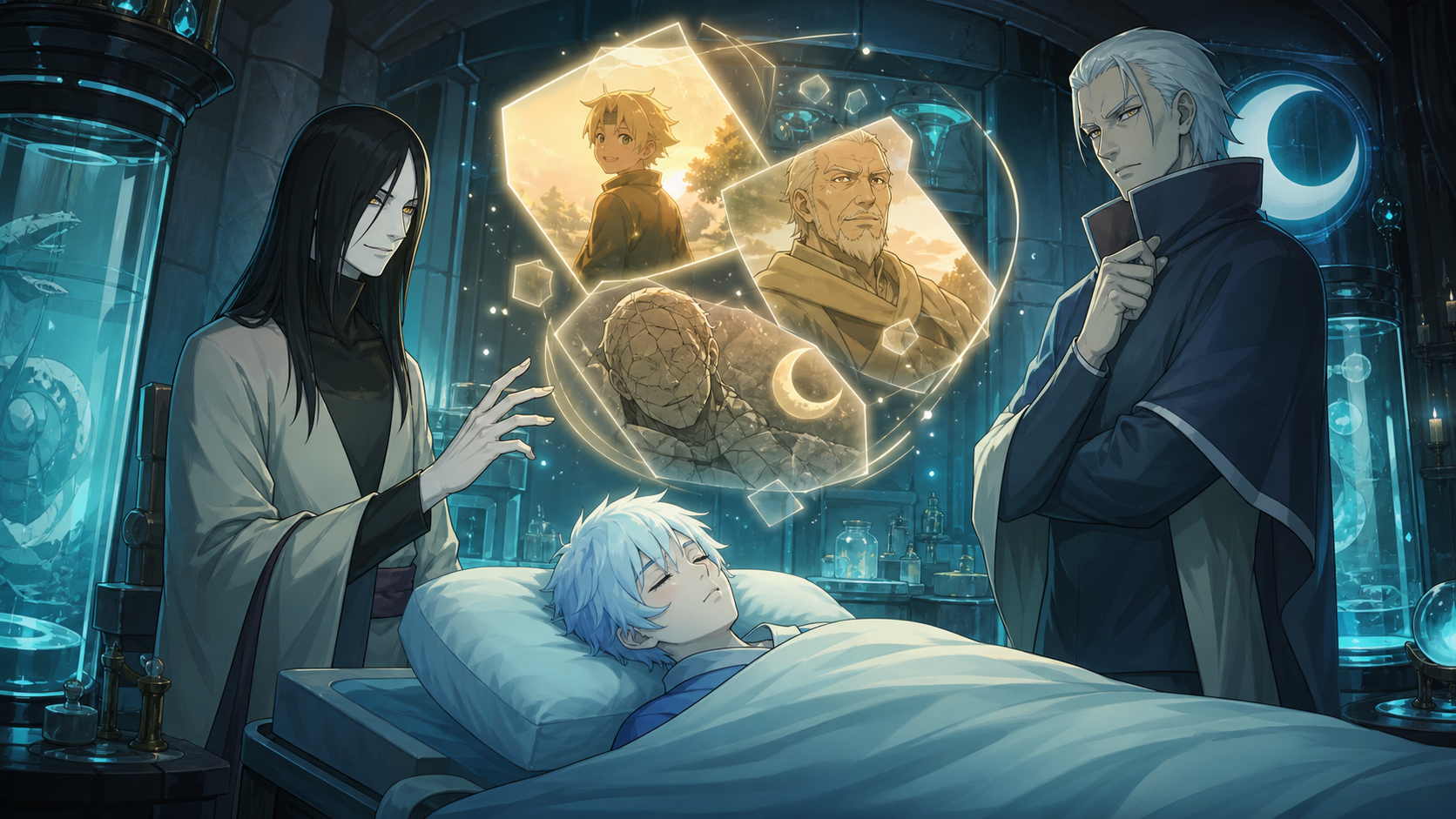
A Wound on the Heart
Orochimaru can remove the painful memories. Mitsuki has to decide whether comfort is worth losing the person those memories built.
Series: Boruto: Naruto Next Generations
Episode: 105 · A Wound on the Heart
Arc: Mitsuki's Side Story
Release: 2019-05-05
Previous: Episode 104 · The Little Roommate
Directory: All 293 Boruto episodes
Bottom line
Boruto Episode 105 is a clip show, and I am not going to dress twenty minutes of recycled footage in a lab coat and call the whole package new. “A Wound on the Heart” spends far too much time replaying the Mitsuki Disappearance Arc from a camera angle the audience already knows. Still, the new framing matters because Orochimaru and Log are not reviewing a mission report. They are watching Mitsuki develop a mind that can hurt. His recurring dreams, physical weakness, and memory loops show that the child they designed has started processing guilt, grief, attachment, uncertainty, and choice in ways they cannot fully predict. Orochimaru offers a terrifyingly practical solution: erase the memories and remove the pain. Mitsuki refuses, even after hearing that the wound may continue. That choice is the episode. Pain is not proof that his growth failed. The pain exists because Sekiei mattered, Boruto mattered, Ohnoki's questions mattered, and Mitsuki's decisions belong to him now. Orochimaru has enough control to edit the child back toward comfort, yet chooses to leave the memory intact after Mitsuki decides. I do not suddenly trust the world's most experienced body thief because he respected consent once. I do recognize the difference. The episode lets Orochimaru act like a parent who is frightened by the cost of autonomy and still understands that removing the cost would remove part of the person.
Mitsuki returns to the place that made him
He travels to Orochimaru's research facility because his body feels wrong. The symptoms arrive through sleep, weakness, and recurring dreams rather than a visible wound.
Going home for help places Mitsuki back inside the system that can understand his biology better than Konoha can. The visit also puts his newer emotional life under the eyes of the people who designed his earliest choices.
Dreams are new enough to feel like an illness
Mitsuki explains that he did not dream before. Now sleep repeatedly brings back Ohnoki, Boruto's photograph, the Fabrications, and the decisions that carried him away from Konoha.
Most teenagers would describe dreams as annoying, frightening, or confusing. Mitsuki has so little history with them that he reports dreaming as a physical malfunction. His body and mind are changing together, and he cannot yet separate emotional strain from structural failure.
Orochimaru and Log treat memory as evidence
They examine Mitsuki while discussing the Stone Village incident. Log worries that attacking Boruto to earn the Fabrications' trust left a deeper injury than Mitsuki admitted.
The concern is valid. Mitsuki chose a plan that required hurting the person he had built into his sun. Success did not cancel the betrayal, fear, or damage carried by that choice.
The replay begins with Boruto's photograph
Mitsuki remembers the first image that helped define his direction. Boruto existed in his life as an idea before becoming a teammate, argument, friend, and person capable of disappointing him.
The photograph carries uncomfortable weight because Orochimaru encouraged the sun-and-moon framing. Mitsuki's attachment grew genuinely, but an adult placed the first object in his path and hoped a particular kind of growth would follow.
Leaving Konoha was Mitsuki's decision and experiment
The memories return to his secret departure with the Fabrications. Mitsuki wanted answers about artificial life, will, and whether a created person could make choices outside the creator's purpose.
His method frightened Boruto and Sarada, broke village rules, and risked the trust he had built. The decision was still his. Autonomy does not become fake because the first independent choice causes harm.
Attacking Boruto created a wound victory could not erase
Mitsuki struck Boruto to make the Fabrications believe he had abandoned Konoha. The plan required using his friend's trust as camouflage.
Log identifies that moment as a likely source of the current pain. The body remembers a choice Mitsuki could justify strategically but never accept emotionally. A good reason can explain harm without making the harm disappear.
Sekiei gave Mitsuki a mirror with a shorter life
The replay lingers on Sekiei, whose curiosity, deterioration, jealousy, and desire for connection resembled questions Mitsuki had already survived. Both boys were created. Both wanted to know whether feeling and choice could make their lives their own.
Sekiei mattered because Mitsuki could not dismiss him as an enemy object. Their friendship forced Mitsuki to see what happens when artificial life becomes disposable to the adults who made the body.
Ohnoki's grief became everybody else's disaster
Ohnoki supported the Fabrication project after personal loss and fear convinced him that expendable artificial soldiers could protect human shinobi. His intention began with fewer young deaths.
The system reproduced the same cruelty through different bodies. Created lives became tools, the Akuta wore down, the Fabrications searched desperately for stable existence, and Ku turned the village into a laboratory for survival.
Mitsuki chose Konoha without pretending the questions vanished
He eventually fought beside Boruto and Sarada against Ku. Returning did not mean the Fabrications were meaningless or Ohnoki's questions were stupid.
Mitsuki chose the relationships and responsibilities he had built. That answer came from experience rather than Orochimaru's programming, which is exactly why the memories now carry weight.
Sekiei's death does not fit inside mission success
Konoha's team survived. Iwagakure regained control. Ku fell. Those outcomes create an official success story.
Sekiei still died after becoming someone Mitsuki cared about. No completed objective can file that loss away. Dreams keep returning because the emotional account never balanced.
The episode confuses repetition with investigation
Here is my problem with the structure: viewers who watched the disappearance arc do not need so many full reminders. A sharper episode could have selected fewer memories and spent more time on Orochimaru, Log, and Mitsuki interpreting them.
The recycled footage reduces new conversation to bookends around an extended recap. The emotional premise deserves more than a bargain clip package.
The framing still changes what those scenes mean
Watching Mitsuki's choices through Orochimaru and Log adds one useful layer. They see evidence that their created child can form attachments strong enough to produce grief and guilt.
That development is scientifically fascinating to them and personally frightening. They wanted independent thought. Independence means Mitsuki will make choices they cannot protect him from and carry pain they cannot calculate away.
Orochimaru cannot measure the problem like damaged tissue
The laboratory can scan Mitsuki's body, replay memory, compare symptoms, and identify the experiences connected to distress. None of those tools can decide which memories are worth keeping. That judgment belongs to the person living with the consequences.
Orochimaru's usual strength becomes a limitation here. He can replace organs, change bodies, build synthetic life, and treat identity as something physical enough to edit. Mitsuki's wound refuses that neat division. His exhaustion comes from meaning, not only chemistry. The same memory can hold friendship, betrayal, grief, learning, and pride at once.
That complexity is why removal sounds so dangerous. A surgeon can cut away dead tissue while preserving healthy tissue around the wound. Orochimaru cannot promise the emotional equivalent. Erasing Sekiei's death may also erase why Mitsuki valued him. Erasing the attack on Boruto may erase the boundary Mitsuki learned by crossing. The scan locates pain. Mitsuki has to decide whether pain alone defines damage.
Log worries like a brother who knows the machinery
Log understands both the designed body and the burden of being another Mitsuki. His relief and concern come from knowing how easily Orochimaru can reset a life under the language of treatment.
He does not want Mitsuki's memories erased merely because recovery would become easier. That stance gives their sibling relationship a moral job beyond sharing an origin.
Orochimaru offers memory erasure as medical care
After the examination, Orochimaru tells Mitsuki that pain may continue. He can remove the wound by removing the memories connected to the wound.
The offer is chilling because Orochimaru can probably do exactly that. For most parents, “I wish I could take this pain away” is an impossible feeling. Orochimaru has a procedure.
Comfort would cost the person Mitsuki has become
Erasing the memories would remove guilt, but also the friendship with Sekiei, the confrontation with Ohnoki, the decision to return, and the proof that Mitsuki can choose through uncertainty.
Memory does not store pain in a separate disposable folder. The same experiences that hurt him also formed judgment, loyalty, compassion, and boundaries.
Mitsuki chooses the wound
He refuses the reset. Mitsuki would rather continue hurting than surrender the experiences that made the pain possible.
That answer gives him ownership over the past. Orochimaru created his body and influenced his beginning. Mitsuki decides which version of himself wakes up afterward.
Orochimaru respects the answer this time
The episode wakes Mitsuki at home with his memories intact. Log is relieved that erasure was unnecessary. Orochimaru admits a future crisis could make the question return, but expresses confidence that Mitsuki may overcome such a need.
I am keeping “this time” attached to that respect. Orochimaru's history includes stolen bodies, manipulated children, and experiments that make one decent parental choice look very small. The choice still matters to Mitsuki.
The threat of a future reset never completely leaves
Orochimaru speaks of possible memory erasure with clinical calm. Consent today does not fully remove the power imbalance tomorrow.
That unease belongs in any reading of their relationship. Mitsuki can say no because Orochimaru permits the refusal. Genuine autonomy will require the child to keep building a life beyond the laboratory's reach.
Mikazuki wakes Mitsuki in the life he chose
The kitten from Episode 104 pulls him out of sleep at home. That ordinary contact contrasts with glass, displays, and memory procedures.
Mikazuki is a relationship Mitsuki formed without Orochimaru placing the animal in his path. The kitten returns voluntarily. Mitsuki's room now contains evidence that his emotional life keeps expanding through unscripted encounters.
Boruto arrives at the door instead of inside a dream
Boruto calls for Mitsuki because Sarada wants to see Mikazuki. The person who once existed as a photograph and recurring memory now stands outside asking to share an ordinary day.
That ending brings the episode back from abstraction. Mitsuki does not preserve memory to worship old pain. He preserves memory so he can keep living with the people connected to the person he became.
A heart wound proves the heart is doing work
The title frames emotional pain as injury, and the laboratory treats the symptom seriously. The episode never says suffering is automatically good.
The wound has meaning because Mitsuki can trace the hurt to choices, bonds, and losses that matter. Removing every painful response would not create health. Such removal would create distance from his own life.
Mitsuki has spent his whole life around adults who call control protection
Orochimaru does not need to raise a voice or threaten Mitsuki for the power imbalance to remain obvious. Mitsuki wakes inside a laboratory built by the parent who designed his body, arranged his childhood tests, and once treated repeated memory erasure as a reasonable path toward an acceptable result. Every calm medical question carries that history.
That history makes Mitsuki's refusal larger than one treatment decision. He has learned how easily adults can rename control when they believe they understand a child better than the child understands himself. Protection, correction, recovery, and experimentation can all become the same locked door when Mitsuki has no meaningful right to refuse.
Episode 105 finally lets him refuse while fully aware of the cost. Orochimaru asks whether the painful memories should stay, and Mitsuki answers from experience rather than instinct. The answer belongs to him because the wound belongs to him.
A manufactured body does not make Mitsuki's feelings artificial
The series keeps circling one ugly assumption: if Orochimaru created Mitsuki, perhaps every emotion can be reduced to programming, biology, or a successful trial. That assumption sounds scientific until somebody applies the same standard to any other child. Every person develops through inherited traits, family pressure, environment, fear, affection, and repeated choices. Mitsuki's origin makes those forces visible. His origin does not make the result fake.
His grief for Sekiei is not a malfunction. His guilt over Boruto is not corrupt data. His attachment to Konoha does not become less sincere because Orochimaru predicted that another person might become his sun. Prediction is not ownership. A parent can anticipate a child's need for connection without owning every bond the child later chooses.
Mitsuki becomes a person through the same difficult process everybody else faces: he acts, hurts people, changes his mind, accepts consequences, and decides what kind of relationship he wants next.
Sekiei matters because Mitsuki cannot file him as a simple enemy
Sekiei entered Mitsuki's life through deception and still became emotionally real. The Fabrications needed Mitsuki for their own survival, but Sekiei also exposed the loneliness underneath their mission. Both truths survive his death.
That complexity is exactly why a memory wipe would be so destructive. Mitsuki would lose more than the image of a dying opponent. He would lose evidence that an exploited being can make harmful choices and still deserve grief. He would lose one of the clearest mirrors the arc offered him: another created life asking whether borrowed purpose can become a self.
Sekiei never received enough time to build a life beyond Ohnoki's plan. Mitsuki does. Carrying Sekiei's memory gives that difference moral weight. Mitsuki cannot save him retroactively, but he can refuse the convenient story where defeated enemies stop counting as people.
Boruto's injury cannot be separated from Mitsuki's freedom
Mitsuki left because he wanted an answer that did not come from Boruto, Orochimaru, or Konoha. That search was necessary. The way he protected that search still hurt Boruto, and freedom does not cancel responsibility.
Episode 105 works when Mitsuki refuses two dishonest extremes. He does not decide that leaving Konoha proved he never cared about Team 7. He also does not decide that caring about Boruto means his departure was entirely wrong. He needed to test the edges of his own will. Boruto paid part of the price because Mitsuki would not explain the test.
Keeping the memory means keeping both truths. Mitsuki can defend his right to choose while admitting that another person's wound matters. That tension is adulthood arriving early, without the speech that usually announces the lesson.
Orochimaru's calm response is growth with an asterisk
Orochimaru accepts Mitsuki's answer, and the restraint deserves notice. An earlier version of this parent would have treated resistance as a failed stage in the experiment. Here, Orochimaru listens, recognizes the decision, and allows Mitsuki to leave the memory intact.
The episode should not turn that restraint into instant absolution. Orochimaru still controls the laboratory, the medical information, and the mechanism that could alter Mitsuki's mind. A respectful answer given while holding that much power remains only one step toward trust.
Growth means Orochimaru does better than before. Accountability means the story remembers what “before” included. Mitsuki does not owe gratitude for receiving the autonomy that should always have belonged to him.
Log understands the danger because he survived the same design
Log is not a neutral assistant watching a medical procedure. He is another result of Orochimaru's attempts to produce a child capable of choosing an independent path. His concern gives the scene a history nobody explains aloud.
When Log studies Mitsuki's memories, he can recognize the temptation behind erasure. Starting again sounds clean when the current self carries grief, guilt, and uncertainty. Log also knows that a clean start chosen by somebody else is not freedom. The new version may wake without pain, but the missing person does not get to approve the bargain.
The episode could have used more of Log's perspective. Even so, his presence keeps the laboratory from becoming a private conversation between creator and creation. Mitsuki has a witness who understands that survival and continuity are not automatically the same thing.
Mikazuki offers companionship without demanding an identity
Mikazuki does not care whether Mitsuki has solved the philosophy of his creation. The cat returns, leaves, sleeps, eats, and chooses closeness without asking Mitsuki to prove what kind of person he has become.
That uncomplicated relationship matters after an arc full of people trying to define Mitsuki. Orochimaru built him. Boruto became his sun. Konoha calls him shinobi. The Fabrications treated him as a possible answer to their short lives. Mikazuki simply recognizes a familiar person and shares the room.
The cat does not replace human accountability or emotional work. Mikazuki gives Mitsuki a form of affection with no mission attached, which may be the rarest thing in his life.
Boruto comes back without making Mitsuki perform an apology
Boruto's arrival closes the episode with contact rather than a courtroom. Team 7 still needs honest conversations about Mitsuki's departure, Boruto's injury, and the trust that broke between them. One friendly visit cannot settle every consequence.
The visit still tells Mitsuki that the relationship survived long enough for repair. Boruto does not need Mitsuki to erase the journey before entering the room. He comes to the version of Mitsuki who made those choices, carries those memories, and now has to decide what friendship looks like afterward.
That is the better promise. Forgiveness without memory would only restore appearances. Friendship with memory gives both boys a chance to build something less dependent on silence.
The clip-show structure weakens an episode that deserved new confrontation
The repeated footage has thematic purpose, but purpose does not excuse volume. Episode 105 spends too much time replaying scenes the audience recently watched and too little time asking Mitsuki to speak from his present position.
Fresh conversations with Sarada, Boruto, Log, or Orochimaru could have tested what he learned. Sarada deserved space to ask why Team 7 received no trust. Boruto deserved room to separate relief from anger. Log could have told Mitsuki what memory manipulation feels like from the other side. Orochimaru could have faced a direct question about why erasure remains available at all.
The episode chooses efficiency over confrontation, then relies on the final decision to carry the emotional weight. Mitsuki's choice is strong enough to survive that weakness. The surrounding episode should have trusted him with more new words.
Final reaction
“A Wound on the Heart” has about one full episode of character material trapped inside a clip show that needed a much stricter editor. The Mitsuki Disappearance Arc was long. Replaying large sections does not become deep analysis because Orochimaru watches from another room. I wanted more new dialogue, more discomfort from Log, and more time with Mitsuki awake enough to describe what he feared losing.
The central decision still lands. Orochimaru can make the pain disappear, and Mitsuki says no. That refusal turns old footage into an argument about memory rather than a simple greatest-hits package. Sekiei's death, Boruto's injury, Ohnoki's failure, and Mitsuki's uncertainty remain part of him because he chooses the whole record.
The ending with Mikazuki and Boruto keeps the conclusion from romanticizing suffering. Mitsuki wakes into warmth, friendship, and a cat who has already demonstrated that voluntary return means more than forced permanence. He does not keep the wound because misery makes him real. He keeps the memories because love, grief, guilt, and choice arrived together. Orochimaru cannot remove one cleanly without cutting through the rest.
Sources and lawful viewing
Official episode reference: Naruto Official episode guide
Licensed episode route: Crunchyroll licensed series page