
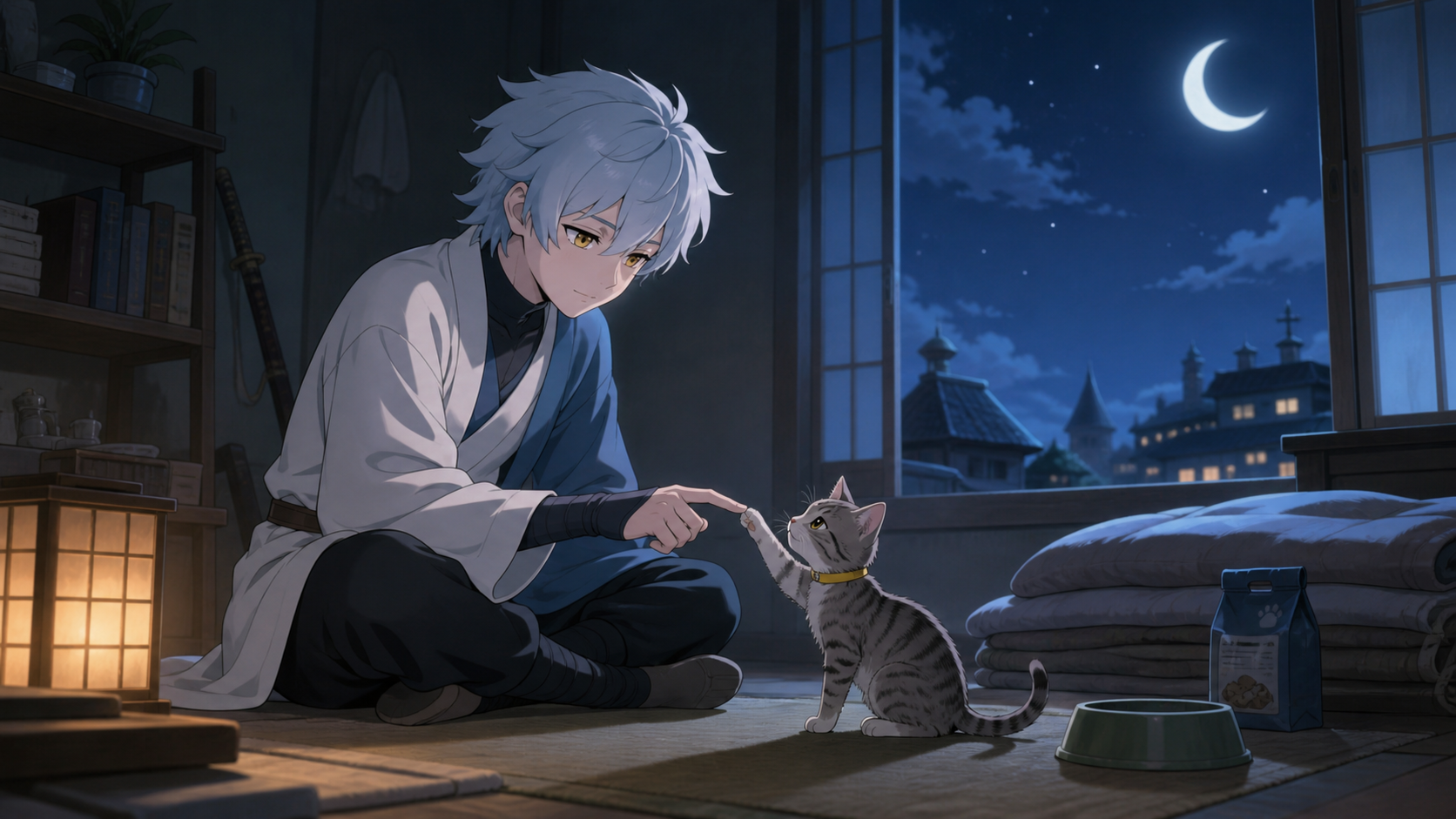
The Little Roommate
Mikazuki gives Mitsuki a relationship with no mission order, no guaranteed permanence, and one very open window.
Series: Boruto: Naruto Next Generations
Episode: 104 · The Little Roommate
Arc: Mitsuki's Side Story
Release: 2019-04-28
Previous: Episode 103 · Migration Season
Directory: All 293 Boruto episodes
Bottom line
Boruto Episode 104 looks like a disposable kitten break after the Jugo Arc, then quietly gives Mitsuki one of his most useful character episodes. “The Little Roommate” is not really about whether a synthetic shinobi can figure out cat food. The episode asks what Mitsuki does when another living creature needs him without giving him a mission, an order, or Boruto's example to copy. Mikazuki cannot explain what hurts, promise loyalty, or tell Mitsuki which response counts as human. The kitten simply appears, hides under his pillow, gets sick, and eventually leaves with its mother. Mitsuki has to notice, learn, worry, spend money, miss an appointment, ask strangers for help, and accept that care does not create ownership. The jewel-thief plot is aggressively silly. Nezumi hiding stolen property inside a kitten moves past clever and lands squarely in “sir, what was your plan after the cat started walking?” territory. Still, the crime gives Mitsuki a reason to protect Mikazuki before he fully understands his attachment. By the end, he leaves the window open even after the kitten chooses another home. That small choice says more about his emotional growth than a speech could. Mitsuki begins the episode asking what a pet requires. He ends by making room for a relationship that returns freely.
Team 7 loses a jewel thief and finds a kitten
The police bring Team 7 into a nighttime pursuit of a jewel thief moving through Konoha. The chase ends without the missing jewel and leaves several suspects for questioning. A frightened kitten appears near the route after the adults are taken away.
Boruto and Sarada cannot bring the animal home, so responsibility falls to Mitsuki. The arrangement begins as temporary logistics rather than instant affection. That setup fits him. Mitsuki knows how to execute a task. Nobody has given him a manual for being chosen by a cat.
Mitsuki walks home with no idea what comes next
He carries the kitten to an apartment built for one unusually self-sufficient teenager. There is no parent waiting with pet advice, no sibling arguing over a name, and no family routine ready to absorb another body.
The empty space matters. Mitsuki can complete dangerous missions beside Team 7 and still return to a room where every object answers only to him. A kitten changes that room before Mitsuki has language for the change.
Boruto thinks naming creates the first connection
At Lightning Burger, Boruto suggests giving the kitten a name. Mitsuki has been treating the animal as a practical problem, while Boruto immediately recognizes that a name turns temporary shelter into a relationship.
Boruto is right, but Sarada has to stop both boys from feeding the kitten a hamburger. This is the Team 7 balance I enjoy. Boruto supplies emotional impulse. Sarada supplies basic common sense. Mitsuki takes both pieces seriously because he is still learning which human instincts deserve trust.
Sarada saves Mikazuki from fast-food parenting
Mitsuki's first food plan exposes how little experience he has with ordinary caretaking. He is not cruel or careless. He simply does not know that a small animal needs different nutrition.
Sarada corrects him without turning the mistake into a moral failure. That distinction feels important. Mitsuki has spent much of his life around people who treat knowledge as proof of worth. Pet care teaches him that ignorance can be repaired through listening.
The pet shop becomes Mitsuki's crash course
He goes to a shop, asks for help, and buys the supplies the kitten actually needs. The scene is mundane by ninja standards. Nobody attacks. No secret bloodline unlocks. Mitsuki has to admit that a civilian worker knows more than he does.
That humility is character growth. Orochimaru created a child with extraordinary combat ability, but competence in one field does not make Mitsuki an expert in every life around him. Care begins when he accepts somebody else's knowledge.
The kitten chooses the space under his pillow
Back home, Mitsuki searches until he finds the animal hiding beneath his pillow. The choice is funny and revealing. Mikazuki does not settle in the supplies Mitsuki carefully purchased. The kitten picks the place that smells most like the person in the room.
Mitsuki cannot solve that preference through procedure. He has to accept that living creatures make choices outside the neat use assigned to objects.
Mikazuki is a name with a little moon inside
Mitsuki chooses Mikazuki, meaning crescent moon, and fastens a yellow collar around the kitten's neck. The name connects the cat to Mitsuki's own moon imagery without turning the animal into a symbol he controls.
He even treats the naming as a question rather than a declaration. That softness matters from a boy raised around laboratories, replacement bodies, and adults who decided his purpose before he could speak.
Ordinary play lets Mitsuki practice affection
The next stretch follows feeding, play, watching, and the little adjustments that happen when two beings share a room. Mitsuki's face does not explode into exaggerated joy. He studies Mikazuki, responds, and begins anticipating what the kitten wants.
That restrained rhythm feels truer to him than a sudden emotional makeover. Mitsuki has always been observant. Affection grows when observation stops serving a mission and starts serving another creature's comfort.
Nezumi watches the apartment for the wrong reason
The released thief circles Mitsuki's building because the missing jewel never left his control. He used the kitten as a hiding place, forcing the animal to swallow evidence until police attention cooled.
The scheme reduces Mikazuki to a container. Nezumi and Orochimaru are not equivalent, but the episode deliberately places Mitsuki between an animal treated as storage and his own history as a body designed for somebody else's plan.
Mikazuki gets sick and Mitsuki finally panics
When the kitten stops acting normally, Mitsuki loses the calm distance that marked his first night. He searches the village for help and misses a meeting with Boruto and Sarada.
Missing that appointment is the clearest sign that Mikazuki has become more than a temporary task. Mitsuki has built much of his daily life around Boruto. A sick kitten becomes important enough to interrupt that orbit.
The village sends him from counter to counter
Mitsuki tries ordinary medical routes before somebody directs him toward a veterinarian. The sequence is funny because a shinobi who can identify poisons and fight transformed enemies has no idea where Konoha treats a sick cat.
The confusion also makes the village feel lived in. Human hospitals, pharmacies, shops, police, and animal care all operate beside the ninja system. Mitsuki has to navigate civilian expertise rather than expect one all-purpose shinobi answer.
Boruto and Sarada notice his absence
When Mitsuki fails to meet them, his teammates go looking. They do not assume he has abandoned the plan or decided they no longer matter. His changed behavior tells them that something is wrong.
That response reflects the trust rebuilt during Mitsuki's disappearance. Earlier, unexplained absence could trigger suspicion. Now Boruto and Sarada start from concern and search for the reason.
Nezumi takes the kitten before help arrives
The thief uses Mitsuki's confusion and the busy streets to recover Mikazuki. His goal is not rescue. He wants the jewel back before the kitten's illness exposes the hiding place.
The danger turns a gentle episode ugly without needing a world-ending villain. Animal cruelty often grows from convenience. Nezumi created a medical crisis because another life seemed less important than avoiding arrest.
Mitsuki does not need an order to give chase
Once he understands what happened, Mitsuki pursues Nezumi immediately. No mission leader assigns the rescue. No rule tells him that Mikazuki belongs to Team 7's case file.
He acts because the kitten matters to him. That difference is the entire episode. Mitsuki has spent years asking what he should do. Protecting Mikazuki becomes something he wants to do before anybody explains the correct answer.
The jewel was inside Mikazuki all along
Nezumi intends to cut the gem out after using the kitten to pass police scrutiny. The reveal explains the illness and the missing evidence, though the plan remains spectacularly foolish. A living hiding place can move, cry, get sick, attract kindness, or disappear with its mother.
Nezumi assumed an animal would remain a silent object until he returned. Mikazuki's connection with Mitsuki ruins that assumption.
Mitsuki's anger stays frighteningly quiet
He stops Nezumi before the thief can harm the kitten. Mitsuki does not need a loud declaration about friendship. His focus becomes sharper because somebody endangered a life that trusted him.
That controlled anger suits him. Orochimaru's son can become terrifying without raising his voice, especially when the opponent has already demonstrated that another body means nothing to him.
Team 7 finishes the arrest together
Boruto and Sarada catch up, help close the pursuit, and return the thief to police custody. Their arrival prevents the rescue from becoming a private Mitsuki showcase.
Mikazuki changed Mitsuki's priorities, but Team 7 remains the community that notices those changes. Boruto and Sarada support the choice he made on his own.
A veterinarian removes the real source of illness
Professional animal care resolves the danger after the fight. The jewel comes out, and Mikazuki can recover from what Nezumi forced on the small body.
I am glad the episode does not let a ninja technique magically replace veterinary care. Mitsuki saves the kitten from immediate violence. A trained specialist handles the medical problem.
Mikazuki's mother returns
After recovering, the kitten leaves with its mother. Mitsuki does not trap Mikazuki indoors, claim repayment, or insist that rescue made him the rightful owner.
Letting the kitten leave completes his first real lesson in care. Protection is not possession. A relationship can matter even when the other life chooses a different home.
The open window is Mitsuki's honest confession
Mitsuki says very little about losing his roommate, but he leaves the window open. Mikazuki returns at night, and the visits continue without a collar, cage, or command forcing the arrangement.
That final choice is almost embarrassingly sweet. Mitsuki has learned enough to prepare a welcome without demanding permanence. For a child whose own life began under somebody else's design, voluntary return carries enormous weight.
Mikazuki matters beyond one cute episode
The kitten becomes evidence that Mitsuki can form a bond outside Orochimaru, Team 7, and the role assigned to him. The relationship is small, domestic, and free from the pressure to define his entire identity.
Boruto remains important, but Episode 104 refuses to make Boruto the source of every feeling Mitsuki develops. Mikazuki gives him a separate responsibility and a separate reason to come home.
Mitsuki has never had an ordinary model for caregiving
Orochimaru taught Mitsuki how to survive danger, analyze people, and pursue a chosen sun. None of that training explains how much food a kitten needs, why a frightened animal hides, or how to recognize sickness before a crisis. Mitsuki enters caregiving without a useful script.
That gap matters because adults often mistake competence in one area for readiness everywhere. Mitsuki can fight trained shinobi and still stand helpless in front of a bag of cat food. The episode lets him be inexperienced without making him foolish. He learns by asking, watching, adjusting, and caring enough to feel embarrassed when he gets something wrong.
Care becomes a skill rather than a magical instinct. Mitsuki does not love Mikazuki correctly on the first attempt. He pays attention until his actions become more useful than his intentions.
Sarada refuses to let affection excuse bad care
Boruto wants to solve the feeding problem with whatever smells exciting. Sarada stops the shortcut because the kitten's body matters more than Boruto's enthusiasm. Her correction gives the episode a needed boundary: wanting an animal does not automatically make somebody prepared to protect one.
Sarada's practical response also keeps her from becoming a spectator inside another Mitsuki and Boruto story. She sees the needs neither boy has considered, finds appropriate supplies, and treats the kitten as a living responsibility rather than a cute prop.
That is fandom-level ordinary heroism. No jutsu can replace reading the label, finding safe food, or noticing that a small body needs different care from a human child.
Naming Mikazuki gives Mitsuki language for a relationship
The name connects the kitten to Mitsuki without turning the animal into a miniature version of him. Both names carry moon imagery, but Mikazuki remains stubborn, mobile, curious, and completely uninterested in becoming somebody's symbol on command.
Mitsuki chooses the name after the bond has already begun. Naming helps him recognize the relationship rather than manufacture ownership. That distinction becomes important when the kitten's mother returns. A name can mark affection. A name cannot cancel another creature's freedom or earlier family.
Mikazuki gives Mitsuki a word for the space opening inside his daily life. The kitten gives that word meaning by continuing to choose the apartment.
The apartment changes because Mitsuki starts expecting somebody else
Before Mikazuki, Mitsuki's room feels temporary enough for a person who could leave on a mission without disrupting anything. The kitten creates routines, objects, noises, and small interruptions. Food must be available. A sleeping place matters. The window becomes a route instead of background architecture.
Those changes reveal domestic attachment without forcing Mitsuki into a speech about home. He begins organizing space around another living being. The apartment becomes somewhere to return because somebody may be waiting there.
Mitsuki has spent much of the series studying why Boruto draws him toward Konoha. Mikazuki teaches the reverse lesson. Home can also form when Mitsuki becomes the person another creature seeks.
The village systems fail precisely when the emergency looks small
Mitsuki knows how to respond to a combat injury. A sick kitten produces confusion because ordinary animal care sits outside the shinobi systems that organize his life. He moves from place to place while Mikazuki gets worse, and every delay raises the cost of not knowing where help lives.
The sequence is funny until the kitten's weakness becomes obvious. Then the village's everyday infrastructure matters as much as any hospital used after battle. Peace requires veterinarians, accessible information, safe food, and adults who can direct a frightened child without treating the problem as trivial.
Mitsuki's panic proves that stakes do not need village-wide destruction. One small life can be the entire emergency for the person holding that life.
Nezumi turns a living body into disposable storage
The jewel scheme is absurd, but the moral contrast is clean. Nezumi treats Mikazuki as a container with fur. The kitten's pain, fear, hunger, and chance of injury count only as risks to his property.
Mitsuki begins the episode unsure how to care for an animal. Nezumi never recognizes an animal at all. That difference explains Mitsuki's anger when the truth comes out. The crime is not only theft. Nezumi used a defenseless body because he assumed nobody would value the body more than the jewel.
Mitsuki disproves that assumption before he knows where the jewel is hidden. He chases Mikazuki because the kitten is missing, not because the mission suddenly offers a reward.
Mitsuki's quiet anger is more revealing than a loud threat
Mitsuki rarely needs volume to become frightening. When he understands what Nezumi did, the stillness shows how quickly detached observation can become personal judgment. Somebody harmed a life that trusted him, and the offense reaches a part of Mitsuki he only recently discovered.
The episode does not turn that anger into uncontrolled violence. Team 7 completes the arrest, and medical care remains the priority. Mitsuki's restraint matters because protection is not proven by making the offender suffer more dramatically.
His anger still deserves recognition. Affection has created a boundary. Nezumi crossed that boundary, and Mitsuki now knows the feeling of defending somebody who cannot explain the harm in words.
Letting Mikazuki leave prevents rescue from becoming possession
Mitsuki could interpret the rescue as proof that Mikazuki belongs with him. The episode chooses a more honest ending. The kitten's mother arrives, and Mitsuki allows the family bond to continue even though keeping Mikazuki would comfort him.
That decision is especially important for a child created by an adult who repeatedly controlled his environment in the name of development. Mitsuki does not reproduce the same logic with a smaller being. He does not claim that knowing what is best gives him permanent rights over another life.
Love becomes visible through release. Mitsuki accepts loss because Mikazuki's needs are not identical to his own.
The open window becomes Mitsuki's answer to Orochimaru's locked experiments
Orochimaru built tests where Mitsuki had to escape a designed situation and arrive at a preferred answer. The open window offers the opposite structure. Mikazuki can leave, return, or never appear again. Mitsuki does not control the outcome.
That uncertainty makes every return meaningful. Mikazuki comes back because the apartment feels safe, not because a door or mission removes every other option. Mitsuki receives the kind of bond he has been trying to understand: voluntary closeness that survives freedom.
The image says more about Mitsuki's growth than another speech about his sun. He makes room, leaves the exit available, and trusts that affection does not need a cage.
Final reaction
“The Little Roommate” works because the episode does not treat softness as a break from character development. Mitsuki learning cat food, buying a collar, noticing illness, and leaving a window open all reveal how he handles life without a script. The jewel thief supplies action, but the quieter material gives the episode staying power.
Nezumi's plan is nonsense on several practical levels. Swallowing a jewel can injure the animal, the kitten can wander, and any veterinarian can expose the evidence. I can forgive the foolish crime because the stupidity creates a precise contrast. Nezumi sees a convenient container. Mitsuki sees a life whose needs become important before he can explain why.
The best choice is letting Mikazuki leave. A weaker version would reward Mitsuki with permanent ownership after the rescue. This episode gives him something harder and healthier: a bond that cannot be guaranteed. The kitten goes with its mother, Mitsuki keeps the window open, and Mikazuki returns because the apartment has become another safe place. No laboratory programmed that choice. No mission ordered that choice. Mitsuki made room, and another living creature decided to come back.
Sources and lawful viewing
Official episode reference: Naruto Official episode guide
Licensed episode route: Crunchyroll licensed series page