
Migration Season
Tosaka wanted proof that biology decides a life. A flightless goose gives Jugo the better answer.
Series: Boruto: Naruto Next Generations
Episode: 103 · Migration Season
Arc: Jugo Arc
Release: 2019-04-21
Previous: Episode 102 · Melee!
Directory: All 293 Boruto episodes
Bottom line
Boruto Episode 103 closes the Jugo Arc with one of the strangest combinations this franchise has ever made work: a curse-mark monster fight, a public-health emergency, a teenager preparing to kill an entire flock, Suigetsu turning himself into medicated rain, and one stubborn white goose doing more for Jugo than Boruto's Rasengan could manage. “Migration Season” understands that Jugo's real fight was never Tosaka. Tosaka is loud, cruel, and very beatable once Jugo transforms. The harder enemy is the belief that biology has already decided Jugo's future. Tosaka worships that belief because a predetermined monster gives him a perfect research object. Jugo fears the same belief because every transformation seems to prove that violence will always win. Boruto argues against destiny with his whole body, but the episode wisely lets the goose carry the final answer. The domesticated bird was supposedly born unable to migrate. Then the bird takes flight anyway. Jugo sees a living creature refuse the limit assigned at birth, and that sight reaches the man buried under the curse mark. I have complaints about how quickly the antidote solves the flock problem, and Tosaka deserved a less tidy reckoning. Still, the emotional idea lands. Jugo does not need a promise that the curse mark will disappear. He needs proof that a life can remain difficult without becoming hopeless.
Dawn puts a deadline on every fight
Karin and Sarada watch the Wild Leaf Geese gather at the lake while the sky starts changing. The birds do not care that Team 7 has unfinished business inside a laboratory. Migration follows season, light, hunger, and instinct. Once the flock leaves, infected birds can carry the artificial curse mark far beyond the village that asked Konoha for help.
That deadline makes the finale larger than a rescue mission. Beating Tosaka will not pull infection out of the sky. Saving Jugo will not cure hundreds of birds. Every team has to stop thinking about the nearest opponent and start thinking about what happens after sunrise.
Jugo still warns Boruto before running
The activation drug keeps pushing Jugo toward a complete transformation, but concern breaks through long enough for him to tell Boruto to flee. That warning matters because Tosaka treats the curse mark as Jugo's truest form. According to the scientist, the violent body reveals what Jugo really is.
Jugo's first choice says otherwise. Even while losing control, he tries to protect the child beside him. The curse mark changes his body and attacks his judgment. The curse mark does not erase every value he has built around that danger.
Tosaka wants a spectacle, not knowledge
Tosaka follows Jugo to the lakeshore because the scientist wants to compare their curse marks. He talks about research, but his excitement has nothing to do with careful observation. He wants the thrill of forcing a stronger transformation and surviving close enough to brag about the result.
The infected geese make his motive uglier. A migrating outbreak would give Tosaka more subjects, more samples, and more proof that his weapon can spread. Villages, animals, and ecosystems become free laboratory space in his head. That is not curiosity. That is vanity wearing a lab coat.
Boruto fights while the tranquilizer still owns his legs
Boruto chases Jugo even though Tosaka's drug has not fully released him. Shadow clones and explosive-tag kunai buy a little time, but Tosaka's transformed body creates extra limbs and a tail strong enough to capture Boruto and the clones together.
The sequence is not Boruto at his cleanest. His movement looks desperate because the boy is working against his own nervous system. I like that limitation. Boruto cannot arrive as a perfectly restored hero after Episode 102 spent so much time establishing the tranquilizer. He has to make choices inside the damage already done.
Jugo ends Tosaka's fantasy almost immediately
Tosaka keeps demanding the monster he came to study. Jugo finally gives him one. The full transformation overwhelms Tosaka so quickly that the scientist barely gets time to enjoy the comparison. Jugo absorbs the artificial curse mark and throws him aside.
That short fight exposes Tosaka's foolishness better than a long speech could. He believed copying visible power made him Jugo's equal. He never understood the body, history, pain, or years of control behind the original curse mark. Tosaka copied an effect and mistook the copy for mastery.
Winning the fight does not bring Jugo back
Boruto hoped defeating Tosaka or removing the immediate threat might help Jugo regain control. Nothing changes. Jugo turns on Nue, throws the summon away, and focuses on Boruto.
The continuation is important. Tosaka caused the forced transformation, but Tosaka was never a convenient off switch. Jugo has lived with this danger since long before the scientist entered the forest. Removing an abuser does not instantly remove every wound, habit, or physical consequence that the abuser exploited.
The double Boruto Stream is a beautiful bad idea
Boruto uses one Boruto Stream to accelerate another, stacking momentum until he can drive a Rasengan into Jugo. The move is inventive, reckless, and completely on brand. Boruto sees a wall and responds by finding a faster angle toward the same wall.
The hit lands. Jugo does not change back. Raw force can interrupt a body, but Boruto cannot punch somebody into wanting to live differently. The failure also keeps the episode from pretending that Boruto owns Jugo's recovery because he tried the hardest.
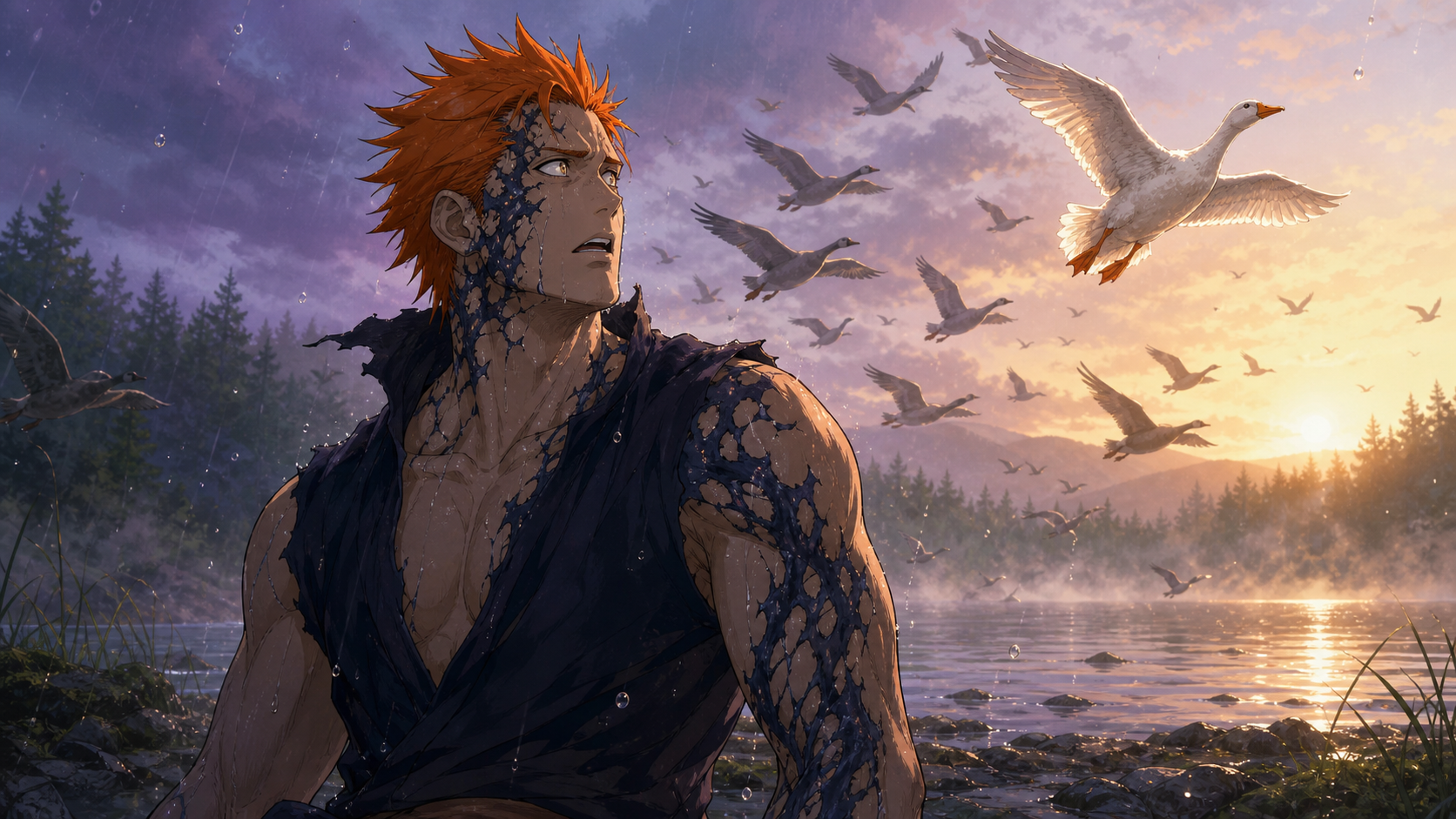
The white goose reaches the person inside the transformation
The domesticated white goose suddenly rises with the flock. Earlier explanations treated the bird's inability to fly as a biological conclusion. The goose had lived close to the lake, watched the wild birds, and kept trying despite a body everyone else had already judged.
Jugo sees the goose cross that boundary, and the curse transformation recedes. The scene could have become painfully sentimental. Instead, the episode lets Jugo recognize his own argument in another living creature. He came to save birds because he understood what a body can force on a life. The bird answers that compassion with evidence. Predisposition is real. Predestination is a claim people make after they stop looking for another possibility.
Sarada prepares to make the brutal choice
Across the lake, Karin tells Sarada that killing the flock may be the only way to prevent a regional outbreak. Sarada does not want that answer, but she raises her weapon when dawn removes the remaining time.
The moment respects Sarada's future leadership better than another easy punch would. A shinobi can love animals and still face a choice where protecting thousands of people may require killing creatures that never chose infection. Sarada does not hide behind disgust or wait for an adult to carry the guilt.
Mitsuki stops her because help finally arrives
Mitsuki interrupts before Sarada attacks. Konohamaru and Suigetsu return with serum stolen from the research vessel. Their timing saves the flock, but Sarada's readiness still counts. She had reached the decision before she knew a cleaner answer existed.
Konohamaru's contribution also repairs his place in the mission. Injury removed him from the laboratory fights, yet leadership meant sending the right people toward the cause rather than the loudest battlefield. The boat produced the solution that another victory at the compound never could.
Suigetsu becomes the strangest delivery system in medicine
Suigetsu drinks the serum, merges with the lake, and sends treated water down over the flock. The plan is ridiculous. The plan is also exactly why a Hozuki shinobi belongs on this mission. A small supply that could never reach every bird becomes rain across the gathering area.
The science remains very anime, and I am not going to pretend the dosage math deserves a journal article. The character logic works. Suigetsu's liquid body turns a limitation of quantity into a question of distribution. The finale solves the outbreak through a specific ability rather than a generic flash of healing light.
The birds leave without carrying Tosaka's experiment
Red eyes clear as the treated water reaches the geese. The flock rises, and the white bird struggles into the formation. Migration changes from a threat back into a natural event.
That reversal gives the arc a satisfying environmental finish. Tosaka tried to turn animal movement into a delivery system for violence. Suigetsu uses the same lake and the same gathering behavior to distribute a cure. The shinobi do not stop nature. They remove the human-made danger and let the birds continue.
Sumire chooses science because Nue needs more than affection
After watching Nue lose control again, Sumire tells Wasabi and Namida that she plans to join the Scientific Ninja Weapons Team. She wants a better way to understand and cooperate with Nue rather than relying on instinct and emergency restraint.
That decision is the episode's most important bridge beyond Jugo. Tosaka represents science without consent, limits, or responsibility. Sumire does not reject science because he abused the work. She chooses a version built around care, partnership, and accountability. Loving Nue does not automatically give her the knowledge to protect everybody around the summon.
Team 15 has to hear the decision first
Sumire asks Wasabi and Namida to keep the plan private until she can tell the others herself. The request acknowledges that her career choice will change their team, and she does not want rumor making the announcement before she can face the people affected.
I appreciate that small piece of awkwardness. The episode does not stage a grand farewell. Sumire has made a decision, but she still has to explain that decision to friends who may feel left behind.
Karin and Suigetsu steal Tosaka on the way out
Konohamaru declares the mission successful, then Mitsuki casually reports that Karin and Suigetsu took Tosaka with them. Of course they did. Orochimaru's people arrived because Jugo was endangered, found a scientist obsessed with curse marks, and left with both their friend and the research problem.
The joke works because Konohamaru has enough on his plate without starting a custody fight after an outbreak. Tosaka is alive, defeated, and no longer free to experiment on villages. Whether Orochimaru's network is a comforting destination is a different conversation entirely.
Karin's teasing cannot hide how much she cared
Suigetsu jokes that Karin acted maternal toward Sarada. Karin snaps back, but Episode 102 already showed the truth underneath the embarrassment. She remembered Sakura saving her, offered Sarada the same healing method, and fought beside Sasuke and Sakura's daughter without turning old history into the girl's burden.
The arc lets Team Taka interact with the next generation without reducing everybody to nostalgia. Karin's bond with Sarada is strange, affectionate, and shaped by history Sarada only partly knows. That mess feels more human than a clean speech about the past.
Boruto and Sarada argue after surviving
Sarada calls Boruto reckless. Boruto points out that his plan worked, which is the standard defense of every reckless person who happened to come home. Both statements are true. He reached Jugo, kept him near the lake, and survived long enough for the goose to break through. He also attacked a full curse transformation while drugged.
Their exchange restores normal team friction after a mission built around bodies losing control. Nobody needs a polished lesson. Sarada is mad because she was scared. Boruto jokes because admitting that fear would require sitting still for five seconds.
Jugo leaves with a question instead of a cure
Jugo watches the white goose join the migrating flock and wonders whether he might fly someday. The question does not promise that his curse mark will vanish. He still carries the body and instincts that have frightened him for years.
Hope works here because the episode keeps the limit visible. Jugo has not become safe through one emotional revelation. He has seen a reason to keep attempting control, connection, and purpose even when failure remains possible.
The Jugo Arc was really about ownership
Every major conflict asks who gets to define a body. Tosaka believes scientific access gives him ownership. Researchers install collars that turn curse marks on command. Jugo fears his biology owns his future. Sumire worries that Nue's appetite may own their partnership. The village fears infected birds will carry another person's decision into their homes.
The heroes answer with responsibility rather than denial. Sarada prepares to contain the outbreak. Sumire seeks knowledge. Suigetsu distributes the cure. Boruto keeps calling Jugo a person. Jugo chooses to protect creatures that share his struggle.
Jugo's body is dangerous without making Jugo disposable
The arc never solves the hardest fact: Jugo can lose control and hurt people who did nothing wrong. Boruto's belief in him cannot erase that danger, and friendship cannot substitute for a plan when the transformation begins.
Sarada understands the difference between valuing Jugo and allowing an outbreak to continue. Her willingness to act is not betrayal. Protection sometimes requires stopping a person whose choices have been overtaken by a condition, even when that person deserves compassion.
The episode works because nobody has to choose between “Jugo is innocent” and “Jugo is dangerous.” Both truths can exist. The ethical failure begins when other people use the danger as permission to exploit his body, erase his agency, or treat death as the only form of containment.
Tosaka confuses access with entitlement
Tosaka studies curse marks, learns how transformations operate, and decides that understanding a mechanism gives him the right to activate that mechanism inside somebody else. Scientific curiosity becomes assault the moment Jugo's consent disappears.
His obsession with spectacle makes the violation worse. Tosaka does not even pretend that the forced transformation serves treatment. He wants proof, power, and the thrill of becoming the most interesting creature in the clearing.
The series has spent years around laboratories where brilliant people cross moral lines and call the result progress. Tosaka belongs to that tradition without Orochimaru's charisma or Kabuto's wounded complexity. He is what the logic looks like after every excuse falls away.
Sarada's hard choice deserves more than a last-second interruption
Sarada prepares to stop the infected birds because dawn will turn a local emergency into a regional one. The decision asks her to accept harm in front of her to prevent greater harm somewhere she cannot see.
Mitsuki arrives with another option before she has to act, but the interruption does not make her reasoning cruel. A leader cannot build every plan around the hope that a cure will appear at the final second. Sarada identifies the deadline, weighs the spread, and moves when delay becomes a choice of its own.
The episode lets her carry responsibility without celebrating the possibility of killing the flock. Relief matters because the alternative was genuinely terrible, not because Sarada needed to learn that decisive girls should wait for boys with medicine.
Sumire chooses a new path without abandoning Team 15
Sumire's decision to pursue scientific work grows from her relationship with Nue. She does not leave fieldwork because she lacks courage or because combat defeated her. She recognizes that protecting Nue requires knowledge her current role cannot provide.
That choice also creates loss. Namida and Wasabi have built trust with her, and a career decision changes the team whether Sumire intends harm or not. Telling them matters because friendship does not turn departure into a private administrative update.
The episode could give Team 15 more room to react, but Sumire's reasoning fits the arc. Science caused the crisis because people used bodies as property. Sumire wants a science built around care, consent, and coexistence. Leaving the battlefield may let her fight the deeper problem.
The serum rain succeeds because several imperfect people cooperate
No single hero owns the cure. Mitsuki carries the information. Karin and Suigetsu help translate knowledge into delivery. Sarada buys time. Konohamaru keeps the larger mission moving. Boruto reaches Jugo emotionally while still needing everybody else to control the physical crisis.
Suigetsu's water technique turns medicine into rainfall, which is ridiculous enough to feel perfectly at home in Naruto. The visual also makes the point cleanly: the solution must reach a flock, not reward one central fighter with a finishing move.
The logistics deserve questions, including dosage and distribution. The collaborative shape remains right. A crisis created by people forcing control onto many bodies ends through people sharing responsibility across many bodies.
The white goose reaches Jugo without becoming a miracle cure
The goose does not remove Jugo's curse mark, promise permanent control, or tell him that kindness makes biology harmless. The bird gives him recognition at the exact moment his transformed body has swallowed every other connection.
Jugo saved the goose when flight looked impossible. The returning bird shows that protection changed another life even though Jugo could not repair his own. That evidence reaches him because nobody can order the goose to become a symbol on schedule.
The moment is hopeful without becoming dishonest. Jugo still needs distance, management, and support. He also needs reasons to believe that the work matters. The goose gives him one reason and then keeps flying.
Final reaction
“Migration Season” is messy, sincere, and much better when the episode trusts Jugo's quiet recognition than when everybody explains the theme around him. Tosaka falls too easily after spending several episodes controlling the plot, and the serum rain fixes a frightening outbreak with suspicious speed. I still buy the emotional ending because the arc built the goose and Jugo as parallel lives before the finale asked that image to carry the weight.
Boruto does not save Jugo through superior strength. Sarada does not save the flock by making the hardest sacrifice. Konohamaru does not save the mission by winning the largest fight. Everybody contributes a piece, then a bird makes the final connection no shinobi could force.
The closing question is stronger than a cure. Jugo may never have an easy relationship with his body. Sumire may never control Nue without fear. Sarada will face decisions where every available choice hurts somebody. Boruto will absolutely keep launching himself at danger before his legs are ready. A future can remain uncertain without being assigned. The white goose flies because the bird keeps trying when the flock finally moves. Jugo looks up because, for the first time in a while, trying again feels honest.
Sources and lawful viewing
Official episode reference: Naruto Official episode guide
Licensed episode route: Crunchyroll licensed series page