
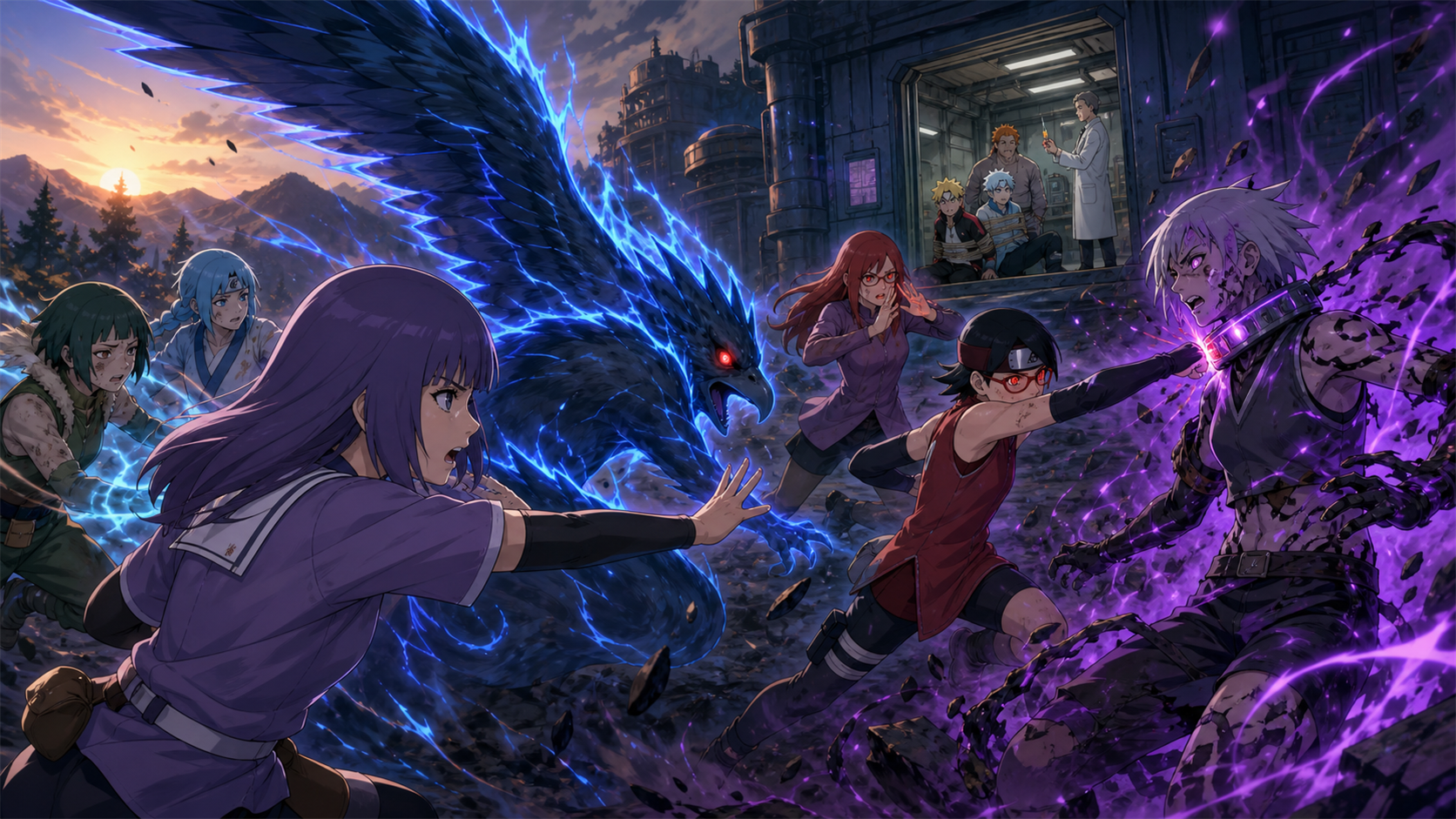
Melee!
Every rescue branch collides while Tosaka turns Jugo, infected birds, and anybody nearby into raw material for his dream weapon.
Series: Boruto: Naruto Next Generations
Episode: 102 · Melee!
Arc: Jugo Arc
Release: 2019-04-14
Previous: Episode 101 · Jugo's Reinforcements
Directory: All 293 Boruto episodes
Bottom line
Boruto Episode 102 earns the title “Melee!” by forcing every rescue branch to solve a different version of the same problem: power becomes dangerous when the person using or controlling that power stops seeing other lives. Sasami and Momo activate curse marks through scientific collars, enjoying strength without respecting the damage. Karin and Sarada beat Sasami by combining sensory precision, Sakura's old act of mercy, and one properly timed Uchiha punch. Sumire, Wasabi, and Namida defeat Momo by feeding chakra to Nue, then immediately face the harder task of stopping the summon from draining a fallen opponent. Tosaka admits that he infected the Wild Leaf Geese to lure Jugo into the open, stole the tranquilizers, and built the mission around observing the natural curse mark. He even uses Boruto's defense of personal dreams to justify creating an ultimate biological weapon. That argument is trash. A dream does not become worthy because somebody wants the result badly. Tosaka's ambition requires infected animals, endangered villagers, attacked children, murdered coworkers, and a man drugged until his body erupts. Jugo's transformation is not scientific success. His pain is the raw material Tosaka refuses to count. By dawn, Sarada realizes the migrating geese could spread infection beyond the forest, and Boruto begins freeing Jugo while the full transformation breaks his restraints. Everybody wins a smaller fight. The environmental disaster is still moving toward flight.
Tosaka stole the tranquilizer himself
Boruto and Suigetsu wake unable to move. Tosaka confirms that the drug used against them came from Jugo's supply.
The missing medicine created Episode 100's rampage and the public excuse for researchers to seize Jugo. Tosaka did not merely exploit the crisis after the fact. He removed the safeguard that prevented the crisis.
The mission was built as bait
Tosaka explains that the investigation was false from the beginning. Earlier operatives were captured near the border, so he joined the official team and used Konoha shinobi as cover.
His credentials, gross field habits, and useful bird knowledge made him look eccentric rather than hostile. Every genuine fact helped conceal the lie holding those facts together.
Jugo was the research target
The infected birds drew Jugo because he could sense and remove their artificial curse marks. Tosaka wanted close access to the natural source Orochimaru once studied.
Creating suffering among animals guaranteed that Jugo's compassion would bring him into the open. The trap depended on knowing he would choose rescue.
Boruto rejects the word subject
He condemns Tosaka for treating Jugo like research material. Boruto has spent the arc learning that dangerous biology does not erase personhood.
Tosaka hears only an obstacle to discovery. Calling someone a subject allows the scientist to describe pain as data and captivity as procedure.
Tosaka twists Boruto's argument about dreams
Earlier, Boruto insisted that people should pursue the life they choose rather than accept a path assigned by birth. Tosaka claims the same permission for his dream of building the ultimate curse-seal weapon.
The comparison fails because chosen purpose does not cancel consent or consequence. Jugo saves birds while accepting cost in his own body. Tosaka forces every cost onto other bodies.
Infection was never an accidental outbreak
He admits that he placed curse marks on the Wild Leaf Geese. The month of crop damage, injuries, fever, and fear came from a deliberate field test.
The village was not unfortunate collateral around a laboratory. The surrounding community became part of the experimental environment without knowledge or choice.
Suigetsu starts liquefying while Tosaka talks
Tosaka enjoys explaining his brilliance long enough for Suigetsu to begin changing one arm into water. Paralysis affects his movement, but the Hōzuki body offers routes an ordinary prisoner would not have.
Suigetsu turns arrogance into an opening. Scientists who reduce people to known abilities often miss the choices those abilities still allow.
Electric restraint answers the water body
Before Suigetsu can free Jugo, another researcher shocks him. Electricity disrupts the liquid form and drops him again.
The compound prepared for Orochimaru-linked reinforcements. Suigetsu's strength remains useful, but the enemy has studied enough to counter the obvious move.
Tosaka injects Jugo with an activation drug
Rather than suppressing transformation, the special dose accelerates the curse response. Tosaka wants to observe maximum power under controlled laboratory conditions.
No condition remains controlled once Jugo reaches full size and killing instinct. The scientist confuses possession of a syringe with possession of the outcome.
Sasami activates her collar against Sarada and Karin
The collar lets Sasami call up curse-mark strength deliberately. She treats transformation as an upgrade because the device creates the illusion of control.
Sarada and Karin face an opponent whose body can shift faster than their initial tactics account for. Surviving requires information, not matching raw force.
Karin uses sensory precision
Karin tracks Sasami's approach and gives Sarada the timing and direction of the next attack. Her sensory ability converts movement hidden by speed into usable warning.
The combination resembles a good team built across generations. Karin supplies data. Sarada turns that data into impact.
Sakura's old mercy returns through Karin
Karin tells Sarada that Sakura once saved her life. The statement catches Sarada emotionally because her mother's history with Sasuke's former team remains complicated.
Karin uses that reaction to persuade Sarada to bite her arm and receive healing. The act is awkward, effective, and framed as repayment rather than an attempt to reopen old rivalry.
Sarada destroys Sasami's control collar
With Karin calling the opening, Sarada lands a full strike. The blow defeats Sasami and breaks the collar enabling deliberate curse activation.
Destroying the device matters more than knocking her down. The technology turned transformation into repeatable power and gave the researchers a lever over the body.
Momo overwhelms Wasabi and Namida
At the Team 15 branch, Momo's curse-mark strength defeats both girls despite their efforts. They are still recovering from infection and imprisonment.
Their struggle is not evidence that they are weak. The enemy designed the condition affecting their bodies and arrives with a device that controls his own version.
Sumire uses water clones as misdirection
She repeatedly sends false targets into Momo's line of attack and strikes from range. The method lets her protect injured teammates without meeting curse-enhanced force directly.
Sumire's combat judgment stays focused on survival. She does not need the most dramatic hit if another move buys time to move Wasabi and Namida.
Nue needs more chakra to fight at full scale
The summon cannot overpower Momo in the smaller form. Wasabi and Namida agree to share chakra despite their exhaustion.
The decision gives them agency inside the rescue. They are not unconscious cargo waiting for stronger people to finish the fight.
Feeding Nue creates another control risk
More chakra restores the larger body that can challenge Momo. The same increase makes Nue's appetite and instincts harder for Sumire to manage.
Power solves the immediate mismatch and creates the next responsibility. Episode 102 keeps repeating that sequence until nobody can pretend strength arrives alone.
Team 15 defeats Momo together
Nue attacks with Sumire directing the opening. Wasabi and Namida's contribution fuels the power behind the finish.
The collar breaks, cutting off Momo's artificial control. The victory belongs to all three teammates and the summon bound to Sumire.
Sumire stops Nue from draining the fallen enemy
After Momo goes down, Nue begins taking chakra beyond what the fight requires. Sumire has to call the summon back.
That restraint separates her from Tosaka. Both command dangerous power. Sumire recognizes the opponent remains a person after defeat.
Other researchers decide Jugo must die
As the transformation grows, members of the research team panic. They want to kill the subject before he escapes containment.
Their fear exposes the lie behind controlled experimentation. They were willing to trigger the danger while they believed somebody else would absorb the consequences.
Tosaka kills his own people
He activates a curse mark and eliminates the researchers who threaten the experiment. Colleagues become disposable once they interfere with his desired observation.
The murder removes any remaining claim that knowledge or animal protection motivated him. Tosaka protects access to power.
Mitsuki reports to Konohamaru
After stopping the assassination attempt, Mitsuki updates the injured leader. Konohamaru decides against pulling every group back together.
Regrouping would feel safer, but time has become the central enemy. They need a way to treat the infection before migration begins.
The research boat may hold an antidote
Konohamaru sends the investigation downstream toward the researchers' vessel. A group capable of creating and controlling artificial curse marks should carry samples, devices, or serum.
The decision shifts the mission from winning compound fights to stopping regional spread.
Dawn changes Sarada's priority
While moving toward the village, Sarada notices morning approaching. Wild Leaf Geese migrate according to natural timing, regardless of human battles.
She changes course because the flock could leave before the rescue teams finish. Ecology will not pause for the heroes to resolve every personal conflict.
Boruto can finally move again
The tranquilizer begins wearing off. He crawls toward Jugo and works on the restraints while Tosaka remains focused on the transformation.
Boruto cannot undo the injected drug. Freeing Jugo at least returns movement to the person whose body everybody else has been controlling.
Suigetsu reaches with an enlarged arm
When Tosaka tries to stop Boruto, Suigetsu extends his arm and blocks the scientist. The Hōzuki technique gives Boruto another few seconds.
Tosaka responds with electricity again. Knowing a counter does not guarantee permanent control when opponents keep creating new timing.
Jugo tells Boruto to run
Even under the activation drug, he warns the child nearest to him. The words show awareness fighting through the transformation.
Jugo's instinct is not the only force inside his body. Concern survives long enough to tell Boruto what the laboratory refuses to recognize.
The restraints break
Full transformation gives Jugo enough strength to tear free. Tosaka finally gets the display he wanted, with no meaningful barrier between the weapon and everyone nearby.
Scientific obsession has converted the compound into a cage with an open door.
Every victory remains incomplete
Sasami and Momo are down. Team 15 is reunited. Konohamaru is alive. Boruto reaches Jugo. Those wins should feel decisive.
The infected flock is approaching migration, Tosaka has transformed himself, the antidote remains downstream, and Jugo is loose under a drug designed to maximize violence.
A dream becomes abuse when everybody else becomes material
Tosaka repeats Boruto's language about pursuing a dream because he wants moral cover, not understanding. Boruto means that fear should not decide a person's future. Tosaka means that another person's refusal should not interfere with his ambition.
The distinction should be obvious, but anime loves a determined genius enough that stories sometimes blur the line. Hard work does not sanctify the goal. Curiosity does not create consent. A scientist can sacrifice comfort, reputation, sleep, and personal safety for research. The scientist cannot volunteer Jugo's body for the same sacrifice.
Tosaka exposes the selfish version of inspirational language. He calls obsession conviction and expects the word dream to make every victim disappear from the sentence.
Jugo's consent matters even when his transformation threatens everyone
Jugo's curse mark creates real public danger. That danger does not give Tosaka ownership of the condition or permission to trigger a violent episode for observation. Medical risk and bodily autonomy do not cancel each other.
The episode makes the problem harder because Jugo cannot guarantee control after the injection. The heroes still speak to him as a person, contain the threat, and search for a way to reduce harm. Tosaka treats the loss of control as the desired result.
Boruto's insistence on the word person is not sentimental denial. Personhood remains the starting point precisely when a body becomes difficult, frightening, or medically unusual. Otherwise protection turns into a polite name for disposal.
Sasami's collar turns survival into forced participation
Sasami has already lived under a device capable of activating her curse mark. When the collar forces another transformation, the fight cannot be read as a clean contest between her will and Sarada's skill.
Sarada responds by targeting the mechanism rather than treating Sasami as the mechanism. Breaking the collar separates the person from the control system and gives Sasami a chance to exist outside somebody else's command.
That choice carries forward Sakura's best lesson: strength is not only the power to strike harder. Strength includes enough precision to remove the source of harm without destroying the person trapped beside the source.
Karin and Sarada work because neither woman needs to diminish the other
Karin brings sensory perception, experience with Orochimaru's world, and the ability to read a battlefield beyond visible movement. Sarada brings tactical focus, Sharingan analysis, and the nerve to act on the opening Karin identifies.
Their partnership avoids the familiar trap where an older woman appears only to praise the younger heroine or seize the decisive moment. Karin contributes knowledge Sarada does not have. Sarada uses that knowledge to make the rescue possible.
The shared victory matters on a site where female characters too often receive medical support work or emotional observation while the main fight happens elsewhere. Here, information and precision are the main fight.
Nue cannot become Sumire's weapon just because their bond is loving
Sumire trusts Nue, and Nue wants to protect her. The relationship still includes a dangerous power imbalance whenever chakra hunger takes over. Love does not make every instinct safe.
Calling Nue back from Momo proves more than winning the exchange. Sumire refuses to let victory excuse feeding past the point of necessity. She protects a defeated opponent and protects Nue from becoming the kind of creature frightened adults already expect to see.
That restraint is part of consent too. Sumire cannot ask Nue for help, ignore every limit during the fight, and then call the bond mutual only when the consequences arrive.
Team 15 wins through coordination rather than a hidden stronger girl
Wasabi, Namida, and Sumire contribute different forms of pressure. Momo expects isolated targets and receives a team that shares information, creates openings, and refuses to leave the outcome to one dramatic technique.
The fight gives Team 15 a needed identity beyond the individual gimmicks assigned to each member. Wasabi's speed, Namida's power, Sumire's planning, and Nue's presence become useful because the girls adjust around each other.
Sumire's later career choice will change that structure, which makes this victory more important. Team 15 was real before the team changed. A future separation does not retroactively reduce the work they learned to do together.
Tosaka kills his colleagues because ownership eventually consumes allies too
The researchers believe they are partners until Tosaka decides their caution obstructs his experiment. His violence reveals that the hierarchy was present all along. People count while they serve the project. The moment they resist, they become more material to remove.
That pattern links his treatment of Jugo, the infected birds, Sasami, Momo, and his own staff. Tosaka does not divide the world into friends and enemies. He divides the world into useful bodies and inconvenient bodies.
The transformation does not create that worldview. The transformation gives his worldview enough power to stop pretending.
Dawn makes the flock more important than the villain
The episode keeps offering fights that demand attention while the migration deadline moves forward without caring who wins. Tosaka can be defeated and the crisis can still spread. That fact prevents the finale from collapsing into one boss battle.
Sarada recognizes the real priority. The birds did not choose infection, and villages beyond the lake will never know whose research ambition started the outbreak. If the flock departs, strangers inherit a conflict they never entered.
The deadline turns command into triage. Sarada must decide where limited people, medicine, and time can prevent the most harm. Winning against Tosaka feels good. Reaching the flock is the mission.
The structure also exposes why loud villains can distort priorities. Tosaka demands confrontation, speeches, and immediate defense. The flock asks for none of those things. The birds simply move when migration begins. Leadership means resisting the person who wants to become the center of every decision and keeping attention on lives that cannot argue for themselves.
Sarada's urgency gives those absent villages a place in the scene. She protects people who will never know her name, which is closer to public service than any victory pose Tosaka could imagine.
The birds also expose the arrogance behind the original experiment. Researchers altered living creatures inside one controlled location and behaved as though the consequences would remain inside that boundary. Migration makes containment a fantasy. Animals cross borders, weather changes routes, and infections move beyond the names on a mission report.
That ecological scale should haunt every decision in the arc. Human beings started the crisis by treating wildlife as replaceable test material. Repair requires recognizing the flock as a community with patterns, destinations, and value beyond the danger the researchers placed inside their bodies.
Final reaction
Boruto Episode 102 refuses to treat “follow your dream” as a moral blank check. Tosaka wants knowledge and power. His dream is built from stolen autonomy, so the ambition deserves obstruction rather than applause. Jugo's choices produce risk too, but he absorbs pain to save living creatures. The difference is not the size of the dream. The difference is who pays.
The parallel fights make that argument physical. Karin and Sarada use information to break Sasami's collar. Team 15 shares chakra to beat Momo, then Sumire stops Nue before victory becomes another violation. Boruto frees Jugo while warning Tosaka that the transformation cannot be owned. By dawn, the story reminds everybody that the birds have their own schedule. Human obsession created the infection. Nature will spread the result unless the rescuers reach the flock in time.
The strongest part is how often the episode asks somebody to stop after gaining the upper hand. Sarada breaks the device instead of punishing Sasami. Sumire calls Nue back from Momo. Konohamaru sends people toward the antidote rather than toward another satisfying fight. Boruto keeps addressing Jugo as a person while Tosaka celebrates the body changing in front of him. A melee can make every problem look like a target. The better shinobi keep remembering which lives they came to protect.
Sources and lawful viewing
Official episode reference: Naruto Official episode guide
Licensed episode route: Crunchyroll licensed series page