
Ohnoki's Thoughts, Ku's Thoughts
Ohnoki says nobody can hand Boruto a personal will. Ku asks Mitsuki to surrender the secrets inside a body created by somebody else.
Series: Boruto: Naruto Next Generations
Episode: 84 · Ohnoki's Thoughts, Ku's Thoughts
Arc: Mitsuki Disappearance Arc
Release: 2018-12-02
Previous: Episode 83 · Ohnoki's Justice
Directory: All 293 Boruto episodes
Bottom line
Boruto Episode 84 traps Boruto and Ōnoki in the Sanzu Plains and gives both of them exactly the company they deserve. Boruto is furious, injured, separated from his friends, and desperate to reach Mitsuki. Ōnoki is exhausted, ashamed, and still defending the artificial army that just scattered a group of children through his village. The barrier disables ninjutsu and will only release someone who finds a heart stone, a plain pebble recognized through honest contact with personal will. Yes, the old man who created obedient substitutes is now teaching Boruto that nobody else can hand a person a will. The irony could power the entire Hidden Stone. Meanwhile, Kū invites Mitsuki to help improve the Fabrications because Orochimaru created him with more advanced methods. Kū wants the science inside Mitsuki's body. Mitsuki wants to know whether a created person can possess a will that belongs to nobody else. Their conversation makes the title work: Ōnoki talks about will as a sacred discovery, while Kū treats another created person's body as research material. Boruto cannot punch his way through the barrier, and Mitsuki cannot accept Kū's invitation without asking what “choice” means when everybody wants something from his creation.
Boruto saves the man he has every reason to hate
Boruto and Ōnoki move through the Hidden Stone at night while avoiding the Akuta. Their partnership is not friendly. Boruto has just learned that Ōnoki helped create the crisis, refused to help, and allowed Kū to turn the village against its own people. Leaving the old man behind would feel emotionally satisfying for about three seconds.
Boruto saves him anyway.
That choice is Boruto at his best. He can rage at somebody's decisions without deciding the person deserves to die. Naruto built an entire legacy from that stubborn separation between stopping harm and throwing away the human being responsible. Boruto inherited more of that instinct than he likes admitting.
Ōnoki wakes up confused by mercy
Ōnoki asks why Boruto bothered to save him. The question exposes how badly the old man's thinking has narrowed. He has divided lives into protected shinobi, acceptable artificial losses, trusted leaders, and dangerous outsiders. Boruto's rescue ignores every category.
Boruto does not save Ōnoki because the old man has earned forgiveness. He saves him because leaving an injured elder in an Akuta-controlled village would be wrong. The action does not settle their argument. The action keeps Ōnoki alive long enough to face the argument.
Mercy is not acquittal, and Boruto understands that better than many adults in this arc.
Ōnoki still calls the project peace
When Boruto presses him, Ōnoki insists that the Fabrications and Akuta were created for peace. He wanted artificial forces to handle dangerous work so young Stone shinobi would not repeat Kozuchi's fate. He also complains that the current generation has become weak and unreliable.
Those two ideas fight each other. Ōnoki says he wants to protect young people, then resents those same young people for growing up without the brutality that shaped him. Peace succeeded enough to produce children who do not live like wartime soldiers. The old man sees that success and calls the children soft.
You cannot build peace for children and punish them for looking peaceful.
Boruto refuses the lecture and walks away
Boruto has no patience left for Ōnoki's defense. Mitsuki is somewhere inside Kū's operation, Sarada and the others are scattered, and the former Tsuchikage keeps turning grief into a history lesson. Boruto decides to continue alone.
That impulse is emotionally honest and tactically terrible. Boruto does not know the village, the Akuta routes, or the trap surrounding them. His urgency keeps pushing him forward, but speed without information has already made this chase more dangerous several times.
Ōnoki responds with the worst possible news: they are inside the Sanzu Plains.
The Sanzu Plains turn the episode into a stone joke
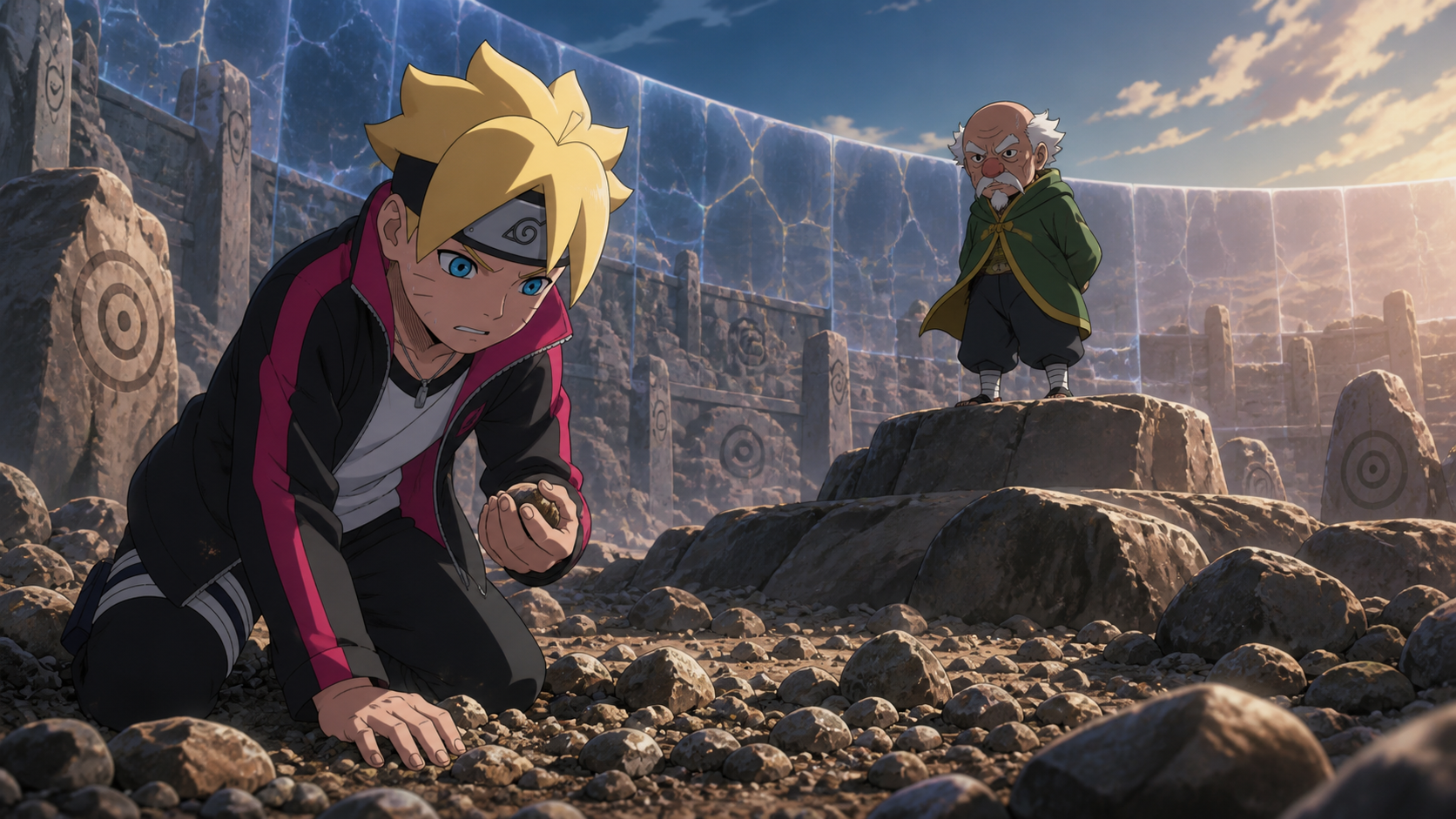
The Sanzu Plains are an old Hidden Stone training ground sealed by a barrier. Leaving requires finding a heart stone. The name sounds mystical. The object is an ordinary pebble. A shinobi recognizes the right stone only after confronting personal will.
Boruto looks around at an entire basin full of rocks, and I felt his irritation in my bones. The Hidden Stone apparently designed a graduation exercise around finding one emotionally significant rock among ten thousand completely normal rocks. No wonder Ōnoki is so patient about other people's suffering. His village turned spiritual discovery into geology homework.
The joke works because the lesson is serious. A heart stone cannot be identified through appearance alone.
The barrier takes Boruto's favorite shortcut
Boruto immediately tries to use shadow clones to search faster. The barrier suppresses ninjutsu, leaving him with his eyes, hands, judgment, and rapidly disappearing patience. The setup removes the technique he usually uses to multiply effort and control space.
The limitation matters beyond the puzzle. Boruto has spent this arc trying to force a clear answer from Mitsuki: friend or traitor, choice or manipulation, return or rejection. A thousand clones cannot search another person's will. Boruto has to slow down long enough to accept that some answers do not become easier when he attacks the problem harder.
He hates every second, which makes the lesson feel earned rather than decorative.
Ōnoki knows nobody is coming
Ōnoki explains that the training ground is no longer used, so rescue is unlikely. The detail turns a quirky exercise into a real threat. Boruto and Ōnoki have no food plan, no working jutsu, no easy exit, and no reason to believe their scattered allies know where they landed.
Ōnoki's age makes the danger worse. Boruto can search through the night, climb, dig, and keep moving. The old man's body is already failing under ordinary travel. Their survival now depends on Boruto understanding a Stone tradition while keeping alive the person he blames for the crisis.
That is one vicious little character assignment.
A heart stone cannot be selected by somebody else
Ōnoki cannot point to the correct pebble. Boruto has to recognize his own heart stone through his own will. The rule contains the lesson Ōnoki failed to apply when he created Kū.
The Fabrications were given a purpose before they could discover one. Protect the village. Replace young shinobi. Obey the plan. Ōnoki treated those commands as enough because he saw the created beings as an extension of his will.
Now he tells Boruto that authentic will cannot be assigned from outside. The old man is correct. He is also standing inside the evidence against himself.
Kū wants more Akuta in the streets
Kokuyō and Kakō report that they have not found Ōnoki. Kū responds by ordering more Akuta into the search. He trusts Kirara to keep villagers from noticing the growing operation.
The decision shows how far the project has moved from its stated purpose. An army created to protect Iwagakure now moves secretly through Iwagakure while its commander hides the deployment from residents. Kū is not supporting the village's shinobi. He is replacing their knowledge, movement, and authority.
The more Kū says “peace,” the more his version of peace looks like nobody being allowed to object.
Kakō says the quiet part out loud
Kakō suggests eliminating witnesses. Kū rejects the idea because killing villagers would violate Ōnoki's plan. That refusal matters. Kū still recognizes a boundary, and the Fabrications are not identical in how they approach violence.
The scene also reveals how unstable the boundary has become. A member of the inner group can propose killing civilians as a practical solution. Kū's answer depends on loyalty to Ōnoki's original vision, not a broader respect for each person's life.
Rules built around one leader's intention can change whenever the leader decides the intention has changed.
Mitsuki enters Kū's real conversation
Mitsuki finally meets Kū directly. Kū invited him because Orochimaru used related but more advanced creation techniques. Mitsuki's body may contain information that could stabilize or improve the Fabrications.
That interest is both understandable and invasive. Kū and the others are deteriorating. They want to survive. Mitsuki knows what being examined as a rare creation feels like, and he may genuinely want to understand people whose lives resemble his own.
The problem is that Kū does not begin with friendship. He begins with access to Mitsuki's design.
The juinjutsu on Mitsuki's heart matters
Mitsuki points out the juinjutsu protecting his heart. Orochimaru placed a barrier around the information inside his body, which makes any attempt to analyze him more dangerous and difficult. Kū dismisses the obstacle as old technology they can eventually bypass.
That answer should set off every alarm. Kū is already imagining a future where Mitsuki's creator no longer controls access, but Kū does not pause to ask whether Mitsuki wants anybody digging through the seal.
Escaping Orochimaru's control would not make Kū entitled to take Orochimaru's place.
Mitsuki asks about the will of created people
Mitsuki does not ask only how the Fabrications were built. He asks whether synthetic people have their own will. That question has followed him since Orochimaru sent him toward Boruto as his “sun.” Mitsuki wants to know whether his choices are real or simply a more sophisticated version of instructions.
Kū tells him to ask his creator.
The answer is almost comically wrong. If Orochimaru gets final authority over whether Mitsuki's will is genuine, then the will remains dependent on Orochimaru's approval. A creator can explain design and intention. A creator cannot climb inside every later choice and certify which desire counts as authentic.
Mitsuki has to answer through living, not through receiving a verdict.
Kū and Ōnoki share the same blind spot
Ōnoki teaches Boruto that a heart stone comes from personal will. Kū tells Mitsuki to ask Orochimaru about personal will. Both men understand creation as a relationship that leaves the creator unusually powerful.
That power makes sense when a child or created being needs care. The mistake comes when guidance becomes ownership. Ōnoki chose the Fabrications' purpose. Kū wants Mitsuki's construction knowledge. Orochimaru arranged the sun Mitsuki would follow. Every adult claims to be helping a created child become complete.
Mitsuki keeps having to find himself underneath their helpful plans.
The Fabrications are breaking down in different ways
Kakō and Kirara begin showing signs of physical deterioration. Their bodies are not stable enough to support the future Kū promises. The crisis explains his urgency without excusing his methods.
This detail also changes how we read the group's behavior. Sekiei's curiosity, Kokuyō's obsession with strength, Kirara's control, Kakō's appetite for battle, and Kū's expansion plan all happen under a clock. They were created with desires and then given bodies that may fail before those desires can become lives.
Ōnoki wanted soldiers who could be lost instead of young shinobi. The bodies were built around that expectation.
Boruto's search mirrors Mitsuki's question
Boruto searches for one stone that will confirm his will. Mitsuki searches for proof that his will belongs to him. Both boys want an answer they can hold.
The episode refuses to provide one quickly. Boruto cannot recognize the stone because he entered the Sanzu Plains by accident and has not settled the conflict driving him. Mitsuki cannot ask Kū or Orochimaru to settle the meaning of every choice.
The parallel is the strongest part of Episode 84. One boy is surrounded by rocks. The other is surrounded by creators. Both environments are full of objects and people that look like answers.
Another night forces the argument to wait
Boruto and Ōnoki prepare for another night inside the barrier. The quiet ending leaves the larger chase suspended. Sarada, Shikadai, Chōchō, and Akatsuchi remain separated. Mitsuki remains inside Kū's base. Kū is deploying more Akuta while his own body and his companions' bodies move closer to failure.
Boruto has no choice but to stay with Ōnoki and listen. Ōnoki has no choice but to watch a child struggle with the lesson he once believed. Their confinement gives the old man time to hear how his philosophy sounds after his project violated the philosophy.
Sometimes Naruto redemption begins with a speech. This one begins with two stubborn people stuck in a rock bowl overnight.
Saving Ōnoki separates Boruto's ethics from Boruto's anger
Boruto has every reason to resent the man whose secret project pulled Mitsuki away, endangered his friends, and turned Iwagakure into a controlled space. He saves Ōnoki anyway because leaving an injured elder to die would make anger the author of his behavior.
Mercy does not settle the argument. Boruto can protect Ōnoki's life and continue opposing the project.
The rescue matters because Boruto refuses the logic he is criticizing. A person's usefulness or agreement does not decide whether the person deserves immediate care.
Ōnoki mistakes survival for endorsement
Waking after Boruto's rescue gives Ōnoki evidence that the child has principles. The rescue does not mean Boruto accepts the old man's explanation of peace.
Ōnoki keeps trying to convert proximity into agreement because he believes enough context will make the project look necessary. Boruto walks away from the lecture because understanding motive has already failed to change the consequences.
Being heard is not the same as being validated. Ōnoki still has to face a no delivered after the listener understands him.
The Sanzu Plains joke hides an environment built for forced reflection
The barrier strips Boruto of easy exits, shadow-clone shortcuts, and the ability to chase Mitsuki immediately. The stone landscape turns movement into repetition until attention shifts inward.
Naruto loves turning philosophy into geography. Here, a rock bowl forces two stubborn people to share time neither would choose.
The joke works because Boruto wants an action scene and receives compulsory patience. Ōnoki wants a receptive student and receives an angry critic who cannot simply leave.
Losing shadow clones removes Boruto's favorite form of emotional avoidance
Boruto often responds to uncertainty by multiplying effort. More bodies mean more directions, more attempts, and less time spent admitting he does not know the answer.
The barrier rejects that strategy. He cannot search every route or overwhelm the problem through motion.
Waiting forces Boruto to confront the possibility that finding Mitsuki will not restore the friend he expected. Mitsuki may return with choices Boruto has to understand before he can accept them.
A heart stone can be guided toward and never assigned
Ōnoki tells Boruto that nobody else can choose the stone. The lesson respects personal discovery better than the Fabrication project respects any created life.
Guidance can provide stories, questions, and opportunities. Guidance cannot predetermine which purpose will feel true.
Ōnoki understands that rule for naturally born children and violates the rule when he creates defenders with purpose installed before experience.
Kū expands Akuta deployment because control looks efficient before collapse
More Akuta in the streets give Kū visibility, force, and the appearance of order. The expansion also increases the number of created bodies treated as replaceable infrastructure.
Occupation becomes easier to administer when nobody in the occupying force may question commands. The efficiency is exactly the moral warning.
A system without dissent can move quickly toward a goal nobody is allowed to challenge.
Kakō says what the project requires everyone else to avoid saying
Kakō recognizes the pleasure, danger, and expendability built into the Fabrications. His bluntness punctures the official language of protection.
The project needs created beings to fight, fail, and be replaced without the village treating each loss like a young shinobi's death. Calling them people would make the arrangement unbearable.
Kakō's developing excitement reveals a person precisely where the project requires a tool.
Mitsuki enters Kū's conversation as a person and gets treated as evidence
Kū sees Mitsuki as proof that created life can become stable. The body, techniques, and relationship to Orochimaru become data for repairing the Fabrications.
Mitsuki asks about will because anatomy cannot answer why one created being obeys, another rebels, and another forms unexpected friendships.
Kū wants the successful design. Mitsuki keeps redirecting the discussion toward the life that happened after design.
The juinjutsu on Mitsuki's heart exposes how creators preserve control
Orochimaru allowed Mitsuki to search for independence while retaining a mechanism connected to the most vulnerable part of his body. Freedom arrives with a hidden boundary enforced by the creator.
That contradiction mirrors Ōnoki's project. Both creators praise will until created life approaches information or choices the creator wants protected.
Mitsuki's autonomy becomes real through pushing against those limits, not through pretending the limits were acts of care.
Asking Orochimaru would only replace one creator's answer with another
Kū suggests returning the question of will to the scientist who made Mitsuki. The suggestion assumes creation includes interpretive ownership.
Orochimaru can explain biology, intention, and experimental history. Orochimaru cannot issue the final verdict on Mitsuki's inner life.
Mitsuki crossed the Land of Earth because he needs experience beyond both Boruto's certainty and Orochimaru's design.
Ōnoki and Kū both believe care gives them authority over another future
Ōnoki created the project to protect young shinobi. Kū expands the project to preserve created lives and the system that gives them purpose.
Both men begin with a life they claim to value and decide that value permits control over other lives. The difference in origin does not change the shared structure.
Care becomes domination when the cared-for person cannot refuse the future chosen on that person's behalf.
The cracking Fabrications make philosophical delay physically expensive
Kū, Sekiei, Kakō, and the others are not debating will inside stable bodies. Their deterioration creates urgency, fear, and pressure to use human organs.
Ōnoki treated instability as a technical problem nearing completion. The failing bodies experience instability as shortened lives.
Every delayed ethical answer leaves created people closer to death and potential donors closer to becoming supplies.
Quick reaction
Episode 84 is mostly conversation and setup, but the parallel saves the slower pace. Ōnoki telling Boruto that nobody can hand him a heart stone is wild when Kū exists because Ōnoki handed an artificial person a purpose and called that purpose enough. Kū telling Mitsuki to ask Orochimaru whether created people possess will is even worse. Mitsuki did not travel across the Land of Earth to replace one creator's answer with another creator's answer. My favorite choice is the barrier shutting down shadow clones. Boruto cannot multiply himself out of this problem. He has to sit with Ōnoki, sit with his anger, and accept that Mitsuki's will may contain an answer he does not like. That is a much harder search than finding a pebble.
Sources and lawful viewing
Official episode reference: Naruto Official episode guide
Licensed episode route: Crunchyroll licensed series page