
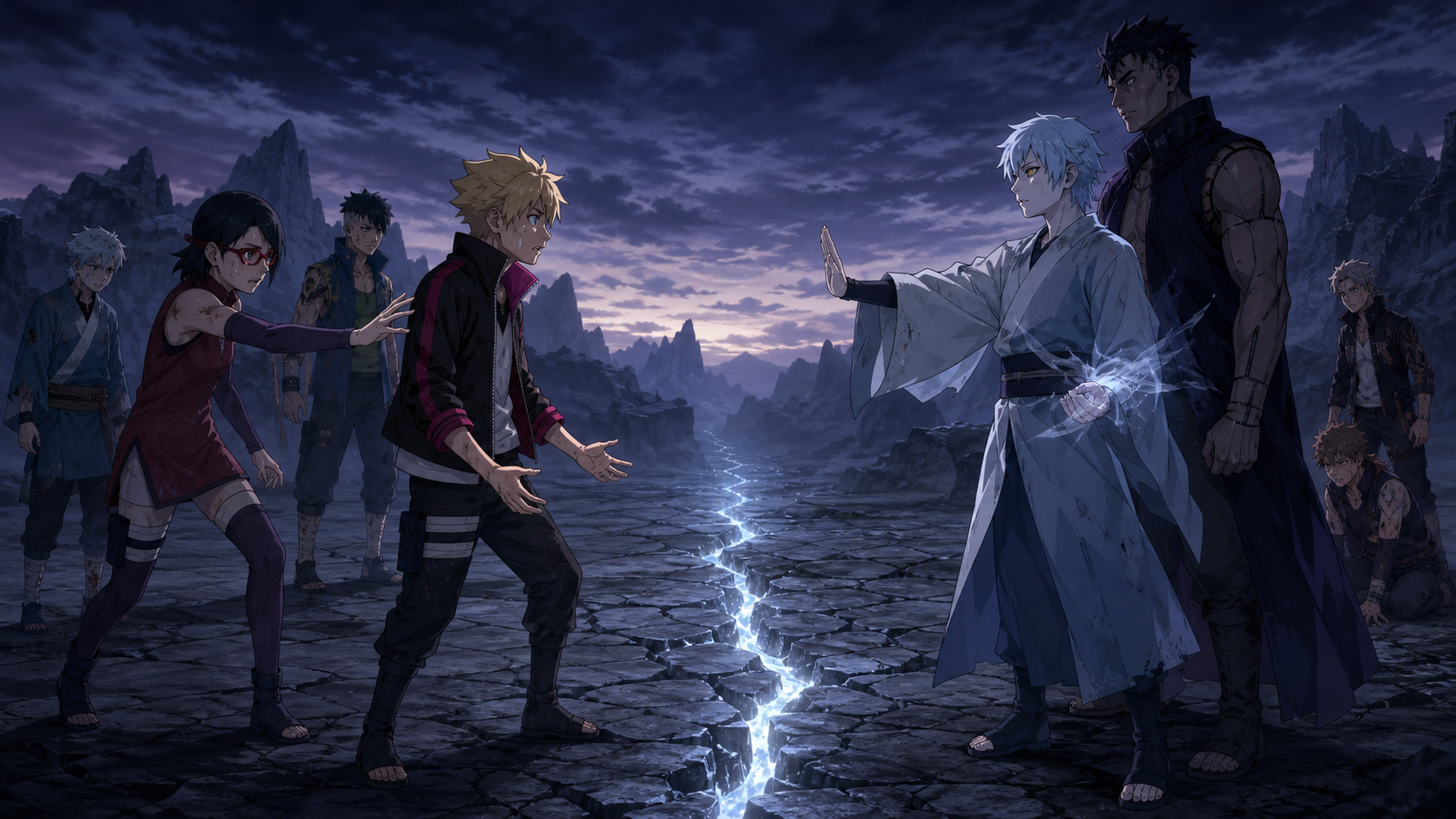
Reunion with Mitsuki
Boruto finally catches Mitsuki after Kokuyō overwhelms the Konoha genin, only to learn that finding a friend and bringing him home are two different promises.
Series: Boruto: Naruto Next Generations
Episode: 79 · Reunion with Mitsuki
Arc: Mitsuki Disappearance Arc
Release: 2018-10-28
Previous: Episode 78 · Everyone’s Motives
Directory: All 293 Boruto episodes
Bottom line
Boruto Episode 79 finally puts Boruto in front of Mitsuki, then makes the reunion hurt worse than the search. Boruto has crossed borders, ignored orders, fought a giant snake, and dragged half of his friend group through the Land of Earth because he believes one conversation will bring Team 7 home. Mitsuki answers that faith with a lightning strike. Whew. “Reunion with Mitsuki” knows exactly where to place the knife.
The episode works because the attack does not erase everything that came before. Mitsuki does not become a cartoon traitor in one scene, and Boruto does not become foolish for loving his friend. Their bond remains real. Their ideas about that bond are no longer the same. Boruto has treated friendship as proof that Mitsuki must want what Boruto wants. Mitsuki has been making choices in silence, and his silence has left everyone else bleeding around the question. Neither boy gets a clean emotional exit.
Before that reunion, Kokuyō gives the Konoha genin a brutal reminder that determination is not a power level. Shikadai recognizes the danger first. Boruto keeps pushing. Chōchō and Inojin return with backup, Garaga arrives on his own dramatic schedule, and the group earns a path forward through teamwork rather than a sudden miracle. Then Mitsuki appears and turns their hard-won relief into heartbreak. The title promised a reunion. Nobody promised a homecoming.
Episode file
- Series: Boruto: Naruto Next Generations
- Episode: 79
- Title: “Reunion with Mitsuki”
- Arc: Mitsuki’s Disappearance Arc
- Japanese airdate: October 28, 2018
- Previous episode: “Everyone’s Motives”
- Next episode: “Mitsuki’s Friend”
This episode sits at the exact point where the arc stops asking whether Boruto can find Mitsuki and starts asking whether finding him will change anything. The search plot reaches its destination, but the friendship plot gets messier. That is the right choice. A softer reunion would have made every warning from Shikadai, Sarada, Orochimaru, and the White Snake Sage feel like decorative suspense.
Kokuyō is not here to entertain the genin
Kokuyō has already flattened the shinobi who tried to stop him. Boruto, Sarada, and Shikadai walk into the aftermath and immediately understand that this opponent is operating above the level of the fights they have survived so far. Kokuyō’s strength is not flashy in the way Garaga’s size is flashy. He moves like somebody who has no reason to fear children, and that calm makes every hit land harder.
Boruto still attacks because Boruto has never met a warning sign he could not turn into a runway. Sarada backs him because leaving Mitsuki behind is no longer emotionally possible for her either. Shikadai watches the field and reaches the sensible conclusion: they cannot win this straight. His frustration has weight because he is not scared of helping his friends. He is scared of watching them confuse loyalty with a suicide pact.
The best part of the Kokuyō fight is the power gap. Teamwork creates openings, but nobody suddenly becomes strong enough to dominate him. Their techniques matter. Their timing matters. Their courage matters. None of those things magically cancel the fact that Kokuyō is stronger. Naruto and Boruto sometimes let a determined speech become a free refill of combat power. Episode 79 does not hand out that coupon.
Shikadai remains the friend who counts the cost
Shikadai has spent this arc saying what everybody else does not want to hear. The group left the village without permission. Their parents and teachers have no reliable way to protect them. Mitsuki may have made a choice they dislike. Every new enemy provides more evidence that the mission has outgrown a genin rescue attempt. Shikadai sees all of that, and he stays anyway.
That last part matters. His caution is not cowardice or a lack of love. Shikadai loves these reckless little disasters enough to keep calculating when they stop calculating for themselves. He looks for retreat routes. He studies Kokuyō’s rhythm. He tries to turn bad odds into survivable odds. Boruto supplies motion, Sarada supplies focus, and Shikadai supplies the part of friendship that asks whether everyone will still be alive after the big gesture.
His leadership also has a quiet ache. Shikadai did not volunteer to become the adult in every room. The adults are simply far away, and somebody has to recognize when a fight is going wrong. Watching him carry that responsibility makes the episode feel more dangerous than another exchange of jutsu ever could.
Chōchō and Inojin come back because of course they do
Chōchō and Inojin could have stayed clear after their separation from the others. Nobody would call their earlier contribution small. Instead, they return when the team needs help, bringing the kind of backup that feels earned by the relationships this series has built. Chōchō may complain, snack, and serve side-eye with perfect timing, but she does not abandon her people. Inojin may question Boruto’s plan, but he does not watch Shikadai face Kokuyō alone.
Their return gives the fight its emotional center. Boruto’s mission began as a Team 7 crisis. By Episode 79, that crisis belongs to a wider circle of friends who have chosen one another repeatedly. They do not all agree with Boruto. They do not all trust Mitsuki. They do not need matching opinions to protect each other.
Chōchō also refuses to become background decoration once the serious boys start making speeches. Her presence keeps the group human. Hunger, irritation, fear, and loyalty can share the same scene. Real friends do not suddenly become solemn monks because the soundtrack changed.
Garaga delivers help with a side of attitude
Garaga’s involvement could have felt like a convenient rescue, but the episode wisely preserves his personality. He does not arrive as Boruto’s obedient summon. Their contract does not transform him into a cheerful transportation service or a giant snake-shaped solution button. Garaga helps according to his own judgment, and his reluctance keeps the relationship honest.
Boruto won the right to call on Garaga by surviving their confrontation and recognizing the wound beneath the snake’s anger. That history pays off here. Garaga understands betrayal. Boruto is racing toward a friend who may betray him. Neither one has forgotten the parallel, even when nobody pauses to explain the theme in capital letters.
The assist gives the Konoha group a chance to move past Kokuyō without pretending they defeated him cleanly. That distinction protects the danger. Kokuyō remains a problem. The genin simply create the opening they need. Sometimes the win is not putting an enemy on the ground. Sometimes the win is getting one stubborn blond boy to the conversation he has been demanding for several episodes.
Boruto has written the reunion before Mitsuki arrives
Boruto reaches Mitsuki carrying a complete ending in his head. He will confront his teammate. Mitsuki will explain the misunderstanding. Team 7 will go home, probably after Boruto says something loud and emotionally honest. The village will deal with the paperwork later. Boruto believes in this ending so fiercely that he has barely made room for Mitsuki to speak.
That belief is loving and selfish at the same time. Boruto has noticed details other people missed. He knows Mitsuki protected the Leaf shinobi instead of killing them. He knows the snake message meant something. He refuses to reduce his friend to the word “traitor.” Those instincts are good. The problem arrives when Boruto treats his accurate knowledge of Mitsuki’s heart as ownership of Mitsuki’s next choice.
Boruto wants the old Team 7 back because that team made him feel secure. He wants proof that his friendship mattered. He wants every risk from this journey to receive a clean emotional reward. Mitsuki is a person, not the receipt for Boruto’s devotion. The episode lets that lesson hurt instead of wrapping the point in a tidy speech.
Mitsuki’s face says less than Boruto needs
When Mitsuki finally appears, his stillness changes the temperature of the scene. Boruto has been all motion for days. Mitsuki looks controlled, distant, and almost painfully quiet. Boruto fills that quiet with hope because silence has always been where he places the version of Mitsuki he understands.
Mitsuki does not give him much. That restraint makes the scene stronger. A long villain monologue would feel false for a character who has spent his life watching, learning, and hiding how much he knows. Mitsuki has been raised around Orochimaru, experiments, staged choices, and adults who call manipulation a test. Direct explanation has never been his first language.
Still, the episode does not let mystery excuse everything. Mitsuki can have reasons. Mitsuki can be under surveillance. Mitsuki can be trying to protect Boruto through distance. The lightning strike still hurts Boruto. The friends who followed still carry the consequences. Understanding why somebody caused harm and pretending no harm happened are two different things.
That lightning strike lands before the jutsu does
Mitsuki attacking Boruto is the image the whole episode has been building toward. Boruto expects recognition to restore their bond. Mitsuki recognizes him perfectly and attacks anyway. That choice is more painful than amnesia, possession, or a cheap disguise reveal would have been because Mitsuki’s eyes are open.
The blow shatters Boruto’s easiest story. He can no longer claim that reaching Mitsuki will automatically solve the problem. He cannot point to the journey as proof that Mitsuki owes him a return. Boruto has to sit with a possibility he hates: his friend may care about him and still choose another road.
Fans know enough about Mitsuki to question the surface. His loyalties are complicated, and his behavior around the Fabrications carries layers the episode has not fully explained. Questioning the surface is fair. Erasing the scene because a future explanation might soften the motive is not. Boruto feels betrayed in this moment. Sarada watches a teammate strike another teammate. Shikadai sees his worst warnings become real. The emotional truth belongs to all of them.
Sarada is watching Team 7 split in front of her
Sarada’s position deserves more attention than the episode gives her. Boruto gets the direct confrontation, and Mitsuki gets the mystery, while Sarada stands close enough to lose both of them. She joined the chase because she believed Mitsuki deserved to be heard. She also understood earlier than Boruto that friendship could not replace facts.
Now she has to process a scene that confirms and complicates every fear. Mitsuki attacks Boruto, but his larger purpose remains unclear. Boruto is hurt, but his decision to chase Mitsuki brought everyone into this danger. Sarada cannot simply choose one boy and stop caring about the other. Team 7 is her team too.
Her restraint reads as shock, but the arc needs to keep giving her more than reaction shots. Sarada is a future Hokage candidate with a sharp eye for contradictions. She should be central to separating what Mitsuki performs from what Mitsuki believes. Boruto sees the friend he wants back. Sarada may be better positioned to see the teammate standing in front of them.
The episode is really about friendship without possession
Boruto’s love for Mitsuki is never the problem. The problem is his certainty that love gives him the correct answer for Mitsuki. He believes returning to Konoha is obviously best. Given the danger around the Fabrications, he may even be right about the safest destination. Being right about danger does not mean he understands the choice Mitsuki is trying to make.
Mitsuki has spent his whole life orbiting somebody else’s definition of him. Orochimaru created him, tested him, erased memories, and arranged a path toward Boruto. Boruto became his sun, a beautiful image that also places Mitsuki in permanent orbit. The disappearance arc asks whether Mitsuki can make a decision that does not begin with his parent or his friend.
That question does not require fans to applaud every decision. Autonomy includes the freedom to make a mess. Friendship includes the freedom to say, “I love you, and this choice is hurting people.” Episode 79 becomes interesting precisely because no single slogan can clean up the conflict.
What changed for me on replay
The first watch belongs to the shock. Mitsuki attacks Boruto, and every earlier scene becomes a clue hunt. Was Mitsuki acting? Did he know Kokuyō and Sekiei were watching? Was the strike meant to stop Boruto from following? How much has Mitsuki learned about the Fabrications? Those questions still matter on replay, but the quieter change happens in Boruto.
He rarely asks Mitsuki a question without attaching the answer he wants. Boruto talks about trust, yet his version of trust assumes Mitsuki will confirm Boruto’s reading. Once that pattern becomes visible, the reunion feels less like a sudden betrayal and more like a collision the arc has prepared carefully.
Garaga also reads differently on replay. The snake warned Boruto that betrayal can survive inside a person long after the original wound. Boruto listened with sympathy, then marched toward Mitsuki believing his own bond was protected from the same pain. The story does not punish him for caring. The story makes him learn that caring does not create immunity.
What works
The episode earns its cliffhanger. We have spent enough time on the road for the reunion to matter, and Mitsuki’s attack changes the central question instead of merely delaying an answer. Kokuyō remains threatening because the heroes escape his control rather than suddenly overpowering him. Shikadai’s tactical intelligence matters. Chōchō and Inojin return as friends with agency, not spare bodies added to a fight.
The emotional logic also holds. Boruto behaves exactly like Boruto: loud, loyal, intuitive, and too certain that his heart can solve a problem his head has not fully examined. Mitsuki behaves exactly like Mitsuki: controlled, unreadable, and willing to carry a choice alone until everyone around him is forced to react. Their personalities create the wound.
Most importantly, “Reunion with Mitsuki” refuses to treat physical proximity as reconciliation. Finding your friend does not mean you understand your friend. That lesson belongs in Naruto’s larger world, where rescue missions and rival bonds often blur into promises that one person will decide when another person is allowed to leave.
What does not work
Sarada needs more room. She has risked as much as Boruto, knows Mitsuki as a teammate, and carries her own vision of leadership. The episode positions her near the emotional center without letting her shape enough of the conversation. A few more lines from Sarada could have challenged Boruto’s certainty and Mitsuki’s silence without weakening either boy’s moment.
The fight against Kokuyō also stretches the familiar shonen problem where characters absorb punishment until the plot has finished arranging backup. The power gap is effective, but some impacts feel more like timing devices than injuries with consequences. Shikadai’s concern sells the danger better than the damage animation does.
Mitsuki’s refusal is supposed to remain mysterious, though the scene walks close to withholding so much that mystery becomes fog. One carefully chosen sentence from him could have deepened the conflict without revealing his plan. Silence fits Mitsuki. Total silence can also make everybody else perform the emotional labor for his storyline.
Reaching Mitsuki is a group achievement, not Boruto's private quest
Boruto supplies urgency, but Shikadai calculates risk, Sarada preserves focus, Chōchō and Inojin return despite every sensible reason to stop, and Garaga gives the team mobility they could not create alone.
The reunion only happens because several people treat Mitsuki as part of a community. Boruto's bond matters without becoming the sole relationship allowed to define rescue.
That shared effort should shape whatever accountability follows. Everyone who carried the pursuit deserves information about the danger they accepted.
Kokuyō's power makes retreat a rational option
Kokuyō does not perform for the genin or gradually reveal strength at a convenient pace. He treats them as obstacles and demonstrates a gap large enough to make continued pursuit look reckless.
Shikadai names that cost because friendship cannot make broken bodies irrelevant. Courage includes knowing when a mission has exceeded available capacity.
The others choose to continue, but the choice gains meaning only because retreat was reasonable rather than shameful.
Mitsuki's silence protects a plan and wounds every person outside the plan
Mitsuki may have strategic reasons to reveal almost nothing in front of the Fabrications. The silence preserves his position and prevents Boruto from interfering with an objective Boruto cannot yet understand.
The same silence makes his friends experience rejection without context. Intent may later explain the choice. Intent cannot erase the impact.
Mitsuki's autonomy deserves protection. His relationships deserve enough truth to make repair possible after the secret work ends.
Sarada watches two teammates turn certainty into collision
Boruto is certain that finding Mitsuki will restore the team. Mitsuki is certain that his chosen path requires pushing Boruto away. Sarada stands between those decisions with fewer illusions about either boy.
She has questioned the evidence without abandoning Mitsuki and supported Boruto without accepting every conclusion. That position is leadership, not emotional indecision.
The episode needed more of her voice because Team 7's fracture affects her future as directly as theirs.
The lightning strike is communication performed through harm
Mitsuki uses force where explanation would endanger the plan or expose feelings he cannot yet organize. Boruto receives a clear answer from the body and almost none from the person.
That asymmetry gives the scene power. The attack proves Mitsuki will defend the choice, but the attack does not tell Boruto why the choice matters.
Physical certainty replaces emotional information, leaving the injured friend to invent meaning around the wound.
Friendship without possession requires Boruto to survive an unwanted answer
Boruto has defended Mitsuki's will throughout the pursuit while assuming that genuine will would ultimately choose Team 7. The reunion exposes the condition hidden inside that defense.
Respect becomes real when another person's choice hurts, confuses, or contradicts the future Boruto imagined.
He can challenge Mitsuki, ask for honesty, and refuse harmful conduct. He cannot make friendship genuine by deciding the answer in advance.
Final take
“Reunion with Mitsuki” gives Boruto exactly what he demanded and proves that he asked for too little. He wanted to find Mitsuki. He found him. What Boruto actually needs is an honest relationship with a friend whose choices he cannot control, and that journey is far harder than crossing a national border.
Kokuyō supplies the physical wall. Shikadai, Chōchō, Inojin, Sarada, and Garaga help Boruto get through. Mitsuki supplies the emotional wall, and no Rasengan can solve that one. The lightning strike hurts because the friendship matters, not because the friendship was fake.
My verdict: a strong, frustrating, necessary episode. The action keeps the Fabrications dangerous, the returning friends make the rescue feel communal, and the ending finally breaks Boruto’s fantasy of a simple homecoming. I wanted more Sarada and one sharper line from Mitsuki, but the cliffhanger lands. Boruto reached his moon. Now he has to learn that Mitsuki was never a thing waiting to be carried home.
Sources and lawful viewing
Official episode reference: Naruto Official episode guide
Licensed episode route: Crunchyroll licensed series page