
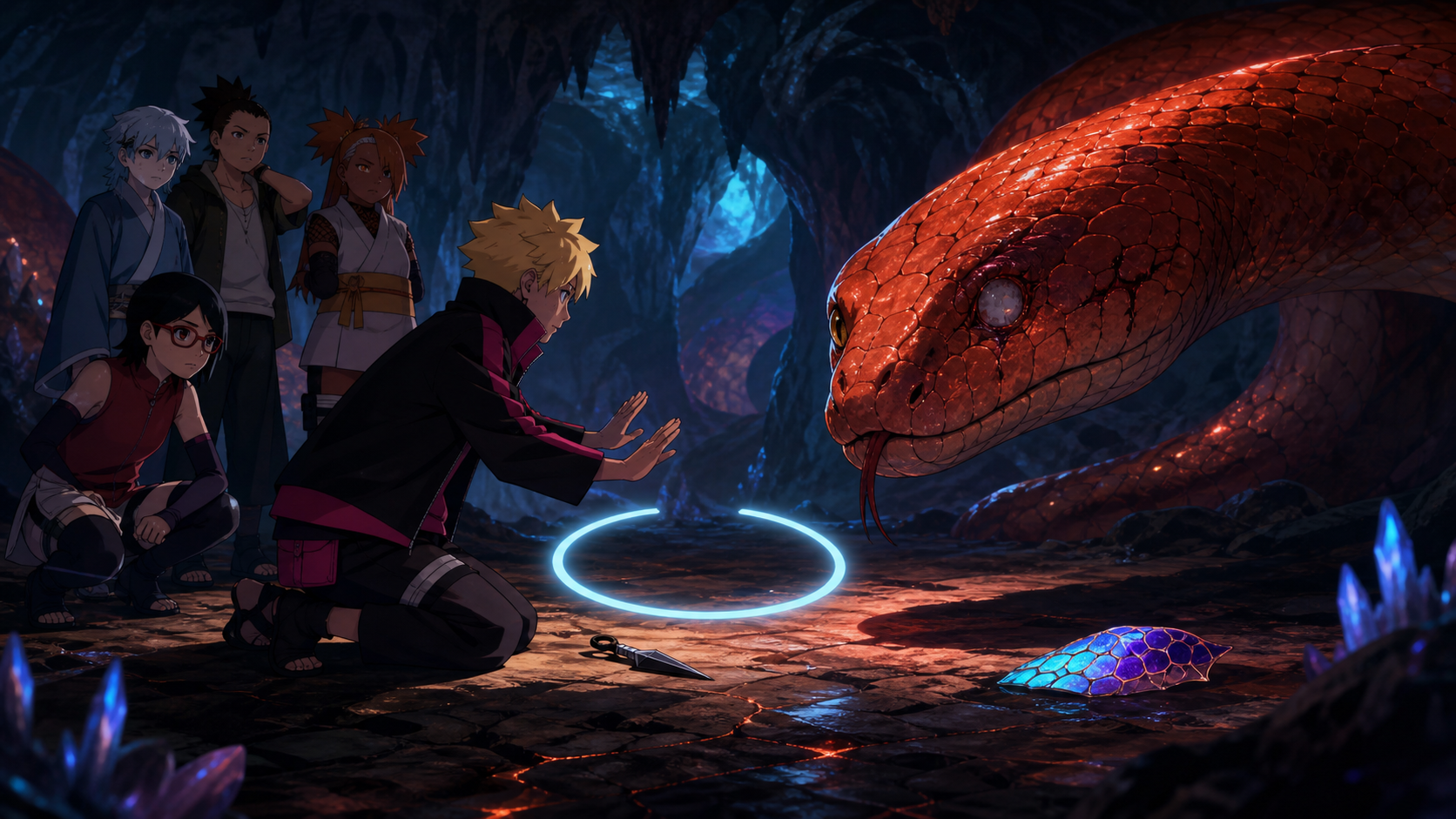
A Fierce Enemy: Garaga’s Ferocious Attack!
Boruto learns why Garaga expects every bond to end in betrayal, then offers a temporary summoning contract instead of tearing away the giant snake’s reverse scale.
Series: Boruto: Naruto Next Generations
Episode: 77 · A Fierce Enemy: Garaga’s Ferocious Attack!
Arc: Mitsuki Disappearance Arc
Release: 2018-10-14
Previous: Episode 76 · Incurring Wrath
Directory: All 293 Boruto episodes
Bottom line
Boruto Episode 77 sends five genin after one furious giant snake, and somehow the loudest creature in Ryūchi Cave is still Boruto. Garaga has already petrified Chōchō, injured Aoda, and claimed the home-field advantage. Boruto is supposed to take his reverse scale for the White Snake Sage. Instead, he discovers the betrayal behind Garaga’s scar and offers a temporary summoning contract. That bargain is peak Boruto: reckless, emotionally intelligent, slightly ridiculous, and just persuasive enough to work.
The episode also delivers the answer the group came to Ryūchi Cave to find. Mitsuki used his snake to stop the gatekeepers’ hearts without killing them. He protected them while making the attack look fatal, then followed the strangers toward the Land of Earth because they promised answers about his will. Boruto gets proof that his faith was not foolish. Shikadai immediately reminds him that Mitsuki still chose to leave with the enemy. Thank goodness somebody in this friend group keeps receipts.
Garaga’s story makes the episode more than a monster fight. He once trusted a shinobi who attacked him and destroyed his eye during battle. Now Garaga believes betrayal is the inevitable ending of every bond. Boruto is terrified Mitsuki will prove the same point. Their temporary contract does not solve trust. The contract gives both of them time to watch what happens next.
Episode file
- Series: Boruto: Naruto Next Generations
- Episode: 77
- Title: “A Fierce Enemy: Garaga’s Ferocious Attack!”
- Arc: Mitsuki’s Disappearance Arc
- Japanese airdate: October 14, 2018
- Previous episode: “Incurring Wrath”
- Next episode: “Everyone’s Motives”
This episode finishes the Ryūchi Cave trial and exposes the first clean piece of Mitsuki’s thinking. The group enters wanting a scale. They leave with a summon, a restored Chōchō, a destination, and a much harder version of the truth.
Garaga has every advantage
Garaga retreats to his feeding ground because he knows the cavern better than the intruders. His size already makes direct combat foolish. His senses allow him to track movement, and his venom turns living bodies to stone. Aoda warns the group that the reverse scale itself can petrify anyone who touches the wrong place. The White Snake Sage did not assign an errand. She sent children into a boss battle with hidden rules.
Boruto, Sarada, Shikadai, and Inojin continue because Chōchō is stone and Mitsuki’s snake remains locked behind the trial. Retreat would leave both friends unresolved. The stakes explain their decision without making the decision sensible. That difference gives the fight tension. Nobody can pretend this group has the situation under control.
Aoda’s presence helps, but he is exhausted and injured. His loyalty to Sasuke makes him protective of Sarada, and his instinct is to get her away from Garaga. Sarada refuses because she has inherited the Uchiha habit of hearing “leave the dangerous snake cave” as a personal challenge.
The team wins minutes, not power
Shikadai builds the plan around Garaga’s damaged eye and limited field of vision. Boruto uses shadow clones to confuse his senses. Inojin helps restrict what Garaga can see. Sarada watches movement and timing. Explosive tags bring down part of the cavern. Every piece has a job, and none of the pieces make Garaga small.
That is why the action works. The genin do not overpower him through a sudden friendship boost. They create seconds. Boruto lands a Vanishing Rasengan on the reverse scale. The others collapse rock around Garaga. Shikadai uses his shadow to hold a creature whose neck alone could probably swallow the team meeting room. Each success creates another problem because Garaga keeps rising.
The fight also reminds viewers how useful Shikadai and Inojin are when the story lets their support techniques matter. Boruto gets the final confrontation, but he reaches that confrontation because everybody else turns chaos into an opening.
Chōchō being stone keeps the jokes honest
Chōchō’s petrification carries over from Episode 76, giving the group an immediate reason to finish the trial. Her absence changes the team’s energy. The loud commentary is gone. Inojin and Shikadai are fighting beside the physical proof of what Garaga’s venom can do.
Boruto stories sometimes use Chōchō as an easy joke, especially when food enters the room. Here her danger matters. Her friends do not brush her condition aside because she is the funny one. They take risks to restore her, and the episode lets her return with her personality intact once the White Snake Sage reverses the effect.
Chōchō asking about the scale after recovery is exactly right. She missed the emotional revelation and woke up expecting the mission report. Boruto answers by summoning Garaga. Subtlety has never lived in that boy’s house.
Back in Konoha, Yurito makes his move
The hospital thread prevents Ryūchi Cave from swallowing the whole episode. Sakura leaves the injured gatekeeper’s room, and Yurito attempts to inject him. Moegi has already transformed into the patient, turning the trap back on the infiltrator. Sakura and Moegi catch the attempted attack, but Yurito escapes after releasing poison gas.
The scene confirms that somebody inside or near Konoha is actively protecting the secret of Mitsuki’s disappearance. This was never a simple case of a student walking away. The people behind the extraction are willing to silence a recovering witness and use familiar faces to move through the village.
Yurito’s betrayal also echoes Garaga’s story. Trust is dangerous in both plots. Garaga trusted his summoner and lost an eye. Konoha trusted a medic and nearly lost a witness. Boruto’s faith in Mitsuki looks sweeter against those betrayals, but the episode refuses to guarantee his faith will receive a happy ending.
Team 5 catches the detail that does not fit
Yurito tries to redirect Team 5 toward the medical unit, but Udon knows Yurito is supposed to be stationed there. That small inconsistency exposes him. Denki then uses a flash bomb to free himself after Yurito takes him hostage.
I love this sequence because the victory comes from attention rather than inherited power. Udon remembers an assignment. Denki carries a practical tool and uses the right moment. Team 5 rarely receives the spotlight, so watching them stop a compromised adult through basic competence feels satisfying.
The escape still leaves consequences. Yurito was close enough to the investigation to know which witness mattered. Somebody placed him or turned him for a reason. Sakura and Moegi now have proof of an internal threat, even if the larger chain remains hidden.
Boruto sees Garaga’s scar from the inside
When Garaga opens his blinded eye during the struggle, Boruto falls into the memory connected to the wound. Garaga once had a summoning contract with a shinobi. During battle, Garaga wanted to continue while his summoner wanted to retreat. The shinobi used Lightning Release against his own summon, destroying Garaga’s eye and ending any belief that partnership meant safety.
The memory does not transform Garaga into a gentle victim. He remains angry, violent, and fully prepared to petrify intruders. The memory explains why the reverse scale carries more than physical vulnerability. Boruto’s group arrived planning to tear away the place Garaga protects most fiercely. From Garaga’s view, another shinobi has entered his territory and demanded part of his body for somebody else’s mission. Of course he expects betrayal.
Boruto recognizes the emotional shape immediately. Mitsuki left without explanation. The village calls him a traitor. Boruto keeps insisting that their bond was real, but Garaga represents the future Boruto fears: a person who once trusted completely and now treats every new relationship as a trick waiting to happen.
Garaga refuses Boruto’s easy optimism
Boruto tells Garaga that one terrible shinobi does not represent every shinobi. Garaga is not impressed. He knew his former partner. He remembers the cold look before the attack. Boruto cannot erase that knowledge with a speech about friendship.
That resistance improves the scene. Naruto’s talk-no-jutsu legacy works when Naruto sees a wound other people ignored and speaks from matching pain. Boruto tries the same move, but Garaga does not owe him instant healing. Garaga points out that Boruto may be walking toward the same betrayal. Mitsuki may look at Boruto with the same cold decision Garaga saw in his summoner.
Boruto cannot prove otherwise because he has not reached Mitsuki. All he can offer is confidence and a willingness to find out. Garaga finds that combination foolish enough to become interesting.
The temporary contract is smarter than taking the scale
Boruto stops trying to rip away Garaga’s reverse scale. He offers a summoning contract instead. Garaga can travel with him, observe the search, and witness whether Mitsuki betrays him. If Boruto fails, Garaga threatens to eat him. Very normal contract language. No notes.
The agreement works because neither side pretends to trust the other fully. Boruto needs Garaga’s cooperation to satisfy the White Snake Sage. Garaga wants proof for his belief that shinobi bonds end in betrayal. Their goals align for a limited period. That is enough.
The contract also reveals Boruto’s strongest trait. He changes the question. The trial says, “How do you take the scale?” Boruto asks, “How do I get what I need without taking the scale?” His answer recognizes Garaga as a person with motives rather than a giant obstacle carrying a quest item.
The White Snake Sage finally pays up
Boruto returns without the reverse scale and summons Garaga as his answer. The White Snake Sage accepts the solution because Boruto achieved the deeper purpose of the trial. He faced Garaga, understood what drove him, and created a relationship where brute force had failed.
She then reveals the memory stored in Mitsuki’s snake. Mitsuki stopped the hearts of the gatekeepers long enough to make them appear dead. The move protected them from the attackers. Those attackers told Mitsuki he could find answers about his will if he traveled with them to the Land of Earth.
Boruto hears the part he needed: Mitsuki did not murder the guards. His friend protected them. The relief on Boruto’s side is earned. He has been defending Mitsuki with incomplete evidence, and now the evidence supports him.
Shikadai refuses the victory lap
Shikadai points out the piece Boruto wants to skip. Mitsuki still went with the enemy. Saving the guards proves compassion. The snake memory does not prove that Mitsuki wants to return. Boruto has cleared one accusation and learned the destination, but the central choice remains Mitsuki’s.
That correction keeps the arc honest. Boruto’s faith was not foolish, yet his preferred ending is not guaranteed. Mitsuki may be investigating. He may be manipulated. He may believe the strangers can answer questions nobody in Konoha has allowed him to ask. More than one truth can fit inside the same departure.
Shikadai is not trying to hurt Boruto. He is protecting the mission from turning evidence into wish fulfillment. Somebody has to do that while Boruto celebrates.
Garaga and Mitsuki mirror each other in uncomfortable ways
Garaga once placed his trust in a shinobi and paid with his eye. Mitsuki placed his sense of direction around Boruto, calling him his sun, then left to question whether that direction was chosen or designed. Both relationships carry affection and imbalance.
Boruto wants to prove that bonds can survive uncertainty. Garaga wants to prove that betrayal always wins. Mitsuki has not agreed to serve as evidence for either position, which creates the real tension. Boruto and Garaga are debating what Mitsuki will do before Mitsuki receives a voice in the conversation.
The episode understands that parallel without making the stories identical. Garaga suffered a direct attack from his summoner. Boruto has suffered silence and disappearance. His fear is real, but he has not lived Garaga’s exact wound. Empathy works better when Boruto listens instead of claiming a perfect match.
What changed for me on replay
The first watch makes the summoning contract feel like a clever loophole. On replay, the contract becomes Boruto’s rehearsal for meeting Mitsuki. He cannot force Garaga to surrender the scale, so he creates a temporary relationship that leaves Garaga’s choice intact. Soon Boruto will face Mitsuki and struggle to offer the same freedom.
Yurito’s hospital betrayal also lands harder beside Garaga’s memory. The episode is full of trusted positions becoming weapons: summoner, medic, teammate. Boruto’s refusal to label Mitsuki before hearing him becomes more meaningful in that environment.
The White Snake Sage’s final look at Boruto deserves attention too. She sees his path as strange and difficult to escape. Boruto believes he is choosing a straightforward rescue. Everyone with deeper knowledge keeps watching him like he has stepped onto a road much larger than Mitsuki’s disappearance.
What works
The Garaga fight uses the entire team and respects the opponent’s scale. Boruto wins through observation and negotiation, not a convenient power jump. Garaga’s betrayal gives emotional weight to the damaged eye and reverse scale. The temporary contract suits both characters because their trust is incomplete and their curiosity is stronger than their dislike.
The Konoha subplot contributes real information instead of feeling like a cutaway. Sakura, Moegi, Udon, Denki, and Team 5 all help expose Yurito. Chōchō’s restoration gives the Ryūchi Cave trial a clear payoff. Mitsuki’s snake memory rewards the journey while preserving the larger mystery.
Most importantly, the episode lets Boruto be emotionally smart without making him emotionally perfect. He understands Garaga well enough to change tactics. He still hears only the most comforting part of Mitsuki’s message until Shikadai checks him.
What does not work
The mechanics of Boruto entering Garaga’s memory arrive quickly and receive little explanation. Ryūchi Cave runs on mystical rules, so some weirdness belongs there. A clearer visual cue connecting chakra, the damaged eye, and shared consciousness would make the moment feel less like the script opening a flashback door.
Garaga’s contract also raises expectations the series does not fully satisfy later. He is visually memorable, powerful, and tied to Boruto through a strong emotional parallel. Giving him such a grand introduction makes his limited future use feel like wasted potential.
The hospital sequence moves fast enough that Yurito’s personal betrayal carries less weight than Garaga’s. We learn what he does before we understand much about him. The conspiracy advances, but the person inside that conspiracy remains thin.
Garaga's scar is evidence, not permission for permanent cruelty
The memory lets Boruto understand why Garaga expects every bond to end in betrayal. Pain explains the snake's defensive violence and refusal to trust hopeful speeches.
The scar does not make every later threat harmless. Garaga still chooses how to respond to new people and remains responsible for endangering them.
Trauma deserves context without becoming a certificate that excuses whatever the traumatized person does next.
Boruto's optimism needs a witness willing to challenge the fantasy
Boruto believes Mitsuki will prove that friendship can survive doubt. The belief gives him enough courage to negotiate with Garaga and continue the pursuit.
Garaga exposes the condition inside that optimism: Boruto assumes Mitsuki's independent choice will ultimately agree with Boruto's preferred ending.
Hope becomes mature only when Boruto accepts that another person's will can be genuine and still hurt him.
The temporary contract respects distrust better than forced surrender
Taking Garaga's reverse scale would reduce the snake to an object conquered for access to the White Snake Sage's answer. A limited contract lets both sides retain judgment.
Garaga agrees to help while reserving the right to evaluate Boruto's claim about Mitsuki. Boruto receives support without demanding emotional conversion.
The arrangement works because consent remains conditional and visible. Trust can begin before either side pretends complete safety.
Chōchō's petrification keeps victory tied to an actual body
The team cannot treat the cave battle as a puzzle completed once Garaga stops attacking. Chōchō remains stone, vulnerable, and dependent on the promised cure.
Her condition gives every delay weight and prevents Boruto's negotiation from becoming a consequence-free performance.
Strategy matters because someone they love is physically carrying the price of failure.
Team 5 proves investigation can begin with one detail that refuses the story
Metal, Iwabe, and Denki notice that the hospital account does not fit what they observe. The inconsistency becomes a reason to keep asking rather than a reason to invent certainty.
Their contribution is not glamorous, but conspiracy survives when small contradictions are dismissed as somebody else's responsibility.
Competence appears through attention, comparison, and the willingness to report what does not fit.
Yurito's betrayal needs a person behind the plot function
Yurito advances the conspiracy by exploiting access and trust inside Konoha. The action matters structurally, but the episode gives viewers little sense of pressure, belief, fear, or history behind his choice.
Thin motivation weakens the emotional violation. A betrayal hurts most when the relationship and the betrayer's reasoning both feel lived.
The arc gains information and loses an opportunity to show how the enemy persuaded someone within the village.
Garaga should remain difficult after becoming useful
The contract would lose meaning if Garaga transformed immediately into an obedient summon eager to affirm Boruto. His skepticism is the reason the alliance teaches anything.
Useful allies can argue, refuse, and maintain boundaries. Cooperation does not require sanding away the personality that made negotiation necessary.
Garaga matters as a relationship Boruto cannot control through enthusiasm alone.
Final take
“A Fierce Enemy: Garaga’s Ferocious Attack!” is one of the stronger episodes in the early Mitsuki Disappearance Arc. The action has strategy, Chōchō’s condition creates urgency, Team 5 gets a competence win, and Garaga turns from obstacle into a character without losing his teeth.
My verdict: Boruto talking his way into a temporary contract with a giant snake who promises to eat him is exactly the kind of fandom nonsense I came for, but the episode backs the spectacle with real character work. Garaga believes betrayal is the only honest ending. Boruto believes Mitsuki will prove him wrong. The snake memory gives Boruto one victory and Shikadai gives him one reality check.
They leave Ryūchi Cave knowing Mitsuki saved the guards and traveled toward the Land of Earth by choice. Boruto finally has a direction. Garaga finally has a reason to watch. Neither one understands how much the coming reunion is about to test their argument.
Sources and lawful viewing
Official episode reference: Naruto Official episode guide
Licensed episode route: Crunchyroll licensed series page