
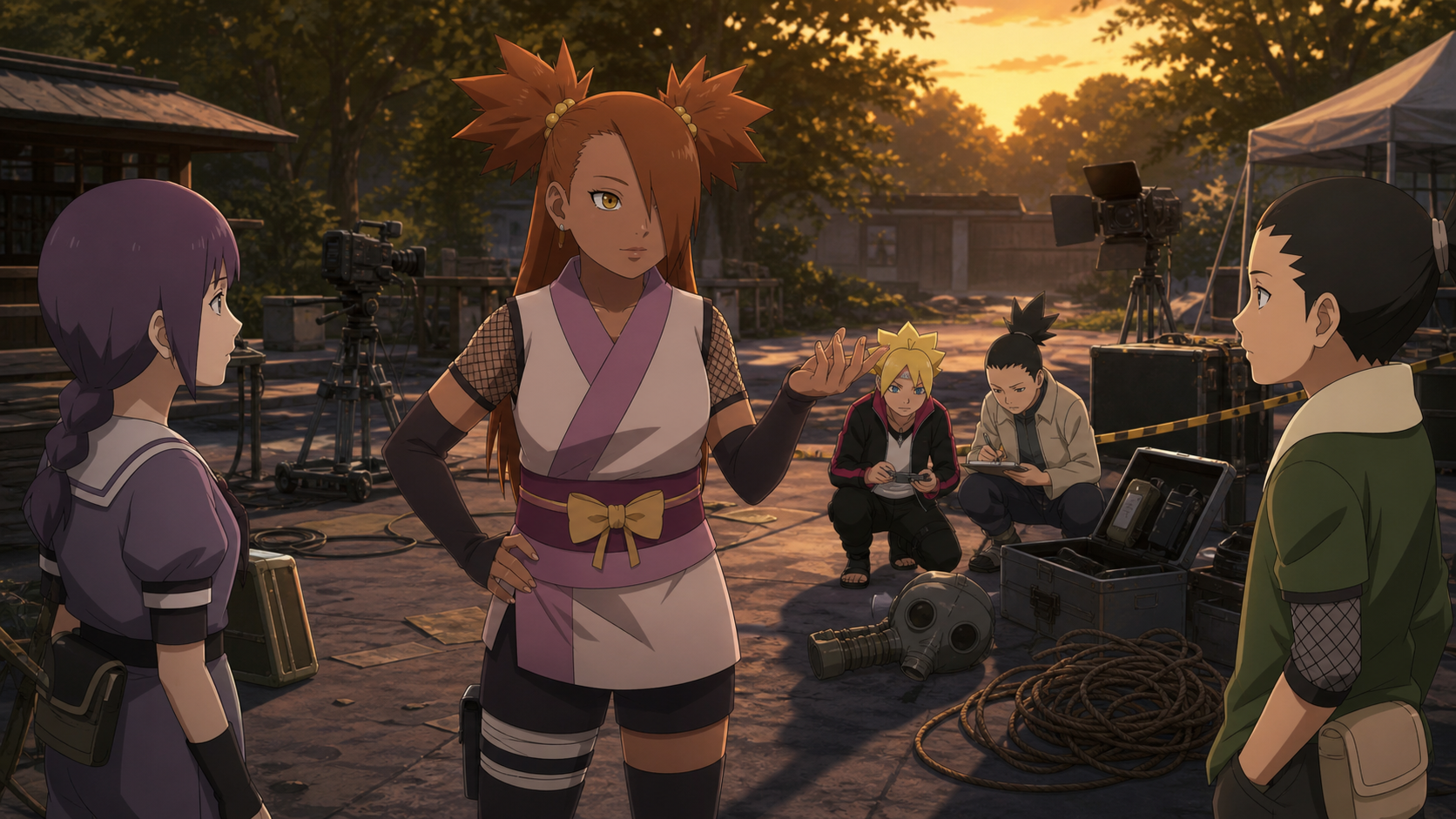
Super Cho-Cho Love Upheaval!
Chōchō saves Tomaru in the body he rejected, refuses his sudden proposal, and walks away with her freedom, her appetite, and the best line in the arc.
Series: Boruto: Naruto Next Generations
Episode: 69 · Super Cho-Cho Love Upheaval!
Arc: Chōchō Arc
Release: 2018-08-16
Previous: Episode 68 · Super Cho-Cho Kiss Mode!
Directory: All 293 Boruto episodes
Bottom line
Boruto Episode 69 finally lets Chōchō stop auditioning for Tomaru's approval, and thank every flavor of potato chip for that. “Super Cho-Cho Love Upheaval!” wraps the celebrity mission with a fake kidnapping, an actress carrying explosive tags, Konohamaru doing his best masked-villain impression, and Mitsuki explaining love through snack food. The mystery is obvious long before the mask comes off, but the episode understands one thing that matters: Tomaru's attention was never the prize.
Chōchō saves him in the body he rejected. Then, when he immediately decides that version is beautiful too and offers her a ring, she turns him down. That refusal is the best scene in the arc. Unfortunately, the road there keeps treating her larger body like a reveal she must courageously confess. Chōchō deserved a story about mastering Butterfly Mode without making thinness the admission price for romance. She also deserved a crush who did not switch preferences every time she changed shape.
Quick reaction
The finale is messy, funny, occasionally sharp, and much better whenever Chōchō owns the frame. Ashina's scheme has the subtlety of an explosive tag taped to a boulder. Boruto and Shikadai spot the contradiction quickly, Konohamaru gets to look competent, and Mitsuki remains the strangest little relationship counselor in Konoha.
My favorite choice is Chōchō refusing Tomaru without pretending she never liked him. She got hurt. She learned something. She still knows she is fabulous. Growth does not have to arrive wearing shame.
Previously, on the set from hell
This mission began as protection duty for actress Ashina after a masked attacker threatened the production. Then Ashina was injured, Chōchō stepped in as her double, and Tomaru started flirting with Chōchō while Butterfly Mode made her body smaller. Sarada could see the warning sign from another postal code. Chōchō wanted the fantasy badly enough to ignore her.
Episode 68 ended with Tomaru showing exactly how conditional his attraction was. Chōchō heard the insult, but she did not snap back into her usual confidence. Episode 69 opens with that bruise still fresh. The arc needs us to remember the hurt because her final rejection means more when we know she genuinely wanted him.
Chōchō and Sarada get the conversation the arc needed
Chōchō talks with Sarada about appearance and the version of herself Tomaru noticed. Sarada is worried, but Chōchō is not asking for a lecture. She is trying to understand why somebody else's gaze suddenly has so much power over her mood.
That tension feels real. A confident girl can still get caught by a crush. Confidence is not magical armor. Chōchō has always spoken about herself like she is the main event, but Tomaru's rejection lands because his earlier attention made her feel chosen. The episode works when Sarada stays close without turning friendship into a victory lap.
Ashina is watching her career disappear
While Chōchō sorts through romantic disappointment, Ashina watches Tomaru and the director discuss possible replacements. She brings back her repaired costume and pitches a meaningful death scene for her character. They barely entertain the idea. Tomaru has become the production's center because he is handsome, popular, and easy to market. Ashina hears the message: years of work can be replaced by a prettier face before lunch.
Her resentment makes sense. Her response absolutely does not.
That distinction gives Ashina more texture than a simple jealous-actress reveal. She sees a shallow system clearly, then chooses to endanger everyone around her so she can manipulate the same system. Boruto gives us a woman with a legitimate grievance and a terrible plan. Both truths can sit in the same chair.
The kidnapping happens because everyone is distracted
Ashina orders Chōchō to fetch water, pulling her away from the route she should be watching. The masked attacker arrives with a flash bomb and grabs Tomaru. Konohamaru gives chase, only to discover a shadow clone buying the culprit time.
Chōchō immediately lashes out at Konohamaru and Moegi for failing to stop the kidnapping. Her anger is fear wearing armor. She cares about Tomaru even after learning how shallow he can be, and that does not make her weak. Feelings do not vanish on command just because the audience has already decided the boy is trash.
The mission failure belongs to the whole team. Chōchō left her assigned position because Ashina sent her away, but the protection plan should never have depended on one genin refusing a client's errand. The show moves past that detail quickly because the ransom mystery has arrived.
Boruto and Shikadai catch the story changing
The attacker previously threatened murder. Now the same supposed criminal wants money and specifically demands that Ashina deliver the ransom. Boruto and Shikadai do not need a detective board covered in red string. The motive changed, the instructions got strangely personal, and Ashina is standing exactly where the new plan needs her.
Shikadai is especially useful because he notices when behavior stops matching the original threat. Boruto brings instinct and urgency. Shikadai brings the raised eyebrow. Together they keep the episode from asking the audience to pretend the twist is invisible.
Konohamaru reports the kidnapping while the younger shinobi continue watching the people on set. For once, the adults and genin divide the work in a way that feels reasonably sensible.
Ashina volunteers a little too perfectly
The ransom note names Ashina as the courier, and she insists on taking the money. Chōchō offers to transform into Ashina and go instead. That offer is brave, practical, and a reminder that Chōchō is still thinking like a shinobi even while her heart is scrambled.
Ashina refuses. She wants the cameras, the crew, and Tomaru to see her as the devoted costar who risks everything. When reporters swarm the production, she performs concern beautifully. Everyone applauds her courage. The episode is not subtle about the difference between acting and sincerity, but the setup fits a story built around celebrity image.
Ashina has spent the whole arc being told that Tomaru's face matters more than her craft. Her answer is to stage a moment where the entire world must watch her. That choice is desperate, ugly, and painfully on brand for this production.
Chōchō refuses to return to her usual form
Before the exchange, the others tell Chōchō she needs her full strength. She is still maintaining Butterfly Mode, which means she is holding onto the body Tomaru liked even when doing so could weaken her during a rescue.
This scene is supposed to show how deeply his judgment got under her skin. The point lands, but the framing still irritates me. Chōchō's usual body is not a secret identity. Her friends know her. Tomaru's ignorance should embarrass Tomaru, not make Chōchō feel as though she has something to reveal.
Still, her refusal has emotional logic. Returning to normal would force the confrontation she has been avoiding. Once Tomaru sees her, the fantasy ends. Chōchō would rather carry the strain a little longer than hear another careless sentence from him.
Mitsuki explains love with potato chips
Mitsuki decides this crisis needs a snack analogy. He compares Chōchō's feelings to choosing a potato chip flavor, because of course he does. Mitsuki has spent most of the series studying human behavior like a moonlit exchange student, and every so often his confusion circles around to wisdom.
His point is simple: hiding a preferred flavor does not create genuine love. Somebody who only wants the packaged version has not chosen the whole person. Chōchō hears him, even if she does not immediately admit how hard the comparison hits.
The scene is funny without treating Chōchō's pain as the joke. Mitsuki is sincere. He knows chips matter to her, so he uses the language she understands. That is oddly tender coming from the child who can discuss parenthood with Orochimaru over snacks.
The ransom exchange turns into bad theater
Ashina carries the money to the exchange point while the shinobi watch from cover. The kidnapper arrives with Tomaru. Ashina makes a dramatic comment about saving the man whose character is supposed to watch hers die. Even before the reveal, she is directing the scene toward herself.
Tomaru is released. Then Ashina tells the kidnapper that taking the money would look suspicious. The masked man offers the cash back, which is not how kidnapping works in any village. That exchange finally tears the curtain down.
Konohamaru removes the mask. The supposed criminal is already in custody, and Konohamaru used the disguise because the accomplice would not name the person behind the scheme. Ashina has been caught performing for an audience she did not know was watching.
Konohamaru earns a clean win
Konohamaru does not get many chances to be the cleverest person in a Boruto episode, so I am giving him this one. He chases the attacker, helps capture the accomplice, recognizes that the confession is incomplete, and creates a controlled sting that forces Ashina to expose herself.
The disguise pays off the gas-mask visual without inventing another villain. Boruto and Shikadai's suspicions matter, but an adult jōnin actually executes the plan. After several missions where the children seem to do everything while their captain watches from the nearest tree, that balance is welcome.
Konohamaru's victory cannot repair the arc's strange choices, but he handles the case with patience and proof. More of this Konohamaru, please.
Ashina's grievance is real and her scheme is reckless
Ashina admits that Tomaru has swallowed the production because of his looks even though she believes he cannot act. She injured herself, helped create the masked threat, and staged the kidnapping so she could become the heroic center of the story.
Then she reaches for explosive tags and threatens to kill herself rather than face what she has done. Konohamaru knocks the tags away, but the blast triggers a rockslide. Her private career panic becomes a public disaster in seconds.
Ashina was right about the industry's shallow priorities. She was wrong to make coworkers, children, and an entire film crew pay for them. The episode lets those ideas coexist, although the speed of her breakdown leaves very little room to explore either one.
The rockslide forces Chōchō to choose
Tomaru falls and injures his back as rocks crash around the set. Moegi and the genin protect the crew. Chōchō has a direct choice: keep hiding inside the form Tomaru praised, or use her full strength and save him.
She remembers Mitsuki's chip speech and releases Butterfly Mode. No glamour shot. No apology. Chōchō returns to the body Tomaru dismissed and puts that body between him and the falling rocks.
That is the episode's strongest visual. Tomaru does not get saved by the fantasy he flirted with. He gets saved by Chōchō, period. Her size is not a punch line during the rescue. Her Akimichi power is exactly what the scene needs.
Tomaru learns nothing at record speed
After Chōchō saves his life, Tomaru suddenly finds her larger body attractive. He pulls out a ring and proposes. Sir, you met her during a protection assignment. You did not know who she was ten minutes ago. Please put the jewelry away.
The proposal is meant as comedy and as proof that he has finally seen her beauty. I do not buy either excuse. Tomaru moves from one surface-level obsession to another. He liked thin Chōchō because she looked good on camera. Now he likes regular Chōchō because she performed a spectacular rescue in front of him. He still has not learned who she is when nobody is watching.
Chōchō understands that faster than he does.
Chōchō choosing freedom saves the finale
Chōchō offers Tomaru potato chips, then refuses his ring. She tells him she wants to stay free and jokes that he will have plenty of rivals if he wants another chance. The swagger is back, but the scene is not a reset.
She is no longer shrinking herself to keep his attention. She is also not giving him instant access because his preference changed. Tomaru does not get rewarded for reaching the bare minimum after she literally saves his life.
Her answer leaves room for desire without surrendering self-respect. Chōchō can like romance, enjoy being admired, and still reject a man whose admiration changes with the lighting. That combination feels much more honest than pretending a strong girl never wants anybody.
The arc fumbles body image before finding one good truth
I want to love Chōchō's victory without qualifications. The story makes that difficult. Across three episodes, Butterfly Mode becomes a makeover, Tomaru's attraction validates the thinner form, and Chōchō treats her usual appearance like information she is afraid to disclose. The finale criticizes his shallowness while depending on the same thin-equals-desirable setup for most of its drama.
The Akimichi clan deserved better. Their techniques have always connected food, family, stored chakra, and enormous physical courage. Butterfly Mode carries history. Turning that legacy into celebrity weight-loss magic cheapens both Chōchō and the technique.
The one good truth arrives when she stops allowing Tomaru to choose which Chōchō counts. Her body changes. Her appetite remains. Her confidence can wobble and return. None of those facts make her a different person.
Sarada was right, but friendship is not about scoring points
Sarada saw Tomaru's shallow behavior before Chōchō was ready. She worried that her friend was disappearing into a role built for somebody else's approval. Episode 69 proves Sarada correct, but thankfully nobody ends the mission with an “I told you so.”
Chōchō needed room to discover the truth herself. Sarada could warn her, stand beside her, and be ready when the fantasy cracked. She could not make Chōchō emotionally skip ahead.
That patience is a quiet strength in their friendship. Sarada respects Chōchō enough to disagree with her. Chōchō feels safe enough to be messy around Sarada. Those moments are more convincing than the film-set romance ever was.
Mitsuki goes home with a new question
Chōchō thanks Mitsuki with a bag of chips. Later, he shares them with Orochimaru and retracts his earlier question about whether Orochimaru is his father or mother. The tag is strange, sweet, and very Mitsuki.
His chip metaphor helped Chōchō because Mitsuki is also learning that labels do not contain a whole person. Orochimaru answers his family questions with the same serene mystery that defines every conversation in that laboratory. A normal parent-child snack scene was never an option here.
The cameo lets the episode end on curiosity instead of romance. Mitsuki is still figuring people out, one deeply odd analogy at a time.
Dinner with Chōji and Karui is the right final image
Chōchō returns home and eats with her parents. After three episodes of film sets, beauty standards, staged danger, and a man reacting to her body, she is back at a table where food is not a moral test.
Chōji and Karui do not need a speech. Their presence reminds us that Chōchō comes from a family where appetite, power, love, and personality have always taken up space. Home gives her something Tomaru never did: recognition without an audition.
I wish the arc had spent more time with that foundation. One quiet family meal says more about Chōchō's real life than every dramatic ring on the production lot.
What worked
Chōchō rejecting Tomaru works. Her rescue works. Mitsuki's potato-chip philosophy is ridiculous in exactly the right way. Boruto and Shikadai notice the ransom contradiction without dragging the mystery out, and Konohamaru's sting lets him behave like a capable team leader.
Ashina's frustration also gives the episode a worthwhile idea about celebrity. She is furious that craft has lost to a handsome face. The story does not excuse her scheme, but her motive has enough truth to sting.
Most importantly, Chōchō does not end the episode begging to be accepted. She makes the decision. She keeps the chips. She walks away.
What did not work
The entire arc confuses a clan technique with a makeover and then asks Chōchō to repair the damage in one rescue scene. Tomaru's proposal is shallow, rushed, and too close to rewarding him for changing which version of her body he prefers. Ashina's turn from neglected actress to explosive-tag crisis also happens so fast that her character becomes a plot device.
The kidnapping mystery is barely a mystery. Once the ransom note names Ashina, the episode might as well place an arrow over her head. Comedy can survive predictability, but the reveal still needs more energy than a transaction where the criminal tries to return the ransom.
The finale has a strong Chōchō choice trapped inside a weak Chōchō arc.
Chōchō saves herself from the romance before she saves Tomaru
The rockslide provides the obvious rescue, but Chōchō’s real victory happens when she separates desire from self-worth. Tomaru only recognizes her after Butterfly Mode changes her body. His attention feels flattering because the whole arc has encouraged Chōchō to treat his gaze like a prize. Once danger strips away the performance, she has to decide whether keeping that prize matters more than using her full strength.
Chōchō chooses the rescue. She returns to the body the story kept treating as a punchline, catches the falling rock, and protects a man who may stop wanting her the moment he sees her clearly. That choice is not romantic sacrifice. Chōchō refuses to let somebody else’s shallow preference control what kind of hero she becomes.
Tomaru’s proposal confirms the problem. He falls in love with an image, learns almost nothing, and reaches for a ring as though attraction completed the relationship. Chōchō finally sees the offer for what the offer is: validation from somebody who has not earned authority over her confidence.
Her refusal rescues the episode from its own fantasy. She does not need permanent thinness, a celebrity boyfriend, or applause for becoming visually acceptable. She needs room to decide whom she likes after that person demonstrates actual character. Tomaru fails the audition.
The dinner scene restores what the arc kept forgetting. Chōchō belongs in a family where food, size, power, and affection can share the table without becoming shame. Chōji and Karui do not require a transformed daughter. Their presence gives the finale a home stronger than Tomaru’s temporary gaze.
RaeRae verdict
“Super Cho-Cho Love Upheaval!” earns its best moment when Chōchō saves Tomaru as herself and refuses to let his sudden attraction become her happy ending. She does not need his ring, his permission, or a permanent Butterfly Mode transformation. She needed to remember that his gaze was information about him, never a final judgment about her.
I laughed at Mitsuki's chips. I appreciated Konohamaru's plan. I wanted much more for Ashina than a last-minute breakdown, and I wanted the series to stop acting like Chōchō's ordinary body was a shocking confession. The finale cannot erase the arc's fat jokes or thinness fantasy.
Still, Chōchō gets the last word. Tomaru offers a ring, and she chooses freedom, food, family, and the possibility of somebody better. Keep the chips. Lose the actor. That part is perfect enough for me.
Sources and lawful viewing
Official episode reference: Naruto Official episode guide
Licensed episode route: Crunchyroll licensed series page