
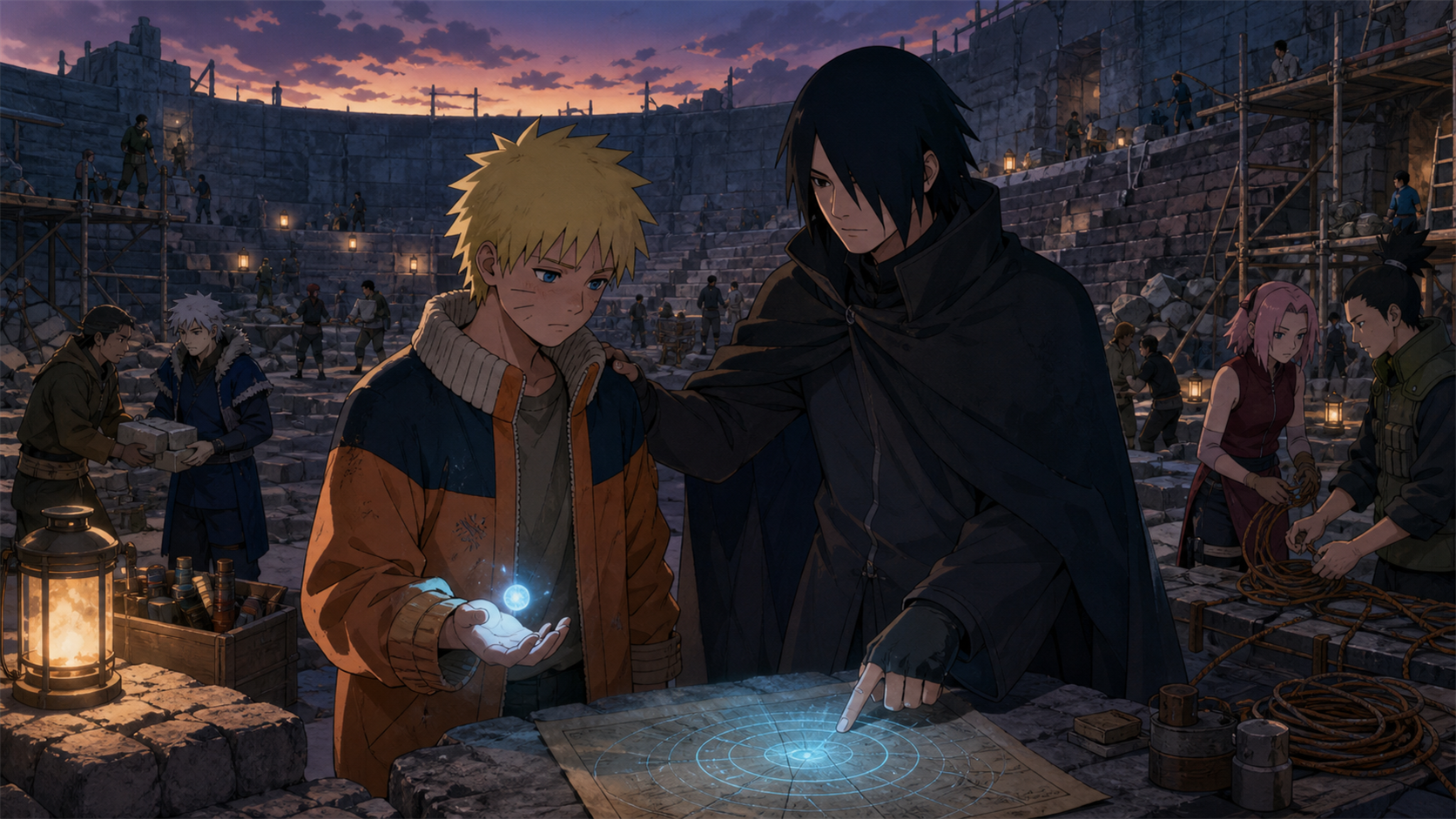
Sasuke’s Secret Weapon
Boruto faces the invasion’s human cost, throws away the cheating device, wears Naruto’s old jacket, and accepts Sasuke’s scratched headband before the rescue.
Series: Boruto: Naruto Next Generations
Episode: 63 · Sasuke’s Secret Weapon
Arc: Versus Momoshiki Arc
Release: 2018-06-28
Previous: Episode 62 · The Otsutsuki Invasion
Directory: All 293 Boruto episodes
Bottom line
Boruto Episode 63 makes Boruto walk through the wreckage left behind after his worst public mistake and his father's greatest act of protection. “Sasuke's Secret Weapon” begins in a hospital full of injured people. Hinata tried to chase the Ōtsutsuki after they took Naruto. Mitsuki had his chakra stolen. Friends are repairing the arena while Boruto is still wearing the gauntlet that helped him cheat.
Then Sasuke finds him in Naruto's old jacket and offers a way forward. Not forgiveness. Not a clean exam record. A mission. Boruto's Vanishing Rasengan has real tactical value, Naruto is still alive, and the four visiting Kage are ready to cross dimensions. Sasuke gives Boruto his scratched forehead protector because the boy needs something heavier than a costume. The headband carries history, failure, and the possibility of returning after disgrace. Nobody knows that better than Sasuke.
Quick reaction
This episode does not need a fight to hit hard. Boruto throwing away the Shinobi Gauntlet, Hinata waking up and asking for Naruto, Shikadai postponing the apology, Sarada asking to join the rescue, and Sasuke placing his old headband in Boruto's hands all land because Episode 62 broke everything first.
My one giant side-eye remains the same: these adults are taking a recently concussed, publicly disgraced genin into an Ōtsutsuki dimension. Sasuke has a plan. He also has the child-safety instincts of a man who left home at twelve to train with Orochimaru.
Boruto wakes up asking for Naruto
Boruto regains consciousness in the hospital and immediately asks Sarada about his father. The anger from the exam is gone. The terror underneath has nowhere left to hide.
Naruto protected the arena from Momoshiki's massive attack and disappeared in the blast. Boruto saw him smile before the light swallowed him. The last conversation between father and son was a public disqualification.
That unfinished ending is crushing. Boruto does not know whether he will ever get another chance to speak without resentment doing the talking.
Himawari is calling for Hinata
Boruto hears Himawari calling for their mother. Sakura is treating Hinata, who was injured trying to stop Momoshiki and Kinshiki from taking Naruto.
Hinata's choice is completely in character. She watched Naruto get dragged away and followed, even against enemies far beyond ordinary shinobi. The same woman stepped between Naruto and Pain when she knew the power difference.
The scene also shows Boruto the cost carried by the rest of his family. Naruto's abduction did not happen to the Hokage alone. Hinata is hurt. Himawari is terrified. Boruto wakes up surrounded by the consequences.
Mitsuki is in critical condition
Sarada tells Boruto that Mitsuki is badly injured after Urashiki stole his chakra. Boruto's teammate nearly exposed Sage Mode to protect him during the exam, then got attacked before he could act.
Mitsuki's condition widens Boruto's guilt. He did not cause the Ōtsutsuki invasion, but his obsession with beating Naruto kept him from seeing how much his team was carrying.
Sarada stands in the hospital as the one member of Team 7 still upright. She has to deliver the facts while her father prepares another impossible mission. Nobody gives her enough credit for holding that corridor together.
The hospital shows what Naruto protected
Boruto sees wounded villagers and shinobi throughout the building. Naruto stopped the largest attack, but protection did not mean nobody got hurt.
The scale changes Boruto's understanding of the Hokage. Naruto was not choosing paperwork over family because paperwork thrilled him. He was carrying responsibility for all these people, including the ones Boruto never had to know by name.
That realization should not erase missed birthdays. The stronger lesson is more complicated: Naruto's devotion was real, and his family still deserved better communication. Both can be true.
Boruto runs because shame needs somewhere to go
Overwhelmed, Boruto leaves the hospital. He cannot repair Hinata, wake Mitsuki, find Naruto, or undo the exam. Movement is the only answer available.
Outside, he trips over a medical kit and notices the Shinobi Gauntlet still attached to his wrist. The device survived the attack like a receipt nobody asked to keep.
Boruto tears the gauntlet off and throws the device away. He is not making a thoughtful statement about technology. He is furious at the version of himself who believed the shortcut could make him worthy.
Throwing away the gauntlet is not the whole lesson
The tool did not force Boruto to cheat. Katasuke manipulated him, but Boruto chose concealment because the result mattered more than honesty.
Rejecting the gauntlet feels emotionally necessary in the moment. Long-term growth requires something harder: learning that tools can be useful when purpose, rules, and attribution are clear.
Episode 65 will prove that difference. Katasuke uses the same technology recklessly and feeds Momoshiki. Boruto accepts Naruto's chakra openly and wins. Help is not the problem. Hidden help is.
Friends repair the arena without applause
Boruto sees people clearing debris, tending injuries, and rebuilding the space where he wanted everyone to admire him. The spectacle is over. Work remains.
That contrast is the episode's quietest lesson. Boruto chased a title and a public victory. His friends now demonstrate shinobi responsibility through tasks nobody will replay in a highlight reel.
Heroism includes carrying broken material, finding survivors, restoring roads, and staying when the crowd leaves. Naruto understood that. Boruto is beginning to.
Naruto's office feels different without Naruto
Boruto goes to the Hokage office and remembers every complaint he made about his father. The room once represented the job stealing Naruto away. Now the empty chair represents the man who may never return.
Boruto finds Naruto's old clothes and puts them on. The jacket is oversized, worn, and visually tied to a childhood Boruto barely understands.
He is not becoming Naruto. He is trying to stand close enough to the person behind the title to understand him.
The old jacket is family history, not cosplay
Naruto wore that orange jacket when the village mocked him, when he failed exams, when he chased Sasuke, and when he kept promising to become Hokage before anybody believed him.
Boruto has spent his life looking at the polished Seventh Hokage. The old jacket belongs to the loud, lonely boy underneath the monument.
Hinata later sees Boruto wearing those clothes and recognizes Naruto immediately. The resemblance is not about fabric alone. Her son has finally reached the point where shame can become determination instead of another prank.
Sasuke finds Boruto at his lowest point
Sasuke enters without pretending the cheating never happened. He tells Boruto that Naruto also knew what being scorned felt like.
Nobody in Konoha understands disgrace and return better than Sasuke. His forehead protector carries Naruto's scratch from the Valley of the End. His own history includes betrayal far beyond an exam violation.
Sasuke does not tell Boruto they are the same. He offers perspective: one failure can define the next choice without defining the entire person.
Naruto is alive
Sasuke can still sense Naruto's chakra through the space-time connection. That sentence changes the room. Boruto's grief becomes a rescue objective.
Sasuke has already decided to go after his friend. The four visiting Kage will join him. Naruto protected every village leader's people inside the arena, and they are not leaving him behind.
The alliance stops being ceremonial. The Chūnin Exams were meant to display cooperation. The rescue team proves cooperation when the stadium is gone.
Sasuke calls Boruto his secret weapon
Sasuke wants Boruto on the mission because Momoshiki does not know about the Vanishing Rasengan. The technique is small, honest, and unpredictable.
Boruto thought the Rasengan was a failure because the sphere disappeared. Sasuke saw a nature transformation and a tactical surprise. A good mentor notices value the student cannot recognize yet.
Calling Boruto a secret weapon is dramatic enough to restore his posture. More importantly, Sasuke gives him a specific reason to come. Boruto is not joining because guilt deserves danger. He has a tool the enemy may misread.
The Kage question bringing a genin
Gaara, Darui, Chōjūrō, and Kurotsuchi arrive and challenge Sasuke's decision. Finally, somebody in the room notices that Boruto is twelve.
Sasuke vouches for him without revealing every detail. The Kage accept the plan because Sasuke's intelligence brought them this far and because the rescue window is closing.
Their concern matters. Boruto's presence should feel extraordinary, not like a normal field trip. One useful technique does not make him equal to five leaders and Sasuke.
Everybody pools intelligence on the Ōtsutsuki
Before leaving, the rescue team reviews Momoshiki and Kinshiki's known abilities. Absorption, amplified return, physical power, and space-time movement all shape the plan.
That preparation gives the next two episodes tactical credibility. The Kage do not enter the dimension expecting a tournament match. They know ninjutsu can become enemy ammunition.
Boruto has direct observations from the arena. His experience becomes useful information instead of a story about how special he is.
Sasuke gives Boruto the scratched headband
Sasuke hands over his forehead protector, the one Naruto scratched when their original bond nearly broke. He explains that the mark came from Naruto.
The object carries a relationship through conflict, separation, war, and return. Sasuke once abandoned the Leaf while wearing that symbol. Naruto never stopped believing he could come home.
Boruto wears the headband after his own public fall. The message is not subtle, and the message does not need to be. Failure is not the end when the next choice moves toward people instead of away.
Sarada asks to join her father
Sarada sees Sasuke preparing to cross dimensions and asks to go. She is a genin, a Sharingan user, Naruto's admirer, and Boruto's teammate. Her desire is every bit as understandable as Boruto's.
Sasuke tells her to stay and help Kakashi and Shikamaru protect the village because she is the only other person present with the Sharingan.
The explanation gives Sarada a meaningful assignment, but the double standard still deserves a raised eyebrow. Boruto goes because Sasuke needs his unusual technique and because the story centers father and son. Sarada remains behind despite being the more reliable exam performer.
Shikadai postpones Boruto's apology
Boruto tries to apologize to Shikadai for cheating during their match. Shikadai tells him there are more urgent matters and promises to listen later.
That is not instant forgiveness. Shikadai does not say the match no longer matters because Naruto was abducted. He creates a pause.
The scene respects both friendship and accountability. Boruto can join the rescue without buying absolution. The conversation waits for a day when crisis is not deciding the emotional terms.
Hinata sees young Naruto in her son
Hinata reaches the departure point after waking. She sees Boruto in Naruto's old clothes and Sasuke's headband. For a moment, the child she protected looks like the boy she believed in long before the village did.
Letting Boruto leave costs her. Naruto is already gone. Mitsuki is critically injured. The enemy nearly killed everyone at the arena. Hinata knows exactly what stands beyond Sasuke's portal.
She still entrusts Naruto's safety to Boruto. The moment is emotional, not evidence that the mission is safe. Mothers in this franchise deserve a vacation from watching their families enter glowing holes in space.
Sasuke opens the portal
The Kage assemble. Boruto adjusts the headband. Sasuke opens a passage to the Ōtsutsuki dimension.
The image closes the episode on choice. Boruto began in a hospital bed surrounded by consequences. He ends standing beside leaders, carrying a technique he actually learned and a symbol he did not steal.
The rescue will not erase the exam. The mission gives him a chance to act from a better place.
Manga material gains anime aftermath
Episode 63 adapts Boruto Chapter 6 while using the anime's wider cast to show the hospital and village recovery. Mitsuki's condition, Urashiki's attack, and the repair work make the invasion feel larger than the movie version alone.
Those additions help Boruto's realization. He does not change because Sasuke gives one inspiring speech. He sees Hinata, Himawari, Mitsuki, Sarada, Shikadai, and injured villagers carrying the cost.
The jacket and headband then turn that realization into a visual promise.
Replay notes
Watch Boruto's hands. The gauntlet begins as evidence he wants to tear away. Sasuke's headband ends as history he chooses to carry.
Watch Sakura in the hospital. She handles Hinata's injuries while Sarada manages Boruto, placing mother and daughter in parallel support roles.
Watch Shikadai's response to the apology. His calm postponement is more emotionally mature than instant forgiveness would be.
Finally, watch Hinata's face when she sees the jacket. She is remembering Naruto and deciding to trust Boruto at the same time.
What worked
The episode lets consequences breathe. Boruto sees injured people, discards the gauntlet, and recognizes the quiet labor behind Naruto's title. Sasuke's mentorship is firm without becoming cruel.
The old jacket and scratched headband carry franchise history without requiring a flashback marathon. Shikadai's delayed apology scene is small and excellent. Sarada receives a real village-defense role even though she cannot join.
Most importantly, Boruto's value comes from the Vanishing Rasengan he genuinely created. His imperfect work becomes the secret weapon.
What did not work
Taking Boruto into another dimension remains reckless. The Kage question the choice, but Sasuke's confidence ends the discussion quickly. A child motivated by guilt will always say yes to rescuing his father.
Hinata's injury happens offscreen, which continues the franchise habit of using her devotion without giving her action equal space. Sarada's request also exposes how often girls are assigned to protect home while boys receive the headline mission.
The gauntlet toss risks implying technology caused the cheating. Boruto's later growth needs to address choice and honesty, not merely reject the device.
Shame tells Boruto to disappear when repair requires staying visible
Boruto wakes in a hospital surrounded by the cost of the invasion. Mitsuki lies injured. Himawari calls for Hinata. Naruto is missing. The arena where Boruto cheated has become a disaster site repaired by friends who received no applause for the work. Every direction offers another reason to believe he made everything worse.
Shame turns those facts into a false conclusion: Boruto should leave because everybody would be better without him. Running feels like accountability when facing people feels unbearable. Real accountability demands the opposite. He must stay visible long enough to apologize, accept consequences, and help repair what can still be repaired.
Sasuke finds him before shame becomes a permanent decision. Sasuke understands the urge to define a whole life through the worst choice inside that life. He does not excuse Boruto or erase the disqualification. He gives the boy accurate information. Naruto survived. Boruto’s training produced a useful technique. The next choice still exists.
Calling Boruto a secret weapon sounds generous after the cheating scandal, but Sasuke bases the claim on a specific advantage. Momoshiki cannot perceive the Vanishing Rasengan correctly. Boruto possesses knowledge and a technique the adults can use. The role does not make him the strongest person entering the portal. The role makes him relevant.
That distinction restores agency without handing out instant redemption. Boruto can contribute to Naruto’s rescue while still owing Shikadai an apology. He can wear a headband while remaining disqualified from the Exams. A person does not need to finish repairing every failure before helping during an emergency.
Naruto's jacket and Sasuke's headband carry warnings as well as hope
The clothes could look like a shortcut to inherited cool. Boruto puts on Naruto’s old jacket, receives Sasuke’s scratched headband, and suddenly resembles the visual promise of two legendary shinobi. The episode works because both objects carry failure.
Naruto wore that jacket when the village dismissed him, when missions exposed how little he knew, and when stubbornness regularly ran ahead of judgment. The orange does not represent effortless greatness. The jacket remembers a child who embarrassed himself, trained, lost, apologized, and kept returning.
Sasuke’s headband carries an even sharper warning. The scratch records his break from Konoha and the damage caused while he pursued power through isolation. Sasuke returned, but return never erased the people he hurt. Giving Boruto that headband says failure can become part of a repaired life without becoming a badge that makes the failure admirable.
Boruto needs both messages. Naruto’s history proves that public humiliation does not set a permanent ceiling. Sasuke’s history proves that pain cannot justify every response. Boruto can recover from cheating. Recovery requires choices different from the ones that produced the scandal.
Hinata recognizes young Naruto when she sees her son dressed for the rescue. Her reaction is not simple nostalgia. She remembers a boy charging toward impossible danger because somebody he loved needed help. She also knows how often that boy returned injured. Pride and fear arrive together.
The Five Kage question the plan because bringing a genin into an Ōtsutsuki dimension sounds irresponsible. They are correct. Sasuke answers with tactical value, not sentiment. Boruto will remain protected until his specific contribution matters. The adults do not pretend a headband created battlefield experience.
Shikadai postponing the apology keeps the story honest. He does not forgive Boruto because Naruto disappeared. He recognizes an emergency and saves the personal reckoning for later. Their friendship has enough strength to hold anger and concern at the same time.
Boruto steps through the portal without knowing whether he can save Naruto or whether anybody will trust him afterward. That uncertainty makes the choice meaningful. A secret weapon becomes useful only when the person carrying the weapon stops hiding what the weapon is.
RaeRae verdict
“Sasuke's Secret Weapon” is the episode where Boruto stops trying to look like a shinobi and chooses to act like one. The difference is not Naruto's jacket or Sasuke's headband. The difference is that he finally understands other people's labor, pain, and risk.
Sasuke gives him exactly enough hope. Naruto is alive. The Vanishing Rasengan matters. One terrible decision does not end a life. Shikadai will hear the apology later, and the exam consequences will still be waiting when Boruto comes home.
Boruto walks through the portal wearing two generations of complicated history. Naruto's jacket says a hated child can become Hokage. Sasuke's scratched headband says somebody can leave, fail, and return. Boruto has not earned redemption in one afternoon. He has earned the chance to make the next choice honestly. That is a much better secret weapon than any scroll under his sleeve.
Sources and lawful viewing
Official episode reference: Naruto Official episode guide
Licensed episode route: Crunchyroll licensed series page