RaeRae Reacts
BABYMONSTER Stuck In The Middle React
No rap break. No chant. No choreography to distract us. Just six voices, a piano, a suspicious amount of fairy dust, and a first crush that refuses to answer a direct question.
Artist: BABYMONSTER
Song: Stuck In The Middle
Release: February 1, 2024
Album: later included on BABYMONS7ER in seven-member and remix versions
Original lineup: RUKA, PHARITA, ASA, RAMI, RORA and CHIQUITA
RaeRae lane: English piano ballad, first-love confusion, vocal showcase in a fairy-tale greenhouse
Overall vibe
Bottom line: Stuck In The Middle is not BABYMONSTER’s complete identity, but it is the early receipt proving the group could survive without rap breaks, chants or heavy production. The lyrics circle one simple question for too long, and the fantasy video sometimes dresses uncertainty so beautifully that the hurt cannot get dirty. Still, the six-member recording gives every voice room, turns the rap line into useful singers, and documents the awkward moment when the group was still suspended between its debut lineup and its intended seven-member future.
First thought: Did the girls from BATTER UP get kidnapped by a very expensive prom committee?
Sound check: Piano, strings, almost no rhythmic hiding place, and enough exposed high notes to make every “they are only visuals” accusation leave the room quietly.
The moment I leaned in: When the voices stop being pretty one at a time and begin stacking. That is where the song finally becomes a group record instead of six audition clips stitched together.
The side-eye: The lyrics keep asking the same emotionally reasonable question in slightly different outfits for four minutes. Somebody please text this crush and demand a yes, a no, or rent.
Current status: I would not call it BABYMONSTER’s identity. I would call it the receipt proving the vocal department exists.
What changed every time I replayed it
First listen: I heard the concept switch before I heard the members. After BATTER UP, the piano felt like YG had pulled an emergency brake. No chant, no rap section and no final party meant I had nothing to watch except the vocals. That was clearly the assignment. My first response was that the song worked as evidence, but not yet as identity.
Second listen: RAMI became the spine of the record. Her lower weight keeps the verses from turning into one long ribbon of pretty tone. RORA sounds calm without becoming flat. PHARITA brings brightness, while CHIQUITA’s younger color fits a narrator who still treats one unclear crush like a constitutional crisis. The arrangement gives each voice a different emotional job even when the lyrics keep returning to the same question.
Third listen: ASA and RUKA became more important. Neither receives the obvious “main vocalist proving herself” framing, but both stop the track from sounding like four singers and two guests. ASA keeps her phrasing precise without a rap beat organizing the rhythm for her. RUKA’s darker tone adds contrast to a song determined to glow. Their presence is what makes this a BABYMONSTER record instead of a vocal-unit side project.
After the seven-member version: AHYEON adds power and makes the lineup sound fuller, but the original six-member recording does not become obsolete. The two versions answer different questions. The February single asks whether the active six could carry a ballad while public attention focused on the missing member. The April version asks what the song sounds like once the planned team is restored. Both belong in the history.
After the remix: the brighter pulse changes the emotional problem. The original lives inside hesitation. The remix gives the narrator enough movement to sound closer to leaving. I prefer the original because the stillness matches the title, but the remix exposes how much the song’s meaning depends on arrangement rather than complicated writing.
The fairy tale makes emotional sense, even when it looks too clean
First love rarely arrives with useful scale. A delayed reply can feel like a national emergency. One kind glance can support three days of theories. The music video understands that imbalance. It turns a small interpersonal question into weather, gardens, moons and royal dresses because the person inside the crush does not experience it as small.
That is where the fantasy earns its budget. Each member gets a private world because uncertainty is isolating. They are surrounded by beauty and still cannot get a direct answer. The glowing rooms do not prove the relationship is magical. They show how much imagination the narrator is using to fill the silence.
The problem is that perfection protects the song from consequence. Nobody looks tired from overthinking. No room is messy. No face stays uncomfortable long enough to break the beauty campaign. The visual tells us heartbreak is happening, but it rarely lets heartbreak leave a mark. One ordinary image could have made the fantasy hit harder by giving us something human to compare it against.
English access and the risk of becoming too universal
The English lyric makes the emotional problem immediately portable. International listeners do not need subtitles to understand the push and pull. That matters for a group designed for a global market, and it gives the vocal delivery nowhere to hide. Every repeated question has to gain meaning through tone because the words are plain.
Plain language can be powerful. It can also remove fingerprints. Most young pop groups could sing these lines without changing the plot. BABYMONSTER supplies identity through voice rather than writing: RAMI’s weight, RORA’s steadiness, PHARITA’s brightness, CHIQUITA’s youth, ASA’s precision and RUKA’s darker contrast. The members personalize a lyric that the writing room kept deliberately broad.
That tradeoff explains why the song works better inside the rollout than alone. BATTER UP gave the group too much company attitude and too little melody. Stuck In The Middle gives them melody while stripping away most attitude. Put the two releases together and the strategy becomes obvious. YG was presenting the extremes before finding the middle ground where BABYMONSTER could sound like itself.
What “stuck in the middle” means here
The middle is not a love triangle. It is the miserable gap between friendship and romance, where one person is emotionally floating and the other has apparently misplaced every useful word. The narrator cannot tell whether the connection is real or something she invented. She tries to step back, gets pulled close again, and ends up circling the same question: do you feel this too, or am I building a relationship out of eye contact and poor communication?
That is why the song sounds suspended. It rarely develops a strong beat because certainty would ruin the feeling. The piano keeps the ground soft, the strings widen the emotion, and the melody rises whenever the narrator imagines closeness. Then the lyric drops her back into doubt. It is first-love confusion presented without sarcasm, the stage where every small gesture becomes evidence and none of the evidence is admissible in court.
The English is intentionally direct. There are no complicated metaphors to decode. That makes the song easy to understand globally, but it also means the singers have to create depth the words do not always supply. The difference between a convincing verse and a greeting-card verse comes down to breath, tone and whether the member sounds like she believes the question.
A vocal showcase disguised as a single
YG followed the hip-hop-heavy BATTER UP with the opposite possible move. Stuck In The Middle is built around piano and vocals, with no “monster” chant, no rap flex and no performance break. It is less a definition of BABYMONSTER than a correction to the first impression. If the debut made you think the group only knew how to posture over a beat, this song places every singer in bright light and removes the exit.
RAMI is the vocal anchor. Her tone has weight even when the arrangement asks for softness, which keeps the song from floating away completely. RORA brings a calmer, rounder color that sounds unusually settled for such an uncertain lyric. PHARITA supplies clean brightness, while CHIQUITA has a youthful edge that fits the first-crush perspective without sounding helpless.
The surprise is how useful the rap line becomes without rapping. ASA and RUKA give the song different textures instead of waiting offstage for a beat that never arrives. Neither is presented as the main belter, but both help the record feel like BABYMONSTER rather than “the vocal members featuring everybody else.” That matters in a group this large. Range is not just having different genres on an album; it is keeping the whole lineup useful when the genre changes.
The missing seventh voice
The February music video and original single feature six members. AHYEON was still on health-related hiatus when the material was recorded and filmed. Days before release, YG announced that she had recovered and would return for the April mini album. BABYMONS7ER later included a seven-member version with her voice, as well as a remix.
This timeline is worth stating clearly because the catalog can otherwise look contradictory. Stuck In The Middle is a six-member pre-release single. The album version expands it to seven. The official music video remains the six-member film. AHYEON was not secretly edited out, and the April recording does not rewrite what the February release represented: the group showing its vocal side while still incomplete.
The seven-member version adds fullness, but I am glad the original survives. It documents what RUKA, PHARITA, ASA, RAMI, RORA and CHIQUITA carried during the awkward period between the announced group and the complete debut. The absence is part of BABYMONSTER’s history, not a mistake to airbrush away.
The music video: six princesses, one extremely committed fairy-light budget
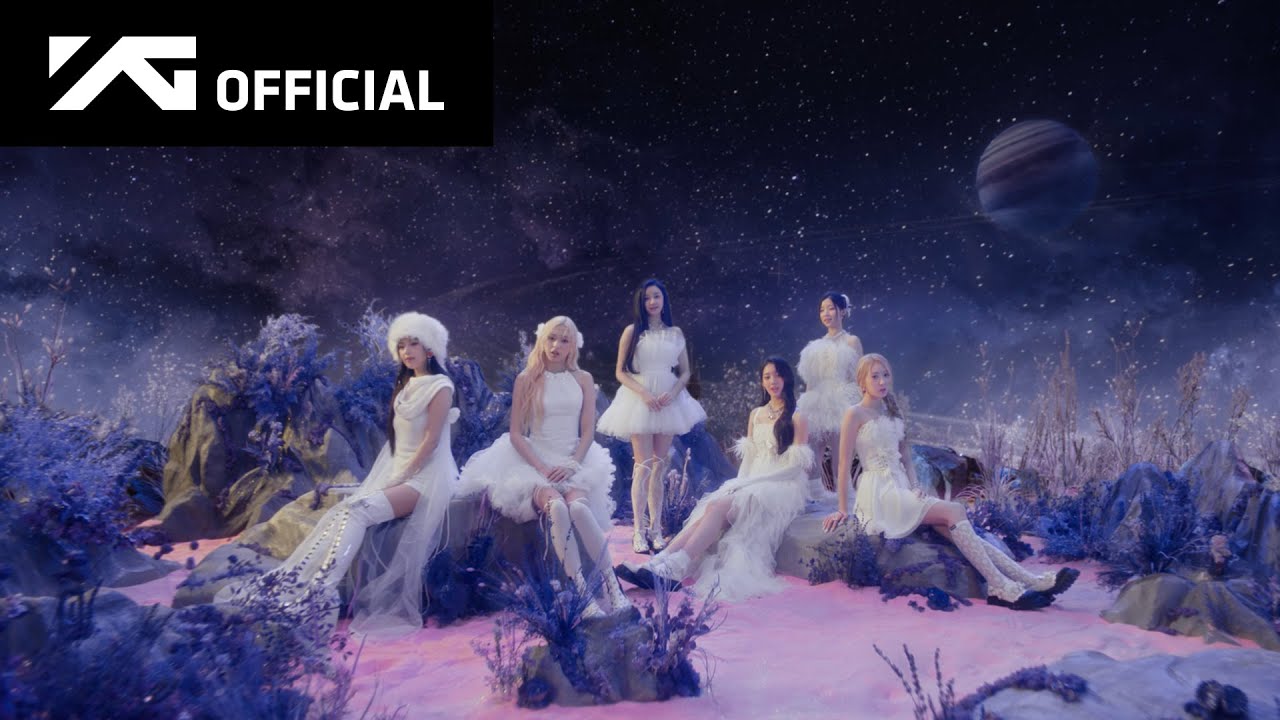
The video refuses realism. We get celestial skies, flowering rooms, glowing gardens, floating fabric, ornate dresses and sets that look as if a perfume commercial wandered into a fantasy musical. Each member is framed like the heroine of her own enchanted portrait. Nobody is waiting for a text in sweatpants under a kitchen light; heartbreak has apparently secured couture and a CGI moon.
That mismatch is part of the charm. The lyric is emotionally small and personal, does this person like me?,while the visuals treat the uncertainty as a kingdom-level emergency. A hesitation becomes a storm cloud. A crush becomes a private planet. The exaggeration captures how first love actually feels when you are inside it: objectively one confusing relationship, subjectively the collapse of weather systems.
The dresses and individual sets also solve a practical problem. A ballad has no choreography and very little sonic movement, so the video needs visual changes without breaking the mood. Flowers open, light shifts, rooms expand, and the camera moves from one member’s fairy-tale pocket to another. The result is beautiful, though sometimes so polished that the sadness cannot leave a fingerprint. I wanted one image that felt messy enough to belong to a person rather than a luxury display window.
Easter eggs, context and details worth knowing
- This is BABYMONSTER’s first English-language single. The direct language made it immediately accessible but also placed extra pressure on vocal expression.
- The original has no official choreography. YG itself emphasized that the ballad was completed through vocals rather than a special performance.
- The February release is six-member history. AHYEON returned on the seven-member album recording released April 1.
- The contrast with BATTER UP was planned. Official rollout material presented the song as a new musical direction away from the group’s first hip-hop image.
- The special stage extends the fairy tale. A giant arch, grand piano, petals, starlight screens and soft lighting recreate the MV mood without pretending the song needs dance.
- The remix changes the emotional weather. The album’s brighter arrangement turns the suspended ballad into something closer to tears-on-the-dancefloor pop.
Who made the song
Lyrics: Jared Lee and Dan Whittemore.
Composition: DEE.P, Jared Lee and Dan Whittemore.
Arrangement: DEE.P.
The writing team built a deliberately traditional pop ballad rather than forcing in YG trademarks. That restraint is the point. The production does not try to win through novelty; it creates a clean runway for six distinct voices and asks whether they can carry four minutes without a beat drop. Mostly, they can.
What I love, what I side-eye, and the verdict
Stuck In The Middle is lovely, sincere and slightly too well-behaved. It proves BABYMONSTER can sing, but it does not tell me why these particular singers needed this particular song. The lyrics are universal enough to fit almost any young vocal group, and the fantasy video sometimes replaces personality with polish. If I heard only this track, I would admire the voices and still not know the monster.
But as the second half of a one-two argument with BATTER UP, it makes sense. One release showed attitude and gave too little melody; the other gives us melody with almost no attitude. The complete group would eventually learn how to put both instincts in the same song. Here, while the lineup itself is stuck between six and seven, we get the clearest early evidence that BABYMONSTER’s vocal reputation was not company propaganda.
Also, if somebody keeps you emotionally “stuck in the middle” for four straight minutes, RaeRae’s professional recommendation is to stop singing and send one terrifyingly clear text.
Receipts, not rumors
 Official “Stuck In The Middle” music video , BABYMONSTERDaily+18.5KTotal views141.2M
 Official special stage , YG EntertainmentDaily+754Total views17M
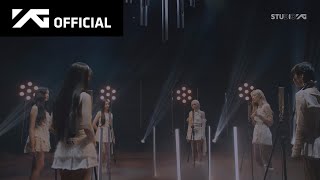 Official live stage , YG EntertainmentDaily+2.4KTotal views18.7M
- YG description of the song and special stage
- YG special-stage release report
- YG announcement of AHYEON’s return and seven-member versions
- Official credit-poster report