
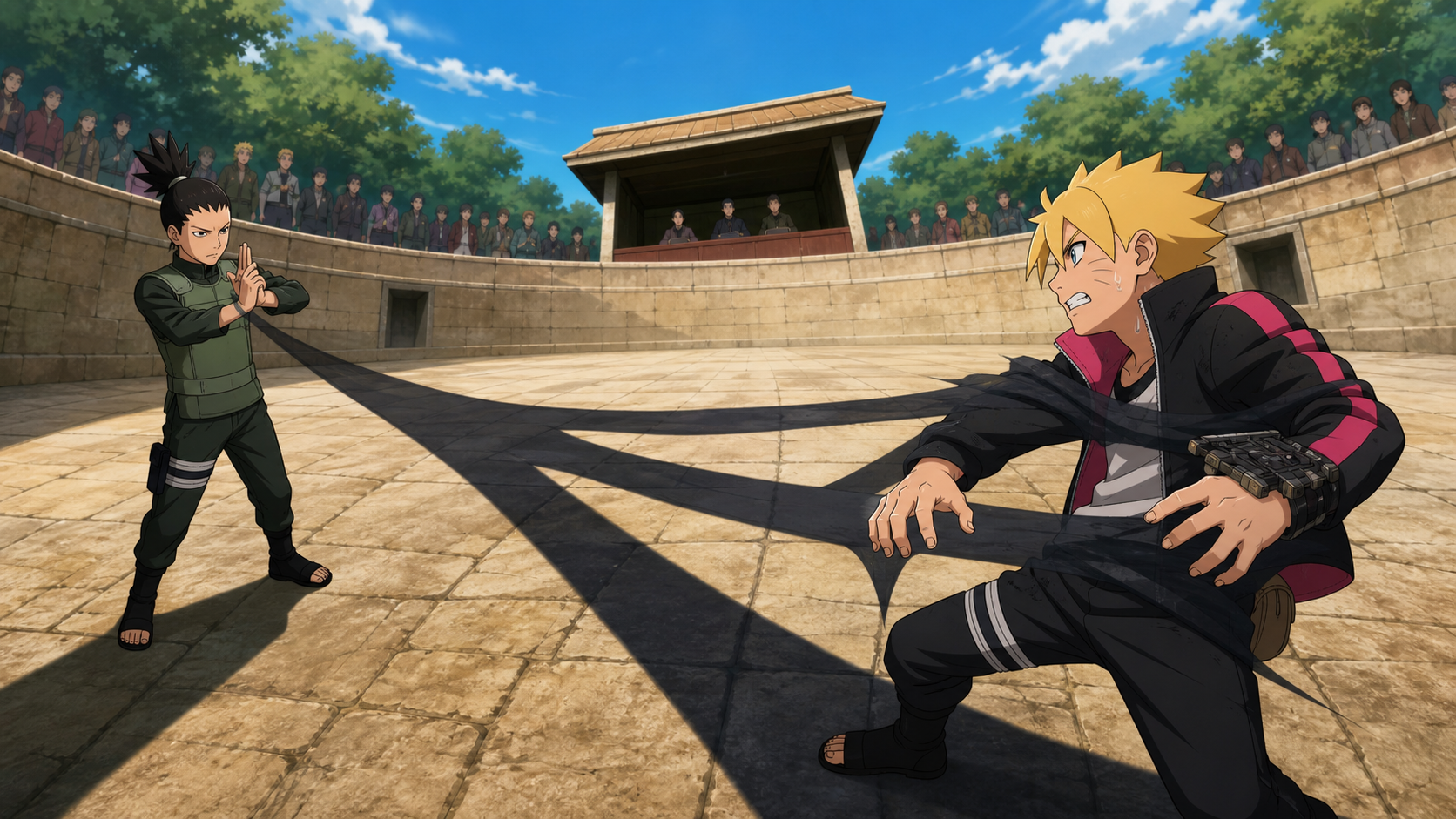
Boruto VS Shikadai
Shikadai solves Boruto’s legitimate attack and earns the win. Boruto uses one forbidden clone to steal the result from his friend and turn Naruto’s praise into something he cannot enjoy.
Series: Boruto: Naruto Next Generations
Episode: 59 · Boruto VS Shikadai
Arc: Versus Momoshiki Arc
Release: 2018-05-24
Previous: Episode 58 · The Tournament Begins!!
Directory: All 293 Boruto episodes
Bottom line
Boruto Episode 59 makes the cheating hurt because Boruto does not steal a win from a stranger. He steals one from Shikadai, the friend who knows his habits, respects his talent, and still does enough honest work to put him in checkmate. Boruto has already crossed the line with the Scientific Ninja Tool, but this match removes every excuse about panic or confusion. He understands the rule. He knows the extra Shadow Clone did not come from his own chakra. He sees Shikadai surrender because of that hidden clone, hears the arena celebrate, and takes the applause anyway.
That is ugly. The episode should let the ugliness stay ugly.
I also need to say this before the Boruto and Shikadai fight takes over the room: Chōchō fights Shinki first, and she does not embarrass herself. Shinki is simply operating on a frightening level. Chōchō charges into a defense that turns her best physical power into evidence of how far ahead he is. Her loss establishes the problem waiting for every finalist, but her effort belongs to her. She is not a warm-up act for two boys with famous fathers.
Chōchō walks into the hardest matchup
Chōchō enters the arena with confidence because confidence is how she moves through the world. She does not approach Shinki as a doomed contestant. She enlarges her fists, commits to her attacks, and expects force to create an opening. Against most opponents, that pressure would matter. Against Shinki, Iron Sand absorbs the impact and reshapes the entire distance between them.
The visual is mean in the right way. Chōchō brings weight, momentum, and directness. Shinki barely needs to give her the satisfaction of reaching him. His defense behaves like an extension of his judgment, closing routes before her body can finish choosing one. He is not merely stronger. He makes strength look obsolete.
I like Chōchō most when the writing lets her appetite, vanity, loyalty, and combat sense exist in the same person. Episode 59 mostly uses her to establish Shinki as the bracket monster, yet she still refuses to shrink. She tries. She gets back up. She makes him answer her instead of surrendering to his reputation.
Shinki does not perform for the crowd
Shinki’s stillness separates him from nearly everyone else in these exams. Boruto wants Naruto’s eyes. Sarada wants to prove that her Hokage ambition has substance. Shikadai would rather conserve energy until responsibility corners him. Chōchō enjoys being seen. Shinki enters as if the audience has no claim on him.
Gaara watches from above, and that relationship gives Shinki’s control another texture. Gaara knows what overwhelming power can do to a child’s place among other people. Shinki carries a similarly isolating advantage, but he has discipline where young Gaara had terror. The episode does not open his emotions yet. The restraint is useful. Everyone else has to project onto the blank wall he presents.
His win sends a message through the bracket: tricks that worked in the preliminary round will not be enough. The finalists are moving toward somebody who can dominate the field without showing his full hand.
Boruto knows exactly what the tool means
Before facing Shikadai, Boruto considers the Scientific Ninja Tool again. That pause matters. The device is not an accidental button under his sleeve. Katasuke placed a forbidden advantage on a child and wrapped the offer in praise, secrecy, and the thrill of being selected for something special. Katasuke deserves adult blame for creating that situation.
Boruto still makes a choice.
He could remove the gauntlet. He could tell Konohamaru. He could accept that the earlier win against Yurui was already compromised. Instead, he carries the shortcut into a match against somebody he cares about. Naruto’s attention has become so emotionally valuable that Boruto begins treating every honest limit as a threat to the relationship.
That does not make him evil. The choice makes him twelve, hurt, proud, and responsible.
Their friendship makes the opening fun
Boruto and Shikadai know one another well enough for the match to feel conversational. Boruto presses. Shikadai watches. Neither needs a long speech explaining what the other usually does. Their history is embedded in the timing.
Shikadai’s familiar complaint that everything is a drag can disguise how seriously he reads people. He notices patterns because noticing lets him spend less energy later. Boruto’s clones, speed, and improvisation are dangerous, but they are also information. Shikadai does not need to overpower every version of Boruto. He needs to shape where those bodies stand and where their shadows fall.
I enjoy this fight before the betrayal because both boys look like themselves. Boruto creates movement. Shikadai turns movement into a board he can solve.
Shikadai learned from Temari too
The Nara shadow is the obvious inheritance, but Shikadai is not a miniature Shikamaru. Temari’s influence sits inside his willingness to act decisively once the plan is ready. He does not spend the entire match admiring his own intelligence. He creates a condition, extends his reach, and closes the trap.
The anime has already shown that Shikadai understands wind and range through his mother’s side. Episode 59 keeps the main emphasis on Shadow Possession, yet his whole approach carries Temari’s refusal to indulge nonsense forever. Lazy language does not equal lazy preparation.
That distinction matters because the match places two sons under their fathers’ gaze. Boruto responds to parental pressure by reaching for borrowed power. Shikadai responds by using training that has become part of his own decision-making.
The shadow-clone puzzle has a real answer
Boruto believes numbers can overwhelm Shikadai. That is reasonable. Physical Shadow Clones give him multiple angles, and every body can attack. Shikadai cannot simply ignore the copies as illusions.
Shikadai’s solution is better. He uses the shadows cast across the arena to catch Boruto and the clones together. The exact geometry matters more than raw chakra. Once the formation closes, Boruto has no legitimate move left.
This is the point where a fair match ends.
Boruto has been outthought. He could surrender, hate the result, train harder, and still leave with his skill intact. Losing to Shikadai would not prove that Boruto is weak. The loss would prove that another talented child prepared a stronger answer on that day.
One extra clone changes the moral weight
Boruto activates the gauntlet and produces an additional Shadow Clone beyond his natural limit in the match. Shikadai has solved the available board, so the illegal piece breaks his calculation. He dodges, loses control of the formation, and gets surrounded.
Shikadai surrenders because surrender is the rational response to the evidence he can see. That choice echoes his father’s old Chūnin Exam match, but the emotional meaning is different. Shikamaru surrendered after proving he had controlled the fight and exhausted his chakra. Shikadai surrenders because Boruto secretly changes the rules after losing.
The crowd reads the result as a clever comeback. Shikadai reads the result as Boruto having one more legitimate resource. Only Boruto knows that his friend’s calculation was correct.
That knowledge is why the applause feels rotten.
Naruto’s praise lands like a knife
Naruto openly acknowledges Boruto after the victory. This is the response Boruto has wanted for weeks. His father sees him. His father sounds proud. The moment should feel triumphant, and Boruto’s face cannot hold the feeling cleanly because the praise belongs to a performance he did not give.
I do not think Naruto’s attention causes the cheating in a simple one-to-one line. Plenty of neglected children do not cheat, and Boruto already knows right from wrong. Naruto has still helped create the hunger Katasuke exploits. A Hokage can protect an entire village and remain absent inside his own home. Both facts can be true.
The tragedy is that Boruto finally receives the exact affection he requested and cannot safely enjoy a second of the reward.
Shikadai loses more than advancement
The bracket records Shikadai as the loser. That record is false.
He correctly analyzed Boruto’s clone limit, controlled the field, and forced the legitimate version of his opponent into defeat. Those are Chūnin qualities: observation, planning, restraint, and knowing when continued resistance wastes lives. The hidden tool erases the evidence in front of the officials who are supposed to evaluate him.
Shikadai also loses the right to understand what happened between friends. He can accept a fair loss because games have outcomes. He cannot consent to being used as scenery in Boruto’s argument with Naruto when nobody tells him the argument is happening.
Later repair cannot begin with “Boruto felt pressured.” Repair has to begin with “Shikadai beat him.”
Chōchō deserves her own record too
Winner-centered storytelling can flatten Chōchō’s match into a Shinki highlight reel. I refuse to leave her there.
She faces an opponent whose defense neutralizes her best route, and she keeps looking for a way through. Her confidence does not disappear when the matchup becomes bad. She does not need a secret device to protect her image. She loses in public and remains Chōchō.
That contrast with Boruto is sharper than any lecture. Chōchō’s defeat is honest. Boruto’s victory is counterfeit. The scoreboard gives the better-looking result to the person who handled the exam worse.
Katasuke’s hands are all over the arena
Katasuke is not physically in the match, but his manipulation travels with Boruto. An adult researcher recruits the Hokage’s son, encourages secrecy, and turns a prohibited exam into an unauthorized product trial. He offers the device at the exact point where Boruto feels desperate to impress Naruto.
Calling Boruto responsible cannot mean pretending the adults did nothing. Katasuke has more knowledge, more authority, and a professional motive. He understands that a successful public performance can sell the tool. Boruto understands that winning might make his father proud. Those are not equal positions.
The village will eventually need to discipline Boruto, but Katasuke’s conduct demands more than an embarrassed conversation about a gadget.
The anime makes the movie wound deeper
The broad cheating story comes from the film and manga version of this arc, but the television series has spent far more time inside Boruto and Shikadai’s friendship. We have seen them play games, complain, cooperate, and understand one another outside a tournament bracket.
That added history changes the match. Shikadai is not merely the clever Nara opponent required for a plot beat. He is one of the people Boruto can relax around. Boruto knows how Shikadai thinks and still chooses to falsify the result.
The expanded anime bracket also gives Chōchō and Shinki their own semifinal. The extra match makes the finals feel like a community event with multiple children carrying family histories into the same arena.
First watch: I wanted Boruto to take the loss
My first-watch frustration begins the instant Shikadai closes the shadows. The fight has delivered a satisfying answer. Boruto tried something bold, Shikadai read the field better, and the deserved ending is sitting right there.
Then Boruto reaches for the gauntlet.
I understand why he does so, which makes the scene worse rather than easier. The audience has watched Naruto miss Himawari’s birthday, send a clone home, and struggle to speak to his son without becoming the Hokage in the room. Boruto sees a win as a bridge back to his father. He cannot recognize that a bridge built from hidden machinery will collapse under both of them.
I still wanted him to lose. Sometimes love for a character means wanting the consequence before the lie gets bigger.
Second watch: watch Shikadai’s face
On replay, I pay more attention to Shikadai after the extra clone appears. He does not know the board has been rigged. His surrender carries no theatrical bitterness because he believes Boruto legitimately found the final counter.
That calm makes Boruto’s silence crueler. Shikadai gives him the respect of accepting the result, and Boruto cannot return the respect with truth.
The later public exposure will humiliate Boruto, but Shikadai’s private realization matters too. His friend let him walk away believing his own analysis had failed. Trust damage often begins in a tiny gap between what one person knows and what another person has been allowed to know.
Third watch: Naruto is proud too late
Naruto’s praise is not fake. He loves Boruto and wants to recognize him. The problem is timing. Boruto has been asking for ordinary attention at home, while Naruto finally offers visible approval in an arena after a win.
That arrangement teaches a dangerous lesson even if Naruto never intends the lesson: achievement opens the door. Boruto then protects the achievement because he is scared the door will close.
Naruto will be right to enforce the exam rule. He will also need to understand why his son believed a fraudulent victory was safer than an honest conversation. Accountability without that understanding becomes punishment. Understanding without accountability becomes another excuse.
What the episode gets right
The fight stays readable. Shikadai’s plan develops from the actual arena rather than a last-minute explanation that no viewer could have anticipated. Boruto’s illegal escape is visually small, which fits the secrecy. One additional clone does not look like a world-ending offense. The moral damage comes from context.
The episode also lets Boruto experience the reward before the exposure. Immediate discovery would make cheating a simple lesson. Delayed discovery makes him sit inside stolen praise.
Chōchō’s willingness to attack Shinki and Shinki’s cold control widen the episode beyond Boruto’s family problem. The bracket is producing legitimate excellence all around him while he keeps reaching for a manufactured version.
Where the episode falls short
Chōchō needs more interior space after her loss. The story uses her power to measure Shinki, then moves quickly toward the title match. A brief scene with Team 10 could have protected her match from becoming pure setup.
The episode could also press harder on Katasuke’s adult responsibility before the eventual reveal. Boruto carries the visible shame, while the scientist’s recruitment scheme remains offscreen enough to fade from the immediate emotional record.
Shinki’s dominance is effective, but the character remains so sealed that Chōchō has little personality to strike against. Mystery works. Total emotional opacity can make a fight feel like somebody attacking weather.
What honest repair would require
Boruto cannot repair this by winning a later fair match and declaring himself improved. The original record needs truth. Shikadai deserves acknowledgment that his plan worked. The exam officials need accurate evidence when considering promotion. Team 7 deserves to know that their teammate risked their shared reputation. Naruto and Hinata need to address the home life surrounding the choice without turning Boruto’s pain into an acquittal.
Katasuke needs adult consequences for placing the tool on a child and using a public exam as covert testing. The village also needs safeguards so one researcher cannot reach a candidate through flattery and secrecy.
Shikadai controls the pace of friendship after disclosure. Forgiveness is not another prize Boruto earns on demand.
The extra shadow clone steals more than the match
Boruto and Shikadai know each other well enough to make the opening feel playful. Shikadai expects Boruto’s habits. Boruto anticipates the shadow routes. Their friendship turns strategy into conversation, with every movement answering something the other boy already knows.
The honest match ends when Shikadai solves Boruto’s limit. Four shadow clones cannot break the position. Boruto has reached the edge of his trained ability, and Shikadai has earned the answer. Losing there would hurt, but the loss would contain respect.
The gauntlet produces one more clone and quietly rewrites the entire exchange. Shikadai calculates from accurate knowledge. Boruto changes the rules without disclosure, lets his friend surrender, and accepts applause for a solution he never developed. The stolen advancement matters. The stolen trust matters more.
Naruto praises Boruto at exactly the wrong moment. That approval is what Boruto has wanted through every missed dinner and postponed promise. He finally receives the words after using a lie. The praise cannot reach him cleanly because the performance Naruto admires does not belong to the boy standing below.
Katasuke understands that wound and keeps feeding the shortcut. An adult sees a child desperate for parental recognition and turns that desperation into field testing. Boruto still chooses the device. Katasuke still designed the pressure around the choice.
Shikadai’s surrender carries dignity. He believes Boruto exceeded the known limit, accepts the tactical defeat, and gives his friend the win without excuses. Later discovery will contaminate that generosity. Boruto did not merely fool a referee. He used Shikadai’s respect as part of the mechanism.
Chōchō offers the necessary contrast. She faces Shinki, attacks honestly, loses honestly, and leaves with her identity intact. The result hurts. The loss still belongs to her. Boruto advances while surrendering ownership of the victory to a device hidden beneath his sleeve.
Repair will require more than admitting the rule violation. Boruto must name what he took from Shikadai, accept that trust may return slowly, and stop treating forgiveness as evidence that the apology worked. Shikadai gets to decide when friendship feels safe again.
RaeRae verdict
Boruto Episode 59 is one of the better Chūnin Exam episodes because the central action is not a bigger explosion. The episode takes a friendship, gives both boys a fair tactical puzzle, lets Shikadai solve that puzzle, and then asks us to watch Boruto choose the lie he thinks will buy his father’s love.
Shikadai wins the real match. Chōchō loses hers honestly. Shinki leaves the arena looking like the wall waiting at the end of the bracket. Boruto advances with applause stuck to a secret under his sleeve.
I am angry with him, worried for him, and completely invested in what happens when Naruto finally sees the gauntlet. That messy combination is the fandom experience the episode earns. No polished lesson can replace the awful little silence after a friend says “I give up” and Boruto knows he did not deserve to hear those words.
Sources and lawful viewing
Official episode reference: Naruto Official episode guide
Licensed episode route: Crunchyroll licensed series page