
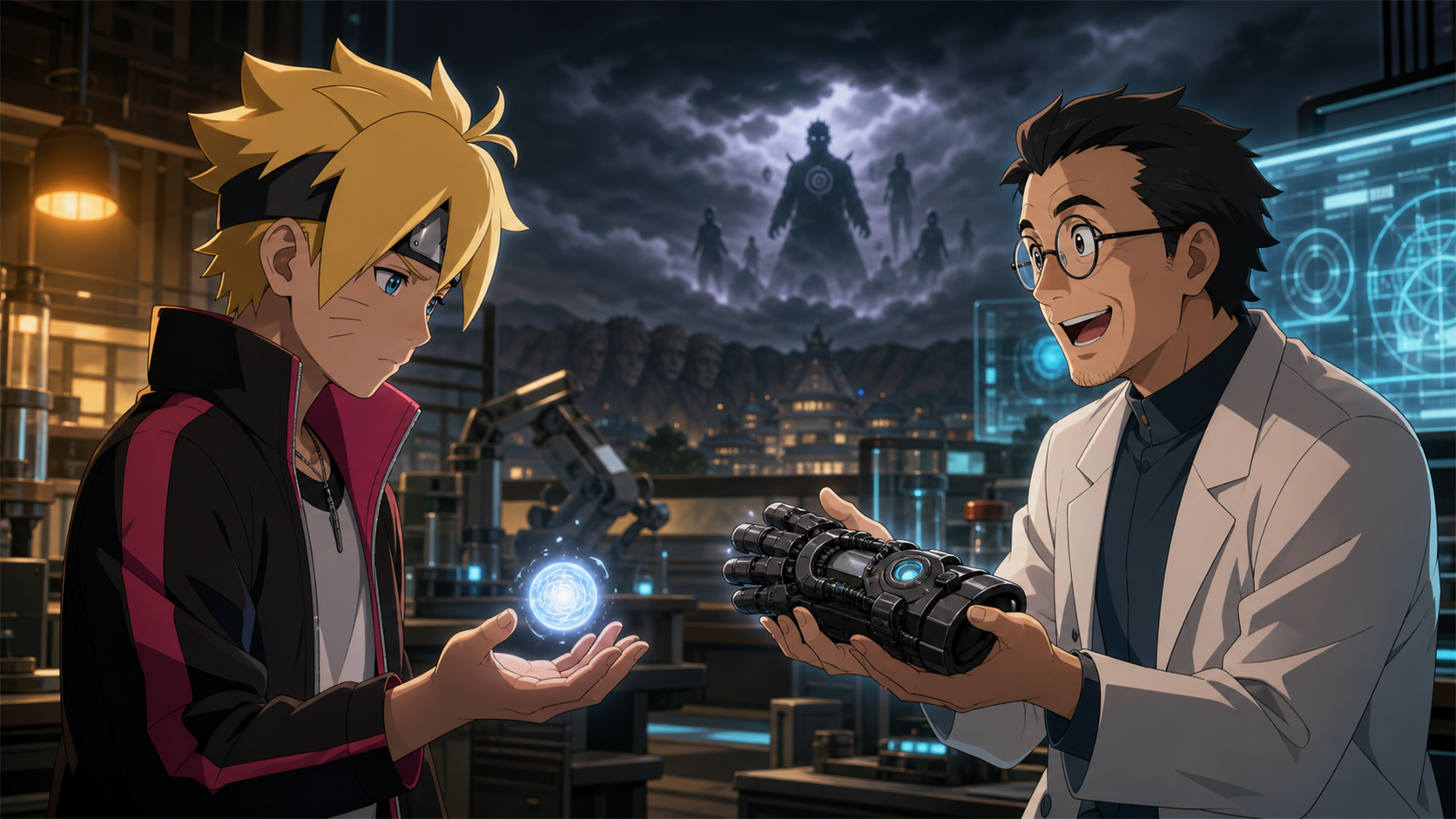
The Scientific Ninja Tool!
Boruto creates an original Vanishing Rasengan, then accepts a gauntlet that makes borrowed techniques look finished. Far away, Momoshiki attacks Killer B to harvest another person’s power.
Series: Boruto: Naruto Next Generations
Episode: 55 · The Scientific Ninja Tool!
Arc: Versus Momoshiki Arc
Release: 2018-04-25
Previous: Episode 54 · Sasuke and Boruto
Directory: All 293 Boruto episodes
Bottom line
Boruto Episode 55 puts two versions of power in the same child’s hands. Boruto has a tiny, strange Rasengan he built through actual training. The attack vanishes before impact, surprising even Sasuke. Then Katasuke gives him the Scientific Ninja Tool, a wrist-mounted shortcut that releases stored techniques with none of the uncertainty that made the Rasengan his.
The technology is not the villain. The Kote could change medicine, emergency response, disability access, and how ordinary shinobi survive impossible missions. The problem is Katasuke handing a prohibited device to the Hokage’s insecure son and letting praise do the manipulation. Boruto wants Naruto to look at him. Sasuke asks him to practice. The gauntlet promises a result that looks finished before Boruto has to risk being seen unfinished.
Meanwhile, Momoshiki and Kinshiki attack Killer B and extract Eight-Tails chakra. The parallel is not subtle. Both storylines involve power separated from the person who made or carried that power. One is a village invention. The other is predation on a catastrophic scale. The episode is asking who gets credit, who gets used, and what happens when strength becomes something another person can simply harvest.
Boruto’s small Rasengan is already special
Boruto completes the Rasengan challenge Sasuke gave him, but the result is smaller than the famous technique he expected. He sees size and assumes failure.
Sasuke sees more. The Rasengan disappears after being thrown, then strikes from outside the target’s expectation. Boruto has unconsciously added Lightning Release and created the Vanishing Rasengan.
That is not a consolation prize. Boruto takes a technique associated with Naruto, learns the foundation through Konohamaru, and produces a variation neither teacher handed him. The result belongs to his own chakra and instincts.
I need the story to sit with that longer. The child chasing borrowed perfection has already made something original.
Sasuke agrees to train the person Boruto really is
Sasuke accepts Boruto as a student after seeing the Rasengan. He does not require Boruto to become a smaller Naruto first.
That distinction matters because Boruto approaches the apprenticeship as a route toward beating or impressing his father. Sasuke keeps redirecting him toward skill, patience, and understanding. A good mentor cannot promise that training will repair a family relationship. Sasuke can give Boruto tools for becoming more honest about his own ability.
The irony is delicious and painful. Sasuke, who spent years rejecting every bond that could not immediately solve his anger, has become the adult asking a gifted child to stop demanding instant answers.
Konohamaru knows where the comparison hurts
Sasuke tells Konohamaru that he is training Boruto. Konohamaru understands the emotional geometry immediately. Boruto sees Sasuke as the cool, available version of power and Naruto as the father whose title keeps taking him away.
Konohamaru has his own history with both men. Naruto was the older boy who treated him as a person when adults saw only the Third Hokage’s grandson. Sasuke carries the Uchiha myth, the missing years, and the kind of distant competence Boruto can admire without having to ask for breakfast with him.
Boruto’s image of Sasuke is incomplete. So is his image of Naruto.
Boruto asks for Naruto’s weakness
During training, Boruto asks Sasuke about Naruto’s weaknesses. The question sounds tactical, but the emotional purpose is obvious. He wants a route around the father he cannot reach directly.
Sasuke answers by talking about Naruto’s past and the effort hidden behind his present strength. Boruto becomes irritated because he has heard versions of that story before. Everybody wants him to admire the orphan who became Hokage. Very few people ask him what living with the Hokage feels like now.
I understand Boruto’s impatience. Naruto’s childhood suffering does not cancel Himawari’s broken birthday cake or Boruto’s loneliness.
I also understand Sasuke’s point. Boruto keeps treating Naruto’s power as a finished object while resenting anybody who asks him to build his own strength slowly.
Sasuke cannot give him the shortcut he wants
Boruto wants one weakness, one technique, one dramatic move that will settle the argument. Sasuke gives him practice.
That answer feels emotionally insufficient because the problem is not truly combat. Boruto could become stronger than every genin in the village and still want his father home for dinner.
Sasuke’s training remains valuable precisely because the sessions cannot fake family repair. He can teach shuriken control, tactical patience, and how to read an opponent. He cannot make Naruto attend.
The Kote becomes dangerous because the device pretends the visible symptom is the whole problem. Win enough, look spectacular enough, and surely Naruto will finally respond.
Team 5 puts work on the page
Metal Lee, Iwabee, and Denki train for the exams with three very different relationships to confidence. Metal has physical ability that anxiety can scramble in public. Iwabee trusts force and experience. Denki relies on analysis while worrying that knowledge looks less impressive beside combat.
Their preparation reminds us that the Chūnin Exams are not a private Uzumaki family event. Other children are investing time, accepting fear, and carrying their teams into the same tests.
Every honest hour matters later when Boruto’s hidden device begins changing results. He is not cheating a blank bracket. He is entering a field full of people who practiced while nobody promised them the Hokage’s attention.
Team 15 plans instead of posing
Sumire, Wasabi, and Namida discuss likely opponents and possible strategies. Their scene is quieter than the loud training matches, but planning is part of readiness.
Wasabi wants decisive movement. Namida worries. Sumire reads the group and keeps the conversation useful. The episode allows different forms of competence to exist before the tournament starts ranking them.
I appreciate any scene that lets the girls prepare without reducing their purpose to reacting to Team 7. The exam belongs to their ambitions too.
Temari reminds Team 10 what pressure feels like
Shikadai, Inojin, and Chōchō spar against Temari, which is less a practice match and more a family weather emergency.
Temari does not let Shikadai hide behind “what a drag” when another village is sending serious competitors. She tells them about Gaara’s adopted son, Shinki, and the warning carries both auntie pride and tactical concern.
Team 10 already knows one another well. Their danger is comfort. Temari forces them to feel the distance between being competent around friends and making decisions against unknown techniques under public pressure.
Also, watching Shikadai discover that his mother has absolutely no interest in preserving his lazy image remains funny.
Shinki arrives before he appears
Episode 55 builds Shinki through Temari’s report and Gaara’s departure preparations. The audience hears that Gaara’s adopted son has unusual power and a large chakra reserve before meeting him in the exam crowd.
That setup connects Shinki to Gaara without revealing everything. Gaara was once the terrifying Sand child sent into Konoha’s Chūnin Exams as a weapon. He now sends an adopted son into an allied competition.
The repetition could become ugly if Gaara were simply reproducing what happened to him. Shinki’s discipline and relationship with his team will show that the family story has changed, even if the burden of representing the Kazekage remains heavy.
Boruto tries the Kote during shuriken practice
Katasuke’s device turns stored techniques into cartridges. Boruto can release a polished jutsu without performing the normal chakra transformation or practice behind the technique.
He tests the Kote during shurikenjutsu training and feels the immediate thrill. The result is clean. The frustration disappears. The machine appears to close the gap between what Sasuke asks and what Boruto wants to show.
This is where I start yelling at the screen.
Boruto’s own Vanishing Rasengan proves he can create something nobody expects. The Kote teaches him to distrust that messy originality in favor of somebody else’s finished move.
Katasuke knows which praise to use
Katasuke does not need to threaten Boruto. He treats him as special, capable, and important to the device’s success. For a child who feels secondary inside his own home, being selected by an admiring adult is powerful.
The adult responsibility is enormous. Katasuke knows the exam rules. He knows the device can hide authorship. He knows Boruto wants to impress Naruto. He supplies the tool anyway.
Boruto remains responsible for every later activation. Responsibility does not require pretending the two participants have equal power. One is a genin with a family wound. The other is a senior scientist using privileged access and professional authority.
The Kote is not proof that technology ruins shinobi
The series is right to resist a lazy “machines are bad” conclusion. Ninja tools have always extended bodies and techniques. Puppets, explosive tags, soldier pills, wire, prosthetics, medicine, and communication systems all change what a shinobi can do.
The Kote could let a medic deploy an emergency technique outside their natural affinity. A disabled shinobi could access tasks previously closed to them. Civilians could survive disasters while trained chakra users are absent.
The exam problem is disclosure. Candidates are supposed to demonstrate their own current judgment and ability under a shared rule. A hidden cartridge presents stored labor as personal mastery.
The Chūnin Exam application montage matters
Boruto, Sarada, Mitsuki, and the other genin sign up. The registration scenes turn training into commitment.
Some candidates want promotion. Some want proof. Some are following teammates. Some are carrying parental expectation into a room where the form looks the same for everybody.
Boruto’s reasons are already tangled with Naruto. Sarada’s Hokage ambition gives the exam a longer horizon. Mitsuki is interested in the choices Boruto makes. Team 10 understands the assignment as both competition and responsibility.
The paperwork cannot show any of that, which is why the episodes around the exam need to.
Far away, Urashiki reports what Earth has
Urashiki tells Momoshiki and Kinshiki about Kaguya’s territory, the spread of chakra among Earth’s people, and the tailed beasts that concentrate enormous power.
The Ōtsutsuki do not view the shinobi world as a network of families, villages, or histories. They see distributed resources.
Momoshiki’s chakra pills make the parallel with the Kote intentional. He consumes power gathered by others and converts that stolen work into instant personal force. Boruto is nowhere near Momoshiki’s cruelty, but both are being positioned around a shortcut that separates technique from training.
Killer B gets treated like a battery again
Momoshiki and Kinshiki attack Killer B and extract Gyūki’s chakra. Killer B has spent a lifetime becoming a person beyond the village’s jinchūriki label. The Ōtsutsuki reduce him to the valuable thing sealed inside his body.
The scene should feel horrifying, not merely useful as a villain-power demonstration. B and Gyūki have a relationship. The chakra being harvested belongs to a living partnership.
Naruto’s generation fought a war over tailed beasts being collected as resources. Peace has barely settled before a new set of predators arrives with the same basic hunger on a cosmic scale.
The attack is frighteningly brief
Killer B deserves more fight time. The episode uses his defeat to establish that Momoshiki and Kinshiki operate above ordinary threats, but the speed can make B feel disposable.
This is a jinchūriki who mastered cooperation with the Eight-Tails, trained Naruto, survived Akatsuki attention, and escaped more than one attempt to turn him into somebody else’s prize. A longer resistance would preserve the villains’ danger while giving B the dignity of his history.
Instead, the extraction lands like an alarm. The Chūnin Exams are beginning while something capable of hunting tailed beasts is already moving toward Naruto.
First watch: I wanted Boruto to trust the weird Rasengan
My first-watch frustration comes from watching Boruto hold an original technique and still believe he has nothing. The Vanishing Rasengan is small, but the disappearance changes how an opponent reads the attack.
That is Boruto’s strength in miniature. He is quick, inventive, and willing to bend the expected path. He does not need Naruto’s enormous chakra reserve to create a move worth respecting.
The Kote feels attractive because the episode has made his insecurity clear. I still wanted Sasuke to grab the gauntlet, look directly into whatever camera Katasuke was using, and say, “absolutely not.”
Second watch: Konohamaru understands more than he says
On replay, the Sasuke and Konohamaru conversation carries extra weight. Konohamaru knows Boruto’s admiration for Sasuke and resentment toward Naruto. He also knows the version of Naruto who changed his own childhood.
The adults around Boruto keep trying to translate father and son to one another. Translation cannot replace Naruto listening directly.
Konohamaru can teach the Rasengan. Sasuke can reveal Naruto’s history. Neither man can supply the ordinary attention Boruto keeps asking his father to provide.
Third watch: Momoshiki and Boruto are being placed on parallel tracks
Momoshiki consumes stolen chakra and turns power into pills. Boruto loads stored techniques into a device and experiences mastery without the training attached.
The moral scale is wildly different. Boruto is a hurt child making bad choices. Momoshiki is an invader attacking people for fuel.
The structural parallel still matters. Both learn to value the result while ignoring the person and process behind the power. The coming arc will force Boruto to confront that resemblance when Momoshiki’s absorption makes the gauntlet useless.
What the episode gets right
Episode 55 makes Boruto’s temptation understandable without proving the Kote necessary. His own Vanishing Rasengan is already evidence against the shortcut.
The side-team training gives the Chūnin Exam a community around Team 7. Temari’s warning builds Shinki effectively. Sasuke and Konohamaru show different forms of mentorship. The Killer B attack raises the threat beyond school competition.
Most importantly, the technology remains morally neutral until people decide how to use access, secrecy, and credit.
Where the episode falls short
Killer B’s defeat is too brief for his importance. Team 5 and Team 15 receive useful preparation scenes, but the montage could offer more specific character stakes.
Katasuke’s manipulation needs stronger immediate resistance from another adult. Sasuke appears perceptive enough to notice that Boruto’s results are changing, yet the device remains in place.
The episode also risks making persistence sound like a personality flaw unique to Boruto. He has shown persistence repeatedly when relationships matter to him. The real problem is that he does not trust slow work to earn Naruto’s attention.
The Vanishing Rasengan is already the answer Boruto keeps rejecting
Boruto looks at the small Rasengan and sees everything missing. The sphere lacks Naruto’s scale, dramatic weight, and instant recognition. Sasuke sees the change in chakra nature, the disappearing path, and a technique Naruto never created. One person sees failure. The other sees authorship.
That difference defines the episode. Boruto wants a result large enough to force Naruto’s attention now. Sasuke offers training that may create something original later. Katasuke offers cartridges that produce impressive techniques immediately, with no waiting and no risk that effort ends in an ordinary result.
The Kote does not manufacture fake chakra. Real shinobi developed every stored technique. Real researchers captured and encoded the work. The device becomes dishonest when Boruto hides the source and accepts evaluation as though every ability came from his own training.
Katasuke understands exactly which praise will move him. Calling Boruto gifted would not be enough. The scientist presents the tool as proof that Boruto can exceed expectations without relying on Naruto’s method. Independence gets confused with secrecy while the child becomes dependent on cartridges designed by adults.
Sasuke’s training offers a healthier inheritance. He teaches principles, creates pressure, and lets Boruto fail. The teacher contributes without erasing the student’s responsibility. When Boruto changes the Rasengan by accident, the result belongs to their relationship and Boruto’s chakra rather than a hidden inventory.
Konohamaru recognizes the emotional comparison because he once chased Naruto’s acknowledgment through imitation. He knows that copying a hero can begin training but cannot finish identity. Boruto has to discover which techniques express his own decisions.
The Chūnin Exam montage surrounds him with children doing that work. Team 5 trains through repetition. Team 15 plans around individual strengths. Temari pushes Team 10 beyond comfortable routines. Every group enters with incomplete skills exposed to honest testing.
Boruto could join them. His four clones, lightning affinity, shuriken practice, and Vanishing Rasengan already form a legitimate toolkit. The Kote feels necessary only because he evaluates every skill through the imagined speed of Naruto’s approval.
Momoshiki shows the endpoint of power without relationship
Killer B becomes a target because Momoshiki sees the Eight-Tails as concentrated chakra. No interest in B’s life, music, village, or partnership survives the calculation. A person becomes packaging around a resource.
The attack ends quickly because Momoshiki does not treat combat as an exchange between fighters. He extracts, processes, and moves on. Kinshiki serves the same hierarchy, carrying loyalty toward somebody who measures loyalty through usefulness.
Boruto has not become that person. He loves teammates, protects family, and creates bonds easily. The parallel concerns habit. Stored techniques invite him to admire outcomes while forgetting the people and hours behind those outcomes.
The Vanishing Rasengan resists that habit. The technique carries Sasuke’s teaching, Boruto’s effort, Naruto’s legacy, and an accidental transformation only Boruto produces. Every layer remains visible once somebody asks how the skill came to exist.
Momoshiki’s pills erase the history of absorbed power. The Kote can do the same when used without disclosure. Boruto still has time to choose the little Rasengan whose imperfect path belongs to him.
RaeRae verdict
Boruto Episode 55 gives Boruto exactly what he thinks he wants and shows us why the gift is dangerous. He has Sasuke as a teacher. He has a Vanishing Rasengan that is genuinely his. He has teammates preparing for the same exam. None of that feels certain enough to quiet the fear that Naruto will look away.
Then Katasuke offers certainty in cartridge form.
Across the world, Momoshiki harvests Killer B’s chakra because he sees power without personhood. Back in Konoha, Boruto begins using stored power because he sees a result without the hours behind the result.
Boruto is not Momoshiki. The parallel is a warning, not a verdict. The kid holding that tiny disappearing Rasengan still has a chance to recognize that his imperfect original work carries more of him than every flawless technique hidden under his sleeve.
Sources and lawful viewing
Official episode reference: Naruto Official episode guide
Licensed episode route: Crunchyroll licensed series page