
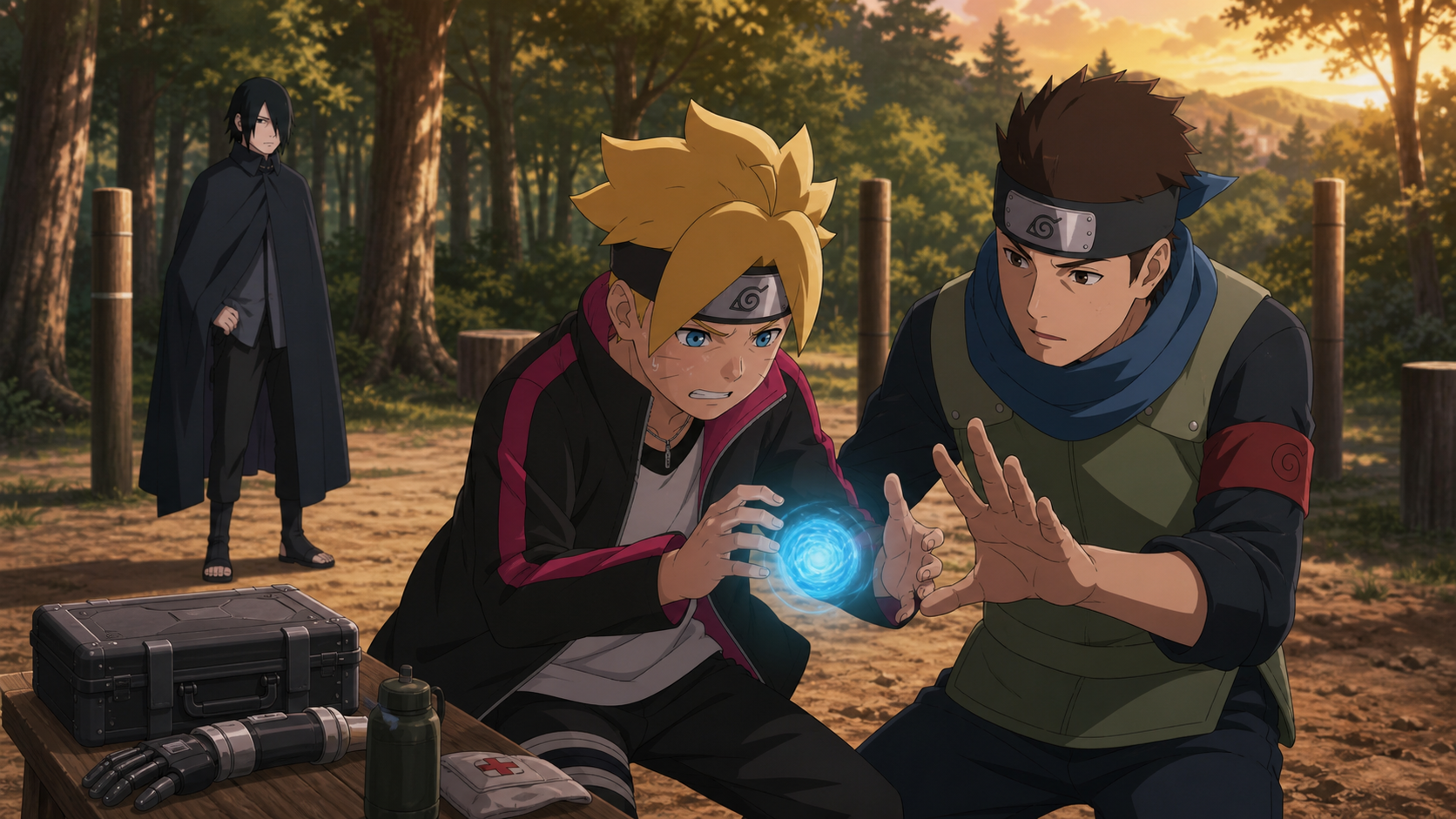
Sasuke and Boruto
Boruto asks Sasuke for power against Naruto, learns the Rasengan from Konohamaru, mistakes the small result for rejection, and leaves before seeing his attack vanish and land.
Series: Boruto: Naruto Next Generations
Episode: 54 · Sasuke and Boruto
Arc: Versus Momoshiki Arc
Release: 2018-04-18
Previous: Episode 53 · Himawari’s Birthday
Directory: All 293 Boruto episodes
Bottom line
Boruto Episode 54 begins an apprenticeship with all the wrong reasons and still produces something real. Furious after Naruto breaks his promise to attend Himawari’s birthday, Boruto decides Sasuke is the answer. Sasuke is powerful, mysterious, and unavailable in a way Boruto can mistake for freedom because Sasuke is not his father.
Boruto attacks him first, asks to become his student second, and admits he wants enough strength to defeat Naruto. Sasuke sets one condition: learn the Rasengan.
Konohamaru teaches him through water balloons, rubber balls, sore hands, exhaustion, and the kind of repetition Boruto hates when nobody is applauding. The result is tiny. Boruto assumes Sasuke has rejected him, throws the Rasengan away, and leaves before seeing the technique vanish and strike its target.
That disappearing attack is the episode’s answer. Boruto keeps reading small as worthless and distance as power. The Vanishing Rasengan proves that his difference is not a failed copy of Naruto. The frustrating, imperfect thing he made carries a possibility nobody else saw coming.
Sasuke picks up Naruto’s discarded jacket
Before Boruto and Sasuke properly meet, Sasuke finds Naruto’s old jacket in the street after the birthday disaster. The image connects the exhausted Hokage to the boy Sasuke remembers.
Naruto is inside the office blaming himself while Shikamaru helps with the work. He knows the shadow clone collapsing over Himawari’s cake was not a small mistake. Knowing does not repair the evening.
Sasuke carries the old jacket back with him, physically holding the history Boruto does not want to hear. Boruto sees the Hokage who failed his family. Sasuke sees the lonely boy who fought for every bond.
Both views are true. Neither person has the whole man.
The scroll brings a larger danger home
Sasuke returns from Kaguya’s ruined palace with information about the Ōtsutsuki threat. Naruto’s family crisis is happening beside a danger capable of swallowing villages.
That context explains Naruto’s workload without excusing how he handles home. Hokage duties are not fake. The threat is not paperwork invented to avoid dinner. Naruto is protecting people from something most of Konoha cannot yet see.
Boruto still needed his father at Himawari’s birthday.
I appreciate the story most when both facts remain in the room. Naruto is neither a deadbeat with a fancy hat nor a flawless public servant whose children must never complain.
Boruto attacks before he introduces himself
Boruto meets Sasuke by launching an attack. Sasuke blocks him with embarrassing ease.
The choice is pure Boruto. He wants to test the legend, prove courage, and avoid the vulnerable sentence underneath the performance: “Please help me because my father hurt me.”
Sasuke’s skill gap creates instant admiration. He is everything Naruto is not in Boruto’s current imagination: mobile, sharp, free from an office, and willing to meet force directly.
Of course the image is incomplete. Sasuke’s freedom is built from years of absence that Sarada has already paid for.
Sasuke looks cooler from outside his family
Boruto can idealize Sasuke because he does not wait for Sasuke to come home.
Sarada knows the missing chair, the unanswered questions, and the pain of meeting a father who did not recognize her. Boruto sees the cloak, sword, Rinnegan, and private mission. Distance reads as mystery when somebody else bears the loneliness.
This is one of the sharpest quiet tensions in their friendship. Boruto wants Sarada’s father. Sarada wants Boruto’s father’s office. Each child is staring at the public version of an adult whose private failures have shaped the other.
“Make me your student” is also revenge
Boruto tells Sasuke that Naruto broke a promise and asks for training. He wants to become strong enough to beat his father.
The goal is not really physical victory. Boruto wants to reverse the power relationship. Naruto decides when work interrupts family, when a clone is good enough, and when an apology arrives. If Boruto can defeat him, perhaps Naruto will finally have to stop and look.
That emotional logic makes sense for a child. A sparring win cannot create reliable time at home.
Sasuke recognizes enough of the anger to avoid giving him immediate power.
Sasuke sets the Rasengan condition
Sasuke agrees to take Boruto as a student if he can learn the Rasengan. The condition ties the apprenticeship Boruto wants to the father he is trying to escape.
The Rasengan came through Minato, Jiraiya, Naruto, and Konohamaru. Learning the technique means entering a chain of teaching rather than inventing a private rivalry with Sasuke.
Boruto accepts because he thinks the task is a gate. Sasuke understands that the work itself is the first lesson.
Power does not become his because he knows the right famous adult. He has to put his own chakra into the shape.
Konohamaru becomes the teacher the moment needs
Boruto asks Konohamaru to teach him. Konohamaru has spent years mastering a technique he first saw Naruto use and carries the Sarutobi family’s own complicated history of expectation.
He does not hand Boruto a finished answer. He begins with rotation in a water balloon, then increases the difficulty with a rubber ball.
Konohamaru’s teaching is patient without becoming soft. He knows Boruto learns quickly. He also knows the Rasengan punishes anyone who tries to replace control with attitude.
The episode gives him a meaningful bridge role between Naruto and Boruto. He can honor Naruto’s work without demanding that Boruto become Naruto.
The water balloon stage looks boring because learning is boring
Boruto wants the dramatic technique. Konohamaru gives him a water balloon.
This is exactly why the scene works. Foundational practice often looks ridiculous beside the final move. Rotation has to become bodily knowledge before power and containment can join the process.
Boruto complains because the task does not resemble the image he wants to present to Sasuke. Nobody watching a child pop balloons would assume legendary progress.
The Chūnin Exam cheating problem begins here, before the Kote appears. Boruto has already started separating valuable work from visible spectacle.
Pancakes unlock the rotation
While making pancakes for Himawari, Boruto recognizes a movement that helps him understand the Rasengan’s rotation. The domestic scene becomes part of the technique.
I love that detail. Boruto’s growth does not come only from a battlefield, an Uchiha mentor, or the desire to surpass Naruto. He learns while caring for his sister after their father damaged her birthday.
The same home life causing his anger also supplies the observation that moves him forward.
Power in this family has always been tangled with food, care, and the people waiting after a mission. The pancake solution feels more honestly Boruto than copying one of Naruto’s giant attacks.
Sarada watches him work
Sarada notices Boruto’s exhaustion and realizes he is taking the training seriously. She watches from a distance as he keeps returning to the technique.
Her attention matters because she knows his usual performance. Boruto likes appearing naturally brilliant. Repetition exposes how much effort sits beneath the result.
Sarada also understands why Sasuke’s approval matters, perhaps better than Boruto does. She has spent years wanting the same man to notice her life.
The episode could give her more direct involvement, but her witness protects Boruto’s work from being reduced to a lucky trick.
The rubber ball stage hurts
The second stage adds power and containment. Boruto’s hands, focus, and patience are pushed harder than the water balloon required.
This is where his persistence becomes undeniable. The policy-shaped version of Boruto as a child who simply refuses work cannot survive the footage. He practices for days. He arrives tired. He keeps trying after the novelty disappears.
Boruto’s weakness is not an inability to work. He struggles when work cannot guarantee the emotional result he wants.
That difference matters when Katasuke later offers certainty.
The Rasengan is tiny and Boruto hears rejection
Boruto finally produces a Rasengan and brings the small sphere to Sasuke. Sasuke comments on the size.
Boruto hears “not good enough.”
The reaction is larger than the sentence because the moment contains Naruto, the birthday, Sarada’s father, Sasuke’s legend, and days of hidden effort. Boruto cannot tolerate the possibility that all of that work still looks small.
He throws the Rasengan away and leaves before Sasuke can finish evaluating the technique.
That exit is frustrating because Boruto has done the difficult part and cannot remain in the room long enough to receive an answer that might complicate his shame.
Sarada calls Sasuke on the apparent cruelty
Sarada confronts her father after Boruto leaves. She has watched the work and thinks Sasuke dismissed the result too harshly.
I enjoy seeing her advocate for Boruto because their friendship often hides beneath arguments. She knows when he is showing off. She also knows when he has genuinely tried.
Her challenge forces the episode to acknowledge how Sasuke’s sparse communication can injure people even when his judgment is not cruel. He may understand the Rasengan. Boruto cannot read thoughts.
Sasuke has spent enough years speaking through dramatic departures. The man can use a complete sentence.
Sasuke had already decided to accept him
Sasuke explains that he was not rejecting Boruto. The small Rasengan met the condition, and the unexpected behavior after being thrown makes the technique more interesting.
Boruto and Sarada both jumped to conclusions. Sasuke also created the empty space where those conclusions grew.
Mentorship requires more than setting tests and privately approving the outcome. A student needs usable feedback. “Small” without context sounds like dismissal to somebody already expecting disappointment.
The episode lets Sasuke be perceptive without pretending he is naturally good at emotional delivery.
The Rasengan vanishes instead of failing
After Boruto throws the small Rasengan away, the sphere disappears and still hits the target. Sasuke recognizes that Boruto has unconsciously added Lightning Release.
The technique becomes the Vanishing Rasengan.
This is the payoff I wanted the entire article to orbit. Boruto thinks the jutsu disappeared because his effort was inadequate. The disappearance is the new power.
How many times does a child mistake difference for failure because every comparison uses an adult’s finished form as the standard?
Boruto’s Rasengan does not need to be Naruto-sized. The attack creates its own problem for an opponent.
Boruto inherits and changes the technique
The Rasengan reaches Boruto through family and mentorship, but the Lightning Release variation makes the result his.
Inheritance does not require duplication. Naruto made the technique his through Shadow Clones, enormous chakra, Sage Mode, and later transformations. Konohamaru adapted the teaching through his own experience. Boruto adds a disappearance nobody planned.
Sarada’s future relationship with Uchiha techniques follows a similar question. Children deserve access to family knowledge without being trapped inside a reenactment of their parents.
First watch: I was angry with everybody’s communication
Boruto attacks instead of asking. Naruto apologizes through shame more easily than reliable change. Sasuke offers one-word feedback. Sarada watches from behind a tree. Konohamaru teaches the clearest lesson because he is the only adult consistently saying what the next step is.
The episode’s misunderstandings are believable, but I wanted to put the whole family network at one table and ban dramatic exits.
Boruto leaving before Sasuke can respond made me yell because the tiny Rasengan is visibly an achievement. Sasuke letting him leave made me yell louder.
Second watch: the pancakes are the heart
On replay, the domestic training breakthrough carries more weight than the formal mentorship agreement.
Boruto is making pancakes for Himawari after Naruto ruined her birthday. Care creates the motion that helps him understand rotation. He is learning a technique tied to his father while doing the family work his father failed to do.
That contradiction is Boruto in one kitchen scene.
The story does not need to announce a lesson. Flour, batter, a tired brother, and one remembered hand movement do enough.
Third watch: Sarada and Boruto trade fathers
Boruto sees Sasuke as the cool master outside bureaucracy. Sarada sees Naruto as the present leader who supports her Hokage dream.
Each child wants the public version of the other child’s father.
That does not make their pain equal in every detail. The parallel does make their arguments richer. Sarada can recognize Boruto’s effort because she understands how much Sasuke’s judgment can matter. Boruto will eventually need to recognize what Sasuke’s distance cost her.
What the episode gets right
Episode 54 grounds a famous technique in repetitive practice, family frustration, food, mentorship, and miscommunication. Boruto’s progress feels earned. Konohamaru gets meaningful teacher work. Sarada’s observation validates the effort. Sasuke identifies the innovation.
The Vanishing Rasengan is also a perfect character technique. Boruto creates something small, easy to underestimate, and capable of changing direction after everybody thinks the moment has passed.
The episode refuses to make him a weaker Naruto. Good.
Where the episode falls short
Sasuke could communicate more clearly, and the episode sometimes treats emotional opacity as automatic coolness. Boruto’s attack-first introduction is funny, but the underlying family pain deserves a more direct follow-up.
Sarada needs more than observer status in an episode titled for her father and teammate. Her confrontation helps, yet the apprenticeship affects her relationship with both boys.
Naruto’s remorse appears without a concrete home repair. Feeling terrible in the office is not the same as rebuilding trust with Himawari and Boruto.
Boruto wants Sasuke because Sasuke looks like freedom from Naruto
Boruto does not approach Sasuke with a clean desire to learn. He sees the famous rival who can challenge Naruto, leave the village, return on his own terms, and still command the Hokage’s respect. Becoming Sasuke’s student feels like training and revenge wrapped together.
That fantasy ignores the cost of Sasuke’s life. Distance did not make him free. Isolation damaged friends, family, and himself. Adult Sasuke travels because his Rinnegan and history make him uniquely capable of investigating threats, not because absence is a glamorous personality trait.
Boruto attacks before introducing himself because performance feels safer than asking. A successful ambush might prove worthiness instantly. Failure lets him blame the gap in strength instead of naming the need beneath the challenge: teach me, see me, and help me become somebody my father cannot dismiss.
Sasuke recognizes Naruto’s stubbornness in the boy and refuses the shortcut. The Rasengan condition requires Boruto to learn a technique tied directly to Naruto. Boruto cannot become Sasuke’s student by using Sasuke as an escape from his father. Training begins through the inheritance he resents.
Konohamaru becomes essential because legends still need teachers who can explain steps. He breaks the Rasengan into rotation, power, and containment. The work looks boring because foundational learning usually looks boring. No crowd, dramatic rival, or immediate praise arrives to make repetition feel important.
Himawari’s pancakes unlock the motion because family knowledge enters from an unexpected direction. Boruto sees the swirl in batter and understands what verbal instruction never made visible. The domestic image contributes to a combat technique without becoming lesser for coming from a kitchen.
Sarada watches the process while negotiating her own complicated view of Sasuke. Boruto idealizes the absent shinobi because distance looks cool from outside. Sarada lives with the loneliness that distance creates. Each child wants access to the father the other can see more clearly.
The tiny Rasengan becomes original before Boruto can value originality
Boruto completes the shape, but the result looks too small. He measures the sphere against Naruto’s giant versions and hears inadequacy before Sasuke gives a verdict. Shame answers first.
The disappearance appears to confirm failure. Boruto throws the technique, sees the visible sphere vanish, and assumes the chakra dissolved. Sasuke watches the attack continue along an invisible path. Lightning Release changed the Rasengan without Boruto consciously planning the transformation.
Accident does not make the result meaningless. Boruto supplied the chakra nature, training, and instinct. Sasuke provided the condition. Konohamaru taught the method. Himawari supplied the visual clue. The technique belongs to Boruto precisely because all those relationships produced a change nobody else predicted.
Sasuke’s communication still deserves criticism. He allows Boruto to walk away believing the attempt failed, then reveals that acceptance had already been decided. Emotional opacity may look impressive, but a child at the edge of shame needs accurate feedback more than another mysterious pause.
Sarada calls him out because she sees the injury forming. Her intervention proves observer status has value, though the episode should give her more space. Sasuke’s new student will affect her access to her father, her training, and Team 7’s balance.
The Vanishing Rasengan answers the identity problem Boruto brought to the doorstep. He does not need to become Naruto or Sasuke. He can inherit Naruto’s technique, learn under Sasuke, receive Konohamaru’s guidance, remember Himawari’s pancakes, and create a result none of them owns alone.
Boruto cannot value that answer yet because originality arrives small. The coming temptation will offer borrowed techniques that look complete. Episode 54 makes the choice painful by showing that his own imperfect work had already become extraordinary.
The episode also proves that apprenticeship should expand identity rather than replace identity. Sasuke does not need another version of himself, and Boruto does not need a cooler father substitute. Their best work begins when Sasuke recognizes a technique only Boruto could make and Boruto eventually learns to recognize the same truth.
RaeRae verdict
Boruto Episode 54 starts with a child trying to borrow Sasuke’s legend as a weapon against Naruto and ends with proof that Boruto’s own strange contribution was enough.
Konohamaru gives him the process. Himawari’s pancakes give him the motion. Sarada witnesses the work. Sasuke sees the Lightning Release hidden inside the small sphere.
Boruto sees only size and walks away.
That is the ache. He has already made the Vanishing Rasengan, a technique that will matter against enemies far beyond this exam, and shame convinces him the disappearing act means nothing.
The next time somebody offers a shortcut, remember this episode. Boruto did not need borrowed perfection. He needed enough patience to watch his own imperfect work land.
Sources and lawful viewing
Official episode reference: Naruto Official episode guide
Licensed episode route: Crunchyroll licensed series page