
RaeRae Reacts · One Piece Episode 183
Luffy Ricochets Past Mantra as Deathpiea Begins
One Piece Episode 183 lifts Ark Maxim, activates Deathpiea, and lets Luffy defeat Mantra’s prediction through reflex and unpredictable ricocheted punches.
What I loved: Luffy’s empty-mind dodge is clever and completely useless for attacking. That is the joke and the limitation. He finds a way around Mantra, then realizes a body acting without intention cannot aim a punch. The second solution, bouncing attacks off the wall, keeps the unpredictability while giving the chaos somewhere to go.
I could feel Enel getting offended by physics. He can accept resistance only when resistance still recognizes him as the center of the fight. Luffy’s ricochets remove that privilege. Enel cannot read a route nobody planned, and his panic is far more satisfying than another speech about godhood.
What happens in One Piece Episode 183?
One Piece Episode 183, “Maxim Rises! The Start of Deathpiea,” continues the duel after Luffy proves rubber can touch lightning. Enel changes weapons, reshaping his golden staff into a heated spear that can burn and pierce. Mantra lets him read Luffy’s intended attacks, so natural immunity does not become easy victory. Enel powers Ark Maxim, lifts the golden ship, and activates Deathpiea.
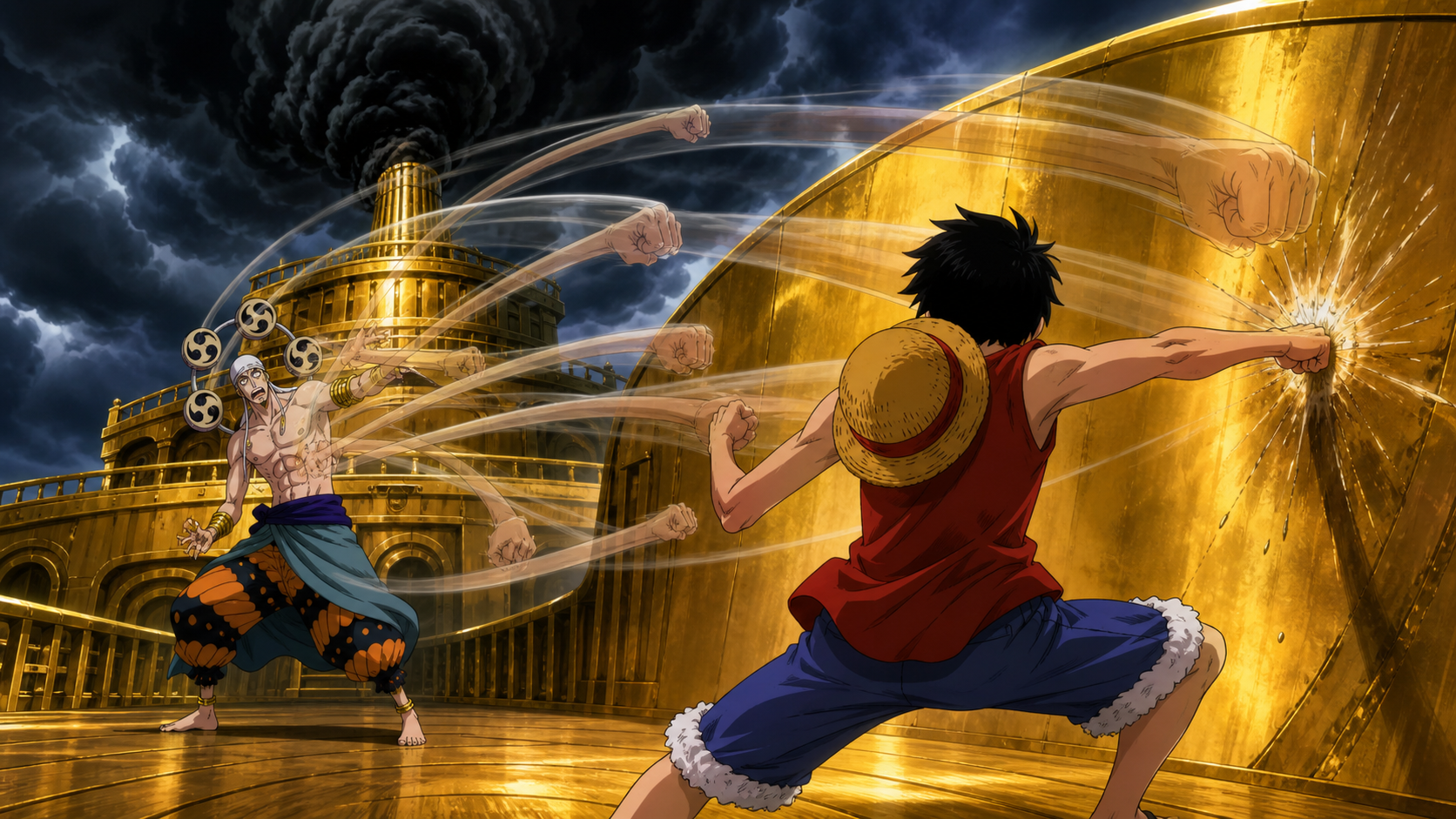
Black thunderclouds spread over Skypiea while evacuation moves through Angel Island. Luffy first empties his mind so Mantra cannot predict reflexive dodges, but the blank state prevents deliberate attack. He then punches Maxim’s wall with loose rubber limbs, letting uncontrolled ricochets strike Enel from directions neither fighter planned. The barrage and a Bazooka leave Enel panicking as Luffy prepares another Rifle.
Enel learns what rubber means through failure
The White-White Sea has no familiar rubber culture, so Enel does not understand the word when Luffy identifies his body. That ignorance matters because godhood has allowed Enel to treat unfamiliar facts as impossible facts. Luffy remains present anyway.
Knowledge arrives through consequences. Lightning fails, physical contact lands, and Enel has to revise the fight. The ruler who listened across an island discovers that hearing everything nearby does not equal understanding the wider world.
The golden staff becomes a heated spear
Enel abandons electricity as the direct answer and uses heat to reshape gold into a spear. Rubber insulates against voltage but can still burn, tear, and receive blunt force. The weapon restores danger without violating the natural counter.
This adaptation makes Enel more frightening than stubborn escalation would. He is arrogant, not incapable of learning. Once a method fails, he changes the damage type. Luffy’s advantage opens access but does not remove pain.
Mantra keeps Luffy from landing clean attacks
Luffy throws strikes that would hurt Enel if they connected. Mantra reads intention before movement completes, allowing Enel to step around each direct line. Luffy can touch the Logia body and still struggle to reach the body.
The distinction is tactical and emotional. Episode 182 broke Enel’s untouchable myth. Episode 183 refuses to pretend one broken layer ends the fight. Prediction remains a separate defense that requires a separate answer.
Gomu Gomu no Daze removes conscious intent
Luffy lets his mind go blank and allows his body to sway around the spear through reflex. Enel cannot read a planned destination because Luffy has not selected one. Air movement and instinct guide the dodges.
The idea is ridiculous enough to sound like a joke and precise enough to expose Mantra’s input. Prediction depends on intention. Remove intention, and the forecast loses the future action needed for accuracy.
A blank mind cannot choose an attack
Luffy discovers the immediate flaw: unconscious defense creates no deliberate offense. He can avoid the spear while remaining unable to strike Enel. Safety without agency leaves Maxim free to rise and Deathpiea free to spread.
The failed experiment still produces knowledge. Luffy now knows unpredictability works. The next problem is creating unpredictable impact without surrendering the ability to act. Progress arrives through a bad first version.
Gomu Gomu no Octopus turns the wall into a partner
Luffy loosens his arms and legs, turns away from Enel, and punches Maxim’s curved gold surface. The fists rebound through natural angles. Luffy controls the starting action but not each return path.
The wall becomes part of the technique. Instead of trying to outthink Mantra, Luffy adds an environment that redirects force after intention ends. Enel can read the punch toward the wall, not every ricochet leaving the wall.
Ricocheted fists defeat prediction without defeating Enel
Reflected punches reach Enel from multiple directions and finally batter the body Luffy could not approach directly. The success belongs to randomness inside a bounded physical system, not pure luck. Gold provides reliable bounce while flexible limbs multiply paths.
Enel takes damage and loses composure, but the episode stops before final victory. The distinction keeps Episode 184 material outside this React. Here, Luffy has found a way through Mantra and created panic.
Nami sees an impossible decision aboard Maxim
Nami understands that Enel powers the ark. If he dies at the wrong moment, Maxim may crash into Skypiea. If he continues piloting, Deathpiea may destroy the islands. Every available outcome appears catastrophic.
Coercive systems often leave survivors responsible for managing disasters created by the aggressor. Nami did not build Maxim or activate the clouds, yet she has to calculate how stopping Enel might harm the people below.
Luffy puts the straw hat on Nami’s head
Luffy responds to Nami’s fear by placing his hat with her and telling her to have more faith as a future Pirate King’s crewmate. The gesture echoes earlier promises without requiring a long strategy meeting.
The hat gives Nami custody of something Luffy treats as irreplaceable. Trust travels both ways. He asks her to believe in his fight while physically showing belief in her survival and judgment.
Pirate King sounds larger than Enel’s private heaven
Enel becomes interested when Luffy names the Pirate King. Luffy describes a ruler associated with the greatest sea, while Enel imagines solitary ownership of Fairy Vearth. The titles reveal different scales of desire.
Luffy’s dream requires open movement through a world full of other wills. Enel’s dream requires eliminating everybody who might complicate his destination. One ambition seeks freedom among people. The other seeks freedom from accountability.
Ark Maxim rises through stolen power
Enel channels electricity into the golden machinery and lifts Maxim from the cavern. The ship catches against the walls before breaking toward open sky. Gold conducts the current that makes the impossible vessel move.
The spectacle cannot separate technology from theft. Shandora supplied the metal. Forced workers supplied construction. Enel supplies energy and claims sole authorship. Maxim rises because many stolen inputs meet inside one machine.
McKinley organizes evacuation instead of worship
Angel Island residents rush toward escape while McKinley works to prevent panic from turning movement into another hazard. The officer who once enforced Enel’s order now uses organizational skill to protect residents from Enel.
Institutional knowledge can serve a different purpose when loyalty changes. Routes, crowd control, and communication no longer shield divine authority. They help civilians survive long enough to leave.
An old man mistakes surrender for faith
An elderly resident sits crying and says years of belief have prepared him to accept whatever fate God chooses. Enel’s rule has made death feel like obedience. McKinley rejects that conclusion and insists that no god owns the right to take their lives.
The exchange turns evacuation into moral recovery. Leaving is not cowardice or heresy. Survival becomes a duty to oneself, family, and community. The old man stands because another person gives him permission to want tomorrow.
Residents choose to warn the Shandia too
Several evacuees volunteer to carry the warning toward the Shandia settlement. The decision crosses the political separation created by four hundred years of conflict. Destruction will not respect those boundaries, and neither should the warning network.
Solidarity becomes practical before reconciliation becomes complete. Skypieans do not need every historical dispute settled before recognizing that Shandia families deserve the same chance to flee.
Deathpiea converts air into an extermination system
Maxim releases dark clouds formed through intense air currents condensed by Enel’s electrical power. As the clouds spread, Enel can discharge lightning across a much larger area than one direct strike.
The system industrializes God’s Judgment. Individual punishment becomes infrastructure capable of erasing an island. Maxim scales one ruler’s violence beyond the reach of his arms and eyes.
A demonstration bolt turns explanation into evacuation evidence
Enel raises a hand and sends lightning from the new clouds into Angel Island, destroying buildings in view of fleeing residents. He calls the strike a preview. The language treats homes as props in a product demonstration.
Conis and McKinley no longer need to persuade the crowd through testimony alone. The black sky and shattered structures confirm the warning. Evidence arrives brutally late but moves evacuation forward.
Luffy rejects a god defined by taking
Luffy hears Enel describe the right to remove land, homes, and lives. He asks whether godhood means taking whatever the ruler wants. The question reduces Enel’s cosmic language to recognizable theft.
That clarity matters more than theological accuracy. Enel can discuss rightful places and ascension. Luffy sees a man hurting friends and stealing a sky. The moral problem becomes direct enough to punch.
Manga and anime placement
Episode 183 adapts Chapters 280 and 281 during the Skypiea arc. The official Japanese archive lists February 29, 2004 as the broadcast date, with Michiru Shimada credited for script, Takahiro Imamura for episode direction, Kazuya Hisada for animation direction, and Miyuki Sato with Kunihiro Chida for art.
The adaptation balances invention and catastrophe. Luffy experiments with movement on Maxim while Deathpiea expands beyond the duel. McKinley organizes survival below. Each successful tactic races against a machine already changing the sky.
Final reaction to Deathpiea’s activation
Episode 183 turns Luffy’s silliness into disciplined problem solving. Daze fails as offense, so Octopus ricochets preserve unpredictability while returning impact. The comedy belongs to the method, not to the stakes.
Deathpiea keeps that victory from shrinking the crisis. Enel can bleed and still power an extermination system. Residents can evacuate and still lose homes. Luffy can penetrate Mantra and still need to stop Maxim.
The episode draws a useful line between instinct and randomness. Daze removes deliberate thought, allowing reflexive defense but no chosen response. Octopus begins with a chosen action and then releases control over the result. Luffy does not become mindless for the whole exchange. He decides where to place uncertainty. That difference turns an amusing body trick into strategy. Good improvisation is not the absence of thought. Good improvisation recognizes which part of a problem thought has made predictable and hands that part to a physical system.
Nami remains the person translating Luffy’s strange experiments into understandable mechanics. She identifies the failure of Daze, sees the ricochet logic, and reads Enel’s inability to forecast impacts created by the wall. Her commentary protects the fight from becoming arbitrary. Luffy invents through bodily intuition. Nami describes why the invention works. The crew’s intelligence is distributed, and the captain’s breakthrough becomes clearer because another person can name the rule.
McKinley’s speech to the old man carries the same rejection of predetermined outcomes. Enel wants citizens to experience destruction as fate. The old man has internalized that framing so completely that surrender feels faithful. McKinley restores a choice by separating survival from disobedience. Below, a resident learns that wanting life is allowed. Above, Luffy learns that an unreadable attack is possible. Both discoveries weaken the future Enel declared inevitable.
The decision to warn the Shandia deserves equal weight. Skypieans could have treated evacuation as protection for their own neighborhood and allowed old hostility to decide who heard the warning. Instead, volunteers recognize that shared danger creates immediate responsibility across the border. That choice does not erase the theft of Upper Yard. The choice does show that a different political future can begin through who receives lifesaving information.
Maxim itself becomes the episode’s ugliest contradiction. The ship is a technological marvel capable of rising through clouds, yet the ultimate function is designed to manufacture a sky where nobody else can live. Engineering expands possibility while Enel narrows human presence. The problem is not invention. The problem is invention governed by one person who treats every other life as debris beneath a private destination.
The episode ends with Enel desperate enough to retreat from the next Rifle, which matters after so many scenes built around everyone else fleeing his judgment. Fear has crossed the platform. Luffy has not stopped Deathpiea, but he has changed who believes escape is necessary. That reversal gives the survivors below a little more narrative space to imagine that evacuation may preserve people for a world after Enel.
RaeRae’s verdict: a ruler who calls destroyed homes a preview has explained enough. Luffy’s reflected fists give Enel the only feedback his system never designed to receive.