
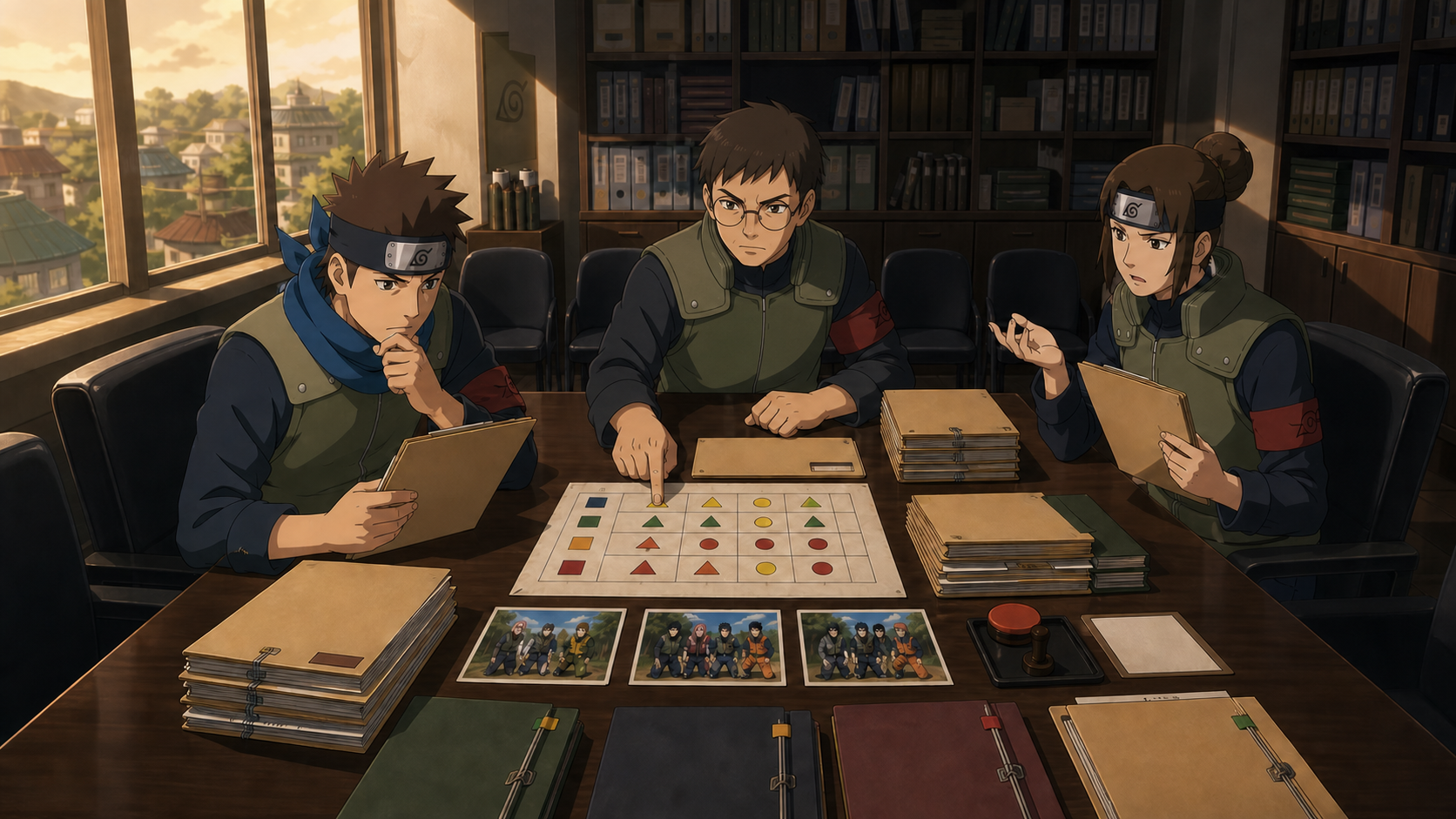
The Chunin Exams: The Recommendation Meeting
Konohamaru worries Boruto has survived too much through luck, the teachers judge how far every team has grown, and one serious meeting ends in drunken insect chaos.
Series: Boruto: Naruto Next Generations
Episode: 50 · The Chunin Exams: The Recommendation Meeting
Arc: Chunin Exams Arc
Release: 2018-03-21
Previous: Episode 49 · Wasabi and Namida
Directory: All 293 Boruto episodes
Bottom line
“The Chunin Exams: The Recommendation Meeting” is a recap episode, and I am not going to pretend otherwise. Half the runtime revisits missions we already watched. What saves the episode is the person doing the remembering. Konohamaru has to decide whether Boruto, Sarada, and Mitsuki are ready for the Chunin Exams, and his hesitation is more interesting than another speech about how talented Team 7 has become. He has seen them succeed. He has also seen luck, reckless choices, adult rescue, and Boruto charging toward danger because somebody told him no.
The meeting lets Konohamaru, Moegi, Udon, and Shino behave like adults who grew up together and now have children under their command. They compare teams, defend their students, tease one another, and eventually take the conversation to a bar where Hanabi drinks Konohamaru under the table and Shino’s insects turn one night out into a Hokage-level cleanup call. The comedy keeps the recap from becoming homework. More importantly, the teachers do not ask who can win the flashiest fight. They ask whether these genin have grown enough to face an exam designed to expose judgment, teamwork, nerve, and every weakness a child hoped nobody noticed.
Shikamaru is doing Naruto’s paperwork again
Konohamaru begins by delivering a mission report to Shikamaru, who is buried under Hokage paperwork while Naruto meets with the daimyō. The sight is funny because Shikamaru once wanted a life with minimal trouble, and adulthood rewarded him with everybody else’s forms.
The Chunin Exam documents catch Konohamaru’s attention. Shikamaru tells him to think about recommending his team, then leaves the responsibility where the responsibility belongs. Naruto and Shikamaru may organize the event, but Konohamaru has watched Team 7 work close enough to know what their victories cost.
Recommendation makes Konohamaru nervous
Konohamaru wants his students to advance. He also worries that Boruto has relied on luck and that a serious failure could crush him. That concern is not an insult. A teacher who only remembers the winning moment is not paying attention.
Boruto has talent, quick instincts, and the confidence to move when other people freeze. He also takes unnecessary chances and sometimes treats correction like a personal challenge. The exam will place those traits under pressure in front of other villages. Konohamaru understands that confidence can become fuel or shrapnel depending on what happens next.
The adults remember the class before the teams
Shino joins Konohamaru, Moegi, and Udon as they revisit the Academy class that produced the current genin squads. Those students caused an absurd amount of trouble before graduation. Nue, the class trip to the Land of Water, graduation exercises, family conflicts, and first missions already pushed them beyond an ordinary school year.
The recap has a clear purpose when viewed through the teachers. We are not simply watching old clips because the production needed breathing room before the Chunin Exams arc. The instructors are building an argument from what they witnessed. Did the children merely survive unusual events, or did they learn enough from those events to deserve the next test?
Shino has every right to look exhausted
Shino taught the class through possessions, explosions, disappearances, fights, and Boruto’s talent for turning one problem into a village-wide situation. His students grew, but they did not make his job peaceful.
I love that Shino still defends them. He knows the trouble better than anybody and can identify the change because he watched the beginning. His quiet pride gives the recap emotional value. These children did not become responsible overnight. Shino saw them fail, recover, apologize, and try again often enough to recognize a pattern.
Team 7 has the loudest résumé
Boruto, Sarada, and Mitsuki have already handled missions and crises that most new genin would never meet. They bring unusual strength, excellent observation, flexible ninjutsu, and a team bond that keeps tightening under pressure. On paper, their case looks easy.
Konohamaru knows the paper leaves things out. Boruto can become obsessed with proving himself. Sarada sometimes carries more strategic responsibility than her rank should require. Mitsuki’s devotion to Boruto can blur the line between loyalty and independent judgment. Their strengths are real, and their rough edges travel with them.
Boruto’s luck is not imaginary
Konohamaru specifically worries that Boruto has survived situations where timing, hidden help, or circumstances broke in his favor. Fans sometimes treat that observation as the episode disrespecting Boruto’s ability. I hear a teacher asking whether success taught the correct lesson.
A talented child who survives a reckless choice may conclude that the choice was brilliant. Boruto often improvises well enough to make the conclusion tempting. The Chunin Exams will reward speed and creativity, but later leadership cannot depend on every gamble finding a rescue at the exact second Boruto needs one.
Sarada has been practicing leadership already
Sarada’s Hokage ambition is not a cute slogan attached to an Uchiha child. She watches team dynamics, reads opponents, challenges Boruto when his pride outruns the mission, and asks what the group needs. Her Sharingan gives her information, but her value does not stop at her eyes.
The recommendation meeting should be a strong moment for her because the exam is not only about power. Chunin are expected to make decisions that affect other shinobi. Sarada has already started thinking in those terms. She still needs experience, but the direction of her growth is visible.
Mitsuki remains the hardest student to evaluate
Mitsuki is calm, powerful, observant, and far more dangerous than most people around him fully understand. He also built much of his early identity around Boruto as his sun. A promotion exam can test whether Mitsuki acts from his own judgment when Boruto chooses badly.
His unusual origin should not erase the work he has done with Team 7. The origin does make ordinary assumptions unreliable. Konohamaru has to evaluate the student in front of him, not Orochimaru’s reputation and not the fantasy that Mitsuki’s quiet manners mean every internal question has already been settled.
Moegi knows Team 10 is more than inherited formation
Shikadai, Inojin, and Chōchō carry famous clan techniques and a family formation with generations of history. That inheritance gives them an advantage. The same inheritance creates expectations before they decide what kind of shinobi they want to become.
Moegi has watched them learn to use the old structure without becoming copies of their parents. Shikadai sees patterns quickly, Inojin has to work through the gap between borrowed technique and personal confidence, and Chōchō’s easy self-belief can hide how seriously she reads people. Team 10’s readiness lives in how those differences support one another.
Udon’s Team 5 has something to prove
Metal Lee, Iwabee, and Denki look uneven beside the children of legendary shinobi. Metal has physical skill tangled with anxiety. Iwabee has strength and practical experience tangled with impatience. Denki has technical intelligence without the same combat background.
Their missions have forced each boy to depend on the abilities he once dismissed in somebody else. That growth belongs in the recommendation conversation. A Chunin candidate does not need to resemble the strongest person in the room. A candidate needs to understand what the team can do and make sound choices with the team that actually exists.
The recent Team 15 mission matters
Wasabi, Namida, and Sumire just finished a mission that exposed conflict, fear, and the consequences of Sumire’s history with Nue. The mission did not end because one girl became dramatically stronger. The team repaired trust and worked through information that could have split them.
That kind of growth is easy to overlook when the Chunin Exams are marketed through combat. Leadership often looks like telling the truth before silence becomes another danger. Team 15 has emotional work left, but the adults have evidence that the girls can face a fracture rather than pretending no fracture exists.
Recap episodes live or die by the framing
I normally groan when a series pauses for clips right before a major arc. Episode 50 gets away with more than most because the clips answer a current question. The teachers are not narrating everything Boruto has ever done. They are comparing the students who entered Shino’s classroom with the genin now asking for harder work.
The episode still feels padded in places. No framing device can make every repeated sequence fresh. However, the adult conversation adds evaluation, affection, and doubt. The recap becomes a report card written by people who know the children well enough to argue over the grade.
Konohamaru fears the wrong kind of failure
He worries that failing the exam could crush Boruto. I understand the concern, especially because Boruto ties recognition to his conflict with Naruto. A public loss could hit every insecurity at once.
Failure might also teach Boruto something success has not. He needs to learn that one result cannot define his talent, his relationship with Naruto, or the value of Team 7. Protecting him from every loss would leave the deeper problem untouched. Konohamaru’s job is not to guarantee Boruto wins. His job is to decide whether Boruto can enter, fail, learn, and return without abandoning himself or the team.
Moegi and Udon push Konohamaru forward
The other teachers do not share his level of doubt. They remind him that Team 7 has grown and that uncertainty cannot become a permanent excuse to hold capable students back. Their disagreement feels affectionate because all three understand what recommendation means.
Konohamaru once followed Naruto around as a loud child determined to become Hokage. Moegi and Udon remember that boy. Watching him worry that Boruto is too reckless has to be a little hilarious. The former troublemaker became the adult rubbing his forehead over the next one.
Their friendship makes the meeting work
Konohamaru, Moegi, and Udon were Team Ebisu long before they became instructors. The episode lets that history exist without a large nostalgia speech. They interrupt, tease, and challenge each other like people who have been doing so for years.
That familiarity matters because recommending students can become defensive. Nobody likes hearing that a beloved team has weaknesses. These three can question one another without turning the conversation into professional hostility. Their old bond gives the new generation a better review than three isolated reports would.
Hanabi arrives and the meeting loses all dignity
Once the teachers go drinking, Hanabi joins the group and matches Konohamaru drink for drink. The serious debate about children, leadership, and exam readiness slides into competitive alcohol nonsense with astonishing speed.
I support this detour completely. Adults in Naruto have spent years carrying wars, clans, village duty, and children who sprint toward forbidden ruins. Let them be ridiculous for one evening. Hanabi’s confidence and Konohamaru’s inability to back down turn the bar into a different kind of examination, and he is absolutely not ready.
Konohamaru versus Hanabi is the real preliminary round
Konohamaru tries to keep pace because pride is hereditary in the Naruto universe even when bloodlines are not involved. Hanabi drinks with the calm focus of somebody who already knows the outcome. Watching Boruto’s instructor ignore obvious limits while worrying about Boruto’s impulsiveness is excellent comedy.
The parallel is not subtle, but the episode does not need subtlety here. Konohamaru is responsible, experienced, and still capable of making a bad choice because somebody challenged him in front of friends. Maybe Boruto’s teacher understands his student so well because the same button still works on both of them.
Shino should never be given accidental alcohol
Hanabi accidentally gets Shino drunk, and the situation escalates when he loses control of his insects. Shino is already the quietest person in the group. Of course his drunken disaster would involve an entire swarm rather than one embarrassing sentence.
The gag also pays off years of Shino being overlooked. Everybody remembers him once insects fill the room. Naruto eventually has to respond, which means the Hokage gets called away from international and village responsibilities because his old classmates cannot manage happy hour.
Naruto cleaning up the teachers is perfect
Naruto spent his childhood causing incidents while teachers chased him. Now he is Hokage and gets summoned because the instructors responsible for evaluating the next generation created their own insect emergency.
That reversal gives Episode 50 the warmth a pure recap would lack. The old children grew into adults, but adulthood did not sand away every foolish trait. Naruto, Konohamaru, Shino, Moegi, Udon, and Hanabi carry history into the room. The next generation does not replace them. The next generation makes their growth visible.
The Chunin Exams remain a strange institution
Even in a peaceful era, Konoha uses a public multinational exam to evaluate children for greater mission authority. The spectacle is exciting. The premise is still wild when spoken plainly.
Episode 50 helps by showing adults taking the recommendation seriously. The teachers know combat strength is not the whole question, and Konohamaru worries about Boruto’s emotional response before anybody enters the arena. That concern cannot make the institution safe, but the concern keeps the story from treating recommendation as a free tournament ticket.
The episode sets up Boruto’s coming contradiction
Konohamaru worries Boruto has relied on luck. Within the coming arc, Boruto will rely on a hidden Scientific Ninja Tool to manufacture techniques and pass them off as his own. The recommendation therefore carries an irony Konohamaru cannot yet see.
Boruto deserves the chance based on his real ability. Boruto also enters the exam desperate to prove that ability to Naruto and everyone who compares him with Naruto. The pressure does not come from the exam alone, but the arena gives his insecurity a scoreboard.
My favorite moment is Konohamaru admitting doubt
The drinking chaos is funnier, but Konohamaru’s hesitation is the part I respect. He could recommend Team 7 automatically and take their success as proof of his own teaching. Instead, he asks whether Boruto’s pattern will hold when luck stops helping.
Good mentors are allowed to believe in a student and worry about the same student. Konohamaru does not want Boruto protected from growth. He wants to know whether the next challenge will build him or break the part already fighting for Naruto’s acknowledgment.
The part that does not fully work
Twenty-three minutes is a long time to spend revisiting material the audience saw during the previous year. Some clips repeat obvious points, and the episode occasionally feels more like a production pause than an essential chapter.
The adult scenes are strong enough that I wish we had more new conversation and fewer flashbacks. Let Moegi defend Chōchō’s judgment with a specific concern. Let Udon explain why Denki’s intelligence counts as field leadership. Let Shino say what Sumire’s recovery changed about his understanding of the class. The episode has the right room and leaves some of the best discussion outside.
Recommendation is a claim about readiness, not a reward for popularity
Konohamaru hesitates because Team 7’s talent makes every success look larger than the weaknesses beneath the success. Boruto improvises brilliantly and ignores plans when excitement wins. Sarada already thinks like a leader and can become rigid when the situation refuses her model. Mitsuki protects teammates while withholding most of himself.
Recommending them means trusting the Exams to expose those problems without destroying the children. Konohamaru knows the old Chūnin Exams could become lethal. His caution comes from responsibility, not a lack of faith.
Moegi and Udon help because they evaluate development rather than perfection. Team 10 inherited famous clan techniques, but the children have begun making the formation their own. Team 5 combines Denki’s analysis, Iwabee’s force, and Metal’s skill even when confidence shifts. Team 15 survived a betrayal that forced every member to reconsider trust.
Shino carries the broadest evidence. He taught these children before formal teams gave their strengths a cleaner structure. His exhaustion has context. He has watched power outbreaks, family pressure, dangerous technology, fear, rivalry, and loyalty move through the same classroom.
The meeting also shows how much adult judgment depends on incomplete observation. A teacher sees missions but not every private struggle. A team leader sees field performance but may miss what happens at home. Recommendation should begin a harder evaluation rather than serve as a certificate that the genin are finished.
Boruto’s coming contradiction already sits inside the paperwork. His record supports advancement. His genuine ability supports advancement. Fear of failing Naruto’s attention will still convince him that honest ability is not enough. The recommendation is accurate, which makes the later cheating sadder.
Konohamaru fears being blamed if Team 7 fails. That fear mirrors the pressure Boruto will carry into the tournament. Both teacher and student risk treating another person’s result as a verdict on personal worth. Moegi and Udon remind Konohamaru that guidance cannot guarantee outcomes. A teacher prepares, recommends, and remains present after the result.
The ridiculous night afterward works because these adults have known each other since childhood. Hanabi turns debate into a drinking contest, Shino’s insects join the chaos, and Naruto arrives as cleanup crew. Authority has not erased personality. Growth means carrying responsibility while remaining recognizably human.
RaeRae’s verdict
“The Chunin Exams: The Recommendation Meeting” is a useful recap because Konohamaru’s doubt gives the old footage a present-tense question. Team 7 has talent. Team 10 has inherited coordination becoming personal skill. Team 5 has learned to make uneven strengths useful. Team 15 has faced broken trust. The teachers have enough evidence to recommend their students, but recommendation does not erase the weaknesses coming with them.
The episode also remembers that Naruto’s generation grew up. Konohamaru, Moegi, Udon, Shino, Hanabi, Shikamaru, and Naruto now occupy the adult side of the desk, and they remain recognizable as the children we met. They make serious decisions, carry village work, drink too much, lose control of insects, and call the Hokage when the night gets out of hand. The Chunin Exams will ask whether the genin are ready to move forward. Episode 50 quietly asks whether the adults are ready to watch them do the same.
Sources and lawful viewing
Official episode reference: Naruto Official episode guide
Licensed episode route: Crunchyroll licensed series page