
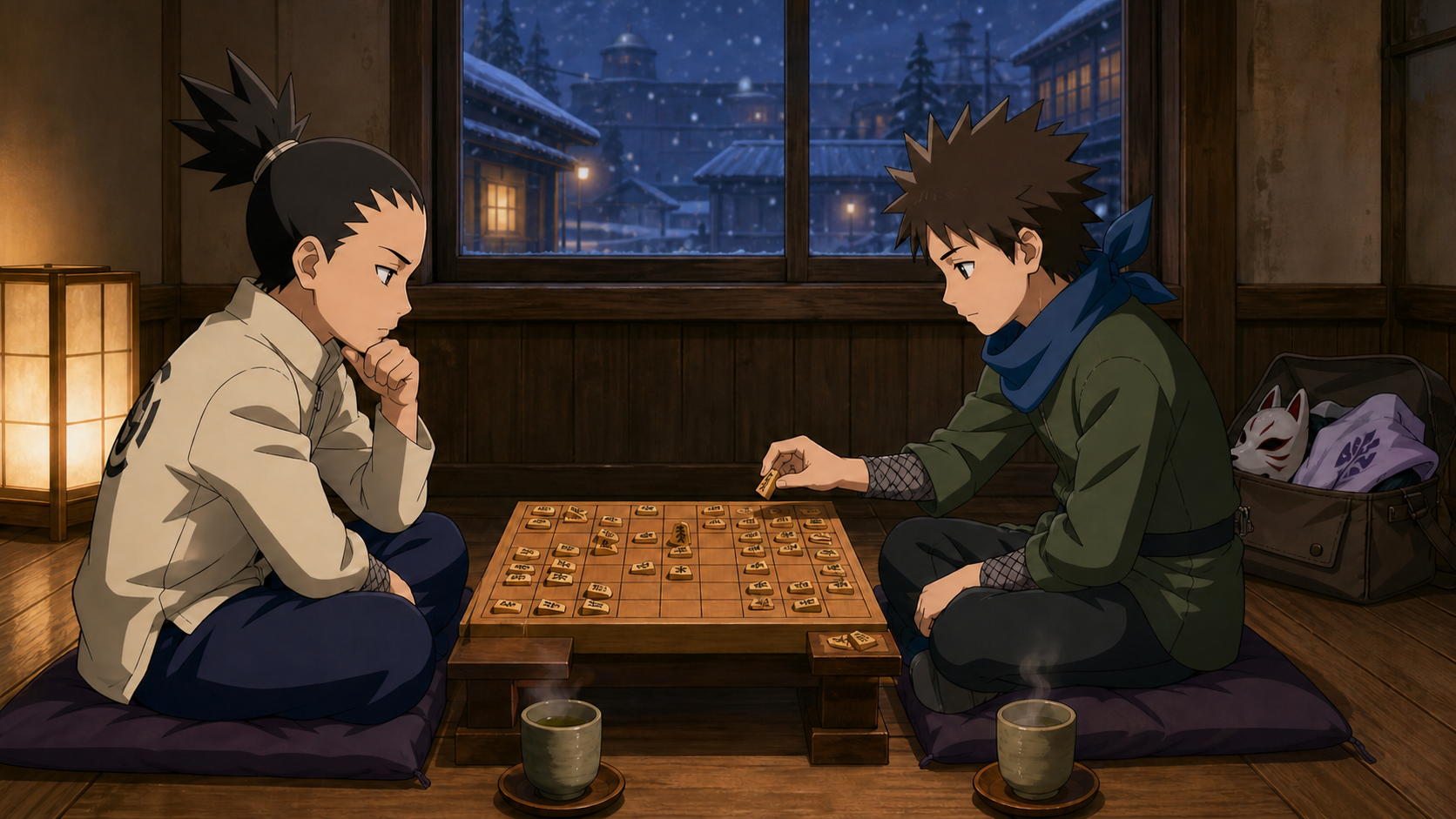
Shikadai’s Doubts
Metal’s injury strips the romance from the Byakuya Gang, while Ryōgi chooses another shōgi game and Shikadai watches friendship collide with an Ice Release escape.
Series: Boruto: Naruto Next Generations
Episode: 44 · Shikadai’s Doubts
Arc: Byakuya Gang Arc
Release: 2018-02-07
Previous: Episode 43 · The Byakuya Gang Surfaces!
Directory: All 293 Boruto episodes
Bottom line
Boruto Episode 44 earns the word “doubts” because nobody has enough information to feel cleanly right. The Byakuya Gang keeps stealing across Konoha, some villagers call them heroes, and Boruto refuses to mistake donations for innocence after Metal gets hurt protecting Denki. Shikadai sees the same crimes but also knows Ryōgi as the quiet boy who makes shōgi fun. Their friendship is not a disguise pasted over the plot. They genuinely like one another, which makes every missing answer heavier. Ryōgi receives another assignment and chooses a game with Shikadai instead. Shikadai introduces him to Boruto. Temari later catches Ryōgi moving through the village, and the escape finally shows Shikadai the Ice Release connection he has been trying not to name. I love how the episode lets uncertainty come from attention instead of foolishness. Shikadai doubts the gang’s simple villain label because he has seen their aid reach poor people. Then he doubts Ryōgi because the boy’s silences and techniques keep matching the thieves. Both doubts can be honest. Only one friend knows the whole board.
Konoha cannot find thieves the village keeps praising
Police searches produce no useful result while the Byakuya Gang becomes bolder. Their masks, Ice Release, and carefully chosen targets make them difficult enough to catch. Public admiration gives them another layer of cover. Every stolen item redistributed to struggling people creates a new person willing to look away, repeat the gang’s slogans, or question why shinobi protect wealthy institutions faster than poor neighbors. That does not make the theft harmless. The episode is smart enough to show why “noble thief” sounds appealing before asking who pays for the performance. Gekkō is building a reputation as aggressively as he is stealing property.
The genin receive an order built around restraint
Kōtarō drafts the recently graduated genin into the search but tells them to observe and report, not engage. That boundary bruises every young ego in the room. These kids trained to act, and now the safest useful job is noticing something and calling an adult. Iwabee immediately asks what happens if the gang attacks first. Boruto, usually the quickest person to chase danger, hesitates. His uncertainty surprises Iwabee because Boruto has seen the gang deliver supplies to poor villagers. The briefing establishes the episode’s real conflict: knowing when action protects people and when action merely satisfies the person taking action.
Boruto is conflicted, not converted
Boruto does not approve of theft, but Episode 43 showed him villagers who genuinely needed what the gang brought. That experience keeps him from shouting “villain” as easily as everyone expects. I appreciate that pause. Boruto grew up with more comfort than Naruto ever had, and the Byakuya Gang forces him to see people left behind by Konoha’s shiny new prosperity. His empathy is not an endorsement. Once the gang hurts Metal during another escape, Boruto becomes clearer about the difference between helping people and using them as moral cover. A gift does not erase the body left on the ground.
Team 5 finds the gang during an ordinary mission
Iwabee, Denki, and Metal are helping at a construction site when another robbery erupts nearby. Their normal assignment becomes the exact situation the briefing warned them about. Iwabee gives chase because asking him to watch criminals run past was never going to work. He blocks the escape with earth walls, a solid move that would stop ordinary thieves. The Byakuya members break through anyway. That power difference matters. The genin are not being patronized by cautious adults. They are facing shinobi whose techniques can punch through their containment before the children understand the threat.
Metal takes the icicle meant for Denki
An ice attack flies toward Denki, and Metal moves between his teammate and the strike. The injury ends every romantic argument about the Byakuya Gang faster than a lecture could. These thieves may hand stolen goods to struggling families, but they are willing to impale a child protecting his friend. Metal’s choice also says something lovely about Team 5. Anxiety makes him shake during attention-heavy moments, yet his body knows exactly what to do when Denki is in danger. Courage arrives before self-consciousness can interfere.
Iwabee has to sit with the cost of ignoring orders
Iwabee pursued the gang because stopping them felt obviously right. Metal is hurt because the encounter escalated beyond what Team 5 could control. I do not blame Iwabee for the icicle, but the episode makes him face why the order existed. Intent and outcome are not always friends. His earth wall was brave, useful, and insufficient. That is a hard lesson for a kid who measures strength through willingness to stand his ground. Sometimes protecting a team means refusing the chase until enough power arrives.
Shikadai keeps finding peace across from Ryōgi
While the village debates thieves and heroes, Shikadai meets Ryōgi over a shōgi board. Both boys speak from half a step outside the noise around them. Shikadai hides effort under boredom. Ryōgi carries an entire gang affiliation behind a calm face. Their games give them structure without demanding confession. They can study each other through moves, joke without performing for a crowd, and enjoy somebody who understands patience. The friendship feels so natural that I understand why Shikadai protects the feeling before he protects his suspicion.
Ryōgi chooses the game when Gekkō expects work
Ryōgi is in Konoha because the Byakuya Gang has another purpose for him, yet he spends time playing with Shikadai. That choice proves the friendship has escaped whatever category Gekkō intended. Ryōgi is not merely gathering intelligence every second. He wants to be there. The tragedy is that genuine affection does not stop him from lying about who he is or what the gang plans. He creates a small honest life inside a larger deception and hopes the walls never touch. Episode 44 begins pushing them together.
Shikadai enjoys having a friend who does not demand energy
Boruto, Inojin, and Chōchō care about Shikadai, but their friendships are loud, familiar, and tangled with village expectations. Ryōgi arrives without history. He does not care whose son Shikadai is, does not demand a display of Nara genius, and does not treat every sigh as a personality problem. They meet through a board where thinking quietly is the whole point. Shikadai starts looking forward to those meetings because Ryōgi gives him companionship without spectacle. That is exactly why suspicion feels so personal later.
Boruto meeting Ryōgi should be casual, but nothing is casual now
Shikadai introduces Boruto and Ryōgi, briefly placing his old friend and new friend inside the same space. Boruto does not know that the quiet boy belongs to the gang he has been chasing. Ryōgi knows exactly who the Hokage’s son is and what danger an introduction could create. Shikadai believes he is connecting two parts of his life. Ryōgi has to manage a collision between the life he chose and the life Gekkō controls. The scene stays friendly on the surface, which makes the secret feel even louder.
The noble-thief argument sounds different after Metal’s injury
Boruto can respect the needs of poor villagers without pretending the Byakuya Gang’s method is clean. Metal’s bandages draw a boundary. A group that chooses violence against children cannot hide forever behind the people receiving its donations. The episode does not ask Boruto to stop caring about inequality. The better lesson is that moral language deserves scrutiny when leaders use somebody else’s suffering to excuse whatever they already wanted to do. Gekkō’s charity is becoming a shield held by people he endangers.
Shikadai hears the debate through a friend’s face
Every conversation about the Byakuya Gang now carries Ryōgi’s shadow for Shikadai, even before he confirms the connection. That changes his posture. Boruto can argue about methods from outside the group. Shikadai is unconsciously testing those arguments against the person who sits across from him. Ryōgi is thoughtful, patient, and capable of kindness. Could somebody like that be one of the masked thieves? Naruto has answered that question many times: loving qualities and harmful choices can occupy the same person. Shikadai is only beginning to learn how painful that truth feels up close.
Temari notices danger before the boys finish naming anything
Temari encounters Ryōgi moving through Konoha and does not accept the harmless-child appearance at face value. Her instincts are sharp because her life has demanded sharpness. She has represented a village, fought in wars, raised a strategist, and learned how quickly a quiet situation can become an ambush. When she challenges Ryōgi, the episode gains the adult competence missing from Team 5’s encounter. Temari does not need a speech about noble thieves. She watches movement, reads resistance, and responds to the threat in front of her.
Boruto and Shikadai join a fight neither fully understands
Boruto and Shikadai become involved when Temari confronts Ryōgi. Boruto sees a suspected gang member. Shikadai sees his shōgi friend. Both boys move, but their reasons are different. Shikadai wants answers and protection at the same time. He has not yet accepted that those wants may pull in opposite directions. Boruto’s presence keeps the scene connected to the larger investigation, while Temari’s presence prevents the children from carrying the whole confrontation alone. Nobody manages a clean capture because Ryōgi is more capable and more desperate than his gentle meetings suggested.
Ice Release turns suspicion into a body-level truth
Ryōgi’s technique matches the signature connected to the Byakuya Gang. Shikadai can debate motives, charity, and appearances, but ice exploding through an escape is harder to explain away. The reveal works because the series gave us several quiet games first. We do not discover a random masked criminal. We discover that the hands moving shōgi pieces can also fill the air with lethal ice. Shikadai’s doubt changes shape. He is no longer asking whether Ryōgi has secrets. He is asking how much of their time together existed beside those secrets.
Temari’s Wind Release meets Ryōgi’s ice
The clash between Temari’s wind and Ryōgi’s Ice Release looks impressive, but character makes the exchange memorable. Temari represents the family and village Shikadai knows. Ryōgi represents a relationship Shikadai has kept separate from both. Their techniques colliding externalize the conflict he has avoided. Temari fights to contain a threat. Ryōgi fights to preserve the gang identity that gave him survival and belonging. Shikadai stands between those worlds without enough truth to reconcile them.
Ryōgi escapes, and nobody gets the comfort of certainty
The failed capture denies Boruto a simple victory and denies Shikadai an immediate explanation. Ryōgi gets away, but his secret is fraying. Temari has seen his techniques. Boruto has seen him resist. Shikadai has seen enough to stop treating every concern as imagination. Escape buys Ryōgi time, not safety. Gekkō’s next operation will demand more loyalty just as Shikadai becomes less willing to ignore the clues. The episode ends with both boys closer to a confrontation neither wants.
Shikadai’s doubt is a strength before becoming a burden
Shikadai refuses two easy conclusions. He does not accept the gang as heroes because they give away stolen goods, and he does not flatten every member into a monster because Ryōgi has shown him genuine companionship. That hesitation keeps him observant. The danger comes when emotional hope delays action after evidence becomes clear. Episode 44 holds him right on that line. Doubt gives him nuance, but the next episodes will require a decision.
Ryōgi is already failing Gekkō by caring
Gekkō needs Ryōgi’s loyalty to remain total. Shikadai creates a competing attachment built without rescue debt or commands. Every voluntary shōgi match weakens the idea that the Byakuya Gang is Ryōgi’s only family. Ryōgi may still complete assignments, lie, and escape, but he keeps returning to Shikadai because the friendship answers a need the gang cannot. Gekkō offers purpose tied to obedience. Shikadai offers time. That difference will eventually become strong enough to crack the story Gekkō built around him.
The Haku echo is present without becoming a copy
An Ice Release boy devoted to an older criminal naturally recalls Haku and Zabuza. Boruto knows exactly what franchise lives underneath this arc. Ryōgi’s story still finds its own center through Shikadai. Haku’s bond was shaped by being useful as a weapon. Ryōgi has been shaped through a false family history and a manufactured debt. Shikadai does not approach him as Naruto approached Haku during battle. Their bond grows over shōgi before the masks fully drop. The echo adds history without replacing the children in front of us.
Modern Konoha makes the gang’s message possible
The village looks prosperous, technologically advanced, and safer than Naruto’s childhood home. That success has not reached everyone equally. Kaminarimon Company symbolizes the benefits and anxieties of rapid change. The Byakuya Gang finds people ready to believe that wealthy institutions hoard progress while ordinary workers struggle. Boruto cannot defeat that argument by proving Gekkō is a criminal. Konoha also has to look honestly at the conditions Gekkō exploits. Episode 44 does not solve the politics, but the background keeps the arc from becoming a simple chase.
What changed on every replay
My first watch followed the reveal that Ryōgi was Shikadai’s friend. On replay, Metal’s injury became the episode’s moral anchor. The icicle strips the romance from the gang without erasing the poverty Boruto witnessed. Another pass made Ryōgi’s choice to play shōgi stand out. Gekkō sends him into Konoha for gang business, and Ryōgi spends precious time with Shikadai because he wants that ordinary connection. The last detail I kept returning to was Shikadai introducing Ryōgi to Boruto. He is proud enough of the friendship to bring the boy into his circle, while Ryōgi already knows that honesty could destroy the moment.
Metal’s injury ends the noble-thief fantasy
The Byakuya Gang builds a public image around taking from the powerful and helping people ignored by prosperity. That claim deserves examination because Konoha’s growth has not reached everybody evenly. Metal lying injured after protecting Denki proves that a righteous slogan does not control every consequence.
Team 5 receives an order centered on restraint. The genin should observe, report, and avoid escalating a situation involving civilians. Iwabee sees a chance to act against thieves and lets urgency outrun the plan. Metal pays the immediate cost.
The icicle was meant to stop pursuit, but intention cannot make the injury abstract. Ryōgi’s group uses force while hiding behind a story where every target represents corruption. Denki and Metal are children carrying out an ordinary mission. No theory about redistribution turns them into acceptable collateral.
Iwabee has to confront that distinction. His anger toward unfairness makes the gang’s message attractive, yet ignoring orders exposes a teammate. Judgment requires holding structural criticism and immediate safety in the same mind.
Boruto experiences the same conflict. He has witnessed poverty, understands why public praise follows the gang, and dislikes defending wealthy institutions automatically. Metal’s injury prevents him from treating the gang as folk heroes. A valid complaint cannot function as a permission slip for hidden violence.
Shikadai’s doubt keeps him honest
Shikadai sees Ryōgi as the quiet friend across a shōgi board. The relationship gives him evidence no police report contains: Ryōgi enjoys ordinary company, makes independent choices, and returns when gang duties could have taken priority.
Suspicion therefore creates two risks. Ignoring the clues may endanger people. Treating every clue as proof may reduce Ryōgi to a case before Shikadai understands the story. Doubt slows both mistakes.
Temari recognizes danger quickly because adult experience has taught her how often hesitation gets exploited. She still allows Shikadai to process what happened rather than demanding immediate emotional clarity. Her protection includes respecting that betrayal hurts before analysis becomes clean.
The Ice Release confrontation turns suspicion into physical fact. Ryōgi fights, escapes, and confirms connection to the gang. Shikadai now knows the friendship included deception. He still knows the games and conversations were real.
Those truths can coexist. Ryōgi cared and lied. Shikadai trusted and noticed. Genuine affection does not erase harm, while harm does not prove every affectionate moment was counterfeit.
Gekkō depends on Ryōgi believing no life exists outside the gang. Choosing another shōgi game already weakens that story. Ryōgi spends time on a friendship that produces no profit, leverage, or assignment. Care becomes disobedience before he names the choice.
Shikadai’s intelligence cannot solve the emotional problem immediately. His strength lies in refusing false certainty. He can investigate Ryōgi, protect Konoha, remember Metal’s injury, and still want his friend to have a way back.
That combination prepares him for leadership better than instant judgment would. Strategy decides where pieces move. Friendship reminds him that people are not pieces simply because a plan needs clarity.
Ryōgi also retains agency inside the manipulation. Gekkō shaped his history and loyalty, but Ryōgi chooses each return to Shikadai, each game, and each moment of hesitation. Those choices do not erase the gang’s harm. They prove Gekkō never achieved total ownership. A second life keeps forming across the board, one ordinary move at a time.
Shikadai sees that unfinished life and refuses to look away.
The next move remains possible.
RaeRae’s final reaction
Episode 44 made me ache for Shikadai because his intelligence cannot protect him from caring. Every clue is there: the gang’s Ice Release, Ryōgi’s guarded movements, Temari’s confrontation, and the escape. Shikadai still remembers the person across the board, and that memory deserves space. I am also angry at Ryōgi because genuine affection does not make deception harmless. That combination is why the episode works. Nobody has to become perfectly innocent for my heart to break. Metal protects Denki. Temari protects the village. Boruto protects his growing sense of right and wrong. Shikadai tries to protect a friendship that has already crossed into danger. Ryōgi protects the lie that gave him a family. By the end, everybody has chosen something, and the doubts have only become sharper.
Sources and lawful viewing
Official episode reference: Naruto Official episode guide
Licensed episode route: Crunchyroll licensed series page