
The Byakuya Gang Surfaces!
A frozen flower exposes the bank heist, Katasuke explains the thermal trick, Boruto follows stolen money uphill, and Ryōgi answers Shikadai’s shōgi problem.
Series: Boruto: Naruto Next Generations
Episode: 43 · The Byakuya Gang Surfaces!
Arc: Byakuya Gang Arc
Release: 2018-01-31
Previous: Episode 42 · A Ninja’s Job!
Directory: All 293 Boruto episodes
Bottom line
Boruto Episode 43 opens the Byakuya Gang arc with a robbery that feels like a mystery, a political argument, and a friendship origin story sharing one winter coat. The bank hostage situation was only a distraction. While everyone watched the frightened man outside, masked thieves emptied the vault without triggering thermal security. Sarada finds a frozen flower, connects the cold inside the vault to Ice Release, and brings Team 7 to Katasuke for the science behind the trick. Their pursuit leads away from Konoha’s polished streets to a poor village where one gang member spends stolen money on food and supplies. Boruto arrives ready to catch a criminal and leaves unable to ignore the people thanking that criminal. Meanwhile, Shikamaru gives Shikadai a shōgi problem, and Ryōgi casually supplies the missing move. That first game looks small beside a bank heist, but the whole arc will turn on the boy across the board. I love an opening that refuses to hand Boruto or the audience an easy moral chair. Theft is still theft. Hunger is still hunger. Gekkō plans to use both truths.
The hostage crisis was stage lighting for the real crime
Kōtarō and Konohamaru explain that the bank standoff distracted everyone while the Byakuya Gang entered the vault. Episode 42 made the frightened former game developer feel like the whole emergency, which is exactly why the reveal works. His pain was real, but somebody else recognized how much attention a bomb and a hostage situation would pull toward the front door. The gang turns one man’s collapse into cover without needing to invent his desperation. That is the first clear sign of how Gekkō operates. He finds genuine suffering and positions his plan behind the noise.
Boruto insists on seeing the vault for himself
Boruto wants inside the crime scene because secondhand explanations never satisfy him. He notices the cold before the adults finish understanding why the security system failed. That physical detail gives the mystery texture. The vault was protected by sensors designed to detect body heat, so a thief who lowered body temperature could move through without sounding the alarm. Boruto does not solve the method alone, but his stubborn presence puts him close enough to feel the evidence. Curiosity remains one of his best shinobi traits when impatience does not run ahead of judgment.
Sarada finds the frozen flower everybody else overlooked
Outside the vault, Sarada notices a flower caught in unnatural frost. That clue belongs to her because Sarada scans a scene for what does not fit. The cold vault could be machinery. A single frozen flower outside extends the pattern into human movement. She keeps thinking through the five quiet days that follow and eventually names Ice Release as the likely explanation. I love giving Sarada investigative work instead of limiting her Sharingan to combat. Leadership begins with noticing the small thing everybody stepped past.
The inside-job theory makes sense until ninjutsu changes the rules
Kōtarō suspects an employee because the vault security should have detected any ordinary intruder. That conclusion is reasonable from the available system, but shinobi stories are built to punish the word “ordinary.” Ice Release gives the gang a method outside the bank’s assumptions. The scene also says something fun about modern Konoha. Technology has advanced enough to create sophisticated thermal protection, yet a rare bloodline technique can still slide through the blind spot. Old chakra and new infrastructure are already learning how to deceive one another.
Five days without progress lets the gang become a story
The investigation stalls, and the Byakuya Gang’s reputation grows faster than the evidence. Denki explains the idea of noble thieves who steal from the rich and give to the poor. Once a crime has a familiar heroic label, people can decide how they feel before learning what happened. Boruto hates the theft. Other villagers admire the redistribution. The gang benefits from both reactions because outrage and praise keep its name moving. Gekkō understands branding long before Konoha understands his operation.
Boruto wants morality to behave like a straight road
Boruto says stealing remains wrong no matter who receives the goods. His answer is blunt, and part of me appreciates the clarity. Somebody owned those jewels. Bank workers were endangered. A desperate hostage became a distraction. The gang does not become harmless because food appears later. Boruto’s problem is not the boundary. His problem is assuming the boundary answers every question. Why are nearby villagers hungry enough to celebrate masked thieves? Who profits from Konoha’s modernization? Catching the robbers will not make those questions disappear.
Shikadai refuses the easy answer because the board is larger
When Boruto asks Shikadai what he thinks, Shikadai says the gang must have reasons and that the Academy did not teach them everything worth knowing. That answer surprises Boruto because Shikadai does not offer the expected loyal-shinobi line. He is not defending robbery. He is reminding Boruto that a move makes sense only when you can see the board around the piece. Poverty, reputation, resentment, and target selection all belong to the position. Shikadai’s instinct for context is exactly what will make Ryōgi trust him.
Boruto’s argument keeps ruining Shikadai’s shōgi study
Shikadai is trying to solve a shōgi formation from Shikamaru while everyone debates the gang nearby. The comedy works because his frustration is real. His father has given him a position with a hidden answer, and Shikadai hates being unable to see the move. That little problem mirrors the episode. Konoha sees a bank robbery but not the method. Boruto sees theft but not the village receiving the money. Shikadai sees pieces without the player who arranged them. Everybody is missing one move.
Ryōgi appears as the answer to a puzzle
Ryōgi notices the board and offers the move Shikadai could not find. Their first connection is intellectual before either boy asks for a biography. Shikadai does not have to pretend boredom around somebody who immediately understands the problem. Ryōgi does not have to perform the Byakuya Gang’s righteous language. For a moment, both are simply kids interested in strategy. That ordinary beginning is the emotional trapdoor under the arc. We know Ryōgi is connected to the thieves before Shikadai does, but the friendship does not feel fake.
Shōgi gives two guarded boys a language with rules
Neither Shikadai nor Ryōgi is eager to spill his heart to a stranger. A board solves that problem. Every move reveals patience, risk tolerance, and how somebody reacts when a plan fails. Silence becomes comfortable instead of empty. Shikadai finds a person who can keep pace without making a spectacle of his intelligence. Ryōgi finds attention that does not depend on debt to Gekkō. The game creates a relationship neither boy knows how much he needs.
Sarada brings Team 7 back to the actual clue
While Shikadai meets Ryōgi, Sarada develops the Ice Release theory and gathers Boruto and Mitsuki. Her deduction shifts Team 7 from arguing about noble thieves to investigating a technique. That transition matters. Moral certainty cannot identify a suspect. Evidence can. Sarada’s frozen flower, the cold vault, and the thermal sensors form a chain strong enough to test. She moves the story because she refuses to let five quiet days turn confusion into resignation.
Katasuke translates ninjutsu into security failure
Boruto introduces Sarada and Mitsuki to Katasuke, whose laboratory represents the scientific future waiting just beyond this arc. Katasuke confirms that Ice Release could lower body temperature enough to bypass the bank’s sensors. I like his role here because the scientist does not replace shinobi observation. Sarada supplies the hypothesis. Katasuke explains the mechanism. Their knowledge fits together. The scene also plants Katasuke’s research in the Byakuya Gang’s awareness, which becomes much more important when Gekkō targets the laboratory.
Katasuke shows them the Konoha prosperity prefers not to display
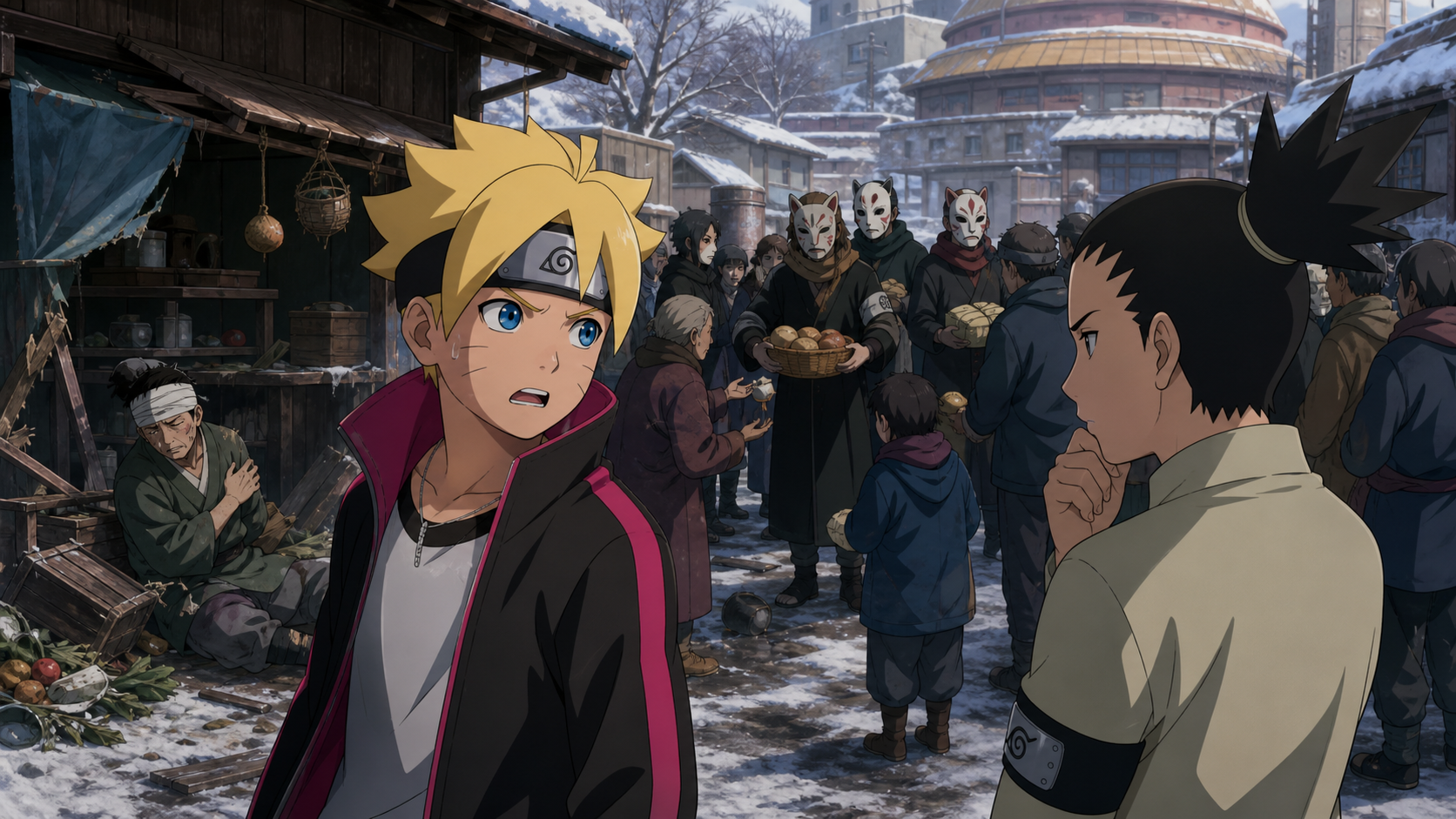
The pursuit takes Team 7 through a less polished side of the village and beyond the postcard version of modern Konoha. Katasuke knows routes and communities the children do not usually see. That contrast matters because Boruto’s life has been comfortable enough to make “stealing is wrong” feel like the end of the conversation. He has not had to decide whether accepting stolen food is worse than watching a family go hungry. The episode does not mock his principle. The episode makes him carry that principle into a place where need has faces.
Footprints lead away from the bank and toward hunger
Team 7 follows tracks to a water system along the mountainside and then up toward an impoverished settlement. The physical climb becomes a movement between two versions of Konoha’s success. Below, a bank can afford thermal sensors around jewels. Above, residents need basic supplies brought by a masked stranger. That visual argument is stronger than the policy speech the old draft tried to turn this episode into. Boruto sees the distance with his own eyes, and fandom gets to feel his certainty wobble.
The gang member uses stolen money to buy real supplies
The person Team 7 tracks does not appear in the village to hoard jewels or celebrate a heist. He buys food and needed goods for residents who welcome the help. The aid is real. That fact does not clean the robbery, but the story would be weaker if the charity were completely fake. Gekkō’s operation gains power because some stolen wealth genuinely reaches struggling people. Villagers are not stupid for caring about the person who filled an empty shelf. They are responding to a need Konoha allowed to remain visible.
Boruto loses interest in the arrest he wanted
Boruto arrives determined to catch a thief and then hesitates when he sees the supplies distributed. That pause is growth, even though his response is not a complete solution. He recognizes that dragging the gang member away in front of grateful residents would not feel like justice to the people standing there. He also lets a suspect escape, which carries consequences in Episode 44 when the gang’s violence reaches Metal. The beauty of the moment is that Boruto’s compassion and mistake can exist together. He sees more of the board, but not the entire position.
Sarada and Mitsuki let Boruto make the call
Team 7 could have forced the pursuit, yet Sarada and Mitsuki understand what Boruto is seeing. Their restraint does not mean they endorse the gang. They are learning alongside him. Mitsuki often follows Boruto’s moral instinct because he wants to understand the light Boruto represents to him. Sarada cares about becoming Hokage and therefore has to look at the villagers her future office could overlook. The poor settlement is not a side note for either of them. This is part of the village they may one day help lead.
Charity can be genuine and still serve Gekkō’s strategy
The supplies relieve immediate need, but they also buy the gang admiration, silence, and a heroic identity. Gekkō decides which thefts count as justice and which communities receive help. Residents gain food without gaining control over the system that produced their hunger. That is the difference the episode begins exploring. One generous delivery can matter deeply while remaining useful propaganda for somebody planning a larger crime. Fandom can hold both thoughts without turning the React into a government memo.
The frozen flower and the shōgi piece tell the same story
Sarada finds physical evidence that a rare technique moved through the bank. Shikadai finds a stranger who knows the exact move missing from his board. Both clues point toward Ryōgi, though nobody can connect them yet. The episode plants its mystery through character-specific attention. Sarada notices environments. Shikadai notices strategy. Boruto notices people. Each child holds a different piece of the Byakuya Gang, and the arc will need all three ways of seeing.
Ryōgi’s first game is already an act of disobedience
Ryōgi belongs to Gekkō’s operation, but sitting with Shikadai creates time not fully controlled by the gang. He could solve the puzzle and leave. Instead, he plays. That choice becomes more meaningful after we learn how tightly Gekkō shaped his childhood. Shikadai offers companionship with no rescue debt, family claim, or mission attached. Ryōgi does not know how to choose that life yet, but the first match gives him a glimpse.
Katasuke enters before scientific ninja tools become controversial
This episode introduces Katasuke as helpful, curious, and deeply embedded in Konoha’s technological expansion. Later, Boruto will misuse his invention during the Chūnin Exams, and outside influence will exploit Katasuke himself. Seeing him here matters because his laboratory is not an abstract plot warehouse. He helps three genin solve a mystery, explains security through science, and guides them toward a part of the village they did not know. The coming theft targets work connected to a person we have already met.
The arc begins by making every simple label incomplete
“Hostage” does not explain the bank robbery. “Inside job” does not explain Ice Release. “Noble thief” does not explain the endangered worker. “Criminal” does not explain the food carried uphill. “Stranger” does not explain why Ryōgi and Shikadai understand one another immediately. Episode 43 keeps adding information until every first label needs revision. That does not mean truth is impossible. The gang stole the jewels. The village is poor. Ryōgi likes Shikadai. Gekkō will exploit the unrest. Complexity comes from all of those facts being true at once.
What changed on every replay
My first watch followed Sarada’s detective work and Boruto’s decision in the poor village. On replay, the bank hostage diversion became much darker because Gekkō’s entire method is visible from the beginning. He uses somebody else’s crisis to move unseen. Another pass made Katasuke stand out because his cheerful explanation quietly places his laboratory on the gang’s future board. The detail I loved most was still Ryōgi solving Shikadai’s problem. Their friendship begins with a move freely given, which makes every later use of shōgi as manipulation hurt more.
Charity does not erase the person used as cover
The Byakuya Gang distributes real supplies to people Konoha’s prosperity has not reached. Villagers receive food, warmth, and evidence that somebody noticed their conditions. Boruto sees gratitude rather than abstract messaging, which makes an immediate arrest feel morally incomplete.
The bank worker still experienced a hostage crisis. Gekkō uses that fear as stage lighting for another crime, trusting everyone to focus on the visible danger. A successful theft and later donation cannot return safety to the person used as cover.
Sarada’s frozen flower keeps the investigation grounded. She notices physical evidence, connects the temperature change to Ice Release, and prevents the inside-job theory from becoming a convenient conclusion. Moral complexity never requires abandoning factual work.
Shikadai understands that the board extends beyond a single thief. Arresting the person carrying supplies may stop one delivery without answering why the village needed stolen relief. Boruto hears delay as tolerance for wrongdoing because he wants a clean action that proves where he stands.
Both instincts contain value. Boruto refuses to romanticize theft. Shikadai refuses to pretend punishment automatically repairs the conditions beneath theft. The arc becomes interesting because the story does not force one truth to swallow the other.
Gekkō depends on that tension. Real poverty gives his propaganda credibility. Real charity gives followers emotional protection from criticism. Hidden control lets him redirect valid anger toward whatever target produces profit and leverage.
Katasuke’s explanation adds another layer. Scientific progress can improve lives while concentrating access around institutions, patents, laboratories, and people with money. The gang recognizes the technology as both a symbol and a target long before Boruto understands how central the tool will become to his own choices.
Ryōgi’s first game with Shikadai offers a relationship outside the public argument. He solves a shōgi problem because the puzzle interests him. No gang order requires the move. No donation buys the friendship. That small freedom becomes dangerous to anybody who needs Ryōgi’s entire identity tied to the cause.
Episode 43 therefore refuses simple labels without refusing judgment. Theft happened. Poverty exists. Charity helped. A hostage was endangered. Friendship began. Manipulation waits behind every public gesture. The work lies in holding all six facts long enough to see who benefits when everybody else chooses only one.
Sarada models that discipline better than anybody. She does not decide the bank worker must be guilty because the door opened from inside. She notices the frozen flower, asks what temperature could produce the evidence, and revises the theory when Ice Release explains the locked-room trick. Her loyalty belongs to the facts before the easiest suspect.
That method becomes a quiet leadership lesson. Public pressure wants an arrest, Boruto wants moral clarity, and the police need a usable lead. Sarada refuses to let urgency turn a plausible story into a finished conclusion. The correction protects an innocent worker while moving the investigation toward the actual technique.
Mitsuki supports the process without demanding attention. He watches Boruto’s reaction in the village and allows the emotional evidence to change Team 7’s next action. Their restraint does not resolve the crime, but restraint prevents a frightened community from becoming another target of the response.
The gang benefits whenever Konoha moves too quickly. A wrongful accusation would prove the institutions careless. A violent arrest during aid distribution would create another recruiting image. Careful evidence denies Gekkō both opportunities.
Complexity therefore has a practical purpose. Looking longer is not indecision when somebody designed the first impression as camouflage. Sarada sees the flower, Shikadai sees the board, and Boruto sees the people receiving food. Each view catches a different part of the operation. The truth requires all three.
RaeRae’s final reaction
Episode 43 gave me exactly what an arc opener should: a crime with a clever method, a moral problem with actual people attached, and a new friendship already carrying danger. I agree with Boruto that stolen charity does not erase harm. I also understand why his feet stop when villagers thank the gang member for food. Shikadai’s answer feels wiser because he knows the board extends past the bank, but Ryōgi will test whether nuance can survive betrayal. Sarada is my quiet MVP for finding the frozen flower and doing the work that turns cold air into a real theory. By the end, Team 7 has seen the village Konoha’s prosperity left uphill, Shikadai has found a shōgi partner, and Gekkō has found the exact conditions he plans to weaponize. That is a strong, messy beginning.
Sources and lawful viewing
Official episode reference: Naruto Official episode guide
Licensed episode route: Crunchyroll licensed series page