
RaeRae Reacts · One Piece Episode 180
Wyper Uses Seastone and Reject Against Enel
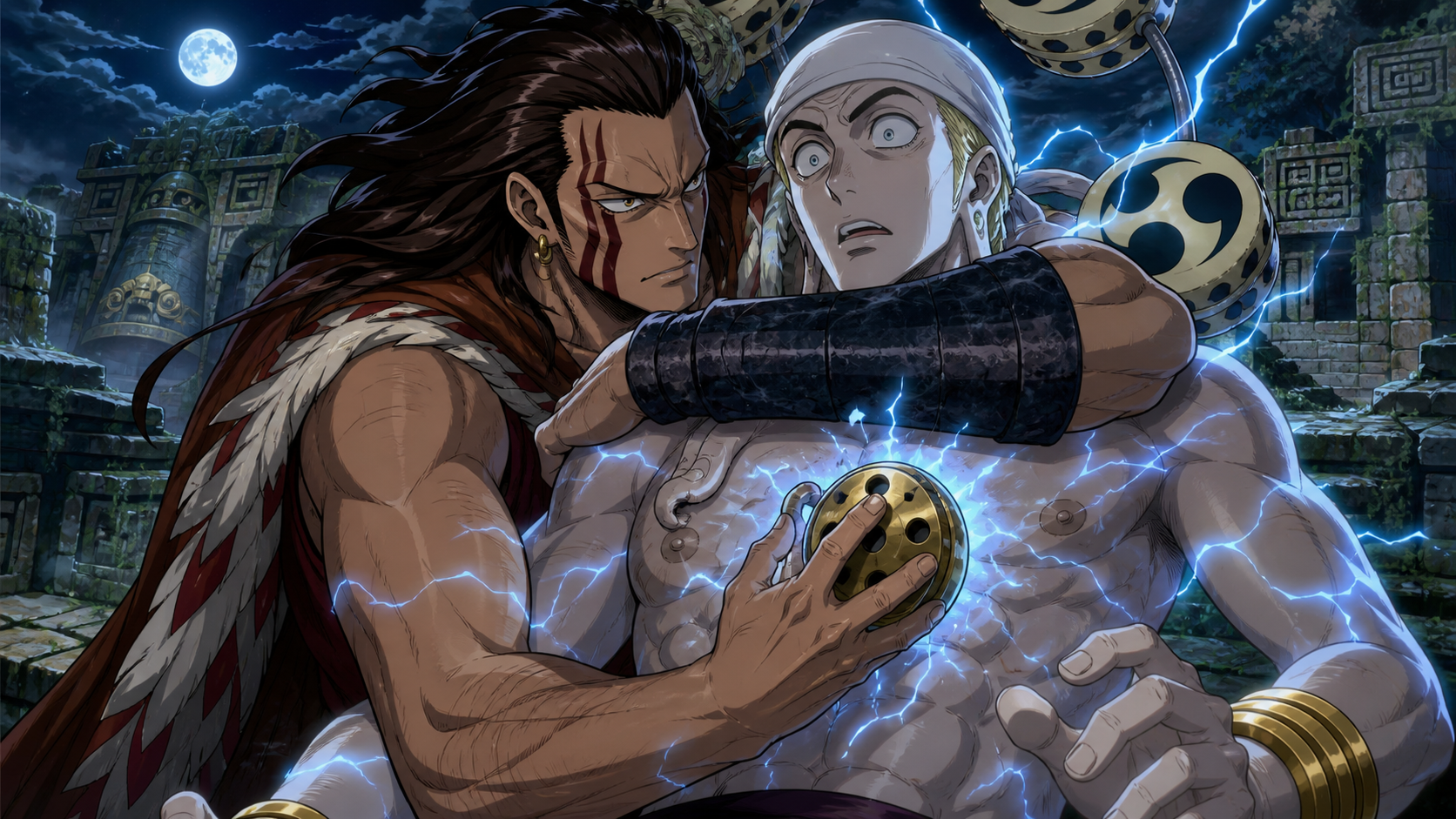
One Piece Episode 180 exposes Enel’s extermination plan before Wyper uses Seastone and a Reject Dial to force the self-proclaimed god down.
My reaction: Wyper landing Seastone and Reject on Enel had me ready to celebrate before the episode even earned permission. The plan is smart, physical, and rooted in tools already established by the arc. Wyper cannot out-lightning Enel. He can shut the Devil Fruit power down, get close, and gamble his own life on force the human body should not survive.
Robin’s attempt to protect the bell hurts because her intelligence gives Enel the missing direction. I did not read that moment as Robin failing. She is bargaining under violence with incomplete information, trying to make a tyrant value the thing she needs preserved. Enel hears only possession. That gap between her purpose and his greed tells us exactly why he should never reach Shandora’s history.
What happens in One Piece Episode 180?
One Piece Episode 180, “Battle in the Ancient Ruins! God Enel’s Desire,” reveals the purpose behind the survival game. Conis travels toward Angel Island while children repeat rumors that helping the Blue Sea visitors made her family evil. In Shandora, Gan Fall asks what Enel intends to do after reducing the survivors. Enel answers with “ascension.”
Enel plans to leave Skypiea for limitless Fairy Vearth and destroy every sky resident before departure. Gan Fall attacks and falls to twenty million volts. Robin tries to protect the island by making Enel consider the golden bell, but her reasoning helps him locate the bell atop Giant Jack. Enel strikes Robin, overwhelms Zoro, and blocks Wyper’s bazooka. Wyper finally closes the distance with Seastone and fires a Reject Dial into Enel.
Children repeat the story power gave them
Three Skypiean children near Conis’s home discuss the family who helped the Straw Hats. One child says Conis and Pagaya are kind. Another repeats that disobedience made them evil. A boy takes pride in a father serving God’s army even though the father has never returned home.
The conversation shows propaganda reproducing itself through ordinary play. None of the children designed Enel’s system. They inherit categories that make absence honorable and compassion suspicious. RaeRae hears the cruelty beneath the innocence: a child has been taught to celebrate the institution that stole his father’s life.
God is a job title until Enel makes the title a weapon
Gan Fall tells Enel that “God” names Skypiea’s governor, not a divine species. The distinction matters because public office carries limits, duties, and accountability. Enel rejects every limit while keeping the prestige. He takes a civic title and uses the title to claim natural superiority.
Authoritarian language often performs that exact theft. A ruler converts a temporary position into permanent identity, then treats criticism of the person as rebellion against the universe. Gan Fall’s correction challenges more than vocabulary. The correction says Skypiea existed before Enel and can exist after him.
Ascension means abandonment with a body count
Enel describes his goal as ascension. The word suggests spiritual elevation, but his plan requires a ship built by forced labor and a population pushed toward death. Grand language does not clean the machinery. Enel wants to leave, and everybody who remains becomes an inconvenience to erase.
His version of transcendence depends on refusing relationship. A governor should protect the residents under his authority. Enel treats residents as proof that he has not risen far enough above ordinary life. Ascension becomes the fantasy of escaping every obligation after extracting every useful resource.
Fairy Vearth turns desire into entitlement
Enel imagines Fairy Vearth as limitless land where a true god belongs. Skypieans treasure tiny quantities of soil because Vearth sustains crops and carries sacred value. Enel takes that cultural longing, expands the scale, and declares himself the sole rightful owner of an endless supply.
Wanting land is not the same as owning every path toward land. His dream becomes destructive when personal desire overrides existing lives. The destination may be real, mistaken, or mythic. None of those possibilities grants permission to drop inhabited islands into the Blue Sea.
Gan Fall hears what happened to his enforcers
Enel tells Gan Fall that the former God’s enforcers died because they were forced into the project behind Maxim. The revelation reaches Gan Fall through deliberate cruelty. Enel wants him angry, because anger creates an attack that Enel can punish before the gathered survivors.
Gan Fall remembers struggling to negotiate peace with the Shandia before Enel seized power. That history carries both effort and failure. He could not resolve the land conflict, and his people were vulnerable when Enel arrived. The enforcers’ deaths turn political failure into personal grief.
Twenty million volts answers a political argument
Gan Fall attacks after Enel announces extermination and insults the dead. Enel responds with twenty million volts of Vari. Lightning replaces dialogue because Enel has no accountable defense for his plan. He can overpower the former governor, so he treats force as proof of correctness.
The strike also demonstrates why titles matter. Gan Fall can be criticized for choices made in office. Enel refuses the category of criticism altogether. Anyone who questions him becomes a body to remove. Power without review produces a ruler who mistakes silence after violence for agreement.
The invitation to Fairy Vearth is not consent
After defeating Gan Fall, Enel invites the remaining survivors to accompany him. The offer arrives after he has destroyed homes, killed workers, struck allies, and announced the island’s extermination. Joining under those conditions would not prove loyalty or admiration. Joining would reflect coercion.
Enel frames the choice as special access to his future. The survivors understand the hidden term: accept his rule or remain among the people marked for death. A luxury seat on the executioner’s ship does not become freedom because the executioner calls the seat an honor.
Robin tries to redirect Enel through the bell
Robin asks what happens if the survivors refuse, then warns that destroying Skypiea may destroy the object Enel seeks. She uses his interest in gold and history to create a reason for restraint. The tactic is intelligent because moral appeals have no purchase with him.
Manipulation becomes defensive when a weaker person must steer an armed ruler away from mass harm. Robin does not owe Enel transparent cooperation. She owes the people at risk every plausible interruption. Her danger comes from facing a man who punishes anyone capable of influencing his decision.
Enel steals Robin’s deduction about the golden bell
Robin’s reasoning helps Enel connect Shandora’s missing bell to the center formed by the four altars and the summit of Giant Jack. He did not preserve the city, study the records, or respect the people who guarded the history. He listens long enough to extract the useful conclusion.
That extraction mirrors Maxim’s construction. Enel takes labor from the Divine Squad, gold from Shandora, knowledge from Robin, and sacred language from Skypiea. He calls the assembled result divine ambition. Every component came from somebody he considers disposable.
Robin is punished for being useful and independent
Once Enel understands the bell’s likely location, he strikes Robin with lightning for attempting to guide him. The attack says that intelligence is welcome only while intelligence serves without agency. Robin may provide knowledge, but she may not influence how the knowledge is used.
This is why control of expertise matters. Enel wants an archaeologist’s conclusion without an archaeologist’s judgment. He wants a city’s gold without a city’s history. He wants workers’ hands without workers’ futures. Robin’s refusal to separate knowledge from consequence makes her dangerous to him.
Zoro catches Robin before he attacks
Zoro catches Robin as she falls. The movement comes before retaliation. His first response protects a crewmate from the immediate consequence of Enel’s strike. Anger follows care rather than replacing care.
That order distinguishes Zoro from fighters who use another person’s injury as permission for personal spectacle. Robin is not a prop for his rage. He secures her body, recognizes the person responsible, and then chooses the fight. The protective action gives the anger moral direction.
Kari turns Wyper’s bazooka away
Wyper fires the Burn Bazooka while Zoro presses forward. Enel uses Kari to heat the air and redirect the attack. The bazooka that carried Wyper through repeated battles cannot reach a Logia opponent protected by speed, Mantra, and electrical control.
Enel mocks the resistance as noise before departure. He wants every failed attack to reinforce the idea that opposition is childish. Wyper reads failure differently. Each blocked method narrows the remaining options and brings the concealed Seastone plan closer to necessity.
Zoro’s strength cannot solve elemental intangibility
Zoro impresses Enel with physical power and commitment, but neither quality makes a sword connect with living lightning. Enel overwhelms him before the anger over Robin can become a victory. The defeat preserves the specific rule of the opponent rather than treating determination as automatic access.
That boundary does not diminish Zoro. He has solved Ohm’s range and crossed a collapsing battlefield. Enel presents a different problem. Strong characters still need information, material counters, or unusual compatibility. Effort matters most when the story allows effort to meet real conditions.
Wyper built Seastone into the plan
Wyper closes the distance and locks Enel with Seastone hidden beneath the covering on his arm. Contact suppresses the lightning transformation and forces Enel’s body to remain solid. The self-proclaimed god experiences surprise because somebody planned around the Devil Fruit rather than worshiping the spectacle.
The counter reflects Shandia preparation. Wyper did not enter Upper Yard believing the Burn Bazooka alone could answer every threat. He carried a material associated with the Blue Sea precisely because Enel’s power required a different condition. Resistance survived long enough to learn.
The Reject Dial makes victory physically expensive
With Enel held solid, Wyper presses a Reject Dial against his chest. The Dial releases a devastating force capable of destroying the target and severely damaging the user. Wyper accepts that cost because ordinary attacks have failed and his people’s survival remains under immediate threat.
RaeRae cannot romanticize the self-destruction. A movement should not require every committed fighter to spend a body as ammunition. The scene remains powerful because Wyper understands the cost and chooses under catastrophic pressure. The tragedy belongs to the system that narrowed resistance toward sacrifice.
Enel falls, but the episode does not declare safety
The Reject Dial leaves Enel unconscious in Shandora. The image punctures the mythology surrounding him. A title did not make his body untouchable. Seastone and accumulated knowledge created a moment where consequence could reach him.
Episode 180 stops before proving the larger crisis resolved. Maxim still exists. Conis still needs to warn Angel Island. Luffy and Aisa remain separated inside Nola’s path. A fallen ruler is not the same as a dismantled system, especially when the ruler commands a body with powers the survivors barely understand.
Manga and anime placement
Episode 180 adapts material from Chapters 274 and 275 during the Skypiea arc. The official Japanese episode archive lists February 8, 2004 as the broadcast date, with Junki Takegami credited for script, Yukio Kaizawa for episode direction, Masayuki Takagi for animation direction, and Miyuki Sato with Fumihiro Uchikawa for art.
The adaptation builds the episode as a series of rejected arrangements. Gan Fall rejects Enel’s divine identity. Robin rejects passive cooperation. Zoro rejects violence against his crewmate. Wyper rejects untouchability itself. Enel answers each refusal with force until Seastone makes force travel in the opposite direction.
Final reaction to God Enel’s desire
Episode 180 explains Enel without excusing him. Fairy Vearth gives his ambition a destination. The Ark Maxim gives the ambition a vehicle. Forced labor, stolen gold, stolen knowledge, political titles, and extermination give the ambition a moral record. A dream built from other people’s disappearance deserves opposition.
Wyper’s reversal lands because the episode has shown how many kinds of power Enel extracted. Seastone removes the supernatural distance. The Reject Dial returns stored force. The same man who reduced people to materials becomes vulnerable to material knowledge carried by the people he dismissed.
The episode’s strongest structural choice places Conis beside Wyper even though they never share the battlefield. Conis carries truth toward civilians who have been trained to fear her. Wyper carries Seastone toward a ruler who has trained civilians to fear him. One challenge works through warning and the other through physical restraint. Both depend on refusing the story that Enel’s power makes resistance meaningless.
Gan Fall and Robin add two more refusals. Gan Fall names God as an office, returning Enel to politics. Robin traces the bell through evidence, returning Enel to ignorance. Zoro catches a crewmate, returning the lightning victim to relationship rather than spectacle. Enel wants every scene to confirm divine isolation. Everybody around him keeps restoring human causes, human costs, and human obligations.
RaeRae’s verdict: Enel can keep calling the project ascension. Leaving every obligation behind after stealing everything useful is not transcendence. Wyper’s grip forces the god costume back onto a human body, and the body finally has to answer.