
RaeRae Reacts · One Piece Episode 175
Ohm Sends Iron Cloud After Chopper’s Escape
One Piece Episode 175 gives Chopper a zero-percent encounter with Ohm’s Mantra and Iron Cloud blade while the upper-ruin fighters converge.
Chopper climbs Giant Jack without knowing who controls the next level
Episode 175 finds Chopper higher on Giant Jack, moving through ruins after defeating Gedatsu. The victory gives him confidence but no map, no crew contact, and no warning about the remaining priest.
Elevation narrows escape routes. A fall, hidden cloud trap, or ranged attack becomes more dangerous when solid ground ends beside the path.
Chopper should mark his ascent, listen before crossing open platforms, and preserve a retreat lane. Reaching higher ground only helps when he can return with information.
His medical role makes isolation especially costly. Sanji, Usopp, Nami, Kamakiri, Genbo, and Wyper may all need care while the doctor walks farther from every known patient.
Holy looks calm because Ohm trained obedience into a weapon
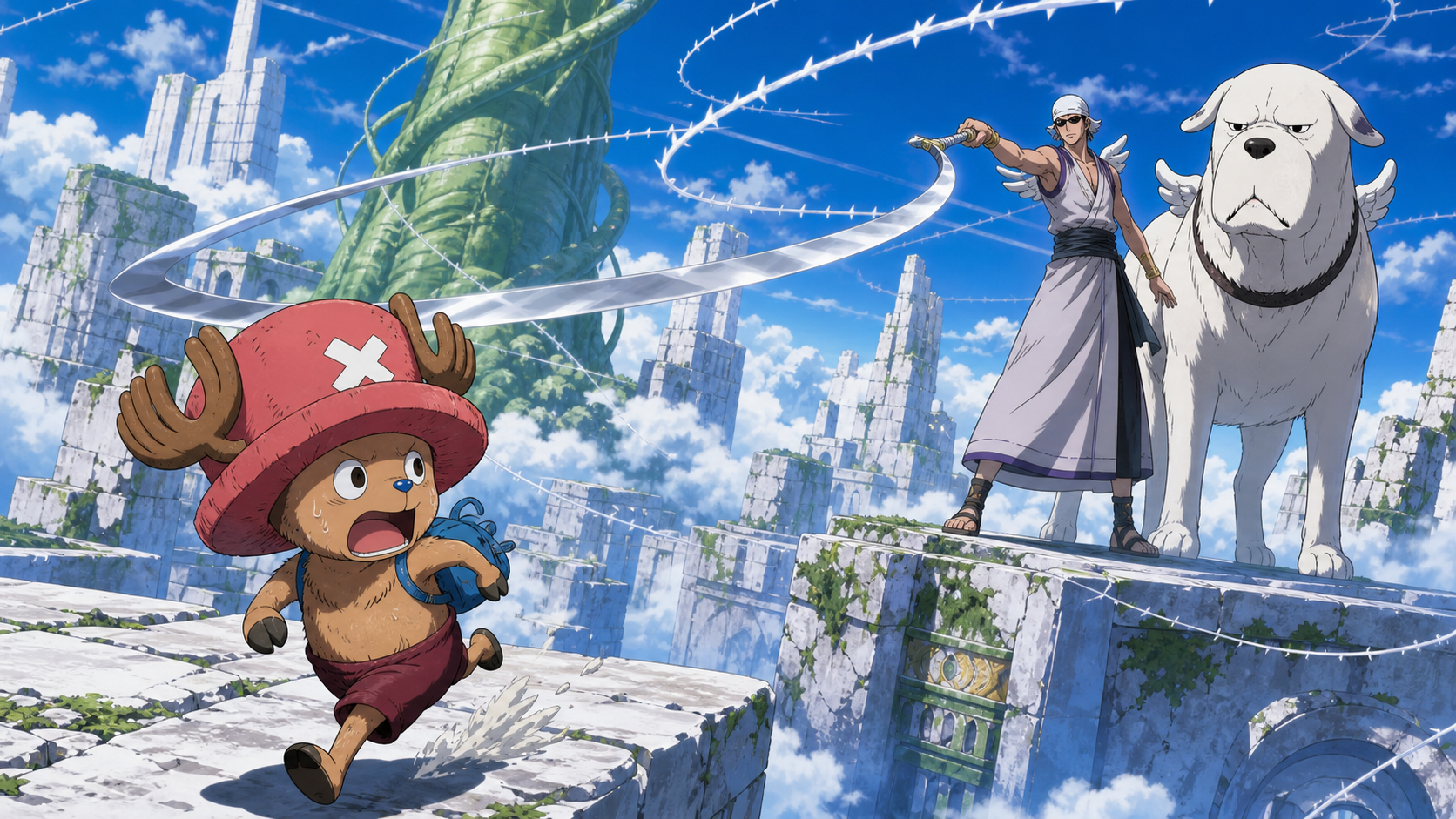
Chopper senses a presence and meets Holy, the enormous white dog beside Priest Ohm. Ohm explains that Holy will not bite without a reason because the animal follows training.
The reassurance defines reason through the trainer, not through safety. A command can turn the calm dog into a combatant before Chopper recognizes the trigger.
Chopper can speak with animals, but communication may not override conditioned behavior. He should keep distance, avoid sudden movement, and test whether Holy responds to commands from voices other than Ohm.
Ohm has converted loyalty into equipment. The dog’s size, speed, and trust become part of the priest’s Ordeal without meaningful choice from Holy.
Ohm speaks about mercy while carrying a sword that reaches beyond sight
Ohm frames death as release from earthly suffering. The language turns killing into a favor and removes the victim’s right to prefer survival.
His calm delivery matters because moral certainty can hide operational cruelty better than shouting. Chopper hears philosophy while Ohm measures range.
A safe response would reject the premise, identify escape paths, and avoid debating a priest whose Mantra already tracks movement.
Ohm’s compassion has no consent, treatment, or alternative. The doctor facing him understands that reducing pain means protecting life, not declaring life an attachment worth cutting away.
Raki finds lightning casualties before she finds Kamakiri
Raki travels the Milky Road and discovers Shandian warriors scorched by Enel’s attacks. The pattern shows the ruler moving through his own Survival Game and removing organized resistance directly.
She should check the scene for active electrical danger before touching anyone. Breathing, pulse, burns, falls, and altered consciousness all require rapid assessment.
Names and last known positions matter because Enel’s count erases identity. Raki needs to report who fell, where Enel moved, and which routes remain exposed.
Moving alone preserves speed but leaves no partner to carry casualties or warnings. Every messenger now needs a second method for delivering information if lightning stops the person.
Kamakiri’s warning names Enel as unbeatable and absent from the shrine
Raki finds Kamakiri alive enough to speak after Enel’s electrical strike. He tells her to warn Wyper that Enel cannot be defeated conventionally and is no longer at the God’s Shrine.
The location update prevents Wyper from charging toward an empty command post. The defense update warns that weapons pass through Enel’s lightning body.
Raki should repeat the message back, note Kamakiri’s condition, and decide whether immediate aid or rapid delivery preserves more lives.
The word unbeatable reflects trauma and incomplete options, not proof that no counter exists. Wyper needs the mechanism, failed attack, voltage, and observed movement more than a conclusion.
Zoro recognizes the altar and still lets a food bag control the bird
Zoro reaches a familiar sacrificial area with the giant South Bird following him. He blames the bird’s appetite and throws his bag aside to manipulate the animal.
The bird grabs the bag, and Zoro catches the straps, converting a food distraction into an unplanned aerial tow.
He should secure weapons, check the straps, and avoid hanging below an animal that never agreed to carry him. One torn seam creates a fall over Upper Yard.
The choice reflects Zoro’s navigation problem: he gains altitude and movement without controlling destination. Speed becomes spectacle instead of route correction.
Luffy attacks a dead end because his cave model still controls every decision
Inside Nola, Luffy reaches a wall and assumes a hidden door blocks his escape. He uses Gum-Gum Bazooka to break through.
The strike produces rumbling and sends him farther inside rather than opening a route. The response should challenge the assumption that he stands in a stone chamber.
Luffy needs to notice warmth, movement, fluid, breathing rhythms, and elastic surfaces. Repeated force may injure Nola without creating a safe exit.
He should follow airflow or light and protect his hat from digestive fluid. Blind structural attacks endanger both prisoner and animal.
Chopper chooses distance against a swordsman and forgets Mantra owns distance
Chopper identifies Ohm as a swordsman and runs, reasoning that separation can preserve his life while he searches for the others.
The plan would work against a conventional blade. Ohm senses Chopper through Mantra and carries an Eisen Whip made from Iron Cloud, extending the cutting line far beyond normal sword reach.
Chopper should break line geometry with hard cover, change levels unpredictably, and avoid stopping inside a hiding place Ohm can sense.
Distance without concealment only gives the priest time to shape the weapon. Chopper needs information about the blade before choosing the useful range.
The Eisen Whip makes a sword flexible without making the cut softer
Ohm’s blade uses Iron Cloud that can bend, extend, and change direction. The weapon combines sword edges with whip reach and cloud control.
Chopper cannot rely on a straight attack line. The blade can curve around cover or alter course after the first dodge.
He should watch Ohm’s hand, shoulder, and Dial control rather than the distant tip alone. Cutting the control source may matter more than blocking the entire length.
Anyone treating an injury from Iron Cloud should expect irregular wound paths and contamination from the environment. A long-range strike can also cause a dangerous fall.
Recovered fragments should be isolated rather than handled like ordinary cloud. The material may retain shape, edge tension, or Dial-driven movement after separating from the main blade.
Usopp could eventually study Iron Cloud for defense, but only after Gan Fall explains storage, activation, and safe collapse. Copying Ohm’s reach without those controls would reproduce the hazard aboard Merry.
Ohm calls survival an earthly desire and uses doctrine to excuse pursuit
Ohm interprets Chopper’s escape as attachment to life. The label turns the doctor’s rational survival response into moral failure.
His doctrine creates a closed system: staying means accepting death, running proves attachment, and fighting proves violence. Every response justifies the priest’s sentence.
Chopper does not need to win the argument. He needs cover, communication, treatment, and allies who can challenge the weapon’s range.
A system that declares survival shameful protects the killer from accountability. Ohm’s zero-percent promise is policy dressed as spiritual insight.
Chopper falls because the attack reaches the hiding place first
Ohm locates Chopper through Mantra and strikes from long range. Chopper goes down before he can reconnect with the crew or apply the analytical sequence that defeated Gedatsu.
The defeat does not erase Episode 172’s growth. Different opponents punish different assumptions, and Ohm’s surveillance plus flexible reach directly counters escape by distance.
Chopper needs immediate assessment for bleeding, fractures, breathing changes, neurological injury, and fall trauma. His small body can hide serious internal damage beneath limited visible injury.
Ohm leaves the crew’s doctor as another casualty inside a battle with no functioning medical chain.
The first finder should not make Chopper stand merely because he regains consciousness. Spine protection, pressure on active bleeding, warmth, and a deliberate carry route matter more than proving the priest wrong quickly.
Zero percent is intimidation presented as actuarial science
Ohm declares a zero-percent survival rate for the Ordeal of Iron. The exact number sounds measured even though the priest controls the trap, the weapon, and the definition of survival.
A forecast created by killing every participant is not neutral prediction. The operator manufactures the statistic and then cites the statistic as proof.
Breaking the number requires one person to survive, document the mechanism, and carry the account outside the Ordeal.
Chopper’s continued rescue remains a direct challenge to Ohm’s authority. Medical care becomes statistical rebellion when the priest claims death as certainty.
Aisa follows disappearing voices while Nami follows Aisa
Aisa senses another voice vanish and tries to search for Raki. Her Mantra provides real information but no safe route, medical equipment, or protection.
Nami follows on the Waver because allowing a child to enter the forest alone would create another rescue target.
They need a rule: Aisa reports direction and urgency; Nami chooses the route, speed, and stopping point. Sensing a casualty does not require approaching every active attacker.
Pagaya and Conis should know their destination and expected return time. The Waver needs a signal that distinguishes discovery, danger, and immediate evacuation.
Nola becomes a moving emergency because Luffy keeps striking from inside
Luffy’s attacks cause Nola pain and panic, sending the giant python crashing through the forest. Nami and Aisa encounter the external consequences without knowing Luffy caused them.
Nola’s movement can crush ruins, fighters, Giant Jack, and hidden casualties. Treating the animal as a simple enemy ignores the trapped person and internal injury.
Nami should flee across open routes, avoid turning into dead ends, and keep enough distance to change direction before the snake commits.
Aisa may sense Luffy’s voice inside Nola, but panic and multiple battlefield voices can obscure interpretation. Confirmation needs more than one frightened impression.
The Waver outruns the first charge and carries both riders too far
Nami accelerates into the forest with Aisa aboard. The repaired Waver provides the speed Pagaya promised and prevents immediate contact with Nola.
Escape also moves them far from Merry, Pagaya, Conis, Sanji, and Usopp. A successful sprint can deepen strategic separation.
Nami should mark turns, monitor fuel or Dial capacity, and choose a loop that returns toward allies instead of one endless line into unknown terrain.
Aisa needs secure handholds and protection from branches, sudden braking, and falls. The child is a navigator through voices, not disposable cargo.
The South Bird drops Zoro when Nola turns the sky route into prey logic
The South Bird sees Nola charging and assumes the snake wants Zoro as food. The bird releases both swordsman and bag to protect itself.
Zoro threatens the bird’s wings while hanging from straps, which offers no incentive for a safe landing. Communication through Chopper would have helped before Chopper became unavailable.
Zoro should release at the lowest safe height, protect his head and swords, and choose a landing roll away from combatants.
The fall delivers him to the upper ruins beside people he did not intend to meet. His route remains accidental, but the convergence may finally reconnect useful fighters.
Wyper, Gan Fall, Zoro, and Nola converge on Ohm’s chosen ground
Wyper climbs Giant Jack toward Enel. Ohm blocks the ascent, Gan Fall arrives after finding the God’s Shrine destroyed, Zoro falls from above, and Nola charges from below.
Four independent routes meet at one priest’s Ordeal. Nobody arrives with a shared command structure or complete casualty report.
Gan Fall should announce Chopper’s possible location, Enel’s shrine destruction, and Ohm’s weapon system. Wyper should relay Kamakiri’s warning if Raki reaches him.
Zoro asks about gold while Chopper lies injured nearby. The priority must shift from treasure to medical search, threat control, and safe passage up Giant Jack.
RaeRae’s verdict rejects zero percent and invoices the entire routing department
Keep this one, painfully. Chopper defeats one priest through diagnosis and meets the next priest whose entire tool kit punishes the assumption that running creates distance.
Ohm’s zero percent is not wisdom. The priest built a flexible long-range blade, paired surveillance with pursuit, and then gave his own killings a probability label.
The action list is urgent: find and stabilize Chopper, carry Kamakiri’s warning to Wyper, stop Luffy from tenderizing Nola internally, return Nami and Aisa toward allies, and map Ohm’s Iron Cloud range.
RaeRae’s final note: when the doctor is down, the swordsman arrives by falling off a bird, and the captain is lost inside a snake he calls a cave, nobody gets to criticize Chopper’s navigation today.